
Why Discord Is Excellent for Communities but Complicated for Offline Plans
Few platforms build community as well as Discord does — and almost none of that excellence transfers to the logistics of getting the same people into a physical room. This is the pillar guide to that gap: why it exists, what it costs, and the working pattern that closes it.
Quick answer
Discord is excellent for community because it was optimized for it: channels give every kind of talk its own room, roles make identity and permissions durable, voice is always available, and servers hold communities at massive scale. Offline plans strain against those same choices. Channels fragment a single plan across parallel rooms; feeds scroll event details into archaeology in busy servers; and the “Interested” marker expresses interest, not attendance, so enthusiasm never becomes a headcount. None of this is a flaw — a community platform is doing its job. The fix is not to abandon the server but to add what it never had: a per-event record with its own address — current details, real sign-up statuses — while the server keeps the conversation that makes the community worth meeting in.
The paradox of the lively server
Ask anyone who has run a Discord community for a while and you will hear a version of the same story, told with genuine affection and mild exhaustion. The server is thriving. People log in daily. The channels are funny and warm, the voice rooms fill up in the evenings, new members arrive on their own. By every measure of community health, things have never been better.
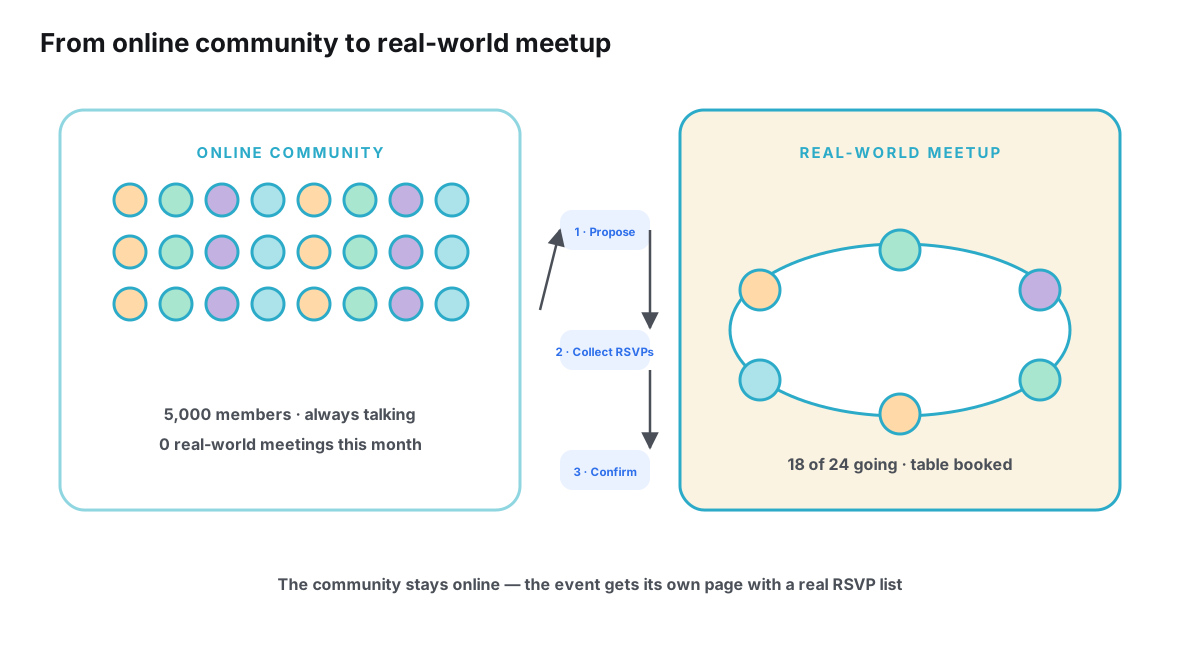
Then someone says the sentence that changes the organizer’s life: “we should all actually meet.” A picnic is proposed. Enthusiasm is instant and real. And from that moment — often for the very first time in the server’s history — the community’s best tool starts to feel like the wrong one. The picnic thread forks into three conversations. The announcement with the meeting point scrolls away by Friday. Forty people marked interested; the organizer, asked by the park pavilion for a number, has no number.
The paradox is that the server’s liveliness is not incidental to the difficulty — it is the cause of it. The same qualities that make Discord a magnificent home for ongoing community life make it a strange home for the narrow, stateful, commitment-shaped task of moving a specific set of people to a specific place at a specific time. This article is the long version of that argument: what Discord gets right, precisely where offline planning rubs against it, what organizers build to compensate, and the pattern that resolves the tension without asking anyone to leave the server they love.
What Discord genuinely gets right about community
An honest account has to start by explaining why Discord won at community in the first place, because the same mechanics return later — transposed — in every difficulty that follows. Four design choices carry most of the weight.
Channels give every kind of talk its own room
A Discord server is not one conversation but a building of them: a channel for general chat, one for the hobby that unites the group, one for photos, one for off-topic jokes, one for announcements. This is a genuinely superior arrangement for community life. It lets a thousand people coexist without a thousand people sharing one timeline; each member dips into the rooms they care about and ignores the rest. Discussion stays coherent because it stays separated by subject.
Roles make identity and permission durable
Members in a server are not an undifferentiated crowd; they carry roles — labels that persist, that can mean anything the community needs (“regular,” “organizer,” “Sydney chapter,” “joined the 2024 cohort”), and that can unlock or restrict parts of the server. Roles give a large community a memory and a structure. They let subgroups self-identify and let moderators delegate trust without giving away the keys.
Voice is a room, not a call
Perhaps the most underrated community mechanic: voice channels are places you can simply be in, not phone calls you schedule. People drop into a voice channel the way they drop into a common room — sometimes to talk, sometimes to quietly co-work. For communities, this converts a message board into something with ambient presence, which is the raw material of real attachment between people who have never met.
Scale without ceremony
Discord servers support very large communities — hundreds of thousands of members — and remain navigable at that size because of the first three choices: channels partition, roles structure, voice gathers. Add threads for contained sub-conversations, polls for quick collective decisions, and a rich ecosystem of bots, and you have arguably the most complete toolkit for keeping a community alive that has ever shipped. If the goal is belonging, the design is close to ideal — a fair verdict you can verify by looking at how Discord communities of every kind use exactly these features to run their daily lives.
Keep those four mechanics in view — partitioned rooms, persistent labels, ambient presence, massive scale — because offline planning runs into each of them in turn.
Three mismatches that surface when plans go offline
An offline event is a peculiar object for any software to represent. It has a small set of facts that must be current (time, place, headcount), a set of commitments attached to named individuals, and a lifecycle that runs from idea to after-action memory. A thriving Discord server, optimized for continuous conversation, offers none of those primitives natively. The friction appears as three distinct mismatches.
Mismatch one: channels fragment the plan
Partitioning is heaven for community and purgatory for plans, because a plan is one thing that must live in one place. The picnic starts as a message in general chat. Someone starts a dedicated thread — sensible — but the date debate happens partly in the thread and partly in general, because that’s where people happened to be. Two members continue in direct messages because their question felt too small for the thread. A role-gated channel appears for “definitely coming,” and now the plan’s truth is distributed across four containers plus whatever individual members remember.
Fragmentation does not merely scatter information; it creates versions. The member who read only the announcement believes the picnic starts at noon. The member who followed the thread knows it moved to one. Both are behaving perfectly rationally given what they saw; the server simply never assembled their views into one. In community terms, parallel rooms are a feature. In planning terms, they are a silent fork of the guest list — and forks surface at the worst possible moment: the day, at the venue gate, in the rain.
Mismatch two: activity scrolls the details away
A healthy server is a fast-moving stream, and every piece of event information entered that stream — the announcement, the venue decision, the parking warning, the “running ten minutes late” — is a bubble in it. Streams are ordered by time, but event facts are ordered by importance, and the two orderings collide immediately. The final meeting point is the single most load-bearing sentence of the whole plan, and it occupies the same visual weight, in the same feed, as a joke about someone’s cat.
The consequences compound with server health. In a quiet server, an announcement might sit visible for days; in the lively server — the one with a message a minute — it is buried within the hour, which means the better your community is doing, the worse your event information survives. Organizers respond by repeating key facts, pinning messages, re-posting corrections; each repetition adds volume, which accelerates the burial of everything else. The system’s liveliness and the plan’s durability are in direct, structural opposition.
Mismatch three: interest is not attendance
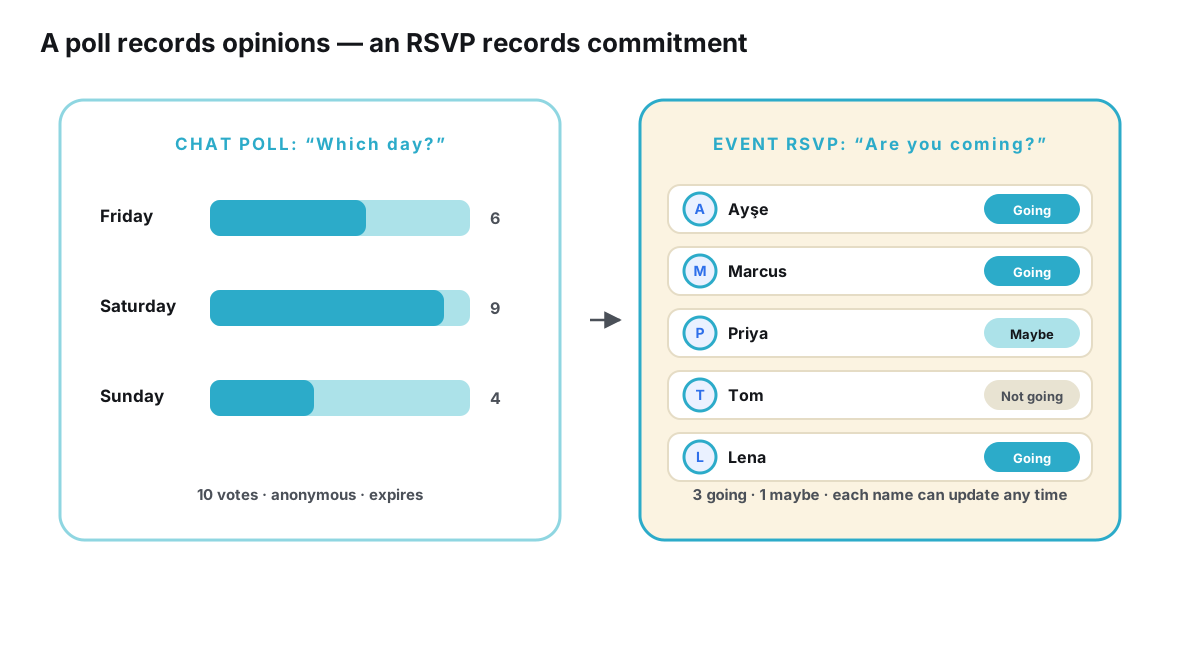
The third mismatch is the deepest, because it is about human signals rather than information layout. Discord’s server events let members mark themselves as interested in a listing — and as Discord’s own support documentation frames it, that marker is an expression of interest. It is cheap to give, pleasant to receive, and binding on no one. Members grant it the way they grant a laugh: sincerely, in the moment, with no promise about Friday.
An offline plan, meanwhile, is built out of exactly the thing the marker doesn’t contain: commitment. The pavilion wants twelve definite humans or it wants its deposit back. The carpool needs to know if it is three cars or five. “Forty interested” is a measurement of community sentiment — a genuinely useful one — but it is not, at any point in the event’s life, a forecast of attendance. The organizer discovers this at the venue, converting enthusiasm into chairs by hand.
Each mismatch has its own deep dive elsewhere in this cluster. The fragmentation and scroll problems are dissected in how Discord servers organize real-world events and the tool-level trade-offs in Discord events compared with dedicated event pages. The interest-to-attendance gap gets the full treatment in what happens after someone says “Interested”, and the headcount problem specifically in how Discord communities can track real attendance.
Community tasks versus planning tasks
The three mismatches become clearer when you lay the two kinds of work side by side. Community work and planning work have opposite requirements, and a platform built to the first spec will strain against the second. That is not a defect; it is two specs.
| Requirement | Community life | Offline plan |
|---|---|---|
| Unit of organization | Ongoing rooms by topic | One event, one container |
| Time ordering | Newest is most relevant | Most important must stay reachable |
| Member signal | Presence, reactions, participation | Named commitments that can change |
| Change handling | Conversation flows onward | Old value must be replaced everywhere |
| Audience boundary | Members of the community | Whoever is actually coming, members or not |
| Success measure | Belonging over time | Right people, right place, right time, once |
| Natural lifespan | Indefinite | From proposal to after-action, then done |
Read the table twice, once as praise and once as diagnosis. As praise: Discord’s design serves the left column superbly, and that is why communities flourish there. As diagnosis: every right-column requirement is something the left-column architecture actively resists — not because anything is broken, but because the right column describes an event object, and a server is a place. Places are for continuous conversation; objects are for state. The gap between those two words is the entire subject of the difference between a conversation and an event object.
The workarounds organizers build — and what they cost
Discord communities are nothing if not resourceful, and over years of meetups a standard repertoire of workarounds has emerged. Every one of them works, in the sense that the event happens. Every one of them also has a cost, and the costs are worth naming, because they explain why organizers feel tired in proportion to their community’s warmth rather than to their event’s size.
| Workaround | What it patches | What it costs |
|---|---|---|
| Pin the final details | Burial by scroll | Stale the moment anything changes; needs manual re-pinning; only members who look see updates |
| Role as sign-up | No commitment signal | One bit per person; no going / maybe; lingers after the event; no headcount deadline |
| Announcement channel broadcast | Fragmented awareness | A snapshot that decays; corrections live elsewhere; outsiders can’t see it |
| Bot collecting sign-ups | Manual list-keeping | Serves the server only; data lives with the bot; another system to maintain |
| Organizer as human answer service | Everything, temporarily | Every question answered one-to-one; the organizer’s patience becomes the community’s infrastructure |
| Repeat the key facts often | Scroll burial again | Adds noise that buries the facts faster; trains members to wait for repetition instead of looking |
Two rows deserve special attention because they compound. The “human answer service” row is the quiet one: in most servers, the load-bearing workaround is a specific person — usually the one who proposed the event — who answers “what time,” “where again,” and “can my friend come” in direct messages until the day arrives. The community experiences effortless coordination; one member experiences a second job. And the “repeat the facts” row is self-defeating: each repetition is a new bubble in the stream, contributing to the very burial it fights. A structure that requires you to shout louder to be heard because you are shouting is a structure asking to be supplemented.
The missing layer: an address for each event
When you line up the three mismatches and the workaround costs, the shape of the actual solution becomes almost obvious — not because a vendor says so, but because the problem defines it. The plan needs a container with exactly the right-column properties from the comparison table: one container per event, facts that stay current, named and changeable commitments, a boundary defined by the guest list rather than server membership, and a lifespan from proposal to after-action.
The web already has a name for that shape: a page with an address. A page is an object, not a place — it holds state instead of hosting conversation. Its facts can be edited once and read correctly forever after. Its guest list can be a real list: each person with a status — going, maybe, not going — that they can update when life intervenes, which is precisely the primitive the interest marker lacks. (That per-person response is even a defined concept in the web’s shared vocabulary; schema.org models the RSVP as its own action type, a formal way of saying that responding to an event differs from reacting to one.) And a page’s address travels: into the announcement channel, into a direct message to one friend, into a group chat on another app entirely, onto the community’s link page.
None of this diminishes the server. The server keeps every job on the left side of the table — the belonging, the ambient presence, the daily talk that makes people want to meet at all. The page takes only the right-column jobs. The two structures connect at exactly one point: the link, carried by every mention of the event. That single discipline — the address travels with the plan — is the whole integration, and it is the load-bearing idea behind creating one source of truth for a group event. Tools like Ontaym implement this pattern directly — one link per event with sign-up statuses and updates — though the pattern itself is bigger than any single tool.
A hybrid playbook for server leaders
Translating the argument into practice, here is the playbook that experienced organizers converge on, stated as a sequence of habits rather than a product purchase.
Keep the community machinery exactly as it is. Do not restructure channels, roles or voice for the sake of events; they are doing their job. The change happens at the boundary where a plan is born, not inside the rooms.
Create the event’s page at proposal time, not at announcement time. The moment an idea gathers momentum, give it an address — even if the page says little more than “picnic, date TBD, sign up here.” An early address means every subsequent conversation has something to point at, and no version of the plan ever exists only as scattered messages.
Announce once, with the link, in the channel that fits. The announcement channel or a server event listing can both carry the same link. Members who live in the server get the warmth of the in-community listing; the page underneath carries the durable truth.
Debate in channels; decide on the page. Let discussion range freely — that is what channels are for. When a decision lands (the date, the venue, the headcount deadline), edit the page. The one-line courtesy message — “date’s set, page updated” — is the only announcement a settled question ever needs.
Let commitments live on the page only. Resist the temptation to run a parallel sign-up role “so members can see who’s coming.” Two lists means reconciling two lists; the page’s list is visible to anyone with the link, which covers every member and every guest besides.
Onboard late joiners and outsiders through the address. The member who joins the server a week before the picnic and the friend-of-a-member who will never join both get the same answer, and it is a five-second answer. No scroll-up archaeology, no temporary membership, no direct-message interview.
Scale makes the split necessary, not optional
For a small, tight server, all of this can sound elaborate. Twenty people who chat daily can run a picnic on goodwill and a pinned message, and they should. The mismatches described here are all scalable quantities: fragmentation grows with the number of containers and participants, scroll burial grows with message volume, and the interest-attendance gap grows with the number of strangers relative to friends. Small communities sit at the bottom of all three curves, where the costs are invisible.
But communities that meet offline rarely stay small, because meeting offline is itself the strongest growth mechanism a community has: people join a server after hearing about the meetup, bring friends, and propose the next one. The curve steepens exactly as the community succeeds. The organizer who noticed nothing at twenty members feels everything at two hundred — the same design, amplified. This is why the pattern matters most to exactly the communities that are winning: the bigger the server gets, the less the stream can hold the plan, and the more the plan needs an address of its own. The same logic extends past Discord entirely — it is the core of why an event needs its own digital space regardless of which app the community calls home.
Frequently asked questions
Is this article saying Discord is bad for planning events?
No — it is saying Discord is excellent for the community half of an event and structurally thin for the state-keeping half. Servers generate the desire to meet, host the debate, and keep enthusiasm alive between events better than almost anything else. What they lack is a per-event container with current facts and named commitments. Communities that pair the server with such a container keep all of the excellence and shed most of the complications.
What exactly is wrong with the “Interested” marker?
Nothing is wrong with it — it is a well-designed expression of interest. It becomes a problem only when read as a headcount. The marker is given in seconds, checks no calendar, binds no one, and is rarely revisited when plans change. Use it for what it is — an enthusiasm gauge for gauging the room — and collect actual commitments somewhere built for them.
Should our server stop using channels and centralize event talk in one place?
Usually not. Channels and threads are the right shape for conversation, and forcing all event talk into one channel fights the server’s grain. The fix is not fewer rooms but one record: the discussion can happen anywhere, while the current facts live on the event’s page, which every room links to. Fragmentation is cured by a shared address, not by rearranging rooms.
Can’t bots solve the headcount problem?
Bots can collect structured responses inside a server and many communities use them that way. Their limits are scope and durability: a bot serves one server’s members, its data lives with the bot, and guests outside the server can’t reach it at all. Bots automate tasks within the community boundary; they don’t extend past it. For events whose guest list includes anyone beyond current members, the boundary is the bottleneck.
How does this apply to gaming communities specifically?
Gaming communities feel the gap least for in-game or in-voice sessions — those live entirely inside the server’s natural habitat — and most for conventions, LAN gatherings and local meetups, where money, travel and physical venues enter. The further an event sits from the server’s native rhythm, the more the split pattern pays for itself.
What is the single first step for an organizer recognizing all this?
Give your next event its own address before you announce it — a page holding everything currently known and a real sign-up list — and carry that link in every mention. One event is usually enough to feel the difference: fewer repeated questions, one place to update, and a headcount you can act on.
Conclusion
Discord solved the community problem so well that it created a planning problem by contrast: hundreds of thousands of people can share a server, every kind of talk gets its room, identity persists, presence is ambient — and then the community tries to book a pavilion, and discovers that liveliness, partition and low-cost enthusiasm are the opposite of what a dated, physical, headcount-bound event needs.
The resolution is not a migration but a division of labor, and it is small enough to adopt this week: the server keeps the conversation that makes the community worth meeting; each event gets a page — one address holding the current facts and named, changeable commitments; and the link joins the two wherever the event is mentioned. Communities that make that split keep everything that made Discord excellent for them, and lose most of what made offline plans complicated. The picnic still happens because someone proposed it in general chat. It just stops requiring an organizer’s entire week to survive contact with reality.
Keep the server for community. Give every offline plan one link that holds itself together.
Plan it with Ontaym