
How to Turn a Discord Community Into an Offline Community
An online community can run happily for years without two members ever standing in the same room. Moving it into the physical world is one of the most rewarding things a server can attempt — and one of the most commonly fumbled. It takes a deliberate bridge, not an announcement.
Quick answer
Turning a Discord community into an offline community is a process, not an announcement. It starts with finding out where members actually live, because geography — not enthusiasm — decides who can attend. First events should be small, low-stakes formats in public places, hosted by trusted local members rather than the server owner. Every event needs a durable record — final time, final place, and a named RSVP list — that lives outside the chat scroll, plus a single link members can share. After each gathering, a recap and a pre-announced next date keep the momentum alive. Communities that follow this sequence convert online warmth into real-world turnout; communities that skip it usually run one badly attended event and quietly give up.
Why online belonging doesn’t carry itself offline
Discord is exceptionally good at the first half of community: people gather around a shared interest, adopt roles, develop in-jokes, and recognize each other by handle within days. A server with channels, roles and threads gives a group identity a place to live, and Discord servers can hold very large communities — hundreds of thousands of members in the biggest cases, a scale Discord’s own product pages are built around. That scale is the platform’s strength.
But the mechanics of belonging online are different from the mechanics of belonging in a room. Online participation is asymmetric: you can lurk for months and still count as a member, you can leave a conversation whenever it stops interesting you, and you never have to travel, dress, or introduce yourself out loud. Offline participation is symmetric and physical: everyone who attends has to be in one city, at one time, and spend real effort getting there. Nothing about a lively voice chat prepares a community for that transaction.
There’s also an identity seam. Server members know each other as handles with avatars, and many communities include people who are comfortable being outgoing in text but shy in person. The first meetup asks everyone to bridge that seam at once — which is why the event’s design matters more than the community’s enthusiasm. If you want the deeper background on this mismatch, we’ve written separately about why Discord is excellent for communities but complicated for offline plans; this article is the practical counterpart — what to actually do about it.
What should be true before you book anything
Impatient communities go straight to “let’s meet up!” and then discover that their three most active members live on three different continents. A little reconnaissance first saves that disappointment. Four preconditions are worth checking:
- A local cluster, not a global majority. You don’t need most of the server in one place — you need a handful of members close enough that a venue is convenient for all of them. Three reliable people in one city beat three hundred spread across the globe.
- Recognition. Attendees should recognize each other’s names from the server. First meetings work best when they feel like a reunion with strangers’ faces, not a room of strangers.
- A reason that survives leaving the chat. A shared activity — games, a craft, a sport, a fandom — gives the event structure. A meetup whose only content is “we are from the same server” leans entirely on small talk.
- An anchor on the ground. Someone local must own the venue choice, the booking, and the greeting. The server owner can bless the event; they can’t host a city they don’t live in.
If two of these are missing, work on them inside the server before announcing anything. A region-specific channel, an introductions ritual, or a recurring voice night will do more for future turnout than a bigger announcement would.
The playbook, step by step
With the preconditions in place, the transition itself follows a repeatable sequence. Each step exists to remove one specific risk: scattering, stranger-anxiety, overreach, information loss, awkwardness, and fade-out, in that order.
- Map where your members actually are. Before any date or venue talk, take a quiet census of locations — a region poll, a map channel, or a question in introductions. You are not looking for a majority; you are looking for clusters of two or more members near enough to share a city, because each cluster can sustain its own meetup indefinitely.
- Recruit a local anchor for each cluster. Every recurring meetup needs a person on the ground who knows the area, can scout the venue, and will greet newcomers by name. Give anchors a visible role in the server so members know whose local judgment to trust, and let them make city-level decisions without waiting for approval.
- Choose a first format with low stakes. A café table or a quiet bar booth reserved for two hours beats a hired hall every time. The first event has exactly one job: prove that meeting in person is pleasant. Scale, production and ambition come later, once the ritual exists and people trust it.
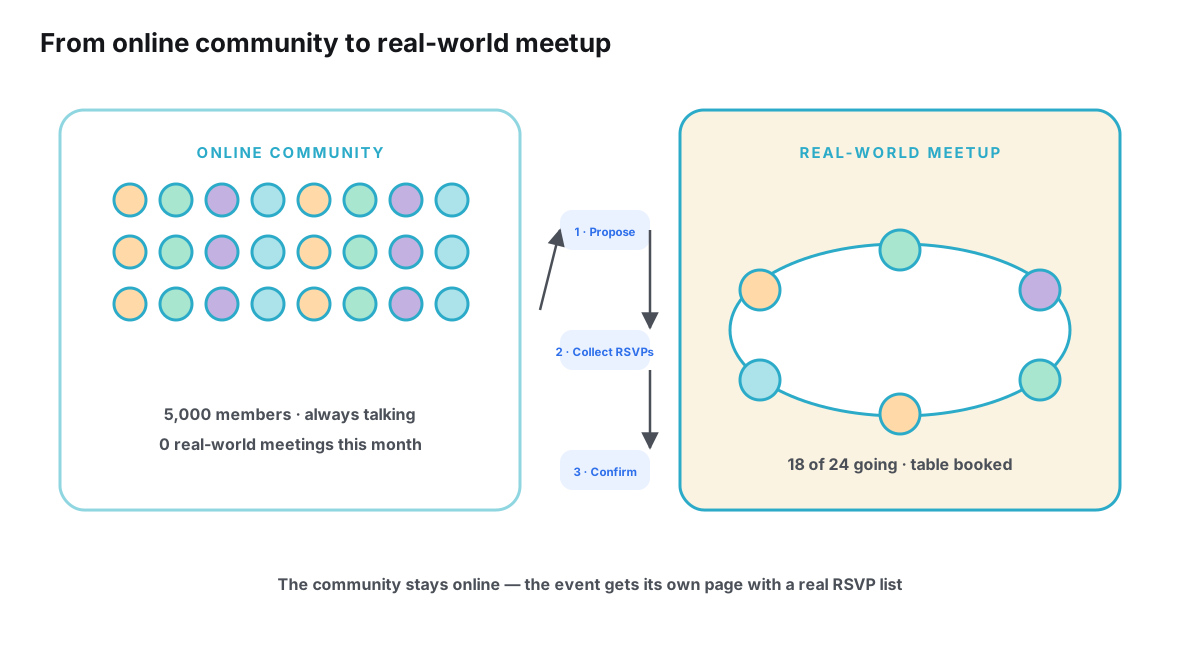
- Give the event an address outside the scroll. Announce in the server, but store the plan somewhere durable: one page holding the final time, the place with a map, and a named list of who is going — a list that updates when plans change instead of sinking under new messages. The chat announces; the page remembers.
- Run it with a small ritual. A standing day and time, a recognizable host wearing something identifiable, a welcome for each newcomer by server name. Rituals are what convert an awkward one-off into something members can decide to attend without deliberating, because they already know what the evening will look like.
- Close the loop and pre-commit to the next date. Post a recap, share the photos people consent to share, thank the anchor publicly — and announce the next date before the energy fades. A second event scheduled while the first is still warm is what separates a community that meets offline from one that tried it once.
Translating your server’s culture into a room
A meetup shouldn’t be a blank social event; it should be a physical translation of the culture the server already has. Communities that treat the event as an extension of their online rituals — not a generic networking drinks — see far more of their quiet members show up, because the familiar structure lowers the social cost of attending.
| What your server has | What it does online | Offline translation |
|---|---|---|
| Voice channels | Loose, drop-in conversation | The main table: unstructured, anyone can join mid-conversation |
| Roles (mod, regular, newbie) | Signal who does what and who is trusted | Named jobs at the event: greeter, photographer, table-captain |
| Welcome channel | Onboards strangers gently | A host who greets each arrival and introduces them to one person |
| Recurring game nights | A scheduled shared activity | The event’s program: the same game, played in person |
| Announcements channel | Broadcasts to everyone at once | A pinned, dated event record with RSVPs that members can check any time |
| Emojis and reactions | Low-cost warmth and acknowledgment | They can’t be translated — which is exactly why the event needs a program |
Notice the last row. The parts of server culture that don’t survive translation are the low-effort parts, and that’s informative: the offline counterpart of a reaction is showing up. Communities that understand this stop measuring event interest in hearts and thumbs, and start measuring it in commitments.
Choosing a first format that can’t fail
Format selection is where most first events go wrong — usually by overshooting. The temptation is to organize something impressive: a big venue, tickets, a program. But impressive events raise expectations, and expectations are the enemy of a first gathering whose real goal is simply to happen pleasantly. Match the format to your community’s existing shared activity instead of to your ambition.
| Format | Best for | Comfortable size | Organizer effort | Main risk |
|---|---|---|---|---|
| Café or pub table | Discussion-first communities | 3–10 | Minimal — a reservation | Flat conversation with no program |
| Shared-activity meetup | Game, craft or sport communities | 5–20 | Low — venue plus materials | Equipment or space limits |
| Viewing or play-along night | Fandom and esports servers | 10–40 | Medium — screen, sound, seating | Passive program discourages mixing |
| Event-attached meetup | Communities near a convention or tournament | Any | Low — a time and meeting point | Noise, crowds, confusion finding the group |
| Hall or venue production | Only after several smaller successes | 50+ | High — budget, tickets, staff | Financial and social overreach |
Some communities have format choice easy: if your server exists around a game, a fandom or a sport, your first event is that thing, in a room. The guild-and-clan version of this story — LAN parties, viewing parties, convention meetups — has its own playbook, which we cover separately in how gaming communities organize real-world meetups. The principles here apply everywhere; the gaming world simply has the most practice.
The RSVP layer: interest is not a headcount
Once the format is chosen, the community faces a deceptively small decision: how to count who’s coming. Discord gives you two native signals, and both are weaker than they look. Members can react to an announcement, and the platform’s server events let people mark themselves as interested — markers that are, by design, expressions of interest rather than RSVPs, as Discord’s support pages document for event responses. Polls — another native tool — tally opinions. None of these bind a person to a place at a time, and none of them update themselves when someone’s Wednesday falls apart.
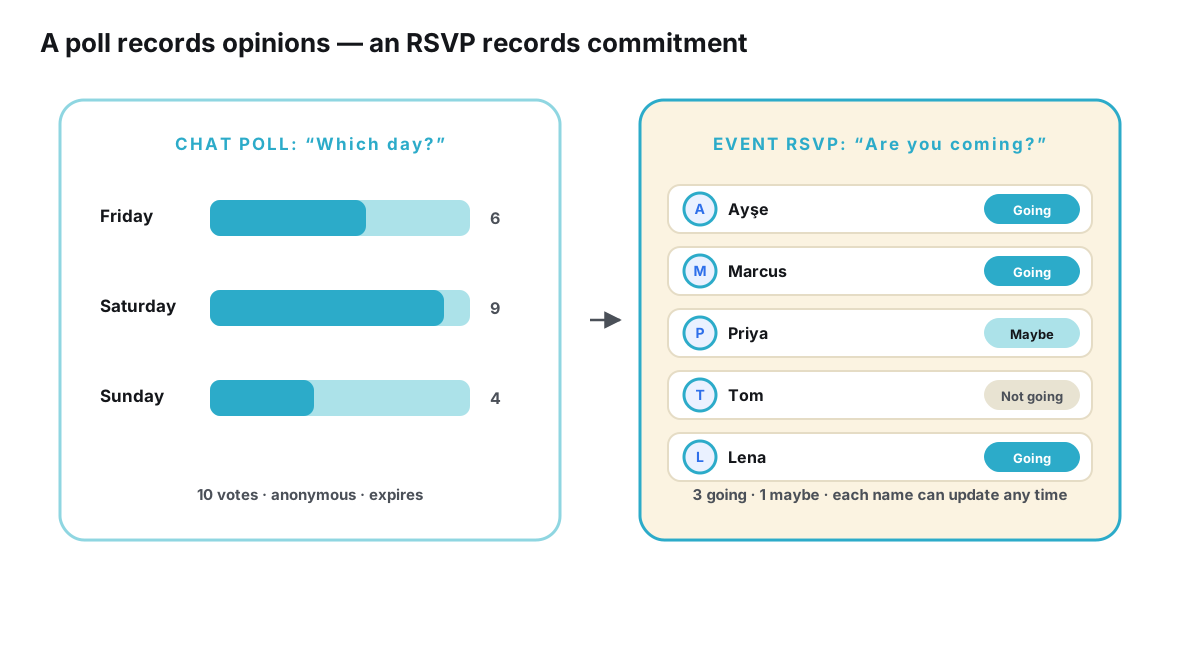
The distinction matters more offline than online, because offline costs are real. A venue reservation is made against a number, and that number is only meaningful if it’s a count of people who have personally, individually said “I’ll be there” — and who can change that answer when their plans change. That is precisely the structure a chat stream can’t hold: it’s the difference between a conversation and a record, the same root problem behind why messaging apps were never designed to be event databases. For a full treatment of the signals themselves, see Discord polls vs actual event commitments; the operational summary is short. You need a named list, per person, with going and maybe states, changeable up to the event, visible to everyone deciding whether to come. Tools like Ontaym exist for exactly this layer — one link per event, statuses that update, no scrolling — but the requirement, not the tool, is the point.
Practically, the division of labor works like this: Discord announces and warms people up; the event record decides and counts. The announcement links to the page; the page never links back into a specific message. Members learn within one event cycle that “check the link” is always a complete answer to “what’s the plan?”
Safety, privacy, and the handle-to-face moment
Meeting in person converts usernames into people, and that conversion deserves care. The rules that have settled into common practice among long-running communities are neither complicated nor optional:
- Public venues first. Cafés, bars, game stores, community centers — places with staff and other people around. Private homes are for later, among members who already know each other well.
- Server rules travel with you. The behavior norms that make the server pleasant apply at the table, and the moderation team’s authority should be restated when the event is announced. A meetup is still the community’s space, even in a rented room.
- No forced contact exchange. Members met as handles; nobody should have to hand over a phone number or personal account to attend a meetup. Event communication should flow through channels and the event record, not through pooling personal contact details.
- An identified host, every time. Newcomers should know exactly who to approach, and hosts should check in with anyone standing alone. The greeter role from the table above is a safety role as much as a social one.
- Extra care with younger members. Communities that include minors should require parental awareness, stick to all-ages public venues, and set clear boundaries — the same caution any youth organization applies.
Handled this way, the handle-to-face moment becomes the community’s best retention event. Most members who attend one meetup stop being peripheral members of the server afterwards — the shared room does what months of chat couldn’t.
Keeping momentum: from one event to a culture
The distance between “we met once” and “we’re a community that meets” is cadence. A modest event on a predictable schedule — the first Saturday afternoon of every month, say — outperforms an ambitious event whenever-someone-feels-like-it, because regularity lets members plan around the community instead of watching for announcements. Recurrence also compounds the ritual: the second event has veterans, the third has inside jokes, and by the fifth, attendance is driven by memory rather than marketing.
Three practices keep the flywheel spinning. First, announce the next date at the current event, as the playbook’s last step says — momentum is perishable. Second, give hosting visibility: a role, a thanks in the recap, and authority over their city’s meetups turn one anchor into several, which protects the community from organizer burnout. Third, feed the event back into the server: photos, a short recap thread, a poll about next month’s format. The event becomes content, the content becomes anticipation, and the anticipation becomes the next event’s headcount.
Reminders are the quiet half of cadence. An event announced three weeks out and never mentioned again will lose people who fully intended to come; a reminder near the date, pointing at the same link, recovers them. This is another advantage of keeping the plan at a stable address — reminders can be one line, because everything they need to say is already on the page.
The first three events: a realistic arc
Communities tend to judge their offline experiment by the first event, which is exactly the wrong unit of measurement. The transition really happens across the first three, and each gathering has a different job.
The first event is a proof of concept. Expect the cluster you mapped, not the server you love: a handful of members, one anchor, one table. Some who said yes will cancel that afternoon; one who said nothing will appear anyway. The success criterion at this stage is modest and crucial — did everyone leave thinking “that was easier than I expected”? If yes, the community has its beachhead, whatever the headcount. If no, the format is wrong, not the community; change the format and try again while the memory is fresh.
The second event is a test of ritual. It typically draws a slightly different group: people who missed the first date, people who waited to see whether the first one went well, a first-timer brought along by an attendee. This is the gathering where a standing time starts to feel like an institution rather than an experiment — and where the recap-and-next-date habit proves its worth, because the second event’s turnout is largely built from the first event’s follow-through.
The third event is where compounding becomes visible. Veterans greet each other, inside jokes have history, and the organizer’s job shifts from logistics to curation — noticing who should meet whom, and keeping the format fresh enough that regulars don’t drift. Somewhere around here, members start saying “see you next month” without anyone prompting them. That sentence, unprompted, is the sound of an offline community existing.
What changes once the community has met
The effects of a first successful meetup show up in places organizers don’t expect. Conversation in the server changes texture: members who have shared a table talk to each other differently — more directly, more forgivingly — because a message now arrives from a face rather than a username. Moderation usually gets easier too; it is remarkably difficult to be cruel to someone whose laugh you have heard.
Onboarding improves as well. A community with visible meetups — photos in the recap thread, a recurring date on the calendar — tells new members what they’re joining far more vividly than any welcome channel can. And the joiners you attract after a few meetups are different people: they came because the community offers something physical, and they are disproportionately the members who will show up to the next one.
The subtlest change is in how the community understands itself. Servers that meet develop a shared self-image — “we’re the kind of community that gets together” — and that identity does quiet organizational work: members propose events instead of waiting for them, cities without an anchor volunteer one, and the offline side stops being one organizer’s project and becomes community property. None of this is reachable by announcement. It is what the bridge, crossed a few times, turns into.
Five ways the transition fails
The failure modes are consistent enough to name. Watch for them in your own planning, because each one is avoidable at the design stage rather than the rescue stage:
- The grand launch. A first event scaled like a festival, with costs and expectations to match. When turnout is ordinary — and first turnout is always ordinary — the gap feels like rejection and the community concludes that “no one wants to meet,” which isn’t what happened.
- The global announcement. Posting one event to a worldwide membership and reading sparse replies as indifference, when the actual problem is that almost nobody was within traveling distance of that one venue.
- The Interested headcount. Booking a venue for the number of interested markers or poll votes collected. Interest inflates; commitments don’t. Reserve against the named going list, with maybe as a buffer you’ve planned for.
- The one-hero organizer. A single founder mapping, hosting, photographing and recap-writing every event across every city. It works exactly until it stops, and communities that never delegate usually stop entirely.
- The silence after. No recap, no photos, no next date. The event happened, but nothing in the server records that it went well — so for everyone who hesitated, it may as well not have.
Every one of these is a process error, not a community defect. Communities that fail offline rarely lack warmth; they lack the bridge structure that lets warmth schedule itself into rooms.
Frequently asked questions
How many members do we need in one city before a first meetup is worth trying?
Fewer than you think. A table of four to six committed people is a successful first event; half of your yes-list dropping is normal, so invite from a pool of roughly double the number you want present. What matters is density — how many members can realistically show up — not the server’s total size.
Should we use Discord’s server events for offline meetups?
Yes, as the discovery layer — server events put the gathering in front of members where they already are, and interested markers are a useful gauge of curiosity. But treat those markers as expressions of interest, not RSVPs. Pair the listing with a durable event record — final details plus a named, updatable going/maybe list — so your venue decision rests on commitments.
Our community is spread across many countries. Is an offline version realistic?
Usually as a federation, not a single event. Map your clusters, appoint an anchor per city, and let each cluster run its own smaller meetups — ideally sharing a format and cadence so the culture stays one community. Many communities also run a flagship annual gathering that travelers attend, fed by the local rituals established through the year.
How do we keep members safe when handles become faces?
Public venues, restated server rules, identified hosts, no obligation to exchange personal contact information, and extra structure for communities with younger members. These conventions are standard among long-running communities and cost nothing to adopt from your first event onward.
Who should host — the server owner or local members?
Local members, with the owner as sponsor rather than host. The person who knows the city picks the venue, greets arrivals and carries local authority; the owner’s role is to bless the event, give the anchor visibility, and keep the culture consistent across cities. Communities that centralize hosting in one remote person run out of organizer quickly.
How often should an offline community meet?
On a fixed cadence you can sustain indefinitely — monthly is the most common, because it’s soon enough to preserve momentum and far enough apart to respect people’s calendars. Regularity beats size at every stage: a small predictable gathering builds a ritual, and rituals, not events, are what members eventually plan their lives around.
Conclusion
The communities that succeed offline treat the transition as infrastructure: a map of where members live, local anchors with real authority, a first format too modest to fail, an event record that outlives the announcement, a ritual that makes attending easy, and a next date announced before the current one ends. None of these steps is glamorous, and together they are the entire difference between servers that meet once and communities that meet always.
Start smaller than feels impressive, count commitments rather than interest, protect safety conventions from event one, and let cadence do the compounding. The server stays the hearth — the place the culture lives between gatherings. The meetups just give that culture a room, a table, and a date it can rely on.
Give your community’s next meetup one link, one page and one real headcount.
Plan it with Ontaym