
How Discord Event Information Gets Lost in Active Servers
An active Discord server is a sign of health — until you’re the one running an event inside it. The same velocity that makes a server feel alive pushes announcements, threads and last-minute changes out of view faster than every member can track them.
Quick answer
Event information gets lost in active Discord servers through simple mechanics, not mismanagement. Chat is newest-first, so anything that stops generating messages sinks; a busy channel can push an announcement out of casual view within hours; threads archive and vanish from the sidebar; and edits to old messages notify no one. Pins, announcement channels and server-event listings each solve a slice of the problem, but none changes the underlying stream. The durable fix is architectural: reserve a small number of slow, authoritative places — an events channel with restricted posting, plus a stable event record outside the chat — and make one link the standard answer to every “what’s the plan?” question. Fast channels stay fast; the event’s facts stay findable.
A healthy server is a fast server
Start with the paradox, because it explains everything else. The server losing your event details isn’t broken — it’s thriving. Channels that fill with messages hour after hour are doing exactly what chat is designed to do: carry live conversation. Discord servers support very large communities — up to hundreds of thousands of members in the biggest cases, per Discord’s own site — and the platform’s channels, roles, threads, bots and polls exist to keep that volume of human activity navigable. Velocity is the product working.
But velocity has a property that matters enormously for anything that isn’t conversation: in a newest-first stream, visibility decays with time regardless of importance. A brilliant event announcement and a message about someone’s lunch occupy the same queue, and the queue only moves one direction. The busier the server, the faster both sink — and the announcement’s importance doesn’t buy it a single extra minute at the top of the channel.
This is not a flaw in Discord; it’s a trade-off inherent to chat as a medium, and every messaging platform makes some version of it. It simply means that an active server, on its own, is the wrong place to store an event’s facts. The rest of this article is about the specific mechanisms of loss, the features that soften them, and the structure that actually survives them. If you’re organizing offline gatherings at scale, it pairs naturally with our broader look at how Discord servers can organize real-world events.
Four ways event details die
Watch a single event move through a busy server and you can usually identify the exact moment each piece of its information became effectively invisible. The mechanisms are distinct enough to name:
- Scroll burial. The default death. An announcement posted at noon sits above hundreds of newer messages by evening. Members who checked the channel at lunch saw it; members who checked at night didn’t; both believe they’re caught up. Nothing was deleted, and nothing was missed on purpose — the stream simply moved on.
- Thread sinking. Planning migrates into a thread, which is wonderful for keeping the main channel clean. Threads, however, live by recent activity: once the discussion pauses, the thread slides down and eventually archives, taking the decisions inside it out of easy reach. The venue choice that took forty messages to reach becomes something members have to remember existed.
- Silent edits. Someone changes the time by editing their original announcement — tidy, in principle. Edits to existing messages don’t notify anyone. The organizer sees the new time; everyone who read the message before the edit holds the old one, and the thread of conversation that would have corrected them never happens, because no one knows anything changed.
- Cross-channel scatter. The date gets decided in general chat, the venue in a regional channel, the poll lives where it was posted, and the headcount discussion happens in a thread attached to none of them. Every fact is somewhere; the event, as a whole, is nowhere. Members shouldn’t need a map to reconstruct one evening.
Each mechanism fails differently, which is why no single feature fixes them all. And each one maps to a particular kind of event information:
| Information | Where it usually lives | How it gets lost |
|---|---|---|
| Date and time | A poll result, or a decision mid-conversation | The poll scrolls away; the decision stays in the thread that archived |
| Place | A reply to a question, a map link pasted once | Buried under newer messages; latecomers find the question, miss the answer |
| Changes and updates | A new message, or an edit to an old one | The message sinks; the edit notifies no one — half the server holds the previous version |
| Who is coming | Reactions, replies, and interested markers | Ambiguous by nature, scattered by design — and none of it updates when plans change |
| What to bring / how to find us | Day-of messages in a fast channel | Posted precisely when the server is busiest, buried within minutes |
Read down the last column and a pattern emerges: every loss is a consequence of storing stable facts in an unstable medium. The facts don’t change their nature — a final time is still one small fact — but their container keeps moving underneath them.
A worked example: the venue change that split a meetup
The four mechanisms stay abstract until you watch one eat a real plan. Consider Tom’s board-game server, a lively community whose general channel moves faster than most members can follow. The monthly meetup is set for the usual café — until, two days before, the café floods. The anchor finds a replacement venue four streets away and posts the change in general chat on Thursday evening, mid-conversation, with a map link.
By Friday, the change is hundreds of messages deep. A member who checked Thursday sees it; a member who checks Saturday doesn’t. The anchor edits the original announcement — the one pinned weeks ago — but edits notify no one, and the pin now contradicts the buried message for anyone who saw only one of them. On the night, the community splits: part of the group finds its way to the new venue through a friend’s DM, and the rest sit in the window of the darkened café, each side assuming the other stood them up.
Nothing here required bad faith or carelessness — every individual action was reasonable. That is what makes the example instructive: the failure was fully mechanical. One urgent fact entered a fast stream once, in one place, as a message rather than as an edit to a record — and the stream did what streams do. Every remedy in the rest of this article, from the slow channel to the stable page to edit-the-record-then-ring-the-bell, is aimed at exactly this failure from a different angle.
Channel velocity: why busy servers bury their own plans
It helps to think of a channel as having a half-life for information: the amount of chat it takes to push a message beyond the horizon members realistically scroll. In a quiet community, that half-life is days — an announcement posted Monday is still visible Friday. In a busy server, it can be an hour. The same announcement, same wording, same importance; the only variable is how much conversation follows it.
This creates a perverse situation for event organizers: the more your community talks — the literal definition of success for a server — the worse your event information survives. An event announcement is competing for attention with the community’s entire social output, and it must win that competition by being re-posted, re-pinned and re-explained just to stand still. Organizers respond by doing exactly that: repeating the details in increasingly compressed forms, bumping threads, pinging roles. It works, moderately, at the cost of making the organizer a human refresh mechanism and adding noise the community then has to scroll past.
There’s an attention-side problem, too. Members don’t read every channel of a busy server; they sample. Most members’ relationship with a large server is a quick scan of whichever channels they habitually check — and the moment an event’s details spread across a poll, a thread, an edit and three channels, the scan can no longer find them. The member didn’t miss the information; the information became unmissable only through effort the member won’t spend. The gap between how organizers see the server (a place they curate) and how members see it (a stream they sample) is close cousin to the gap between membership and real participation we’ve examined elsewhere.
Threads: excellent for deciding, terrible for storing
Threads deserve special attention because they feel like the solution. Discord’s threads exist precisely to pull a focused discussion out of a busy channel, and for the deciding phase of an event they’re superb: the debate over dates, the venue shortlist, the back-and-forth that must happen somewhere. Keeping that in a thread saves the main channel from two weeks of logistics spam, and the thread keeps the whole argument in one tidy place.
The failure comes after the decision. A thread is a conversation with a pause button, not a record with an address. When the venue is chosen, the choice lives in the last message of a thread that now stops being active — and inactive threads sink in the channel list, then archive, and archived threads are a place members go only when they already know what they’re looking for. The decision’s proof is preserved; the decision’s effect is not. Nobody reads an archived thread to learn tonight’s plan; they ask, which restarts the loop, or they guess, which is worse.
The pattern that works treats threads as a stage, not a home. Discuss in the thread; when the group lands on a fact, it leaves the thread immediately and lands in whatever stable place holds the event’s current state. Threads are also where Discord’s own guidance lands when members ask why their old conversations vanished — Discord’s support pages explain thread behavior like archiving and visibility, and reading them as an organizer is quietly illuminating: the behavior is intentional, and the intention is conversation management, not record keeping.
Polls sink like everything else
One more mechanism deserves its own mention, because it masquerades as a solution: the poll. Communities increasingly run event logistics through Discord’s polls — which day, which venue, who’s in — and the tool is genuinely good at the moment of voting. But a poll is a message like any other. It rises once, collects votes while it’s near the top, and sinks beneath the following conversation like the lunch photos. Its final tally survives inside it, visible only to whoever scrolls back to it.
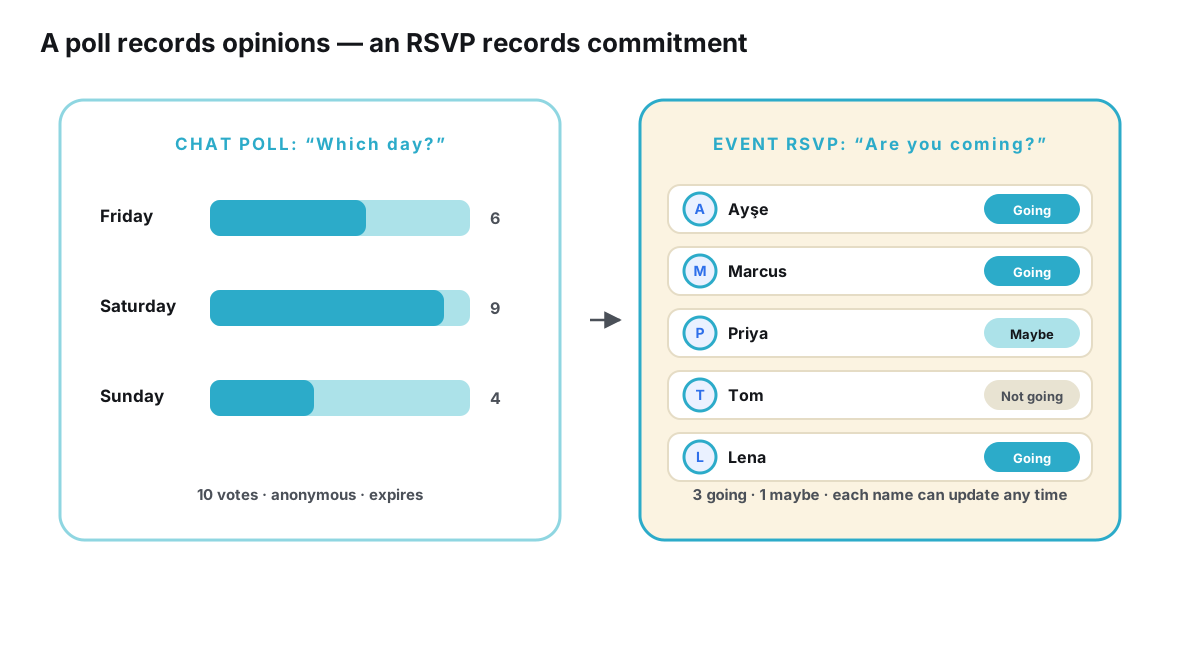
The consequence is a specific and common surprise: the community votes on the date, the poll disappears into the scroll, and the winning date then exists only in the memories of the people who happened to vote — which is rarely the same set as the people who show up. If the poll’s outcome doesn’t graduate into a stable record the moment it closes, the community will re-litigate the date, or worse, split between two remembered winners. The vote itself did its job perfectly; the storage failed.
What the native features do — and don’t — fix
Discord has spent real effort on this problem class, and the features are worth using. It’s just worth being precise about which mechanism of loss each one addresses, because the residual gaps are where meetups go wrong:
| Feature | What it genuinely solves | What remains unsolved |
|---|---|---|
| Pinned messages | Keeps a chosen message at the top of one channel | Pins go stale the moment the plan changes; someone must remember to re-pin; members who saw the first pin never learn it changed |
| Announcement channels | Distributes the post to every server that follows it | Reach, not persistence — the announcement still sinks in the followers’ own busy channels |
| Server events | Puts the event on a calendar-like listing with interested markers | Interested is interest, not RSVP; detail lives in the listing, but headcounts and changes still spill into chat |
| Threads | Quarantines planning discussion away from general chat | Threads archive; decisions inside them stop being visible exactly when the talking stops |
| Role mentions and bots | Pushes a fresh notification to many members at once | Notification fatigue — each ping is a message, so the cure adds to the disease that buried the facts |
Notice the shared shape of the residual column. Every feature either boosts a message’s visibility (pins, announcements, pings) or structures one moment of interaction (events, polls, threads). None of them gives the event’s facts a durable, current-state home that survives the stream — a place where the final time is always the final time, where changes are edits rather than newer messages, and where “who’s coming” is a named list that updates. That gap between what a chat platform offers and what an event needs is structural, and it’s why Discord remains excellent for community but complicated for offline plans even with every feature switched on.
The architecture that survives velocity
The servers that run events well in the long term don’t fight velocity — they route around it. The pattern, once you see it, is consistently two moves:
Make the fast places slow for events. Dedicate a channel to events and restrict who can post in it — organizers and anchors only, one post per event, no conversation. A channel that receives a message a week has a half-life of months; the announcement stays at the top for the entire run-up simply because nothing pushes it down. Members learn that this one channel is where plans live, and their quick scan starts to include it. Discussion still happens everywhere else — that’s what the fast channels are for — but the facts never enter the stream in the first place.
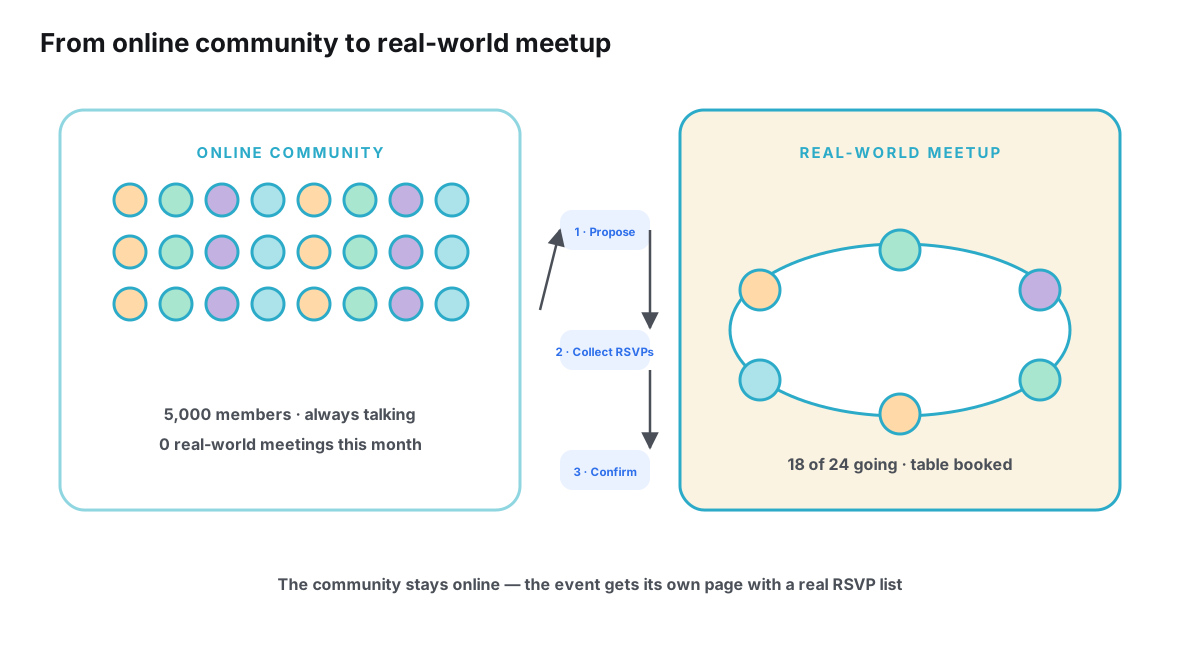
Give each event a home outside chat entirely. A single page per event — final time, place, the going/maybe list, the changes as they happen — living at a link that never sinks, never archives, and shows the same current state to everyone who opens it. The server’s job shrinks to two actions: announce the link once, and answer every question with it. Members who check the page at lunch and the organizer who edited it at night are automatically synchronized, because they’re both reading the record rather than their respective slices of the scroll. This is one practical instance of the broader argument that an event needs its own digital space — a principle that holds for every messaging platform, not just this one.
Handling changes when the server is loud
Updates are where fast servers hurt most, because updates are both urgent and easy to lose. The discipline that works treats the record and the stream as separate instruments with separate jobs. The change is an edit to the event page — the record now says the new time, permanently, for every future reader. The chat message is merely a bell: one line, pointing at the link, telling people something changed. The message can sink five minutes later without harm, because it never carried the fact — it carried the notification. Compare that with the pure-chat version, where the change-message itself must survive, must be found by every member individually, and must defeat every other version of the time already floating in the scroll.
Day-of logistics deserve the same treatment with more urgency. The room number, the “we moved tables”, the “running fifteen minutes late” — all edits to the record first, bells in chat second. Members on a train check the link; the link is current; nobody digs through an afternoon of general chat to find out where to go. A tool like Ontaym implements exactly this split — one event page, statuses, updates and reminders at a single stable link — but the principle is tool-agnostic: edit the record, ring the bell.
Reminders, used sparingly, complete the loop. Two or three scheduled touches — when the event is created, a few days out, and the day before — recover the members scroll burial took from you, each one a single line because the page holds everything else. Reminders repeated hourly in a busy channel become the noise they were fighting.
Rules for an events channel that stays clean
Creating an events channel is easy; keeping it slow is the discipline. The rules that hold up in practice are few and strict:
- One post per event. A new event gets one message containing the link and nothing else. No follow-up discussion, no corrections as replies — corrections are edits to the record.
- Post rights are earned, not open. Only organizers and anchors post. A channel anyone can write in becomes a chat channel within a week, and its half-life collapses accordingly.
- The link is the content. The post’s job is orientation, not information: what, when in one line, and the link where the truth lives. Anything longer starts duplicating the record, and duplicates drift.
- Old events get removed, not buried. When an event passes, delete or archive its post. A channel showing only live events is scannable in seconds; a channel showing two years of history is a slower version of the scroll problem you escaped.
Communities sometimes worry the rules feel heavy. In practice members love them — a slow channel is the one place in a busy server where standing still is allowed, and the restraint of one post per event reads as respect for attention rather than bureaucracy.
Frequently asked questions
Isn’t pinning the event details enough?
Pinning solves scroll burial in a single channel until the plan changes — then the pin goes stale, someone must re-pin, and members who saw the first version never learn it was replaced. Pins are frozen snapshots; events are living facts. Use pins, but point them at a current record rather than storing the details inside them.
What about Discord’s server events listing?
Server events are a real improvement: they give events a dedicated, calendar-like surface with interested markers, which solves discovery far better than a chat message. The gaps are persistence and depth — interested is an expression of interest rather than an RSVP, and headcounts, changes and per-person statuses still spill into the channels. Pair the listing with a stable event record for the facts.
Why not just use an announcement channel with role pings?
Both raise volume, not durability. A ping pushes one message past the noise once; a day later it has sunk with everything else, and members fatigued by frequent pings start muting the role. Reach tools are for the initial announcement — the run-up and the changes need a place that doesn’t sink.
Our planning always moves into threads. Is that wrong?
Threads are the right place for the discussion and the wrong place for the outcome. Let the debate happen in a thread, but the moment a decision lands — date, venue, format — write it into the event’s stable record. A decision that stays in an archived thread is a decision the community has to rediscover one member at a time.
How do we handle day-of changes in a server that moves fast?
Edit the record, then ring the bell. The change goes into the event page as an edit — permanent, current for every future reader — and the chat gets one short line pointing at the link. The message can sink immediately without losing anyone, because it carried the notification, not the fact.
Does this apply to small servers too?
Less urgently — in a quiet server, messages sink slowly enough that a pin and a re-post genuinely cover it. The mechanisms described here all scale with activity: the busier the server, the shorter the half-life of every message, and the earlier you’ll want the slow-channel-plus-record structure in place. Building it before you need it is cheap; discovering you needed it is a missed meetup.
Conclusion
Event information doesn’t get lost in active servers because organizers are careless; it gets lost because a newest-first stream is a machine for making yesterday invisible, and events are made of facts that must stay visible for weeks. Scroll burial, thread archiving, silent edits and cross-channel scatter are simply the four faces of that mismatch, and pins, pings and listings are reach tools that soften each face without changing it.
The communities that solve this stop trying to make fast things slow. They give events two calm homes — a posting-restricted channel with a half-life of months, and one durable record per event at a link that never sinks — and they let the loud channels stay gloriously loud, carrying the conversation, the hype and the jokes that make the server worth meeting in person at all. One post per event, one link per event, one edit per change. In a server that moves this fast, standing still is a feature — and the event’s facts are the one thing that should have it.
One stable link per event — no matter how fast your server moves.
Plan it with Ontaym