
Discord Events: What Happens After Someone Says “Interested”?
Someone tapped “Interested” on your server’s event listing. That tap is sincere, instant — and the beginning of a journey in which most travelers never arrive. What the click means, what survives it, and how organizers help interest become attendance.
Quick answer
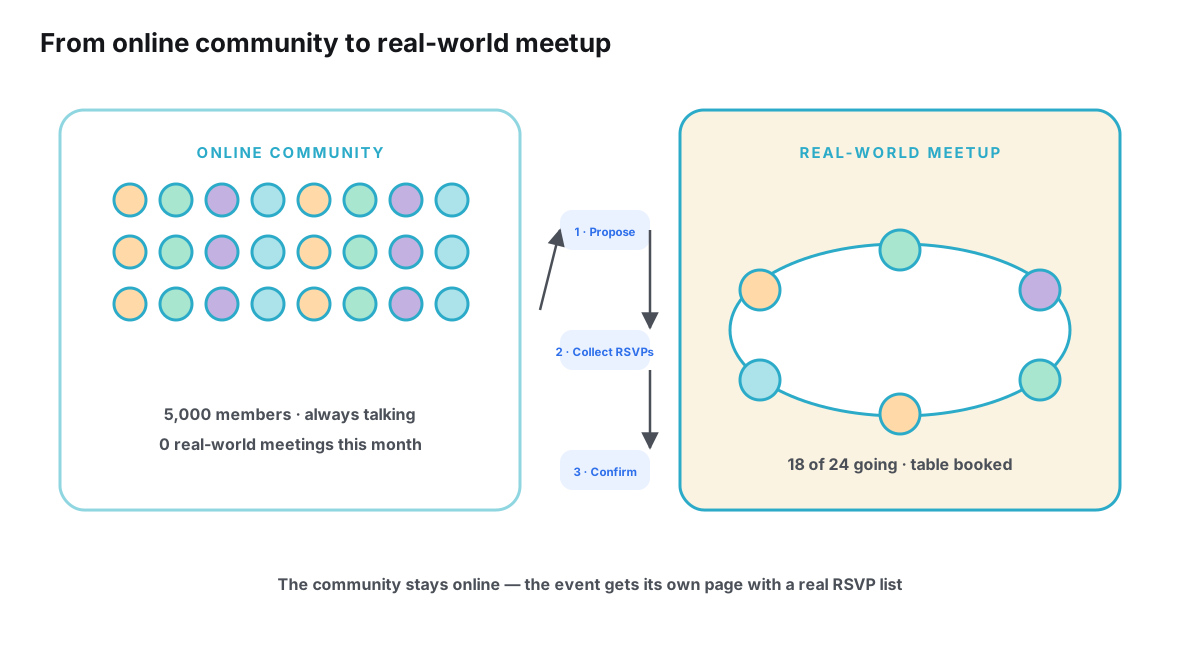
When a member marks “Interested” on a Discord server event, they have expressed a costless reaction — interest, not a reservation. Between that click and the event, four things decide whether it converts: friction (how hard it is to find the final details and get there), memory (whether the plan resurfaces as the date approaches), commitment (whether the person ever states an intention that can survive a busy week), and social proof (whether people they know are going). Raw interest markers influence none of the four. Organizers improve turnout by acting on each force deliberately: one link with current details, a confirmation moment that converts interest into a going / maybe status, a reminder rhythm, and a visible guest list — the mechanics of an RSVP. Interest predicts a good idea; commitment predicts a room with people in it.
The anatomy of a low-cost signal
It is worth starting inside the click itself, because everything downstream follows from what the marker is. A member is browsing the server. The event listing appears — a title, a time, maybe a catchy description. It takes about two seconds to mark interest. There is no calendar check, no conflict scan, no mental rehearsal of the journey across town. There is just a small positive feeling about the idea of the thing, and a button that expresses it perfectly.
Discord designed this honestly. As Discord’s support documentation describes the feature, the “Interested” marker is exactly what it says: an expression of interest in a server event, useful to the member as a bookmark of enthusiasm and useful to the platform as something to anchor reminders around. It is a lovely mechanism for what it is — the lightest possible way for a community to register that an idea has support. If a server wants to know whether people want a summer barbecue, the marker answers that question well.
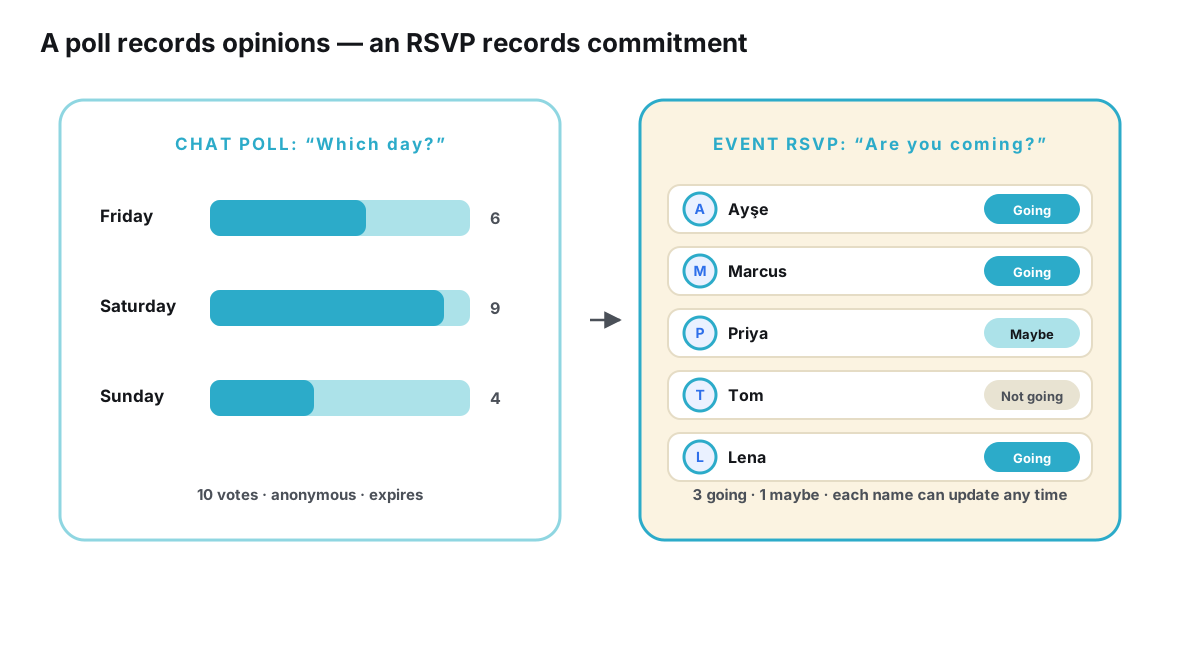
The trouble begins the moment the marker is asked a second question it was never designed for: how many of you will be there? Here it fails silently — not by lying, but by counting a different thing. Forty interested members is a true measurement of enthusiasm and an unmeasured guess about attendance. The organizer who books a space for forty learns that the hard way, usually once. And the marker cannot even improve with time: it has no natural moment that prompts revisiting, so the member whose Wednesday meeting got scheduled for the event’s Saturday keeps their marker, perfectly sincere, now false as a forecast.
The distance between interested and attending
Picture the journey of one interested member — call her Priya — from click to event day. Understanding her path explains why aggregate interest and final attendance are different numbers, and where the difference is manufactured.
Priya marks interest on Monday. Nothing else happens in her life because of the click. Tuesday through Thursday, the server’s channels move on; forty other conversations bury the listing. Friday, Priya half-remembers an event — was it this Saturday? next? She opens the server, and now she is doing archaeology: finding the listing, checking whether the discussion thread changed anything, wondering whether the meeting point in the description is still the meeting point. Each of those steps is small; their sum is a hurdle. If Priya is mildly tired that evening, the archaeology loses.
Suppose she confirms it is next Saturday. A new problem appears: the intervening week. Work runs long, a friend proposes dinner the same night, the forecast turns gray. Priya’s interest never wavered — her calculus changed, and no system knows, because her marker has no way to carry the update. On Saturday afternoon she makes a silent decision, and the organizer’s forty becomes, without any malice anywhere, some smaller number at the venue.
Now run the same week with different logistics. The event has a page; Priya’s click on the marker is followed, the next day, by a sign-up list she can join with one tap — going, for now. On Thursday the page still says the same thing it said Monday, because nothing has changed; on Friday a reminder arrives carrying the link, not a demand. Her friend’s name is on the going list, visible, which quietly settles the question the gray forecast raised. On Saturday she goes. Nothing about Priya improved — the course simply got easier to run.
Two details of Priya’s story deserve emphasis. First, at no point did she mislead anyone — she is a good-faith member of a healthy community whose sincere signal was structurally unable to become a commitment. Second, every obstacle in her path was placed there by information logistics, not by her character: the buried listing, the uncertain meeting point, the missing nudge at the decision moment, the silent Saturday calculation. Logistics is exactly the part organizers can fix — which is the hopeful reading of the whole gap.
What the interest list can and can’t tell you
Before fixing anything, be precise about the instrument. The interest list is information — good information, badly bounded. The table below draws the boundary.
| Question you might ask | Can the interest list answer it? | What answers it instead |
|---|---|---|
| Does the community like this idea? | Yes — well and quickly | — |
| How big should the venue be? | No | Committed going / maybe counts, reconciled at a deadline |
| Who specifically intends to come? | No | A named sign-up list per person |
| Has anyone’s plan changed? | No | Updatable statuses each guest maintains |
| Should we run this event again? | Partly — as one input | Interest plus commitments plus recorded attendance |
| Who should get a reminder? | Only as a broadcast hint | People who opted into updates for the event |
The pattern is consistent: the interest list is a community sentiment instrument, and every planning question requires a per-person commitment instrument. Confusing the two is not a moral failure — the two instruments look adjacent in any interface, counts sitting beside events. But the disciplines are different, and the web formalizes the difference: while a reaction to a listing is just engagement, schema.org defines the RSVP as its own action type — a structured response tied to a person and an event, the atomic unit of a guest list. A community can have both instruments side by side, reading each for what it measures.
Four forces that decide whether interest converts
Across very different communities, four forces do almost all the work of converting interest into attendance. They are worth knowing individually, because each responds to a different organizer behavior.
Friction: how hard is it to say yes again, later
Friction is every step between remembering the event exists and being confidently able to attend it: finding the current details, confirming the date, working out the route, arranging the ticket or the money. The initial click had near-zero friction — that is why it happened. The follow-up decisions must be nearly as cheap, or the interest leaks away at each step. The single highest-leverage fix is boring: one address holding the current details, so that the answer to every follow-up question is a five-second lookup instead of a scroll.
Memory: does the plan resurface at the right moments
Interest marked on Monday does no work on Saturday morning unless something re-surfaces it. Humans reliably remember that they were excited; they unreliably remember when. There is a design subtlety here: a busy server’s own activity — which buries the listing — paradoxically helps only if the event keeps being mentioned, which organically happens only for hotly discussed events. For everything else, the community needs a reminder rhythm tied to the event itself: a note when the date nears, another on the day, each carrying the link. Reminders anchored to an event are a different species from the firehose of general notifications a big server produces, which members wisely learn to ignore.
Commitment: has the person stated an intention
There is a real psychological difference between “I liked the idea” and “I said I’m going.” A stated intention — ideally recorded somewhere both the person and the organizer can see — survives busy weeks better than a private feeling, updates cleanly when life intervenes (“actually, switching to maybe”), and rolls up into the headcount the organizer needs. This is why RSVPs exist as a category, and why communities that move members from markers to statuses see their planning calm down: the pipeline from sentiment to headcount finally has a middle stage. The sibling article Discord polls vs actual event commitments covers the same territory from the voting side — polls, like markers, measure the easy signal.
Social proof: who else is going
The quietest force and often the largest. For most members, the decision to attend a community event is really the question “will people I like be there?” A listing with an anonymous interest count answers it badly; a visible guest list of named people — especially recognizable community members — answers it powerfully. This is one of the strongest arguments for a public sign-up list over private tracking: the list is not just data for the organizer, it is social gravity for every waverer who checks it. Priya’s Saturday calculation looks entirely different when three people she enjoys are confirmed going.
A useful test for all four forces at once: ask what a member has to do, and know, at six in the evening on the day of the event. If the honest answer is “find the listing, work out whether anything changed since I last looked, figure out who else is going, and then decide,” the event is asking a great deal. If the answer is “open the link,” most of the conversion work is already finished. Every force described above is a way of shrinking that six-o’clock burden.
Practices that move interest toward turnout
Each force suggests concrete practices. None is clever; all are cheap. Run honestly, they compound into a community where events simply happen as planned.
| Practice | Force it acts on | What it looks like in practice |
|---|---|---|
| One link with current details | Friction | An event page holding final time, place and updates; every mention carries it |
| A sign-up moment after the announcement | Commitment | “Mark interest, then drop a going / maybe on the page” — one extra step, deliberately |
| A headcount deadline | Commitment | “I confirm the venue Wednesday” — interest must become a decision by then |
| Two reminders, not twenty messages | Memory | A near-date note and a day-of note, both carrying the link |
| A visible guest list | Social proof | Named going / maybe statuses that members can browse |
| A halfway maybe-sweep | Commitment, memory | One warm public nudge plus personal notes to key people |
| A recorded comparison after | All four, next time | Interested vs. committed vs. attended, written down once per event |
Notice what is not on the list: pressure. Guilt-tripping unresponsive members, calling out no-shows, mandating attendance — these corrode the community warmth that made the event possible, and they misread the problem anyway. The gap between interest and attendance is a logistics gap, and the table above is logistics. Treat it as such and the tone stays friendly; the same conversion numbers arrive without anyone dreading the organizer’s messages.
There is an honesty dividend worth naming, too. When the process is legible — a visible list, a stated deadline, a reminder anyone can anticipate — members stop reading the organizer’s messages as mood and start reading them as mechanics. A message that says “confirming the venue Wednesday” is not pressure; it is a schedule. Communities run this way report a subtle shift in tone: attendance stops being a social obligation nagged into existence and becomes a decision each person makes cleanly, updates cleanly, and is respected for either way.
An evening, measured both ways
Two servers in the same city run the same event on the same evening: a board-game café night, capped at two large tables. The first server runs on spirit alone. The listing is up, the marker count is healthy — friends, regulars, the usual warm noise of a community that likes itself. The organizer, needing a number for the café, reads the count, subtracts a hunch, and books the tables. On the night, the room is either overfull with a waiting list and mild chaos, or half empty with an awkward gap — and the organizer genuinely cannot predict which in advance. Both outcomes land on the community’s memory of the event, not on the enthusiasm that produced it.
The second server runs the same warmth with one added instrument. The listing and the chatter are identical; the difference is a link carrying a sign-up list, a stated table deadline, and a reminder before the night. This organizer never reads the marker as a forecast — it is read as applause — and the going list is read as the booking. Maybes get one gentle sweep at the halfway mark, and the people who flip to going or drop out do so on the record, where the arithmetic can see it. On the night, the tables match the list, the list matches the room, and when the café asks whether the group wants the same slot next month, the answer comes from a written comparison rather than a feeling.
Neither community tried harder than the other; the enthusiasm was equal on both sides of town. The second simply gave its enthusiasm a structure to stand in — which is the argument of this article in three paragraphs.
The practices slot naturally into the split pattern this cluster keeps returning to: the server keeps the enthusiasm — the listing, the banter, the momentum — while a small event page holds the current details, the sign-up statuses and the reminder rhythm. Tools like Ontaym are built to be that second half: one link per event, going / maybe statuses guests update themselves, reminders attached to the event rather than to the channel’s noise. The wider strategy — why a lively server makes this split necessary — is laid out in why Discord is excellent for communities but complicated for offline plans.
When the gap doesn’t matter
A fair treatment has to include the cases where loose interest is fine, because they are real. A drop-in voice hangout attached to a server event listing wants exactly the marker it has: zero-cost enthusiasm, no headcount, no venue, no deposit — people arrive if they arrive. A big casual park meetup where twenty or forty are equally fine is deliberately designed to tolerate the gap. Some communities even use interest markers as pure idea-voting: which event should we run at all?
The gap starts to matter in proportion to the event’s hard edges: a reservation, a ticket, a driven carpool, a catered count, a venue with a maximum, a workshop with materials per person. Each hard edge converts sentiment into someone’s liability, and the organizer is someone. The practical rule of thumb: if your event can absorb any number of guests between a third and double your interest count without anyone losing money or face, the marker alone is honest enough. The moment it can’t, you need commitments — and by then, every practice in the table above is already cheap insurance.
There is a cultural dimension as well. Some communities treat drop-in looseness as part of their identity — showing up whenever, bringing whoever — and a heavy sign-up apparatus would sit oddly with that spirit. The right move there is not to impose structure but to match it: keep events tolerant by design, choose venues without hard edges, and reserve the full apparatus for the few events each year that genuinely need it. Structure is a tool applied where an event has stakes, not a value imposed on a community that never asked for it.
There is also a growth argument worth naming. Loose, high-tolerance events are often exactly how an online community takes its first steps offline — and those first steps decide whether there are second ones. The practical playbook for that transition, from cultivating regulars to building a real-world rhythm, is covered in how to turn a Discord community into an offline community. Interest, properly harvested, is the fuel for that whole journey; it just shouldn’t be asked to be the map.
Frequently asked questions
Is the “Interested” count useful for anything, then?
Yes — it is a fast, honest gauge of community enthusiasm. Use it to test ideas (is a barbecue wanted at all?), to compare two proposals, and to sense how visible your announcement was. What it cannot do is forecast attendance, feed a reservation, or update itself when plans change. Read it as applause, not as a guest list, and it serves you well.
How much smaller than “interested” is attendance usually?
There is no trustworthy universal ratio — it varies enormously with the community, the event type, the day, the city and how well the plan is maintained — which is exactly why importing another community’s rule of thumb fails. Your own ratio is measurable: record interested, committed and attended for two or three of your events, and you will have a number calibrated to your people instead of a guess borrowed from strangers.
Should I ask interested members to switch to a going / maybe status? Won’t that feel like nagging?
Not if the ask is structural rather than personal. One clear sign-up step, announced once with the event, feels like normal event mechanics; repeated private messages asking individuals to commit feels like nagging precisely because it is. The design goal is a single obvious place where a status exists and can be changed — after that, the page does the asking, and the organizer can stay friendly.
Do reminders actually help, or do people tune them out?
Reminders tied to a specific event the person already opted into behave differently from a busy server’s general notification noise, which is exactly what people tune out. Two well-placed notes — one when the date nears, one on the day — each carrying the current details, catch the two moments memory reliably fails. What burns people out is repetition of information that hasn’t changed; what helps is the right nudge at the decision moment.
What about members who mark interested and then go quiet?
Treat silence as soft data, not as an offense. A member who marks interest and never signs up was probably never more than curious, and the community is healthier for having their curiosity on record. The single legitimate follow-up is the public halfway reminder; beyond that, quiet members convert on their own schedule or not at all. The list exists precisely so the organizer never has to interrogate individuals — the page asks, the member answers whenever they answer, and both sides stay comfortable.
What’s the minimum setup for a small server that just wants better turnout?
Three things, all cheap: one page or post holding the current details behind a single link; a sign-up list where each guest has a going / maybe status; and a deadline after which you act on that list. Announce once, answer every question with the link, nudge the maybes halfway, and write down who came. That is the whole system at small scale — and the reasons it works are structural, which is the argument of why an event needs its own digital space.
Conclusion
“Interested” is the beginning of an event’s story, not the middle of one. It measures the community’s appetite with a sincerity and speed few signals match — and then it stops, because a costless reaction cannot carry a person through a buried listing, a busy week and a Saturday-morning calculation. The distance between the click and the door is where events are won or quietly lost.
The organizer’s job in that distance is not to doubt the sincerity of members; it is to remove the logistics standing between their sincerity and their feet. Give the plan one address that never goes stale. Give every interested member a small, honest way to become a committed one — and to change their mind cleanly when life requires it. Remind at the two moments memory fails. Let the guest list be visible, because people go where people they like are going. Communities that do this discover that their interest was never the problem — it was, all along, the most abundant raw material they had.
Turn “interested” into a guest list you can trust.
Plan it with Ontaym