
The Gap Between Discord Membership and Real-World Participation
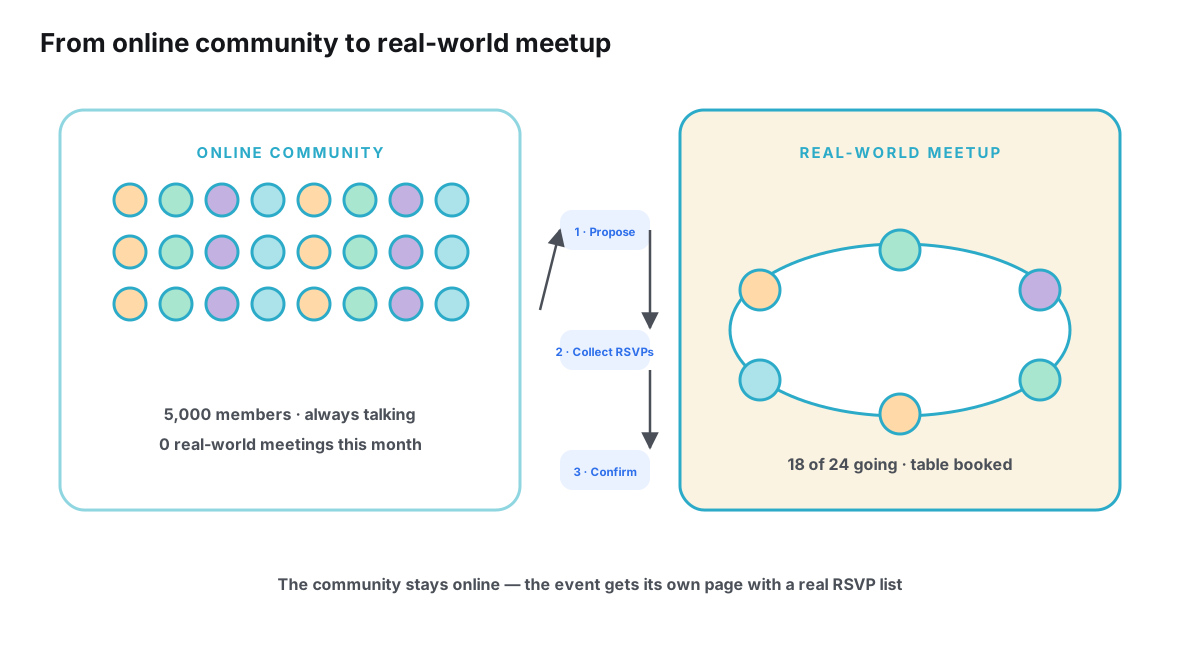
A server can list twenty thousand members and still struggle to fill a café table on a Friday. That isn’t failure — it’s the predictable shape of a funnel that starts with a one-click join and ends with a physical journey across town.
Quick answer
Discord membership and real-world participation are separated by a funnel, and each stage removes people for a different reason. Joining is free and instant, so member counts measure curiosity, not commitment. Most members rarely open the server; of those who do, only some see a given event; of those, fewer are near the venue and free on the date; and fewer still convert intention into showing up. The gap becomes a problem only when organizers read member count as expected attendance — booking venues on inflated numbers. The fix is to measure the funnel you have: who saw the event, who committed, who came. Then target each stage with a specific intervention — visibility fixes seeing, reminders fix forgetting, local clusters fix geography, and named RSVPs fix counting. Membership is the top of the funnel, never the forecast.
The big server and the small room
Picture a server — call it a fan community, a guild hub, a study group, it barely matters — with a member list in the tens of thousands. The announcement channel posts an offline meetup. Reactions bloom, interested markers accumulate, the replies are warm. The organizer, reasonably proud, books a private room sized for a crowd. On the night, the room holds a table’s worth of people, and the organizer spends the evening alternating between delight at the strangers who became friends and confusion about where the other nineteen-and-a-half thousand went.
The answer is: nowhere. They were never coming. The member list counted everyone who ever clicked join — the curious, the passing-through, the people who joined for one question in 2023 and never left, the lurkers who read but never speak, and the genuinely devoted who happen to live on another continent. Membership is a census of everyone who ever opened the door. Participation is a measurement of who will spend an evening, in one city, in one room. These are different quantities by nature, not by defect — and treating the first as a forecast of the second is the single most common planning error in community events.
Worth saying early: this is not a criticism of Discord, where very large communities — hundreds of thousands of members in the biggest servers — are explicitly part of the design, as Discord’s own materials describe. A big member list is a genuine achievement and a genuine asset. The task is reading it correctly — as reach, not as a promise.
Why joining is free and showing up isn’t
The gap exists because the two actions sit at opposite ends of a cost spectrum. Joining a server costs one click and zero ongoing obligation. There is no fee, no schedule, no social risk — you join, you lurk, you drop in when a notification catches you. This low friction is exactly what makes big communities possible, and it is also what makes their member counts so elastic: they include everyone whose interest was ever strong enough for one click.
Attending an event in person costs real things. An evening. Travel across a city. The social energy of meeting people you know as avatars. A decision made in advance against a calendar, defended against the day’s fatigue. And — the stage most often forgotten — physical proximity: attendance is drawn almost entirely from members within reach of the venue, which for any given location is a small slice of a global membership.
Between the free action and the expensive one sits a chain of smaller filters, each removing people for its own honest reason. Organizers who understand the chain stop asking “why didn’t they come?” — a question with no answer — and start asking “which stage did we lose them at?” — a question with several fixable answers.
The funnel, stage by stage
Every community’s numbers differ, but the structure of the funnel is remarkably stable. A member must pass through five stages to become an attendee, and every stage has its own drop:
| Stage | What it requires of the member | Why people drop here |
|---|---|---|
| Joined the server | One click | — |
| Sees the event | Checking the channel or listing where it appeared | Most members sample a server rarely; the announcement sank under chat or never reached their checked channels |
| Interested | The event appealing to them specifically | Wrong format, wrong topic, or the member is a pure lurker by habit |
| Able to attend | Being near the venue and free on the date | Geography and calendars — the two filters no enthusiasm can pass |
| Committed | Saying yes, concretely, in a way that persists | Weak signals (votes, interested markers) never convert into a named commitment; details scattered across chat leak people away |
| Attended | Actually showing up on the day | Forgetting, last-minute conflicts, and the activation energy of an evening alone — recovered partly by reminders and greeters |
Two features of this table matter more than the rest. First, the stages are sequential: nothing at the bottom works if the stage above it is broken — reminders cannot rescue an event nobody saw, and an RSVP list cannot be honest if the details keep changing. Second, each drop is normal. The funnel isn’t a leak to be eliminated; it’s a shape to be known. Communities get into trouble not by having a funnel but by planning as if they didn’t.
It’s worth pausing on how unusual the final stage is. Everything above it happens on a screen, in seconds, alone. Attending is the only stage that requires a member to be physically somewhere at a specific time with other people — which makes it the only stage that produces what communities actually remember. Weeks of chat blur together; nobody forgets the first person from the internet they shook hands with. The funnel is not just an attendance model — it is a sequence in which each step down costs more and returns more, and the organizer’s craft is lowering the cost of each step without cheapening what it returns.
What the gap costs when you ignore it
Misreading membership as participation has three standard price tags. The first is financial: venues, catering and deposits booked against the member list or an interested count, paid for out of a community treasury or an organizer’s pocket. The second is logistical: a room for fifty hosting twelve feels emptier than a café table hosting twelve, because the room indicts the planning. Organizers who scale the format to the committed list — and let it grow — look competent at every size.
The third cost is the quietest and the largest: morale. An organizer who expected a crowd experiences a small room as rejection, and often draws precisely the wrong conclusion — that the community doesn’t want to meet — when the community merely behaved like every funnel in human history. Communities have abandoned offline plans over one mis-sized venue, never discovering that twelve people at the right table is the seed of everything they wanted. The gap doesn’t have to cost that; measured honestly, it never does.
Measuring the gap honestly
You cannot manage a funnel you don’t measure, but community measurement is full of vanity traps. The honest version is modest and per-event, and it needs only three counts: how many people the event reached (saw the announcement or listing — a rough count is fine), how many committed (the named going list, not votes, not interested markers), and how many attended. The third number checked against the second tells you your commitment reliability; the second against the first tells you how well your announcement converts; and the trend of all three across events tells you whether the community’s offline life is growing.
What this method deliberately refuses to do is divide attendance by membership. That ratio is meaningless — it compares one city’s Tuesday against a global census of everyone who ever clicked — and it poisons morale precisely because the denominator is inflated by thousands of members who were never candidates. The member list is context, not a denominator.
Three signals that commonly masquerade as measurements deserve their warning labels:
- Member count measures cumulative curiosity. It can rise for years while per-event attendance stays flat, and it usually does in healthy communities — because growth and engagement are different systems.
- Interested markers on server events are, by design, expressions of interest rather than RSVPs — a gauge of reach and warmth, not a headcount. Discord’s own support pages frame event responses as interest, and that framing is the correct reading.
- Poll votes measure opinion at the moment the poll floated past. They overpredict attendance structurally — voters answer a hypothetical, attendees answer a calendar.
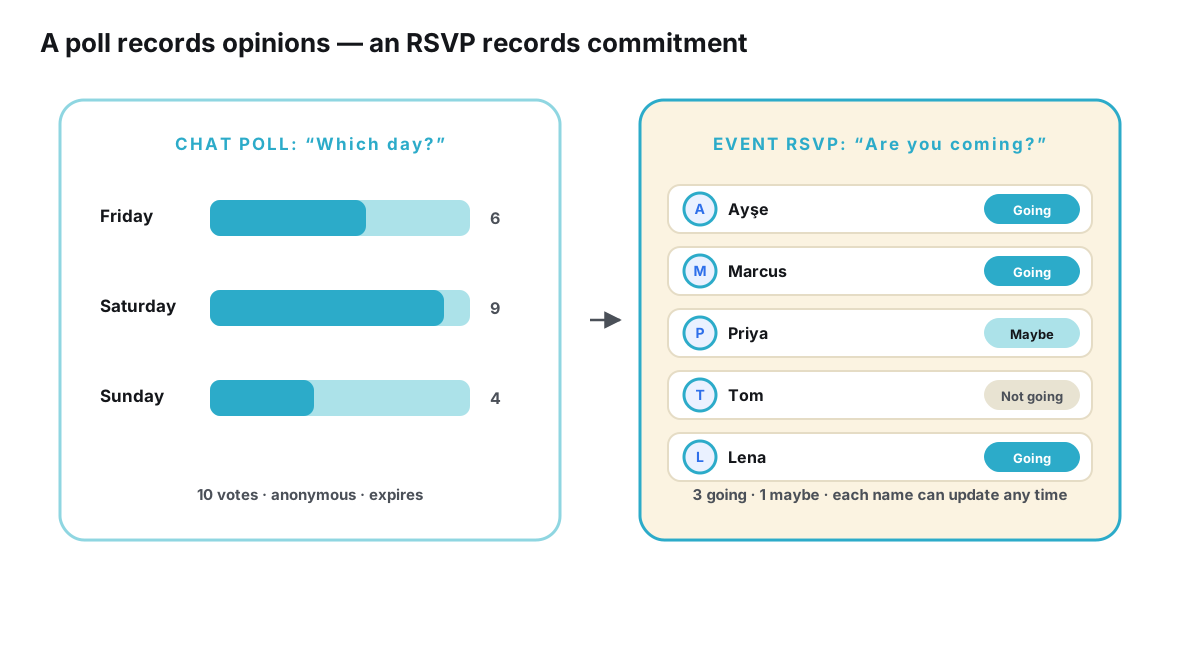
The named RSVP list is where honest measurement and honest planning converge — it is simultaneously the best forecast of attendance and the artifact that improves it, because a commitment is a real psychological object in a way a vote never was. This is also where tooling earns its place: a structured event page with going and maybe statuses, changeable as plans change, gives the funnel a place to be counted. The general argument for that layer — the same one behind why messaging apps were never designed to be event databases — applies with full force to the biggest servers, where chat volume makes any hand-tallied count fiction within hours.
A worked example: one event, three numbers
Suppose Priya’s regional meetup is announced in the community’s events channel on a Tuesday. By Friday, the event listing has collected a healthy band of interested markers, the announcement post has its share of reactions, and the event page’s RSVP list shows eleven people marked going, with six maybes. On the night, nine people arrive, greet the anchor, and take the long table.
Three numbers, three different lessons. The interested count tells Priya the announcement was seen and liked — a visibility reading, useful for nothing except knowing the reach worked. The committed list of eleven was her forecast, and it forecast well: nine attended, one maybe converted on the day, and the drop between commitment and attendance was ordinary life intervening, not a planning failure. Had she reserved against the interested count, she would have booked a room that mocked her; against the member list, a hall. Against eleven, she got a table that fit — and felt full.
Notice what the exercise doesn’t contain: a percentage. Priya doesn’t need to compute what fraction of commitments held; she needs to know that commitments are her reliable planning unit and that maybes add a predictable sprinkle. The next event, she reads the same three numbers again, and the trend — not any single ratio — tells her whether the community’s offline life is growing. After the meetup, one more number quietly becomes the most important one: how many of the nine committed to the next date before leaving the table.
Interventions that actually move each stage
Once the funnel is visible, improving it becomes specific work. The mapping below pairs each stage with the interventions that genuinely act on it — and the popular efforts that don’t:
| Stage | What works | What doesn’t |
|---|---|---|
| Sees the event | A dedicated, posting-restricted events channel; server event listings; one clear link repeated at natural moments | More pings in busy channels — they raise noise and train members to mute |
| Interested | Formats tied to the community’s actual shared identity; photos and recaps of previous gatherings | Generic formats — a meetup that could be anyone’s draws no one specifically |
| Able to attend | Regional clusters with local anchors; dates chosen by poll among realistic candidates | One global event and a global announcement — geography filters the whole audience at once |
| Committed | A named RSVP with going/maybe states, on a stable event page | Interested markers, votes and “sounds great!” replies — none bind to a person and a date |
| Attended | A reminder near the date pointing at the event page; a named greeter for first-timers | Assuming silence means absence — quiet members attend at rates that surprise organizers |
The right-hand column reads like a list of instinctive moves, which is the point: every entry there feels like effort in the right direction and acts somewhere other than where the drop happens. The discipline of the table is refusing to spend energy at a stage that isn’t yours yet. An event nobody saw doesn’t need better RSVP tooling; it needs a channel people actually scan. An event everyone saw and nobody committed to doesn’t need another announcement; it needs the ask to be concrete.
Local clusters beat global announcements
Of all the stages, geography is the least negotiable and the most neglected. No reminder, poll or event page moves a member four hundred kilometers closer to the venue. The communities that grow real-world participation at scale have almost all converged on the same structural answer: stop running one event for a scattered membership, and start running many small events for the places members actually cluster.
The mechanics are unglamorous. A region channel lets members discover each other; a recurring cadence — say, monthly per cluster — lets each cluster build ritual; a local anchor holds authority over their city’s gatherings, keeping them authentic to the place rather than to a remote organizer’s template. The server stays one culture — shared channels, shared in-jokes, a shared event pattern — while the meetups multiply across cities. A community running five tables in five cities on the same evening has quietly solved the participation gap for more members than any single flagship event ever could, and it did so by agreeing with geography instead of arguing with it.
This federated shape also repairs measurement, incidentally: per-cluster attendance is a small, honest number with a real denominator — members near that city — so progress becomes visible event by event instead of drowning in a global ratio. Growth, when it comes, comes as more clusters and steadier tables, which is exactly what sustainable community growth looks like offline. The broader playbook for running real-world events from a server — formats, roles, RSVP layers — is laid out in how Discord servers can organize real-world events, and the tooling question — what Discord’s own event listings cover versus a dedicated event page — is compared in Discord events vs dedicated event pages.
Online events: the funnel’s middle stage
The funnel’s harshest jump is from lurker to traveler — from silently reading a server to spending an evening in a room of near-strangers. Communities that soften the jump insert a stage between them: the online event. Voice-channel hangouts, community watch parties, organized play sessions — these ask for an evening but not for travel, and they do the specific work of converting names into voices and avatars into people.
The effect on offline attendance is indirect but real. A member who has talked in voice with three of the table’s eventual occupants isn’t walking into a room of strangers; they’re walking into a room of acquaintances they haven’t met yet. The social activation energy — the real cost of a first meetup — drops accordingly. Unsurprisingly, the members who appear at offline gatherings skew heavily toward those who had already been appearing at online ones, which makes the humble voice event the cheapest attendance program a community can run.
There’s a measurement dividend too. Online events produce exactly the per-event counts — reached, committed, attended — that train organizers to read funnels honestly, with none of the venue risk. A community that fills a voice channel for movie night has rehearsed everything about event rhythm except the chairs.
Membership is still the asset
Having spent an article on the gap, it’s worth closing the loop on what the member list actually is: the raw material of participation. Every attendee was once a joiner; every cluster was once two members who discovered they shared a city; every greeter was once a lurker who came once and stayed. The funnel flows one direction, and the wide top is what feeds the narrow bottom. A community that despised its silent majority would be sawing off the branch its meetups grow from.
The mature posture is neither cynicism about membership nor naivety about it. Members are an audience to be served where they are — most of them, most of the time, online — and a reservoir from which offline participation slowly condenses: a few at a time, when the format is right, the city is right, and the date is right. Communities that honor both halves keep their servers welcoming to the silent and their calendars real for the committed, and they let each member choose their depth of participation — lurking, chatting, meeting — without treating any tier as a failure.
Signs of a healthy participation funnel
How do you know the funnel is working, without vanity ratios? The signs are qualitative, and they compound quietly:
- Attendance at consecutive events overlaps but doesn’t fossilize. Regulars anchor the table; new faces appear at a steady trickle rather than never or all at once.
- The committed list grows more honest, not just bigger. People update their RSVP when plans change instead of silently vanishing — a sign they take the commitment itself seriously.
- Clusters self-organize. Members in a city you’ve never served start their own gathering, borrowing the community’s format without being told to.
- First-timers arrive already briefed. They’ve seen the photos and recaps, know the format, and need only a greeter — evidence that the content loop is feeding the funnel’s top.
- Organizers plan calmly. Reservations are made against commitments, changes are edits to a record, and nobody refreshes a member count for reassurance.
A community showing these signs has closed the gap to its practical minimum. The member list keeps growing, the tables keep filling, and — the quiet proof of health — nobody confuses the two numbers anymore.
Frequently asked questions
What attendance should we expect from a large server?
Expect it from the committed list, not the member list — a named going list plus a share of maybes is the only honest forecast, and it is usually a small fraction of interested counts. Venue against commitments, keep maybes as buffer, and let the format grow with proven turnout rather than presumed scale.
Isn’t a low attendance-to-membership ratio a sign of failure?
No — the ratio is close to meaningless, because it divides one city’s evening by a global census of everyone who ever clicked join. Big communities have globally scattered memberships by nature. Judge events by reach, commitment and attendance against each other, not against the member count.
Do “Interested” markers predict anything?
They predict reach and warmth better than almost any other signal — interest is real, and heavy marker counts mean the event was genuinely seen and liked. What they don’t predict is attendance, because they’re expressions of interest, not RSVPs. Use them to measure visibility, never to size a room.
How do we grow attendance rather than just measure it?
Move the specific stage that’s stuck: visibility first (a slow events channel and a stable page), then geography (regional clusters with local anchors), then commitment (named RSVPs with going/maybe states), then day-of conversion (reminders and greeters). Growth comes from fixing the bottleneck stage, not from louder announcements.
Should we count lurkers as part of the community?
Yes — most members of any large server are quiet by default, and they attend events more often than organizers expect. The member list is an audience to serve and a reservoir to draw from, not dead weight. Treating lurkers as failures discourages exactly the gentle on-ramp that occasionally converts them into attendees.
Can one big annual event replace regular meetups?
A flagship can anchor a community’s year, but it rides on momentum built by smaller gatherings — the members who travel to an annual event are disproportionately the ones who attended something local first. Sustainable participation grows from steady regional tables upward, not from one large drop downward.
Conclusion
The gap between a member list and a full room isn’t a mystery or a betrayal — it’s a funnel with known stages and known drop rates, running from a free click through attention, geography, commitment and finally a physical journey across town. Communities suffer at exactly one point in that sentence: wherever they read the first number as the last one. Measure reach, commitments and attendance per event; refuse the vanity ratios; and spend effort on the specific stage that is actually leaking.
Then do the two things that reliably widen the bottom of the funnel: give events a stable, addressable record where intentions become named commitments, and organize around geography with regional clusters and local anchors instead of one announcement shouted into a global crowd. A twenty-thousand-member server that reliably fills tables in five cities has closed the gap as far as physics allows — and it did so by treating membership as what it is: the widest part of the funnel, the reservoir everything else flows from.
Count the people who commit — not the people who joined.
Plan it with Ontaym