
Discord Polls vs Actual Event Commitments
A poll with a landslide of “yes” votes feels like proof your event will happen. It isn’t. Votes measure opinion at a moment in time; commitments are what fill rooms — and between the two sits everything that can go wrong with a Tuesday.
Quick answer
A Discord poll is a measurement tool: it aggregates preferences at one moment, usually with a single tap and no cost to the voter. An event commitment is a promise: bound to a named person, persistent over time, updatable when circumstances change, and countable into a headcount you can book a venue against. Polls represent none of that, which is why vote counts reliably exceed attendance. Discord’s event “Interested” markers share the same character — expressions of interest, not RSVPs. The working pattern is to use polls for what they do well, choosing between date or venue options, and then collect a separate, named RSVP for the chosen event. Treat votes as the top of your funnel and commitments as the bottom, and the gap stops being a surprise.
The poll that promised a full house
Picture a community server planning its first real meetup. Maya, the organizer, does what any sensible Discord citizen would do: she posts a poll. “Who’s in for a meetup next month?” Eighty votes land within two days, the comments fill with enthusiasm, and Maya books a space sized for eighty — or at least tells the venue to expect a crowd. On the night, twelve people come.
Nobody lied, and nothing went wrong with the poll. Every one of those eighty voters meant it when they tapped. What failed was the translation: Maya read a measurement of enthusiasm as a count of commitments, and the two quantities are separated by an ocean of logistics, calendars, energy levels and honest forgetting. This article is about that ocean — what a vote actually is, what a commitment actually requires, and how to run an event pipeline that respects the difference.
The distinction matters more on Discord than almost anywhere, because Discord makes voting unusually frictionless. A big, warm server can produce very large poll numbers, and the bigger the number, the more dangerous it is to plan against. The platform’s own features are honest about this once you read them carefully — Discord’s product documentation describes polls as a way to gather the community’s opinion, which is exactly what they are, and no more.
What a Discord poll actually records
Strip a poll down to its mechanics and you find a surprisingly narrow instrument. It presents one question, a fixed set of options, and a one-tap interaction. Depending on how the author configures it, votes may be visible or anonymous; multiple answers may or may not be allowed; the poll may run for a set duration. What you get at the end is a tally — a snapshot of aggregated preferences, frozen at the moment the poll closed or the moment you last looked.
Three properties follow directly from those mechanics, and each one disqualifies polls from serving as attendance records:
- A vote is costless. Tapping an option takes under a second, commits the voter to nothing, and costs no social capital to abandon. Signals this cheap are wonderfully honest about preference and useless for prediction, because the same low cost that encourages voting encourages forgetting.
- A vote is momentary. It records how someone felt when they saw the poll — often within minutes of it being posted, long before they could know their schedule. Nothing about the vote updates itself when a work trip appears or a babysitter cancels.
- A vote is abstract. Most pre-event polls ask about a hypothetical: “a meetup sometime next month.” Voting yes to a hypothetical is easier than saying yes to a specific Thursday at a specific place. The concrete question — the one that predicts behavior — hasn’t been asked yet when the poll closes.
None of this is a defect. A measurement of opinion at a moment is a genuinely useful thing; it’s simply a different thing from a promise. Problems appear only when the tally gets used as a headcount — which, in the excitement of a popular poll, is almost irresistibly tempting.
What an event commitment actually consists of
A commitment looks simple from the outside — someone said yes — but for a yes to be operationally useful to an organizer, it has to carry five properties at once. Laid out side by side, the two objects barely overlap:
| Property | Discord poll vote | Actual event commitment |
|---|---|---|
| Identity | May be anonymous; otherwise a handle that tapped once | A named person the organizer can greet and count |
| Time binding | Reflects the moment the poll was seen | Attached to a specific date, time and place |
| Persistence | Frozen when cast; never re-evaluated | Alive until the event — the person re-confirms implicitly as the date nears |
| Reversibility | Changing a vote is possible but meaningless — nothing follows from it | Changing a no-show into a “can’t make it” updates the headcount and frees the seat |
| Output | A tally: 80 votes for yes | A list: these 14 people, 6 maybes, a reservation sized to match |
The final row is the one that bites organizers. A tally is a single number stripped of identity, so it can’t tell you who to expect, who to chase, or who dropped out when three people cancel on the morning of the event. A commitment list is the operational object — it drives the venue size, the deposit, the food order, the seating, and the organizer’s sanity on the day.
There’s a formal way to say this, too. The web’s structured-data vocabulary treats an RSVP as its own type of action — schema.org defines RsvpAction as a first-class object a person performs with a status and a target — precisely because a response to an event is a record, not a preference. Polls live in the opinion business; RSVPs live in the commitment business. Conflating them is a category error, however good the poll looks.
Why votes overpredict attendance
Every experienced organizer knows votes run hot; it helps to understand the mechanisms, because each one suggests a partial remedy. Four are usually at work in the same poll:
Voting is socially pleasant. Saying yes to a community event is a small act of belonging. Members vote yes because they like the server, like Maya, and like the idea of themselves at a meetup. The vote expresses identity and goodwill — real feelings, attached to a hypothetical, with no schedule consulted.
The poll is answered by the most reachable, not the most available. Who sees a poll? The members online in that channel during its visible lifespan — a skewed sample of the community, and one that overlaps only partially with the people who can actually attend on the eventual date. In a busy server, this gets worse: the poll itself sinks under newer messages within hours, which is its own story, covered in how event information gets lost in active servers.
Time passes between the vote and the event. A poll closes weeks before the gathering. Between those two moments, calendars fill, shifts change, enthusiasm cools, and the mental entry the voter made — “meetup, next month, sounds fun” — never converts into “Thursday, 19:00, the usual place.” Votes don’t nag, don’t reappear, and don’t re-ask the question when it becomes concrete.
Attending is expensive; voting is not. Showing up costs an evening, travel, and social energy, sometimes against a whole day’s worth of accumulated fatigue. The vote cost a second. Any signal with such mismatched costs will overpredict the expensive behavior — not because people are dishonest, but because the two actions are answers to different questions.
The same gap, wherever polls exist
Nothing about this is unique to Discord, which is reassuring in a slightly grim way: it means the pattern is about polls as a category, not about your community. Telegram’s polls can be anonymous or public — with visible votes — and can even run quiz-style, a flexibility its own FAQ documents; the public option gives organizers names, yet the votes still bind to the poll’s moment rather than to the event’s night. WhatsApp groups run simple tap-to-vote polls inside chats that scroll just as fast as any server. Doodle, the long-standing scheduling-poll service, built an entire product on date polls — and experienced organizers still treat a Doodle result as an input to a headcount, not the headcount itself.
The consistency across platforms is the tell. Wherever voting is cheap and commitment is expensive, the cheap signal runs hot. The instruments differ; the arithmetic of human enthusiasm does not. So the two-stage pattern — poll the preference, then count the commitment — travels with you across whatever mix of apps your community actually lives in.
The distance between a vote and a venue
If polls can’t be headcounts, what are they for? They’re the front of the pipeline: the tool that settles which event the community wants, before anyone is asked to commit to it. The mature pattern runs preferences and commitments through separate instruments, in sequence:
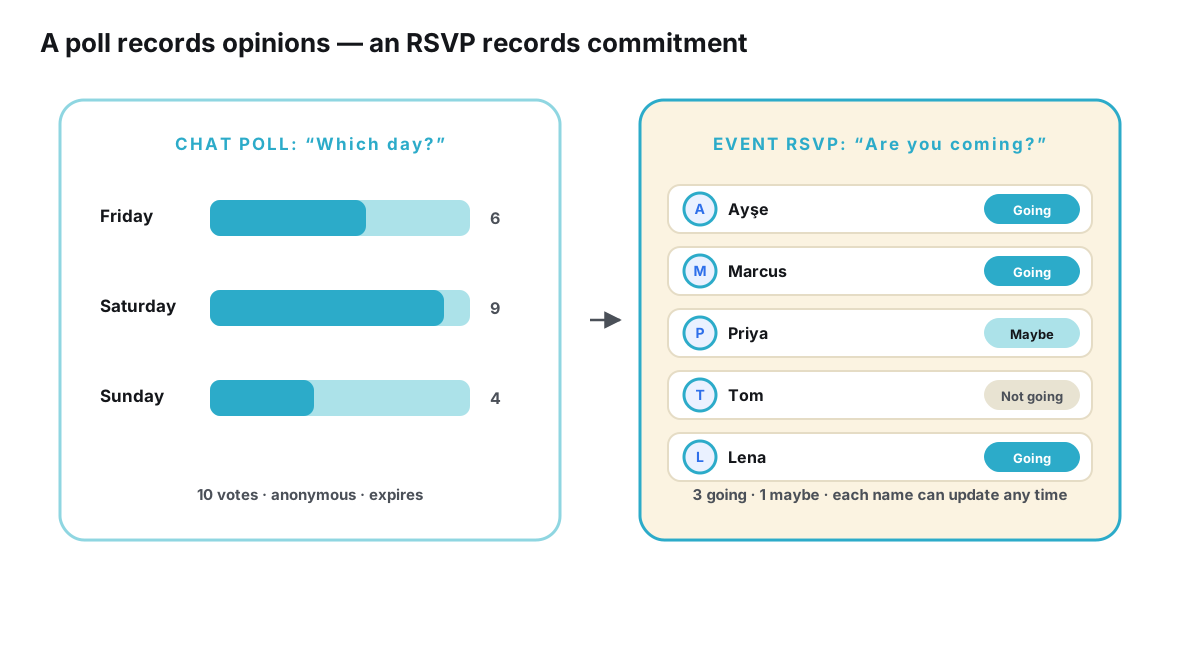
- Poll the options, not the attendance. Ask “Saturday or Sunday?” and “bar or arcade?” — questions where a momentary preference is genuinely the right input. Never ask “who’s coming?” as a poll; that question deserves a better instrument.
- Decide from the poll and freeze the facts. The organizer turns the winning options into a concrete event: one date, one start time, one place. Ambiguity ends here — a commitment can’t attach to a moving target.
- Create the record and collect named RSVPs. Put the frozen facts on an event page with a going / maybe / not-going choice per person, and share one link back into the server. This is the object the venue decision will be made against — tools like Ontaym build exactly this layer, with polls for options and RSVP statuses for the event itself.
- Let statuses live until the day. People’s plans change, so the list must change with them — a maybe becomes a going, a going becomes a regret. Every update re-synchronizes the headcount without a single “who’s still in?” message.
- Remind against the record, not the poll. As the date nears, reminders point at the event page. Maybes convert; forgotten yeses resurface; and by event day the organizer holds a list that matches, roughly, the room.
Notice what this pipeline doesn’t do: it never asks the poll to become something it isn’t. The poll does the deciding-before-committing; the RSVP list does the counting-after-deciding; and the gap between the two numbers — which will still exist, because some commitments fail too — is now visible and plannable instead of shocking.
A field guide to signals
Poll votes sit in a whole family of signals a Discord community produces around an event, and organizers routinely misread several of them in both directions. The honest reading of each:
| Signal | What it genuinely tells you | What it doesn’t |
|---|---|---|
| Poll vote for an option | A preference between choices, at the moment the poll was seen | Availability on the chosen date; intention to attend |
| Reaction to the announcement | The announcement was seen and liked by someone | Almost everything else — it’s a social gesture, not a response |
| Event “Interested” marker | Genuine curiosity, and a useful gauge of reach | An RSVP — by design it expresses interest, not commitment |
| Comment “I’ll be there!” | Warmth and present-tense intention | Durability — a reply is a message, not a tracked status |
| RSVP “going” | A named commitment to a concrete date and place | Certainty — life intervenes; expect a fraction to flip |
| RSVP “maybe” | Real interest blocked by an unresolved conflict | Which way it resolves — chase maybes gently near the date |
| Silence | Nothing, reliably | Non-attendance — quiet members regularly appear on the day |
Two rows deserve emphasis. “Interested” markers occupy a specific place in Discord’s design: they let a large community express enthusiasm at scale, which is valuable — but they are expressions of interest rather than RSVPs, and communities that reserve venues against interested counts are repeating Maya’s mistake with better tooling. And silence is not a signal at all: in any community with a large membership, most members never respond to any given event, and some of them come anyway. Announcements reach; commitments count.
Where polls genuinely shine
After all that caution, it’s worth saying plainly: polls are excellent, and a community that runs good polls plans better events. The trick is matching the instrument to the question. Polls answer preference questions brilliantly — date versus date, venue versus venue, pizza versus curry, casual drinks versus board games. They compress a hundred-reply argument about “when works for everyone” into a glanceable tally, they let quiet members participate without posting, and they produce a decision the community feels ownership of because it visibly participated in making it.
Some communities have elevated this into a whole rhythm. Gaming servers poll which tournament to watch at a viewing party; guilds poll raid night; fan servers poll the theme of a meetup. The gaming world, where date-picking and activity-voting are constant operations, has built the most refined version of this two-stage habit — how gaming communities organize real-world meetups is worth reading for exactly that pattern.
The dividing line is simple to state: a poll is the right tool whenever the question is “which?” and the wrong tool whenever the question is “who?”. Which day, which place, which format — poll away. Who will be in the room on the night — that needs a named, persistent, updatable record. Communities that respect the line get the best of both: decisions with momentum behind them, and headcounts they can trust.
How to read your next poll honestly
Before your next event, decide in advance how you’ll read the numbers, because the moment a tally goes big, optimism starts editing judgment. Four rules hold up well:
- Record the question with the answer. “80 yes” means nothing without “to a hypothetical meetup in June.” File the result with its exact wording; future-you will thank present-you.
- Discount for time. The further the poll closes from the event, the softer the number. A vote three weeks out is a weather forecast for enthusiasm, not a booking.
- Stratify by distance. Glance at who voted, if votes are visible, and sort mentally into near-the-venue and everywhere-else. Only the first group is even a candidate for the room.
- Never let the tally touch the venue. The reservation gets the committed list, full stop. The poll informs the format; the RSVPs inform the furniture.
None of this diminishes the poll — it makes the poll trustworthy, by keeping its claims scoped to what it actually measured.
Planning for the drop
Even a well-run pipeline yields a number smaller than the poll promised, and mature organizers plan for that drop rather than fighting it. Book against the named going list, not the tally. Treat maybes as a buffer you can accommodate, not seats you can sell. Keep a small waitlist habit if capacity is tight, so cancellations convert instead of evaporating. And when the room holds fourteen while the poll held eighty, read it correctly: the poll told you your community’s enthusiasm is wide, and the RSVP list told you its availability that night is narrow. Both facts are useful; only one of them reserves tables.
The deeper fix is keeping the two numbers connected through one artifact. When the poll’s outcome, the frozen details, the RSVP list and the reminders all live in one place with one link, the funnel stops leaking between tools — a pattern with benefits far beyond Discord, explained in how to create one source of truth for a group event. The poll still runs where the people are; the commitment still lives where it can be counted; and nothing has to be transcribed by hand at midnight before the booking deadline.
A worked example: the second meetup
Watch what happens when Maya, from the opening of this article, runs her community’s second event with the pipeline in place. She posts a poll, but a different one: “For the June meetup — Saturday the 7th or Sunday the 15th?” A second poll follows on venue, seeded with options by the anchor who knows the neighborhood. Both polls close within three days. The tallies are smaller than her famous first poll — dozens of votes, not eighty — because they ask narrower questions of a narrower group: the members within reach of the venue. That shrinkage isn’t failure; it’s the funnel becoming honest.
She then freezes the winning combination into an event page — date, start time, place, a going / maybe / not-going choice per person — and drops the link into the server with one sentence. The chat does what chat does: jokes, anticipation, side plans. But when someone asks “wait, which bar?”, the answer is a link, and the link is current. Two people flip from going to maybe when a work conflict appears; the headcount on the page simply updates — no drama, no archaeology, no message from Maya required.
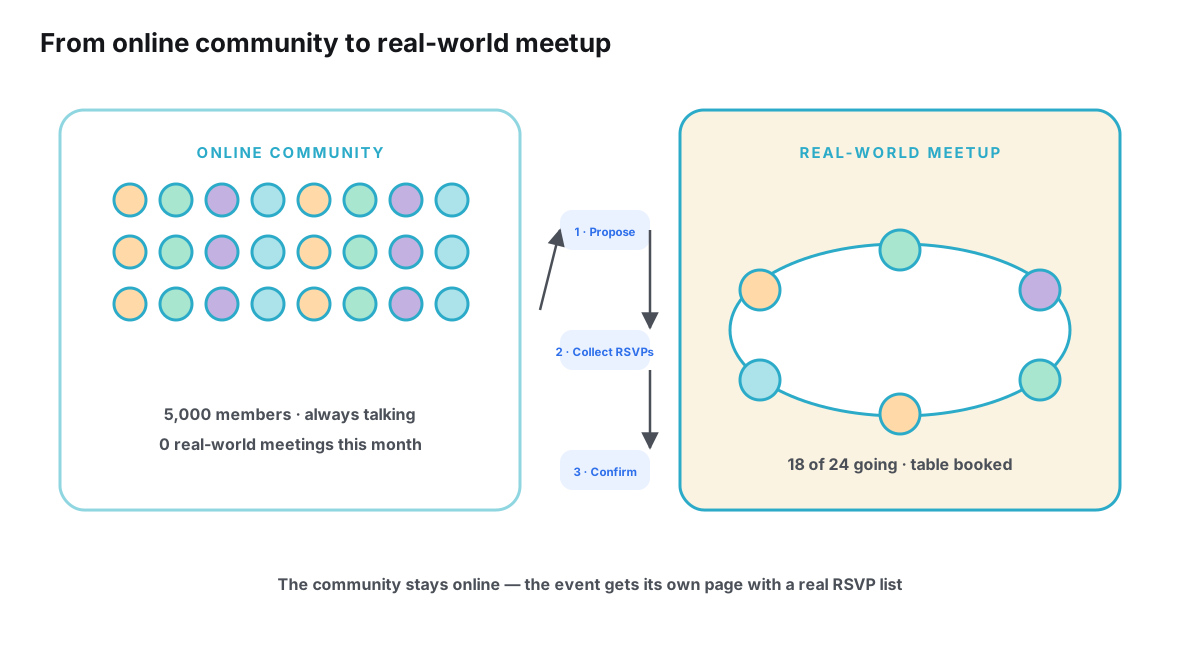
On the night, the room holds roughly what the committed list promised, plus one maybe who decided at the last minute. Maya reserved against eleven names and got a table that fit them, and the gap between the poll and the room hasn’t vanished — it has been measured, respected, and planned around. That is the entire discipline: not a bigger turnout by magic, but a predictable one, built from signals that mean what they claim to mean.
Frequently asked questions
Can I use a Discord poll as an RSVP list if I make votes visible?
It helps a little — visible votes give you names instead of a bare tally — but the other gaps remain: votes bind to the poll’s moment, not the event’s date, and they don’t update when plans change. You’ll know who once leaned yes, not who is coming. Pair the poll with a proper RSVP list for the actual event.
Why does our poll say 80 but only 12 people show up?
Because the poll measured enthusiasm for a hypothetical while it was visible, and attendance depends on availability, memory and energy on one specific night. Voters didn’t lie; the two signals answer different questions. Plan against named commitments and expect the poll to overpredict — that’s its nature, not your community’s failure.
What about Discord’s “Interested” button on server events?
Interested markers are expressions of interest, not RSVPs — they gauge reach and curiosity at scale, which is their purpose. They’re a reasonable proxy for how visible your event is and a poor proxy for how many seats you need. Use them for awareness, and a named going/maybe list for the venue decision.
Should we skip polls and just ask people to reply “coming”?
Reply-based counts have the same weaknesses as polls with extra noise: replies are messages that scroll away, they can’t be updated without new messages, and someone must manually tally them. A poll is actually the better instrument for the preference stage. For the commitment stage, neither works — use a structured RSVP.
How do we convert maybes into going?
Mostly by reducing friction and uncertainty: confirm the concrete details early, keep them at one stable link, and send a friendly nudge a day or two before the event when the unresolved conflict has usually resolved itself. Maybes are interest blocked by logistics; remove the logistics and a share of them always converts.
Do bigger communities have a smaller votes-to-attendance ratio?
Generally yes, and for structural reasons: large servers draw poll responses from a wide, mostly distant membership, while attendance draws from whoever is near the venue. The bigger the server, the more the poll reflects reach and the less it reflects the room. Judge each event by its committed list, never by the tally’s size.
Conclusion
Polls and commitments are two different instruments for two different questions, and the communities that struggle are the ones asking each instrument the other’s question. A Discord poll decides which event: which date, which place, which format — quickly, inclusively, and with real momentum. A named RSVP list decides who will be there, and keeps deciding until the doors open. The poll’s number will always be bigger, and it should be: it’s measuring how wide your community’s enthusiasm is, not how many tables to push together.
Run the pipeline in order — poll the options, freeze the facts, collect named statuses, let them change, remind against the record — and the gap between the two numbers stops being a failure and becomes information. Enthusiasm for the idea, commitment for the night. Every reliably successful community event you’ve ever seen was organized by someone who had quietly learned this distinction; now you can learn it before the venue deposit, instead of after.
Poll the options, then count the commitments — all in one place.
Plan it with Ontaym