
How to Move From Doodle Polls to Complete Event Planning
A scheduling poll answers one question brilliantly: when can people meet? But the date is the first decision of an event, not the last — and everything that happens after the poll closes is where planning usually goes sideways.
Quick answer
A Doodle-style scheduling poll is a focused instrument: it lists date and time options, collects one preference round from each participant, and shows a tally. For choosing among fixed time slots, it works well, and there is often no reason to change anything. The limitation appears after the poll closes: the winning date then has to become an actual event, with a venue, per-person commitments, changes, reminders and late joiners — and a poll holds none of that. The fix is to treat the poll as a stage rather than a system: run the date decision, then move its result into a single event record with RSVP statuses and updatable details, so the plan that follows lives in one place instead of dissolving back into chat.
What scheduling polls get right
Start with the credit that is due. Doodle has been a long-standing scheduling-poll service precisely because the problem it solves is real and stubborn: finding a moment when several busy people are simultaneously free. The mechanism is simple and effective — the organizer proposes candidate dates and times, participants mark which ones work for them, and the tally makes the best option visible without anyone having to broker it by hand. Before such tools existed, this negotiation happened in long reply-all threads where every new constraint reopened the whole question.
The design is honest about its scope. A scheduling poll is about time availability, asked once, aggregated once. It doesn’t pretend to know who will actually show up; it asks only when people could show up. It doesn’t manage a venue or a guest list or a change of plan. Within that boundary, it is one of the more elegant single-purpose tools on the internet, and plenty of meetings are correctly scheduled with one and never need anything else. You can see the current shape of the service at doodle.com.
It is also worth noting that the same basic mechanism now lives inside general chat platforms. Telegram polls can be anonymous or public, with visible votes, and even quiz-style; WhatsApp groups support quick polls of their own. These in-chat versions are more convenient for a group that already lives in one app, though they trade away the standalone poll’s neutral, app-independent page — a trade-off that matters more than it first appears, and one we will return to.
When a poll is genuinely all you need
Not every gathering deserves a workflow. Most of the events in a normal life are small, simple and stable — and for those, a scheduling poll plus a conversation is a perfectly complete system. The mistake to avoid is building infrastructure for a coffee. The mistake to equally avoid is assuming the coffee system scales to a weekend trip.
The dividing line is not the size of the group so much as the shape of what follows the date decision. A quick test, in rough order:
- Is the only open question the date? If the place is fixed, the guest list is known and nothing needs collecting, the poll is answering the whole brief.
- Does anything need to change after the decision? If a switched shift or a sick child will force replanning, you need a record that can absorb the change, not a closed tally.
- Do you need commitments, or just preferences? “Tuesday works for me” and “I’ll be there Tuesday” are different statements; only the second scales into a headcount.
- Will anyone join after the poll closes? Late arrivals need the current plan, which a finished poll no longer represents.
- Will people need reminding? A poll that closed three weeks ago has no relationship to next Thursday.
Three or more “yes” answers to the last four questions, and the poll has become the first stage of something bigger — whether or not anyone has admitted it yet.
| Situation | Poll enough? | Why |
|---|---|---|
| Weekly team stand-up, fixed room, same six people | Yes | The date is the only variable; everything else is stable routine |
| Coffee for three friends on a free afternoon | Yes | No headcount, no logistics, no changes worth managing |
| Dinner needing a restaurant reservation | No | The venue needs a number — preferences must become commitments |
| Weekend trip with travel and shared costs | No | Many decisions follow the date: place, transport, who sleeps where |
| Recurring club night with rotating attendance | No | Every session re-asks the commitment question; polls only answer it once |
| One-off talk with an unknown audience | Partly | A poll suits the internal date decision; the public needs a stable event page |
What actually happens after the poll closes
Here is the pattern almost nobody notices, because it feels like success. The poll closes, Thursday the 17th wins, someone posts “Thursday it is!” into the group chat — and from that moment, the event’s center of gravity silently moves from a structured tool back into an unstructured stream. The poll did its job and stopped. The event kept going.
What follows is familiar. Someone asks which restaurant; a sub-discussion starts and resolves somewhere in the middle of the thread. Two people who voted Thursday discover they can no longer make Thursday; their apologies sit as messages, not as changes to any list. A friend of a friend hears about the dinner and asks what time it starts; the honest answer is buried between a joke and a photo of someone’s dog. The organizer, meanwhile, is trying to turn a two-week-old poll tally into tonight’s booking size — a number that is now wrong in ways nobody can quantify.
The poll didn’t fail. It simply isn’t the kind of object that can hold a plan. It has no place field, no guest list, no notion of commitment, no mechanism for updates, no reminder. When the decision it produced flowed back into chat, the group lost the one structural thing the poll had provided — a single, neutral, current answer to a single question — and gained nothing equivalent for the questions that followed.
The second half of the workflow
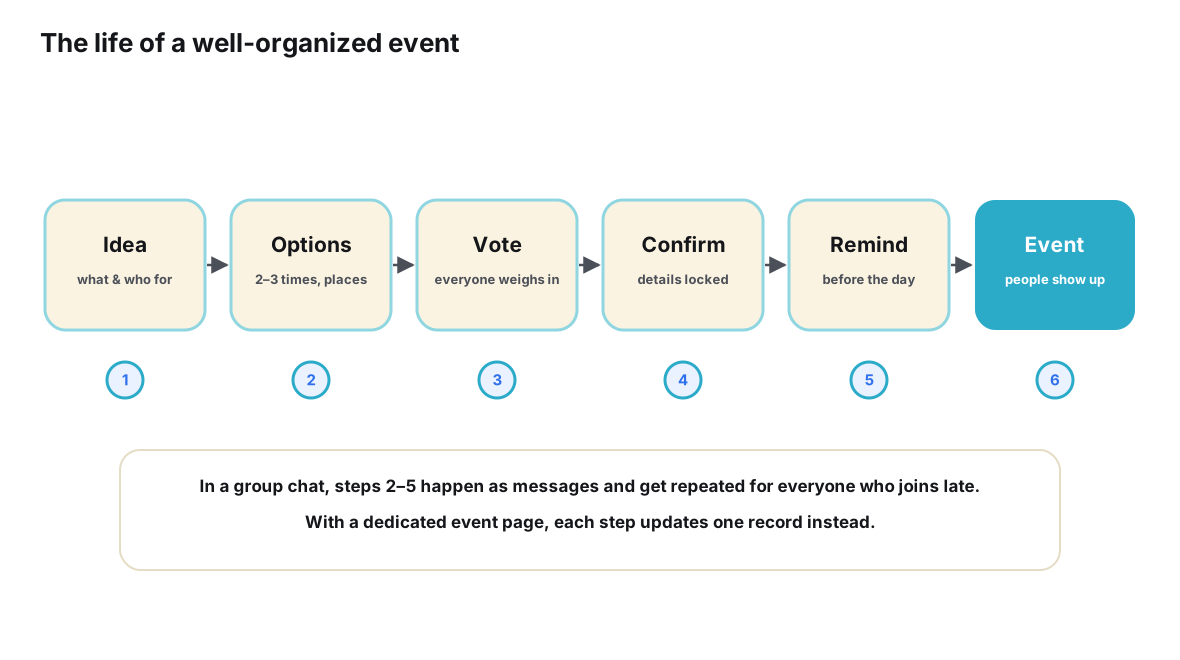
Think of event planning as two halves. The first half is deciding: when, where, what kind of event, what constraints. This half is conversational, exploratory and opinion-rich — it genuinely benefits from polls, debate and back-and-forth. The second half is committing and maintaining: who is coming, what is final, what changed, what happens on the day, who needs reminding. This half is administrative, stateful and repetition-heavy — it is murdered by chat, and no poll even attempts it.
The two halves need different vessels because they produce different things. The first half produces decisions, which are moments; the second half produces state, which is a condition that persists and updates. A scheduling poll is an excellent vessel for one specific decision. An event record — a page with the current facts and each guest’s status — is the vessel for state. Groups get into trouble when they try to serve both halves from one vessel: the poll that gets reopened and edited into an event page it was never shaped to be, or the chat thread asked to remember commitments it structurally cannot hold. This is the same distinction that explains why an event needs its own digital space: state wants a home, not a moment.
None of this requires abandoning polls. It requires sequencing them. The mature pattern — used instinctively by experienced organizers — runs the decision phase with whatever poll mechanism fits, then performs a deliberate handoff: the winning option is written into an event record, and everything after that happens relative to the record. The poll becomes an input; the record becomes the system.
How to move from poll to plan
The handoff is where most groups stumble, so it deserves its own procedure. These steps assume a date poll is running or finished; if your group is starting from raw chat instead, begin with the broader guide to moving from group chats to structured planning and return here once a decision tool is in play.
- Frame the poll as a stage, not the plan. Announce when you open it that the poll picks the date only, and that the full plan will live at a link you will share once the date is settled.
- Close the poll decisively. State the winning option explicitly, thank the participants, and treat the tally as final — a poll left half-open invites relitigating the date for days.
- Create the event record immediately. Set up a single event page carrying the winning date plus everything already known: working venue, rough timing, and any constraints the poll surfaced.
- Collect commitments on the record, not the tally. Ask participants to set their going, maybe or not going status on the event page, because the poll measured availability, not intention.
- Move all follow-up decisions to the record. Venue, start time, what to bring — decide these wherever the discussion naturally happens, then write the outcome into the event page the moment it settles.
- Announce the record as the plan’s address. Post the link once with a clear sentence — “the plan lives here from now on” — and answer every later question in chat by sharing it again.
- Let the record finish the job. Use updates for changes, reminders for the date, and the final guest list for the headcount, so the event ends with an authoritative record rather than an archaeology dig.
The whole sequence takes minutes. Its value is not the mechanical effort but the unbroken chain it creates: every stage of the event — poll, commitments, changes, reminders — hands its output to the next stage through one addressable object, and nothing depends on anyone re-reading a closed poll or scrolling a thread.
Choosing dates without leaving the record
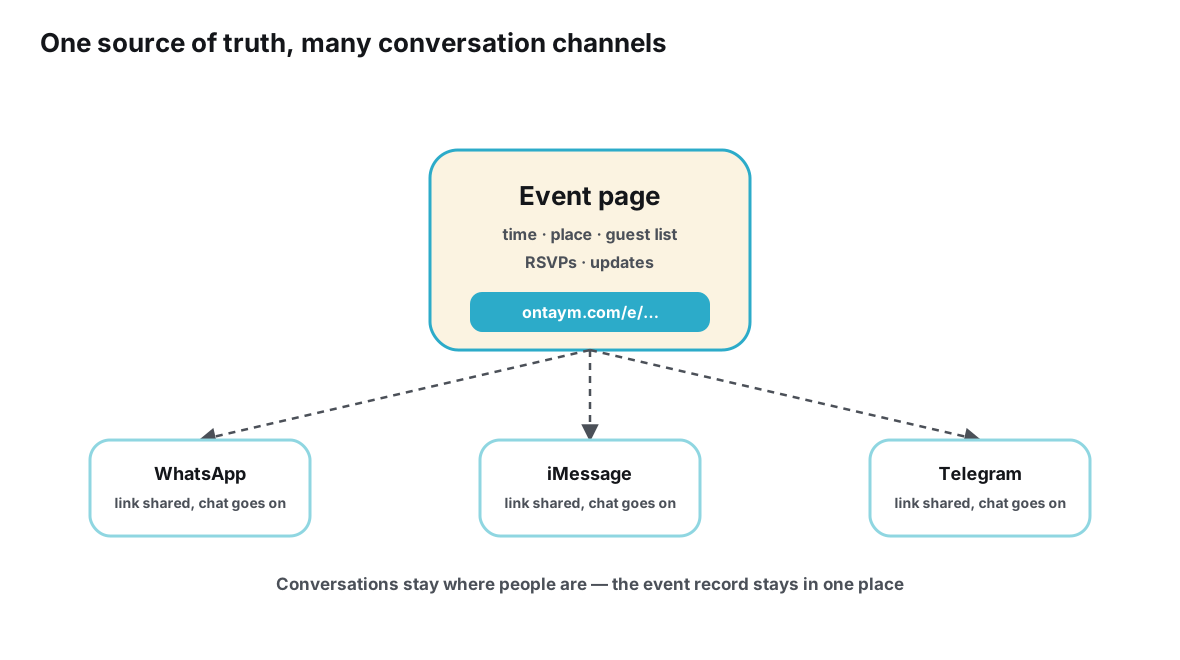
There is a refinement that removes even the handoff. Many event systems include their own option voting: the event page exists from the start with its date marked undecided, candidate options are listed on the page itself, and participants vote on them there. When an option wins, the field flips from “TBD” to the final value — and because the votes were collected on the record rather than in a separate tool, the commitments, updates and reminders were always going to land in the right place.
This collapses two objects into one without losing the poll’s virtue. The exploration phase still happens — people still mark what works for them, and the tally still shows it — but the artifact produced is not an orphan that a human must later transcribe. Ontaym works this way, for example: an event page can hold options that guests vote on, alongside the RSVP statuses, updates and reminders that carry the plan to the day itself. The scheduling-poll idea survives intact; it just stops being a separate destination.
Whether you use a standalone poll plus a handoff, or in-record voting, is mostly a matter of taste and circumstance. The standalone poll remains the natural choice when the participants aren’t yet a group — scheduling across two organizations, or with people who have no reason to share any app — because its neutral page belongs to no one. The in-record version wins when the same people will continue planning together afterward, which, for anything social, is the common case.
| Approach | What it produces | What happens afterward |
|---|---|---|
| Standalone scheduling poll | A tally of availability on a neutral page | A manual handoff: the result must be carried into whatever holds the plan next |
| Poll inside a chat app | A tally inside the group’s existing thread | The result stays in the conversation that produced it, with the thread’s usual decay |
| Option voting on the event record | A decided field on a living page | Nothing to hand off — commitments, updates and reminders already live there |
The chat-app poll deserves one honest note: it is the most convenient of the three in the moment, and the least durable afterward. Telegram’s documentation of its own group features, at the Telegram FAQ, and WhatsApp’s guidance in the WhatsApp Help Center, both describe polls as features of conversations — which is exactly right, and exactly why a closed poll in a busy thread behaves like every other message: it ages, it scrolls, and it answers nobody’s question three weeks later. A poll inside a chat is a fine way to sense the room; it is a poor place to store the room’s decision.
Keeping the conversation in the loop
Nothing in this migration asks anyone to stop chatting. The discussion that surrounds a date poll — the jokes, the veto over the Thai place, the negotiation about ending early — is the social texture that makes group events worth having, and it belongs in whatever messaging app the group already uses. The record is not a replacement for that conversation; it is its anchor. The practical mechanics of running the two side by side — which discussions stay in chat, what moves to the record, how to keep the link alive without nagging — are laid out in how to combine chat apps with dedicated event tools, and the specific pairing of conversation in your messenger with coordination on the event page is developed in using messaging apps for conversation and Ontaym for coordination.
The short version: chat decides, the record remembers. As long as every settled question ends up written on the event page within a minute of being settled, the conversation can rage freely in any number of threads, and the plan will still be one tap away for everyone — including the person who joins the group the night before and has read none of it.
Frequently asked questions
Is there something wrong with using Doodle for events?
No — Doodle does exactly what it is designed to do: date and time polls, run cleanly on a neutral page. The difficulty is not the tool but the expectation that its output is an event. It isn’t; it’s a tally. Groups get into trouble not by using scheduling polls, but by having nowhere for the result to go once the poll closes.
Can I just edit my poll into the full event plan?
You can stretch a poll only so far. It has no place field, no per-person commitment, no update mechanism and no reminders — the things an event needs after its date exists. Editing options and re-sending links turns the poll into a creaking substitute for a record. Create the record and let the poll retire with honor.
What if people voted for a date but haven’t confirmed they’re coming?
That gap is the heart of the issue: availability is not attendance. Some who voted yes will drop out; some silent readers will show up. Ask for explicit going or maybe statuses on the event record, and treat that list — not the poll tally — as your headcount from then on.
Should the poll and the event be in the same app as the group chat?
Convenience favors in-chat polls; durability favors a standalone or event-page poll whose link can travel. If your group lives in one app and the event is simple, the in-chat poll is fine. If the plan will change, attract late joiners or span more than one app, keep the decision on a page that belongs to the event rather than to one thread.
Do I need this for small gatherings too?
For a coffee among three friends, no — a poll and a couple of messages is the correct amount of process. The record earns its place when the event needs a headcount, will change after the date is set, or will outlive the conversation that created it. Small plans can skip the machinery; medium plans are exactly the ones that suffer without it.
What if the winning date changes after everything is set?
This is precisely what the record is for. Update the event page, and everyone who has the link sees the new date — including people who never see the chat message announcing it. A poll cannot represent a changed answer; a record exists to. If replanning becomes routine, reopen options as a fresh vote on the record rather than relitigating in the thread.
Conclusion
Scheduling polls solve the first hard problem of group planning — finding a shared moment — and they solve it well. What they don’t do, and were never meant to do, is carry an event through the long second act: commitments, venues, changes, reminders and the final count. When the poll closes and its result flows back into chat, the group trades a structured answer for an unstructured memory, and pays for it in repeated questions and unreliable numbers.
The upgrade is a change of role, not of tools. Run the poll — standalone, in-chat, or as option voting on the event page — and then hand its result to a single event record with RSVP statuses, updatable details and reminders, declared once as the plan’s only address. The poll becomes the first stage of a complete workflow instead of a dead end. Groups that make this shift keep everything they liked about polls and lose the part nobody liked: the quiet collapse into “wait, which day did we pick?” three weeks after everyone stopped being sure.
Let the poll pick the date — give the plan one address.
Plan it with Ontaym