
Why Emoji Reactions Don't Make Good Attendance Records
Posting “who's in?” and counting the checkmarks feels like keeping a list. It isn't — it's keeping a feeling. This article is about the three properties an attendance record genuinely needs, why reactions have none of them, and what groups can do instead without giving up the warmth reactions are actually good at.
Quick answer
Emoji reactions fail as attendance records for three structural reasons. First, no identity binding over time: a reaction attaches a person to a message at a moment, not to an event across its life — when the plan changes, the reaction keeps asserting the old world. Second, no update path: there is no graceful way to change a reaction-answer, so people leave stale yeses in place and communicate changes elsewhere, leaving the record wrong. Third, no headcount semantics: reactions can't be aggregated — the same emoji carries different meanings, the same person reacts to multiple messages, and considered noes are inexpressible. An attendance record needs a named person, an event, a status from a small set, a current-answer rule, and aggregation. Reactions offer none of these; RSVP mechanisms exist because they offer all of them.
How the reaction became a headcount
Nobody chooses reaction-based attendance tracking; they default into it. The sequence is nearly universal. A plan gets proposed in the group chat. The organizer, wary of fifty reply-all messages, posts the classic workaround: “react 👍 if you're coming.” It works beautifully — better, in the first hour, than anything else could. The thread stays quiet, the tapping is fun, and a little row of checkmarks or hearts accumulates under the message like a guest list forming itself.
The success is real, and it's important to say so. For same-evening plans among a tight group, reaction counting is a genuinely effective coordination hack — everyone relevant is in the chat, nothing has time to change, and the count fits in everyone's head. The trap is that the hack works just well enough to get adopted for plans two weeks out, for groups of thirty, for events with bookings attached. The conditions that made it harmless disappear, and the mechanism stays, now quietly lying to whoever relies on it.
What makes the lie durable is that the record looks authoritative. A message with fourteen checkmarks has the visual grammar of data — names attached to marks, marks attached to a question. It photographs well; organizers screenshot it as their list. But the appearance of structure isn't structure, and the gap between the two has a habit of surfacing on the night, at the door, in front of the venue. Understanding exactly what's missing turns that surprise back into a predictable, avoidable failure.
What an attendance record actually has to hold
Before criticizing the reaction, it's only fair to define the job. Strip planning down to its essentials and an attendance record is a small, precise structure. It binds a person — a known identity the organizer can act on — to an event — a specific occasion, not a message about it — through a status drawn from a controlled set: going, maybe, not going. The record holds the person's current status, replacing earlier ones as they change, and it exists to be aggregated: counted, listed, split into firm and soft.
Each element earns its place through a failure it prevents. Identity prevents the anonymous blur where twelve yeses might be eleven people. Event binding prevents answers leaking across occasions or dying with a message. A controlled status set prevents the interpretive free-for-all of open-ended gestures. The current-answer rule prevents contradictory answers from coexisting. Aggregation prevents the organizer from becoming a human spreadsheet, re-tabulating by scroll every time the question “how many?” comes up.
This structure isn't exotic. It's what any competent RSVP system holds, and it's even formalized on the open web: schema.org, the shared vocabulary that search engines read, models the RSVP as its own type — RsvpAction — with an agent, an event and a response status, as documented at schema.org/RsvpAction. The model exists because the requirements are real. Set the reaction against those requirements and the mismatches line up one by one.
| Requirement | Why the record needs it | What a reaction offers |
|---|---|---|
| Bound to a person | Names drive follow-up, seating, billing, outreach | An account tapped something, once, at some moment |
| Bound to the event | Answers must survive plan changes and follow the occasion | Bound to one message, which may describe a superseded plan |
| Controlled status set | Going / maybe / no are countable categories | Open-ended emoji with personal, shifting meanings |
| Current-answer rule | One status per person, replacing earlier ones | No replacement: old reactions persist next to new ones |
| Update path | Plans change; the record must change with them | Only removal, which is invisible and communicates nothing |
| Aggregation | The consumer of the record is a headcount | Gestures scattered across messages; no sum exists |
| Visible expiry or freshness | Stale answers must be distinguishable from firm ones | A three-week-old checkmark looks identical to a fresh one |
The identity problem: bound to the wrong moment
The reaction's deepest defect is what it binds to. Attendance is a relationship between a person and an event, expected to hold over time. A reaction is a relationship between a person and a message, accurate only at its instant. The instant passes; the event doesn't. Every downstream failure is some version of that mismatch compounding.
Watch it happen. Monday: Maya posts “house dinner on the 14th — 👍 if in.” Fourteen people react. Wednesday: the date slips to the 15th; a new message announces it, and it gathers its own reactions — different ones, from an overlapping but not identical set. The 15th then gets reconfirmed, questioned, and finally locked, each message collecting gestures. Somewhere in the middle, Tom reacts 👍 on Monday's message and never reads anything after it, while Priya reacts on the final message only. Whose 👍 means attending? The question has no answer, because the checkmarks are pinned to six different claims about the world, most of them expired.
The identity problem has a quieter dimension too: reactions don't survive identity drift. People change profile photos and display names; guests share devices; someone reacts from a partner's phone. The organizer scanning the checkmarks performs person recognition on tiny avatars — a human doing optical character recognition on a database that was never written down. It works until it doesn't, and the failures land as double-counts and phantoms in the reservation.
The update problem: no graceful way to change your mind
Plans change constantly — that is the normal condition of planning, not its failure mode. So the truest test of an attendance mechanism is not how it collects first answers but how it handles second ones. The reaction has no second answer. Consider the options available to someone whose Wednesday got away from them.
They can remove their reaction. Almost nobody notices a vanished checkmark, so the organizer's list silently stays wrong while the guest believes they've communicated. They can leave the stale reaction and add a different emoji elsewhere — a 🙏 on the “can't make it, sorry all” message from someone else — creating a scatter of gestures that must be interpreted as a set. They can type a correction, which works socially but lands as a new message in the stream, superseding the old one only for whoever reads both, in order, with attention. Every path either fails to communicate or fails to persist.
Compare that with the same act against a real record: change status from going to not going. The update replaces the old answer, adjusts the headcount everywhere at once, and needs no performance. The difference matters because it changes behavior at the population level. Where changing an answer is graceful, people do it early and honestly; where it's awkward, they postpone it, soften it, and finally let silence do the work. The mechanism doesn't just fail to record change — it discourages the change from being declared at all. That feedback loop, and what it does to data quality, is the subject of what happens when someone changes their RSVP.
The aggregation problem: gestures cannot be summed
Suppose the organizer survives identity and update intact and now simply wants a number. The reaction record cannot produce one, for four stacking reasons.
Polysemy. The same 👍 means “coming,” “seen,” “sounds nice,” “solidarity,” or “I read this on a bus and my thumb slipped.” No shared contract fixes the meaning, and meanings drift by person and by week. Duplication. One human can react to the invite, the update, the re-confirmation and the “final numbers!” message — four gestures, one potential guest, no dedupe. Dispersion. The relevant signals are distributed across messages that no tool can query, because chat platforms don't expose reactions as data to the group. Missing negatives. A reaction cannot state a considered no, so the deliberately absent are indistinguishable from the never-informed.
The consequence is that the headcount is not computed but judged. Someone — the organizer — reads the thread, applies personal knowledge of which thumbs are serious, discounts the habitual reactors, remembers who said what in a side conversation, and emits a number with a confidence interval they can't articulate. It is exactly the work a record exists to eliminate, performed in the worst possible environment: from memory, against a scrollback, under time pressure.

The polysemy problem in practice
It's worth dwelling on emoji ambiguity, because it's the failure organizers understand least. Reaction vocabularies weren't designed as answer sets; they were designed as emotional shading. The checkmark means correctness or completion. The heart means love or, on many threads, “thanks.” The raised hand can mean hello, volunteering, or me-too. Fire means the plan is exciting, not that the reactor will attend it. When an organizer posts “react with ✅ for coming,” they are trying to overload an expressive channel with semantics it doesn't carry — and the group half-complies, each member applying their own private gloss.
Groups attempt to fix this by convention: “✅ means yes, ❌ means no, 🤔 means maybe.” The convention works while the group is small, the thread is short, and everyone was present for its invention. It fails on contact with growth: new members never learned it, old members forget it, and every plan-change message introduces ambiguity about whether the old marks still apply. Conventions are documentation that lives in nobody's head, enforced by nobody, on a channel that keeps generating new contexts. A status field is a convention enforced by the system instead of by memory — that's the entire difference.
The platforms themselves are candid that reactions are social, not semantic. Apple's Messages supports reactions as a quick response to a specific message, documented through Apple Support; Messenger's reactions are described in the Messenger Help Center as expressive responses; GroupMe's likes and polls, per groupme.com, are lightweight group features. Nowhere is a reaction framed as a commitment — the framing is imported by organizers out of necessity, not by the tools out of design.
The failure modes, catalogued
Between the three missing properties and human nature, a small set of recurring failure modes accounts for most reaction-counting disasters. They're worth naming, because each one feels like a unique betrayal when it happens and is in fact a predictable output of the mechanism.
| Scenario | The record shows | The reality |
|---|---|---|
| Enthusiast reacts ✅ to three related messages | Three yeses, counted by a nervous organizer as one-or-three | One person, genuinely intending at reaction time |
| Guest's plans collapse; they remove their ✅ quietly | Nothing — the removal went unnoticed | A confirmed no, communicated to nobody |
| Plan changes date; new message gathers new reactions | Two generations of checkmarks, both still visible | Only the second generation means anything |
| Guest reacts ❤️ meaning “lovely idea” | Counted as attending by the glossary | No attendance intent whatsoever |
| Guest checks calendar, firmly can't come, says nothing | Absence — filed with the people who never saw the message | A considered no, which is useful planning data, discarded |
| Guest joins the group a week later | No trace; the poll-equivalent is history | A potential attendee with no way to matter |
| Organizer screenshots the marks as the final list | An authoritative-looking artifact | A frozen slice of one moment, mislabeled as current state |
The last row deserves special suspicion, because the screenshot is where the pretense hardens. A screenshot of reactions is a copy of history pasted back into the stream — a medium struggling to do a record's job. It cannot update when the underlying truth does; it just adds one more stale artifact for future readers to weigh against other stale artifacts. Groups that run on screenshots aren't keeping a list; they're keeping a museum.
Scale turns a quirk into a system failure
All of these failure modes are tolerable at small scale, which is exactly why the habit survives. With six close friends planning something two days out, the organizer's memory patches every hole: they know whose thumbs are serious, they'll hear about Tom's schedule change by word of mouth, and a miscount costs one spare chair. The reaction record is wrong at this scale too — it's just wrong cheaply, and social bandwidth absorbs the error.
Each step up in scale removes a patch. At twenty participants, the organizer no longer knows every reactor's tendencies, so polysemy goes uncorrected. At fifty, plan changes stop reaching everyone who reacted, so stale yeses accumulate faster than they're discovered. At the scale of large communities — group chats that can run to hundreds of members on most major platforms — the reaction row stops being a list at all and becomes ambient noise: strangers tapping at an announcement they may never revisit. The error doesn't grow linearly with the group; it compounds, because bigger groups also mean more messages, more plan changes, and more turnover among the people holding the gestures.
Meanwhile, the cost of being wrong grows in the opposite direction from the organizer's ability to absorb it. The spare chair becomes a guaranteed minimum spend, a coach booking, a tournament bracket, a class-size decision. Somewhere in that growth the reaction record crosses from harmless convention to institutional liability — and because the crossing is gradual, no one ever announces it. Groups wake up at the far side wondering why their events chronically underdeliver against their checkmarks, blaming flakes instead of the mechanism that trained them to expect a fiction. The mechanism, not the people, is the thing that scaled badly.
Where reactions genuinely belong
None of this is a brief against the reaction itself, which remains one of the best interface inventions of the chat era — for its actual job. Reactions excel at acknowledgment at scale: the organizer learns the message landed without forty replies. They excel at warmth: a row of hearts under good news is social glue that no status field replicates. They excel at low-stakes sentiment: “👍 if you saw this” is a perfectly functioning use of the mechanism. And they excel at pace — reaction density tells you the group's energy in a way attendance data never could.
The division of labor is clean once stated: reactions carry feeling about messages; records carry facts about events. A healthy group uses both, and the presence of one doesn't undermine the other. What breaks coordination is only ever the substitution — asking the feeling-channel to carry facts. Keep the 👍 row on the announcement for morale, and let the going/maybe/not-going list live where it can hold its meaning for more than a day.
Moving from reactions to records
Transitioning a group off reaction-counting is a small change with an outsized payoff, and it can be done without a single awkward conversation. The pattern that works is to give the answers a better home and let behavior follow the home.
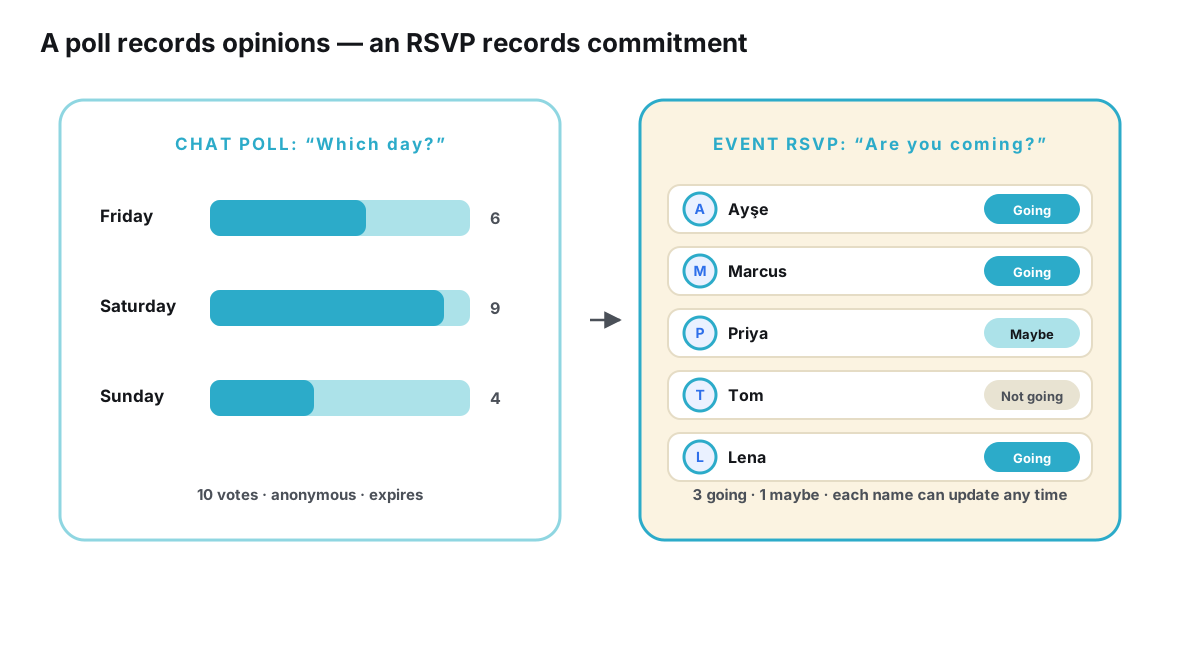
Start by standing up the event as a record — a page with the plan's current facts and a proper going/maybe/not-going mechanic, reachable by a single link. Ontaym was built around exactly this shape — event pages with RSVP statuses, updates and reminders behind one shareable link per event — but any tool that binds named answers to a persistent event will do. Then post the link once, with one sentence: “answers live here from now on — react all you like, but tap your status on the page.” The reaction row stays for warmth; the count moves somewhere countable.
Expect a transition period in which both systems run. Some guests will still ✅ the link message; the organizer's job is to answer every such gesture the same way — “marked you on the event!” — until the group's reflex re-forms around the record. This takes about two events. From the third onward, the organizer stops reconciling gestures and starts reading a list, and the question “who's actually coming?” gets an answer that survives contact with Thursday.
Two more habits consolidate the gain. First, put the freshness back in the system: use the record's reminders to re-confirm as the date approaches, so staleness gets corrected on a schedule rather than discovered at the door — the mechanics of which we cover in how event reminders differ from chat notifications. Second, treat the record, never the thread, as the authority when the two disagree; every exception teaches the group that the thread is still countable, and the migration resets to zero.
Frequently asked questions
Why do reaction counts feel so accurate early on?
Because early is when they are accurate. In the first hours after an announcement, the people reacting are present, engaged, and answering the exact question asked, and nothing has had time to change. The failure arrives with time, plan changes, and group scale — each of which widens the gap between the gesture's moment and the event's moment. A mechanism being right at hour one and wrong at week two is precisely why it can't be a record.
Can't we just agree on emoji meanings — ✅ for yes, ❌ for no?
Conventions work in small, stable, attentive groups and decay everywhere else. New members never learned the glossary; the glossary's inventors forget it; and every plan change re-opens the question of whether old marks still count. A convention enforced by memory is doing a system's job without a system. Status fields exist so the enforcement doesn't depend on anyone remembering.
What's the single biggest problem — identity, updates, or aggregation?
Updates, narrowly. The other two corrupt the count, but the missing update path corrupts the people: when changing an answer is awkward, guests stop declaring changes, and the organizer plans against a number that's quietly rotting. Aggregation failures can be survived with effort; a mechanism that discourages honest updates produces data that no effort fixes.
Isn't a reaction at least better than no answer at all?
As a signal of engagement, yes — and organizers should read reactions as engagement, warmly. As attendance data, a reaction is worse than nothing, because it feels like data. Silence is honestly ambiguous; a checkmark is a false precision. Reading reactions as “the group saw this and likes it” is exactly right. Reading them as “these people are coming” is where the damage starts.
Does this apply to polls too, or just reactions?
Both, differently. A poll adds structure — discrete options, one place to answer — which improves on free reactions, but it still lives in the chat, measures preference at a moment, and has no per-person current answer. The full comparison lives in event RSVP vs group chat reaction, and the deeper architecture behind all of these failures — streams versus records — is covered in why messaging apps were never designed to be event databases.
What should we do tonight, before any tooling changes?
Three habits help immediately. Ask closed questions with a deadline — “going, maybe, or out by Wednesday” — so answers arrive as words with meanings. Keep the interim list outside the thread, in one named place, so there's a single current version rather than a scrollback. And re-confirm once, close to the date, treating silence on re-confirmation as a no rather than a yes. None of it replaces a record, but all of it reduces how much the record's absence costs.
Conclusion
Emoji reactions fail as attendance records not because they're poorly made but because they're made for something else. They carry feeling between people at the speed of conversation, and they're superb at it. Attendance, by contrast, needs identity held over time, answers that can change gracefully, and statuses that sum — the three properties a reaction structurally lacks and an RSVP record structurally has.
The workable arrangement keeps both. Let the chat bristle with hearts and checkmarks — it means the group is alive and the message landed. Put the answers on the event, where each person holds one current status, changes cost nothing and show up everywhere, and the headcount is a fact rather than a guess. Groups that make this split discover that their attendance problems were never really about flaky friends; they were about asking a gesture to do a record's job, and being surprised each time it declined.
Keep the hearts in the chat — keep the headcount on the event.
Plan it with Ontaym