
How to Keep an Event Organized Across WhatsApp, Telegram and Discord
Your family lives on WhatsApp, your university friends scatter across Telegram, and your gaming crew calls a Discord server home. One event, three apps — here is the workflow that keeps the plan whole without asking anyone to switch.
Quick answer
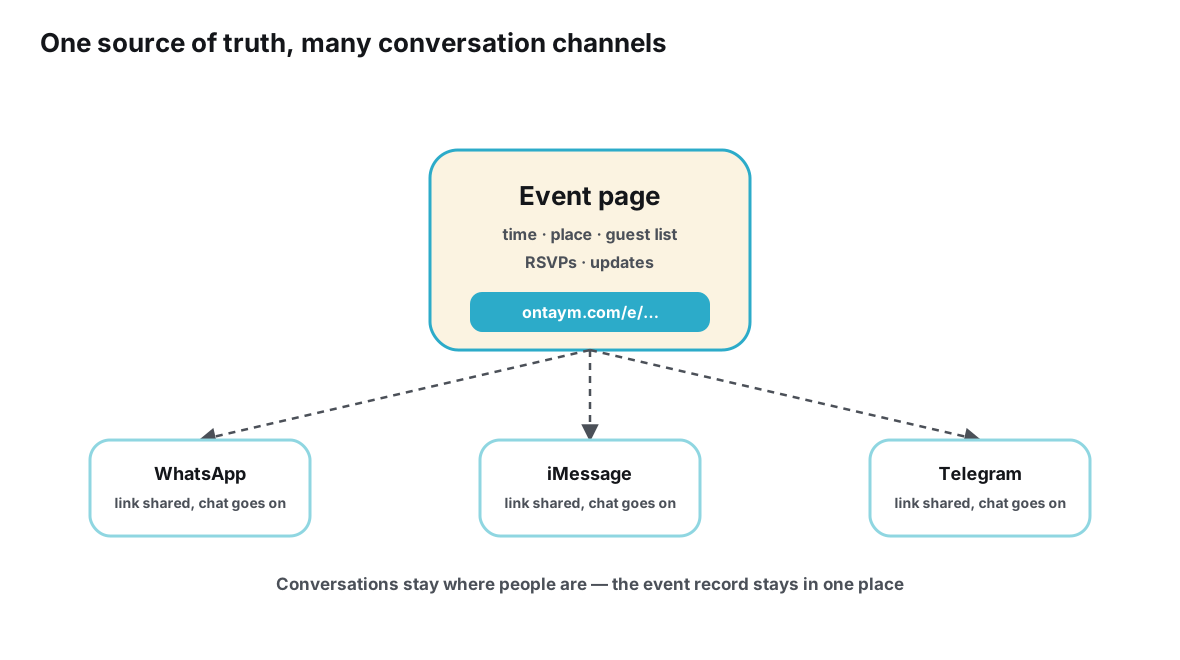
To keep one event organized across WhatsApp, Telegram and Discord, give each app a lane and give the event itself neutral ground. Create one browser-based event page — a single link that opens anywhere — and make it the only home for time, place and RSVPs. Then assign roles: WhatsApp serves your local circle, Telegram the friends abroad, Discord the server’s announcement channel, and each lane’s job is to point at the page, never to hold the facts. Pin the link in all three apps, collect responses only on the page, and when something changes, edit the page first and post a one-line notice per app. The three apps keep doing what they are good at — hosting three conversations — while the plan itself never splits.
The scenario: one event, three habitats
Consider a birthday weekend for Tom, turning thirty. His family and his hometown friends are firmly on WhatsApp — that is where his mother, his cousins and the school crowd all live. His university friends are spread across three countries, and somewhere along the way their group chat migrated to Telegram, where half of them prefer it for its flexibility. And then there is the gaming community: Tom helps moderate a Discord server, and several of its members are genuinely close friends he wants at the party — but they exist, socially, inside that server.
No single app can hold this guest list. WhatsApp excludes the friends who deleted it; Telegram means nothing to the cousins; the Discord server is home to only one of the three circles — and asking everyone to converge on any one app would spend goodwill Tom would rather spend on the celebration itself. So the event must live across all three. The only real question is whether it lives across them as one plan or as three drifting fragments.
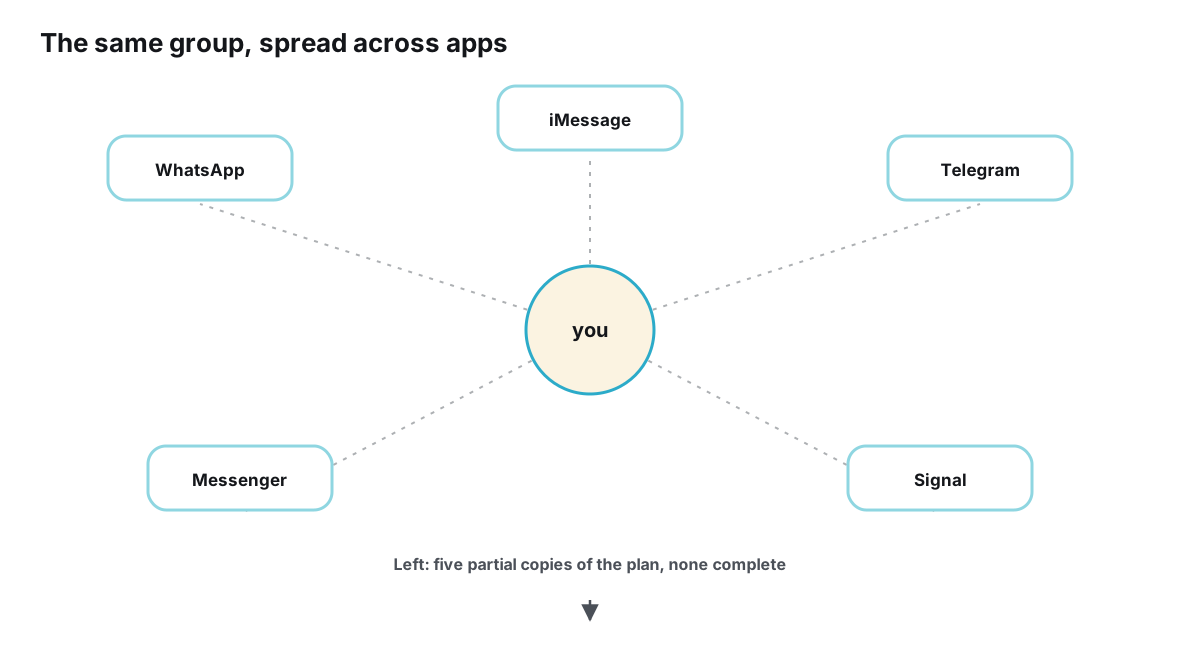
The default outcome is fragmentation, and it arrives without anyone choosing it. The WhatsApp thread decides 7 p.m. because that suits the family. A Telegram poll votes for Saturday while the WhatsApp group had quietly assumed Sunday. A well-meaning server member creates a Discord event with a placeholder time copied from a message two weeks old. Each app’s tools worked exactly as designed — and the result is three mini-events wearing the same name, with Tom as the sole, exhausted point of reconciliation.
The three tempting shortcuts, and why they fail
Before the working pattern, it is worth clearing away the three shortcuts groups reach for first, because each is reasonable and each fails in a characteristic way.
Standardize. Pick one app — usually the one with the largest faction — and ask everyone else to move. For Tom this means the cousins join Telegram, the gamers install WhatsApp and share their numbers, or the family learns Discord. Each transfer succeeds or fails guest by guest, invisibly; the friend who doesn’t install anything doesn’t announce their absence. Standardization converts a coordination problem into a persuasion campaign, and the campaign’s casualties are precisely the guests on the edge of coming.
Relay. Keep the plan in one app and let the organizer carry it to the others, pasting summaries and screenshots. This works for a week and then quietly consumes the organizer. Every change fans out by hand; every question from a minority-circle guest arrives without context; the screenshots age badly. Relay puts a human being in the position of a sync service — one that tires, typos and goes on holiday.
Duplicate. Build the same event natively in all three apps — a WhatsApp poll, a Telegram event discussion, a Discord server event — and try to keep them aligned. Now there is no persuasion and no human sync engine, but there are three sources of truth and no mechanism for keeping them equal. The first change that only gets posted to two of the three starts the countdown to somebody’s Saturday going wrong.
What the shortcuts share is an attempt to solve the problem inside the apps. The working pattern moves the plan to ground that all three apps can already reach, and lets each app do only what it is uniquely good at.
What each app actually gives you — and where it stops
The three platforms are genuinely excellent, and it helps to be precise about their strengths, because the workflow leans on each of them honestly. It is their boundaries, not their features, that dictate the architecture.
| Aspect | Telegram | Discord | |
|---|---|---|---|
| Scale of groups | Group chats support up to 1,024 participants; Communities link related groups together | Supergroups support up to 200,000 members | Servers host very large communities, in the hundreds of thousands |
| Event-relevant features | Pinned messages, polls, and Communities announcements that reach all linked groups’ members | Channels for one-to-many broadcast, separate from groups; polls that can be anonymous or show each vote, including quiz-style | Server events with “Interested” markers, roles, threads, bots and polls |
| Identity model | Membership built on phone numbers, as the WhatsApp Help Center documents | Account-based, with flexible usernames | Account plus server membership and roles |
| Where it stops | At the edge of WhatsApp — and at the phone number | At the edge of Telegram | At the edge of the server — and “Interested” is an expression of interest, not an RSVP |
Three observations fall out of this table. First, each app’s event features are real and useful — but they are benefits of membership, so their reach ends at the app’s own border. Second, the identity models differ enough that “just add everyone to one group” is not merely inconvenient but sometimes impossible. Third, and most practically: the signals these apps produce are not equivalent. A Telegram poll vote, a Discord “Interested” click and a WhatsApp reply are three different acts with three different meanings — and none of them is a commitment the organizer can hand to a restaurant. Telegram’s own FAQ and Discord’s support documentation are candid about what polls and interest markers are designed for, and it isn’t headcounting.
This is why the architecture of the workflow is set in advance: facts live on neutral ground that all three apps can reach, and each app contributes what it is uniquely good at — reach into its own circle. The deeper reasons why chat threads can’t hold a plan even within a single app are covered in why messaging apps were never designed to be event databases; what follows is the applied, three-app version.
The workflow: one record, three lanes
- Map who is where before you build anything. Write three lists — the WhatsApp circle, the Telegram circle, the Discord circle — and a fourth for the stragglers reachable only by SMS or email. Note the overlaps (the best man is in all three; he becomes an ally later). The map matters more than any tool choice, because lanes follow people, not apps.
- Create one event page as the shared record. Put the birthday weekend on a browser-based page with its own link: known facts in plain fields, open questions marked as open, and an RSVP list ready to fill. The page belongs to no platform, opens on any phone in any of the three apps, and becomes the single home for everything that must stay true.
- Assign each app a lane and say the split out loud. One sentence per app, posted where that app’s people will see it: “WhatsApp stays for family logistics, Telegram for the long-distance crowd, Discord for the server folks — the actual plan lives at this link for everyone.” Naming the lanes does half the organizational work in ten seconds.
- Post and pin the link in all three apps. In WhatsApp, send it and pin the message. In Telegram, pin it in the group — and if the circle uses a channel for announcements, post it there too. In Discord, put it in the relevant channel and reference it from the server event so anyone checking the event finds the record. A pinned link is a permanent answer to “what’s the plan?” in that app’s own language.
- Collect RSVPs only on the record. Resist the pull to run parallel polls: a Telegram date poll, a Discord poll and a WhatsApp thread will produce three partial results that no one can add up. Use each app’s poll only for lane-local matters (which car leaves from where), and let attendance — the number the venue needs — accumulate once, on the page, as going and maybe statuses.
- Update once, mirror briefly. When the venue confirms or the time shifts, edit the page first. Then drop one line per lane: “Time moved to 8 — page updated.” The chat carries the signal; the page carries the facts; nobody re-types the plan three times.
- Run the day from the page, and close the loop after it. On the morning of the event, re-share the link with a single greeting per lane. When it’s over, the page stands as the record — final headcount, what changed, a place to drop photos — which is exactly what you’ll want when planning the next one.
Notice what the workflow does not ask of anyone. Nobody installs an app, nobody joins a server for the privilege of one invitation, nobody’s phone number travels between circles. Each community keeps its habitat, each habitat keeps its culture, and the plan stays singular anyway. That is the entire point: the event becomes the thing that’s shared, rather than the app being the thing that’s required.
| Question or decision | Right home | Why |
|---|---|---|
| Final date, time and place | The event page | One current version, visible from all three apps, editable in place |
| Who is coming | The event page (RSVP statuses) | Attendance must roll up into one headcount, not three partial ones |
| Date options before the final call | A poll on the page | Everyone votes in the same place, together, whatever app they live in |
| Lane-local logistics (cars, gear, who brings the cake) | That lane’s own chat or poll | Only that circle needs the detail; the record stays clean |
| Banter, jokes, hype | Everywhere | Conversation is what the apps are for — no coordination required |
| Photos and thanks afterwards | Wherever each circle already talks | Post-event life belongs to the communities; the page simply archives the facts |
The table is the protocol in miniature, and it is worth sharing with the group — or at least with the most active member of each lane. When a second person in each app understands where things belong, the protocol stops being the organizer’s private discipline and becomes the group’s habit. Those two or three allies are the highest-leverage hires an organizer never has to pay.
Running the RSVP phase across three audiences
The middle stretch of any plan — between the invitation and the final headcount — is where multi-app events wobble, because it is the stretch with the most waiting involved. The discipline here is to let the page do the waiting. Set an answer-by date on the record so the deadline is a fact rather than a mood. Guests on all three apps see the same deadline; nobody’s part of the group operates on a different calendar than the rest.
Nudge by silence, not by broadcast. The page shows who has answered and who hasn’t; the quiet people get one short, private message — in whichever app they actually use, which is the entire point of the lane map. The people who already answered hear nothing, which preserves their goodwill and, not incidentally, your notification budget. Compare this with the unmanaged default, where an increasingly desperate “please reply!” is fired into all three chats at once and lands hardest on the people who replied first.
Treat maybes with respect rather than pressure. A maybe on the page is a real, recorded signal — visible to the organizer alone or to the group, depending on the tool and the tone of the event — and it can be revisited as details firm up. What matters across three apps is that the maybe lives in one place; a “I’ll try to make it” murmured in a Telegram voice note and remembered by no one is how headcounts quietly lie to restaurants.
Three pitfalls that bite hardest in a three-app setup
Multi-app events fail in patterned ways. The first pitfall is treating weak signals as commitments. A thumbs-up in WhatsApp, a vote in a Telegram poll and a Discord “Interested” marker all feel like yes — but a poll answer is an opinion at a moment in time, and Discord’s marker is, by design, an expression of interest rather than an RSVP. A restaurant asked to hold twenty seats doesn’t care about interest; it cares about attendance. Recording RSVPs as explicit, current statuses on the page is what makes the number real. The distinction runs deeper than etiquette — it is the difference between a conversation and an event object.
The second pitfall is copy drift. The moment the plan is restated in full inside two chats, there are two plans. The WhatsApp restatement says the old venue; the page says the new one; by Saturday, both versions have eyewitnesses. The discipline is ruthless and simple: lanes point, they never restate. A link plus one line is always enough — and when it doesn’t feel like enough, that is precisely when the plan has grown complicated enough to need the page more, not less.
The third pitfall is the guest who is in none of the three. Every mixed event has one: the old friend without WhatsApp, the plus-one who exists only as a phone number, the aunt who reads SMS. The three-app structure has a natural tendency to absorb everyone into one of its lanes — and the person who can’t be absorbed gets forgotten. The neutral link is precisely what rescues them: it travels by text and email just as easily as by chat, and the page doesn’t ask which app they came from.
A fourth, subtler danger deserves a sentence of its own: the organizer’s own gravity. You live in all three apps, so the temptation is to answer questions where they are asked, in full, every time — which recreates the copy-drift problem one helpful reply at a time. The rule of thumb is one line plus the link, every time, even when typing the full answer feels faster. You are not just answering a question; you are teaching dozens of people over multiple apps where answers live. The reply that saves ten seconds today costs a correction in three chats tomorrow.
When the pattern repeats: communities, not just parties
A single event run this way is a convenience. A community that runs every event this way has changed its operating system — and the three-app pattern scales in a specific direction. The gaming server that plans monthly meetups, the diaspora family that gathers each summer, the volunteer group whose members met on Discord but coordinate outings with relatives on WhatsApp: all of them face the same structural fact, that their people are distributed across platforms that will never merge.
At that scale the workflow gets lighter, not heavier. The lanes stabilize, the allies know their jobs, and the organizer’s recurring work collapses to creating each event’s page and posting its link three times. The pattern for building that single record deliberately — field by field, decision by decision — is described in how to create one source of truth for a group event. And the reason this whole space feels unfinished — why three-app groups have always had to improvise — is itself worth understanding: it is the structural gap between messaging apps and event platforms, and it explains why the neutral record keeps winning despite nobody owning it.
On the day itself, the pattern earns its keep one last time. The morning-of message per lane is short — a greeting, the link, and the one thing that matters most (the meeting point, the departure time). Day-of chaos happens at the edges: a delayed train, a lost plus-one, a last-minute venue hiccup. When it does, the edit-once, point-often reflex scales exactly when you have the least patience for it; a quick page edit plus three one-liners beats three paragraphs typed with cold hands at a station platform. After the last guest leaves, the page becomes the archive — the headcount that actually materialized, the changes that mattered, the photo drop — and the seed of the next event’s link.
Frequently asked questions
Should I create a new group in each app just for the event?
Usually not. The existing circles already contain your guests, and three fresh event-groups mean three new channels to moderate alongside the three you already have — six lanes where three existed. The lighter pattern is to use the chats that are already alive, pin the record’s link in each, and let the event ride on existing rails.
Which of the three apps should hold the official plan?
None of them. Holding the plan in WhatsApp loses the Telegram circle, and so on around the triangle — and even inside the winning app, chat threads bury current facts under new messages. The official home should be the one place with no membership requirements: the event page and its link, reachable from all three apps and from SMS or email too.
Can I just run a date poll in each app and combine the results?
You can, but you will combine three partial electorates, each voting on partial information, at different times — and the people in overlapping groups may vote twice. One poll on the shared page lets every guest vote once, together, with the same options in front of them. Use in-app polls for lane-local questions only, where one circle’s answer is genuinely the only one that matters.
What if most guests are on just one of the apps?
Then plan mostly there — majority comfort matters, and a group that is ninety percent WhatsApp should feel WhatsApp-native. The page still earns its place for the exceptions: the friend abroad, the cousin without the app, the guest who shouldn’t have to join a server to see one invitation. The workflow bends; only the record stays central.
How do I keep the pinned link from getting buried in an active server or chat?
Refresh rather than restate. Every week or so, and always after a real change, post the link again with one new line — “venue confirmed, details here” — so the most recent mention is also the most current one. Pinning handles the quiet weeks; the weekly pointer handles the loud ones. What you must never do is paste the full plan into chat to save people a click — that is how copies start drifting.
Isn’t all this structure a bit much for a birthday?
For eight people in one app, yes — plan in the chat and enjoy it. The workflow is sized for exactly the situation where structure is already forced on you: three apps, three audiences, a venue that needs a real number, and guests who joined at different times. In that situation the “structure” is one page, one pinned link per app and one line per update — which is considerably less structure than the chaos it replaces.
Conclusion
WhatsApp, Telegram and Discord are three excellent answers to the same question — where should a community talk? — and none of them will ever be the answer for everyone at your event. Treating any one of them as the plan’s home guarantees that the other two circles live on secondhand information. The three-app pattern accepts the geography and rises above it: each app keeps its people, its culture and its conversation, while the event itself lives at a single neutral address that all three can reach. Nothing is merged, nobody is migrated, and yet the plan is one plan.
The mechanics fit on an index card. Map the circles. Create one page. Assign each app a lane and say so. Pin the link everywhere. Collect RSVPs once. Update once, point often. Let the record outlive the day, so the next event starts from an archive instead of an argument. Groups that adopt it stop asking the unanswerable question — which app should we use? — and start asking the only useful one: where’s the link?
Three apps, three conversations, one link that keeps them honest.
Plan it with Ontaym