
The Problem With Having Event Information Across Multiple Apps
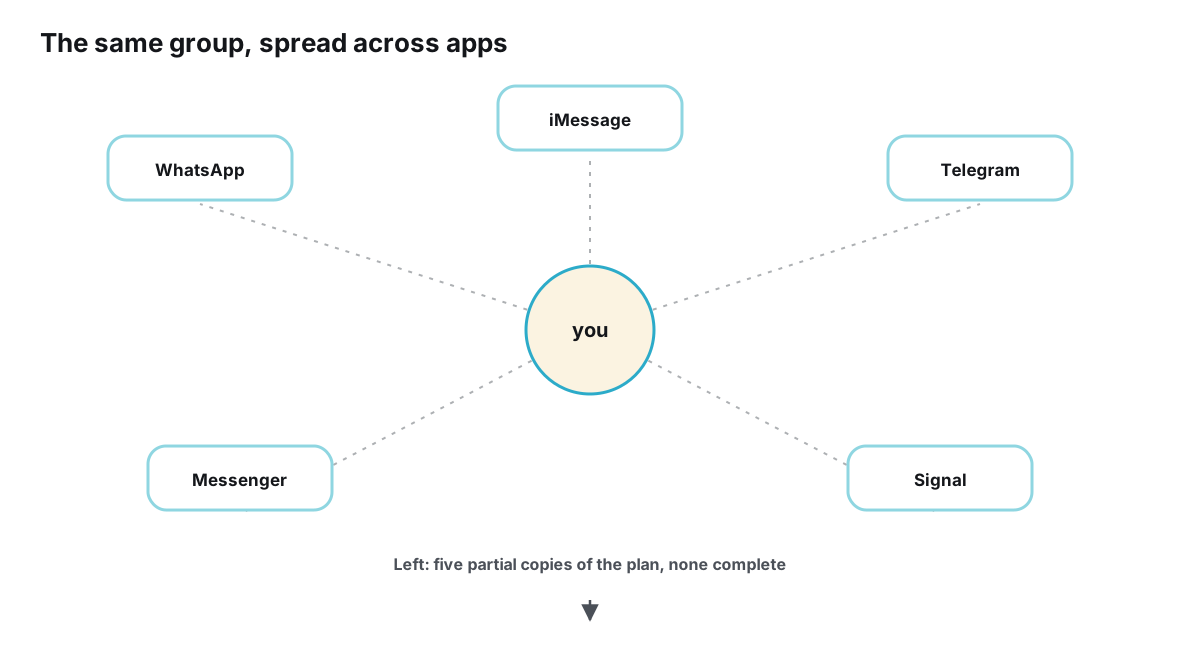
One event, several apps: the WhatsApp group still has the old time, the iMessage thread has the new one, and the direct message where the whole idea started holds the address nobody can find anymore. This is what scattered planning actually costs.
Quick answer
Event information spread across multiple apps degrades in three specific ways. Version drift: each app holds a copy of the plan frozen at the moment it was posted, so when the plan changes, the copies disagree and the disagreement is invisible. Duplicated effort: every update must be manually posted in every channel, and each missed post quietly creates another version. Missing context: decisions get reasoned out in one thread that the other channels never see, so members receive conclusions without the why. The fix is structural rather than disciplinary: stop storing the plan inside conversations and give it one address — a page or link that always shows current state — so every app becomes a transport pointing at the same record instead of a container holding a different copy.
Nobody chooses to spread a plan across apps
If you drew the diagram on purpose, it would look deranged. A birthday dinner with its date debated in one group chat, its venue confirmed in another, its budget discussed in three separate direct messages and its final time captured in a screenshot that has since traveled to two more conversations — no organizer would design that. Yet it is the diagram most real events produce, because every step toward it is locally sensible.
The mechanics of drift are mundane. The plan starts in whichever chat mentioned the idea first. Then a second circle of friends needs to know, and rather than make them join an app they don't use, you summarize. Someone has a constraint they'd rather not announce to twelve people, so it moves to a private message. A friend who isn't in either group asks for details, so you forward what you have. Each action is the polite, considerate move. The aggregate is a plan with no center.
What makes this worth taking seriously is that even single platforms fragment this way. WhatsApp built its Communities feature precisely because organizers were juggling several related groups at once — letting them link groups together and push one announcement to all members. That a messaging company shipped infrastructure for the problem is the clearest evidence that the problem is not your lack of discipline; it is what happens to information when conversations are the only container available. You can read how that grouping works in the WhatsApp Help Center, and you will notice it solves fragmentation between groups on WhatsApp — not between WhatsApp and everything else.
That last point is the crux. A multi-app split cannot be patched from inside any one app, because each app only ever governs its own conversations. The plan, unfortunately, is bigger than all of them.
Version drift: how copies quietly become contradictions
Drift is the quiet one, so it goes first. When information lives in only one place, a change has a simple shape: the thing is updated, and everyone who looks sees the new state. When information lives in five places, a change has a different shape entirely: the thing is updated somewhere, and four copies now assert the old world with full confidence.
The dangerous property of drift is not that copies disagree — it is that the moment of disagreement produces no signal. When the organizer posts the corrected time in the iMessage thread and forgets the WhatsApp group for six hours, nothing crashes, nothing warns, nobody is notified of the inconsistency. The two versions simply coexist, each looking exactly as authoritative as the other, distinguished by nothing except which app you happen to open. Divergence this silent is why plans can fork for days before anyone notices, and why the discovery is usually made by the person who is wrong.
Worse, superseded facts never die in a chat. The message proposing Friday is still there after the plan moved to Saturday, still perfectly readable, still first in search results for anyone who scrolls looking for the date. A thread doesn't replace its past; it accumulates it. So every reader is forced to become a historian, weighing which assertion is current — and every reader performs that archaeology slightly differently, which is how two people can leave the same thread with different plans.
None of this is an accident of behavior; it is a property of the medium. Chat apps record conversations, and a conversation contains statements that were each true when made. For the fuller argument on why that architecture can't hold a plan no matter how carefully you use it, see why messaging apps were never designed to be event databases.
A small illustration makes the invisibility concrete. Suppose the original plan says 8 pm in the WhatsApp group. On Tuesday the organizer moves it to 7:30 in the iMessage thread, where most of the local friends are. On Wednesday, Priya — a WhatsApp member — checks her app, sees 8 pm from Monday, and arranges her evening around it. Nobody lied to her; the 8 pm message is still there, still uncorrected in the only channel she reads. When she arrives at 8 for a 7:30 dinner, the post-mortem will locate the failure in "communication," but the accurate diagnosis is that the plan's state was stored in two places and only one of them was updated. Drift isn't a disagreement between people; it's a disagreement between copies, and the people just inherit it.
The multiplication cost of every single change
Drift describes the state; multiplication describes the labor. In a single-channel plan, announcing a change costs one message. In a plan spread across three channels, the same announcement costs three messages — plus whatever repetition each channel needs for people who missed it the first time, plus the follow-up questions that now arrive in three places, plus the mental overhead of tracking which channel has been told what.
The arithmetic is unkind because events maximize exactly the variables that drive it. More participants means more channels, since big guest lists rarely share one app. More participants also means more changes — dietary needs, plus-ones, schedule conflicts, venue constraints. And time pressure rises as the date approaches, which is precisely when changes are most frequent and most costly to miss. The curve bends the wrong way: the plan is most fragile when updates are most expensive.
Organizers respond to this pressure rationally, and their rational responses damage the plan. Updates get batched, so corrections arrive late. Updates get softened — "probably still 8, will confirm" — because a crisp correction costs three announcements and a hedge costs one. Details get dropped because they seem too minor to justify a broadcast. The information doesn't vanish because people are lazy; it degrades because the system prices precision unaffordably, and everyone, trying to be considerate, negotiates precision downward.
Missing context: decisions made out of earshot
The third cost is subtler than drift or labor, and it corrodes the group rather than the schedule. When decisions are reasoned out in one channel, every other channel receives conclusions without arguments. The WhatsApp half learns that the dinner is at the early seating; they do not learn that it's at the early seating because one member can only do early, the restaurant had nothing later, and someone already put down a deposit. A conclusion without its reasoning reads like an arbitrary decree, and people argue with decrees.
This has a second-order effect that experienced organizers will recognize instantly: re-litigation. Members of channel B, unaware that channel A already debated and rejected an option, raise it again — sometimes with genuine new arguments, more often with the same ones. The organizer must then either reopen a settled question to keep the peace or play the recording of a debate the other half never heard. Either way, work is done twice, and the group develops a vague sense that decisions are shaky even when they aren't.
Late joiners pay the highest context tax of all. A person added in week three inherits fragments from everywhere — a summary here, a screenshot there, a verbal briefing over coffee — with no thread to read even in principle, because the thread that would explain things is split across apps they may not all have. They cannot catch up; they can only be briefed, and briefings are only as current as the briefer.
A map of where your event actually lives
It helps to be concrete about the sprawl. The table below lists the places a single event's information typically ends up, what each one holds, and — the column that matters — how each one ages.
| Location | What it typically holds | Who can see it | How current it stays |
|---|---|---|---|
| Main group chat | The richest record: proposals, decisions, jokes, everything | Members of that one group | Ages with every change; superseded facts stay visible |
| The other group chat | Summaries and copies of the decisions that mattered | Members of the other group | One step behind by default, more when a post is missed |
| Direct messages | The sensitive parts: the surprise, the budget, the conflict being managed | Two people | Never joins the shared record at all |
| Forwarded screenshots | A frozen image of some earlier state of some thread | Whoever received them | Stale from the moment of capture, and unsearchable |
| Personal calendars | The time, as each person understood it at some point | Each individual, privately | Wrong in exactly the same silent way as the copy it came from |
| Verbal agreements | The venue decided at the pub, the favor promised at work | Whoever was in the room | Unverifiable by anyone else, revisable by memory |
Scan the last column and notice the pattern: not one of these locations has any mechanism for staying current. Each is a snapshot or a memory, and the plan's real state is an emergent property of reconciling them all. That reconciliation is a job, and it doesn't appear on any list of jobs — which is the subject of the next section.
The costs nobody budgets for
The most expensive work in scattered planning is invisible because it happens inside one person's head. Before every decision, the organizer performs a diff: what does each channel currently believe, what has changed since, who needs telling, who was told and has forgotten. This reconciliation pass precedes every action, quietly consuming the attention that was supposed to go toward choosing the venue or enjoying the anticipation. It's also strictly manual — there is no tool that can reconcile what only ever existed as separate messages in separate apps.
The second hidden cost is what the role becomes. The organizer of a scattered plan is no longer primarily a host; they are a synchronization service with feelings. They relay questions whose answers exist elsewhere, re-explain decisions to people who missed them, and absorb the blame when a copy goes stale. Groups intuitively sense this and route around it — members stop consulting the channels entirely and ask the organizer privately, which of course creates yet more channels, each with an audience of two.
Then there is the compounding effect on the headcount. Attendance signals arrive in incompatible currencies: a reaction in one app, a verbal yes over lunch, a "should be able to make it" in a thread, and silence everywhere else. Converting that mix into the number the restaurant needs is a research project, and it has to be repeated whenever anything moves — because a guest whose Tuesday fell through may have said yes in a channel the organizer hasn't re-read since. Plans scattered across apps don't just track attendance badly; they track it with a margin of error that grows right up to the door.
The third cost is the ritual that scattered groups will recognize with a wince: the night-before audit. Someone finally asks "so, final details?" in one thread, and the next hour is a group reconstruction of the plan — time confirmed, address re-shared, the drift of three weeks flushed out in one frantic session. The ritual works, barely, which is exactly why the underlying rot persists. A group that can always scramble the night before never fixes the system that makes scrambling necessary, and the one evening the scramble fails — the concert door, the last restaurant seating, the bus that leaves without the half holding the old time — pays for all the times it didn't.
Why the obvious patches don't hold
Every group that suffers scattered planning tries the same set of patches, in roughly the same order. They are worth taking seriously — and worth understanding why each one fails.
| Patch | What it genuinely improves | Why it still breaks |
|---|---|---|
| Pinning the plan in each app | Keeps one visible message at the top of each thread | A pin is a snapshot; after the first change it is stale in every app at once, and two pins can disagree with each other |
| Forwarding the latest version everywhere | Reaches people quickly through a familiar gesture | Creates one more copy per recipient; the new copy is already aging and supersedes nothing it was sent to |
| Telling everyone to check the other group | Costs the organizer nothing | Pushes the entire synchronization burden onto every member, every day, forever — and most members reasonably decline |
| A shared document or note | Creates a single editable copy outside the chats | The link to it gets buried like any message, and a page of prose has no RSVP list, no statuses and no per-person answers |
| A calendar invite from one app | Puts the time on people's calendars and updates it there | Covers the when and nothing else; acceptance is not attendance, and the where, the who and the what-changed still live in the threads |
Look at what the patches have in common: every one of them either freezes information or copies it again. Freezing fails because plans change. Copying fails because copies drift. A fix has to do the one thing none of these can — hold a single, current, shared state — which is a different category of object, not a better-behaved message.
One address, many transports
The structural fix for scattered information is almost anticlimactic: the event gets an address. A page — reachable by a plain link from any app — holds the plan's current state: final time, final place, the guest list with responses, and a short note on anything still open. Every conversation in every app carries the link instead of carrying the facts. The chats become what they should have been all along: places to talk about the event, with a pointer to it.
This single change flips all three failure modes. Drift disappears because there is only one copy, and it is the one everyone reads; a change is an edit to the page, and no other version exists to contradict it. Multiplication disappears because an update is posted zero times — it is applied once, at the address, and every future visit from any app sees it. Context improves because the page can carry a line of reasoning with each decision, visible to all halves equally rather than argued in one thread and summarized to the rest.
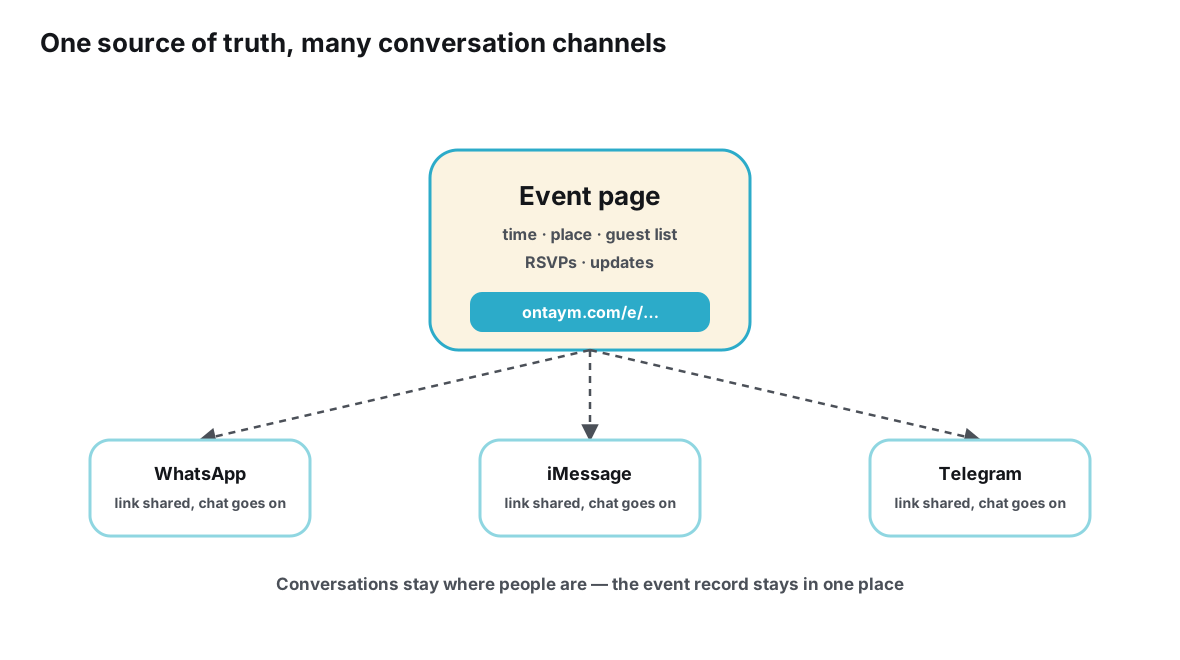
The link itself is doing quiet, essential work. A link is a reference, not a copy — opening it resolves to the current state, today and next week, from WhatsApp on an Android phone or iMessage on an iPhone with equal indifference. That behavior is precisely what a forwarded message cannot offer, and the difference between the two gestures — sending a reference versus sending a frozen copy — is argued in detail in why event links beat forwarding messages. Even the vocabulary of the wider web agrees that an event is an addressable thing with properties, which is why structured event data exists as a standard type at schema.org's Event definition.
Tools designed for group coordination, Ontaym among them, exist to be that address: one event page per event, one link to it, with RSVP statuses and option polls attached to the record rather than scattered through threads. But the principle outranks any product — what matters is that the plan has exactly one home and every app points at it. For the full procedure, from choosing the record's contents to announcing it in every channel, read how to create one source of truth for a group event.
How to tell the split has gone too far
Groups tolerate scattered information because its costs arrive in installments. A few reliable signals indicate the installments have compounded into a debt.
The clearest is repetition of questions. When "what time are we meeting?" is asked by different people in different channels in the same week, each asker has independently discovered that no channel holds a trustworthy current state. A second signal is the rise of private verification — members messaging the organizer directly because the public channels have lost credibility, which both measures the distrust and deepens it. A third is the screenshot economy: when the standard way to share the plan is to photograph a message from another app, the group has begun using images as a synchronization protocol.
The fourth signal is the audit ritual described earlier — the night-before reconstruction — and the fifth, most expensive, is a miss: someone arrives at the wrong time, wrong place or wrong day, and the post-mortem reveals they were faithfully following a copy that no one updated. One miss outweighs a hundred smooth weeks, because attendance is the one part of an event that cannot be retroactively fixed.
None of these signals require sophisticated measurement. They require only that someone asks, occasionally, a diagnostic question: if the plan changed in the next ten minutes, how many places would need to be told — and is there any chance one of them would be missed? If the answer is "several" and "yes," the split has already gone too far.
Frequently asked questions
Isn't spreading information across apps just bad organizing?
No — it's the default result of normal social behavior. People summarize for friends on other apps, move sensitive details to private messages and forward updates out of politeness, and each step is individually considerate. The failure is structural: conversations cannot hold a shared current state across apps, no matter how disciplined the organizer.
My group only uses two apps. Is that small enough to ignore?
Two copies is the minimum unit of drift, so the problem exists the moment a second channel appears. What determines the damage is not the number of apps but the number of changes: a plan that never moves can live anywhere, and a plan that moves twice will fork between two apps exactly as it would between five.
Would a shared document fix it?
It improves the biggest problem — one editable copy instead of many — but it inherits a chat-style weakness: the link to the document gets buried like any other message, so people end up pasting the document's contents back into the threads, recreating the copies. Documents also hold prose rather than structured event fields, so RSVPs and statuses still have no home.
How do I consolidate a plan that's already scattered?
Extract what is currently true — final time, place, likely attendees, open questions — and put it on one fresh event page. Post the link in every existing channel with a single sentence declaring that the plan now lives there, and let the old threads become history rather than authority. The detailed walkthrough is in the guide to creating one source of truth for a group event.
Won't people keep chatting in all the apps anyway?
Yes, and that's the point. The goal is not to concentrate conversation but to stop storing facts in it. Chats keep their role as the social surface of the event — the jokes, the anticipation, the side planning — while the record carries the current state. The apps stay; only the master copy moves out.
Conclusion
Scattered event information charges three fees. Version drift leaves every channel holding a different plan, with no signal at the moment they diverge. Multiplication makes every change cost one announcement per channel, until organizers hedge and batch to afford their own updates. Missing context hands half the group conclusions without reasons, guaranteeing re-litigation and turning late joiners into permanent briefees. None of these fees is optional, and none is waived for groups with good intentions — they are charged automatically whenever a plan lives in copies.
The escape is not better discipline but a different shape: one address holding the current state, with every conversation in every app pointing at it. The change is small to make and large in effect — updates become edits, questions become links, and the night-before audit becomes a quiet evening. If your event's information is already spread across more apps than you can count on one hand, the consolidation is not a project; it is one page, one announcement, and a group of friends who finally hold the same plan.
Give your event one address every app can agree on.
Plan it with Ontaym