
What Happens to Event Information When a WhatsApp Group Gets Huge?
A WhatsApp group can seat a thousand people at one table. What it cannot do is make a thousand people read the same message, remember the same plan, or agree on what was decided — and that gap is where large-group events go to die.
Quick answer
WhatsApp groups support up to 1,024 participants, so scale is never the technical problem — information behavior is. As a group grows, every message is broadcast to more people while each member’s willingness to read grows no faster than before, so event facts sink faster, questions repeat more often, and updates reach a shrinking fraction of the group. Sub-groups splinter off to escape the noise, which fragments the plan across multiple threads; WhatsApp Communities help by linking related groups and distributing announcements, but announcements are still messages, not a current state. Large groups that run events well stop treating the chat as the container for the plan: they give the event its own address — a page or link showing the current details and RSVPs — and use the giant thread purely as the place to point at it.
A thousand seats at one table
Start with the number, because it reframes everything. According to the WhatsApp Help Center, group chats on the platform support up to 1,024 participants — a figure that places the average school class, apartment building, sports club, extended family, or neighborhood squarely inside the group-chat format. These huge groups are not hypothetical power users; they are the PTA, the tower block’s residents, the cricket club, the cousins. Membership runs on phone numbers, so joining is one tap and a contact shared, and the group fills up with exactly the people an organizer most wants to reach.
At that size, the group stops behaving like a conversation and starts behaving like a square. A hundred people can talk over each other and still follow the thread, more or less; a thousand cannot, and everyone knows it, so the dynamics change before a single event is proposed. Most members go quiet by default. A small active core talks. And somewhere in that structure, someone tries to organize a picnic.
It is worth noting that almost no huge group is created for planning. The class group exists so the class feels like a class; the residents’ group exists because buildings need to feel like communities; the cousins’ group exists because someone got married and the group never dissolved. Planning is a tenant, not the landlord — the group was built for belonging, and the event arrives one day asking it to behave like a system. The mismatch between those two jobs is the subject of everything that follows.
The experiment runs the same way almost every time. The announcement goes out to all 1,024. The questions begin — what time, which entrance, can I bring the dog — and each question is answered to the whole square, because that is the only mode the group has. Within a day, the picnic’s facts are smeared across dozens of interleaved messages, half the members have muted the group in self-defense, and the organizer is answering “what time?” for the ninth time with decreasing patience.
Three sizes of group, three different animals
It helps to stop thinking of “a WhatsApp group” as one kind of thing. The format spans such a range of sizes that the same feature — one thread, everyone sees everything — produces entirely different information environments:
| Group size | What the thread feels like | What happens to event information |
|---|---|---|
| A handful of close friends | A conversation; everyone reads everything, replies land in context | Facts survive on social memory; questions get answered before they’re asked twice |
| A few dozen acquaintances | A busy room; parallel conversations braid together, skimming becomes normal | Facts start sinking; the same question returns every few days; first muted members appear |
| Hundreds of members | A public square; a relentless stream most members ration or ignore | Every fact requires re-broadcast to survive; the plan fragments across sub-groups; nobody’s picture of the event matches |
The middle row is where groups feel the change most keenly, because the old habits still feel like they should work. The group is only “a bit bigger,” yet the question repetition and the sinking announcements arrive on schedule. The mechanics of that decay — burial, fragmentation, forking details — are the same ones described in why WhatsApp groups become messy when planning events. What scale adds is not a new kind of mess; it is the mess with the volume turned up until the old coping strategies stop coping.
Why the damage grows faster than the group
The core mechanism is uncomfortable to state plainly: in a broadcast medium, every member added increases the audience for every message without increasing anyone’s capacity to read. Doubling the group doubles the reach of the picnic announcement and doubles the number of people whose “what time?” will be broadcast to everyone else. Message volume rises with the population while human attention stays fixed — so the fraction of the thread any member actually reads shrinks as the group grows.
This is why large-group problems feel nonlinear. Going from ten members to twenty barely changes anything. Going from a hundred to four hundred changes the medium itself: threads now move faster than any reader, “catching up” stops being a real possibility, and muting shifts from rude to rational. The information the event needs to distribute is the same handful of facts it always was — but the environment it must survive in has become a torrent.
Search does not rescue the situation, because search finds words, not truth. Searching the thread for the venue’s name returns the original announcement, the correction, the debate about the correction, two jokes, and a recipe — with nothing marking which message reflects the current plan. Every member performs this archaeology separately, at different times, against different slices of the scroll. A thousand members means a thousand private reconstructions of one event, and the event that shows up on the day is whatever their union happens to be.
The questions that won’t stop coming
Every large-group organizer learns the same arithmetic: basic questions do not scale. “What time?”, “where exactly?”, “how much?”, “can I bring someone?” are each asked by a small, honest percentage of members every day — and in a big group, a small percentage is a steady stream. Because the group only speaks in broadcast, each answer costs a notification in a thousand pockets. Answering honestly becomes antisocial; ignoring questions becomes neglect. The organizer is trapped between two kinds of rudeness, and the event’s information environment degrades either way.
The deeper problem is that each answer helps exactly one person, once. The answer to “what time?” posted at noon sinks by evening, and the member who joins the group — or unmutes, or finally looks — tomorrow asks again, because the question is a reasonable one and the thread is an unreasonable place to keep its answer. Large groups thus generate a standing retrieval traffic around their events: not new information, just the same information being re-requested in a loop, forever, by whoever most recently arrived.
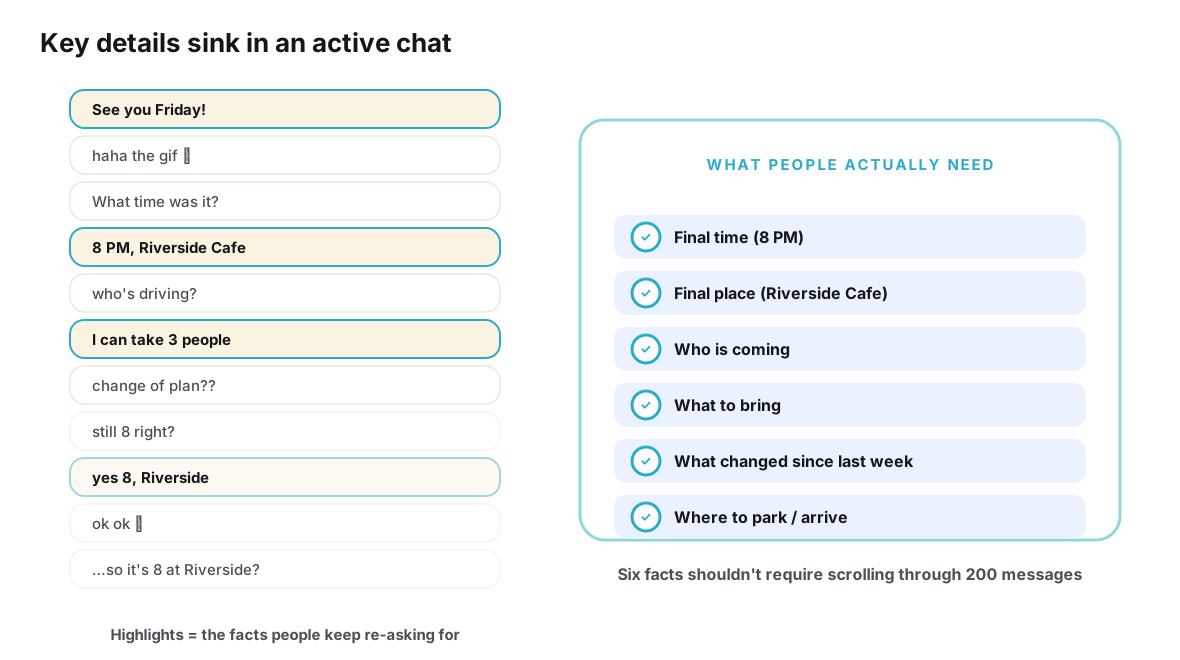
The way out is to notice what the question loop actually is: a distributed, human-powered search engine. Members are querying the group for the event’s current state, one query per person, serialized into broadcast. Any system that lets people answer the query themselves — by opening a link — deletes the entire traffic category at once. This is the quiet insight behind creating one source of truth for a group event: it is not a convenience, it is the removal of an entire class of messages.
Splinter groups and the fragmentation of one plan
Large groups do not merely get noisy; they fission. A sub-group forms for the drivers, another for the food rota, a side chat for the organizers, a thread for the people coming from the next town over. Each splinter is created for good reasons — smaller rooms are calmer, and focused conversations are genuinely easier — but each one also becomes a place where part of the plan lives. The venue discussion happens in one splinter, the timing in another, and the parent group contains a summary of neither.
Now the plan is not just buried; it is distributed. Cross-forwarding between groups creates snapshots that freeze on arrival. The organizer becomes a human router, relaying facts between rooms that cannot see each other. And members who belong to two groups receive two versions of the truth, with no indicator of which room is more current — the fork problem again, now with a room of its own.
WhatsApp’s own answer to this pattern is Communities, which let organizers link related groups and share announcements with all their members at once. For distribution, this is a real improvement: one announcement reaches every linked group, and the announcement feed gives large memberships a place to look that is calmer than the chatter. But notice what is still true — an announcement is a message. It is posted at a moment, it can go stale, and it does not update when the plan changes. The community announcement solves reach; it does not solve state. The event’s current facts still have no home that stays current, and the announcement author is still manually maintaining a copy of the plan inside a message.
The silent majority and the headcount problem
Every large group contains a silent majority — members who never post, never react, and cannot be reached by any message that hopes to be read carefully. In a friend group of eight, silence means something; in a group of four hundred, silence is the default state of most of the population. Any planning method that counts heads by reading the thread is counting only the loud.
The maybe deserves special respect here. In a big group, a large share of potential attendees are genuinely undecided — they want to come, something might come up, they will know closer to the day. In a thread, that honest state has no representation: the silent maybe looks identical to the silent no, and the organizer cannot distinguish a soft yes from an absence. Give people an explicit maybe to hold, and the group’s real shape appears — along with a reason to check back when the maybes firm up.
This collides badly with the one thing large events actually need: a number. The venue, the food, the tickets, the coach seats — every external commitment the organizer makes is a function of the headcount. A thread cannot produce that number. Enthusiastic replies overcount (enthusiasm is not attendance), silence undercounts (the quiet are often the most reliable), and reactions are ambiguous in both directions. The organizer’s final count is, at best, an educated guess dressed up as a list.
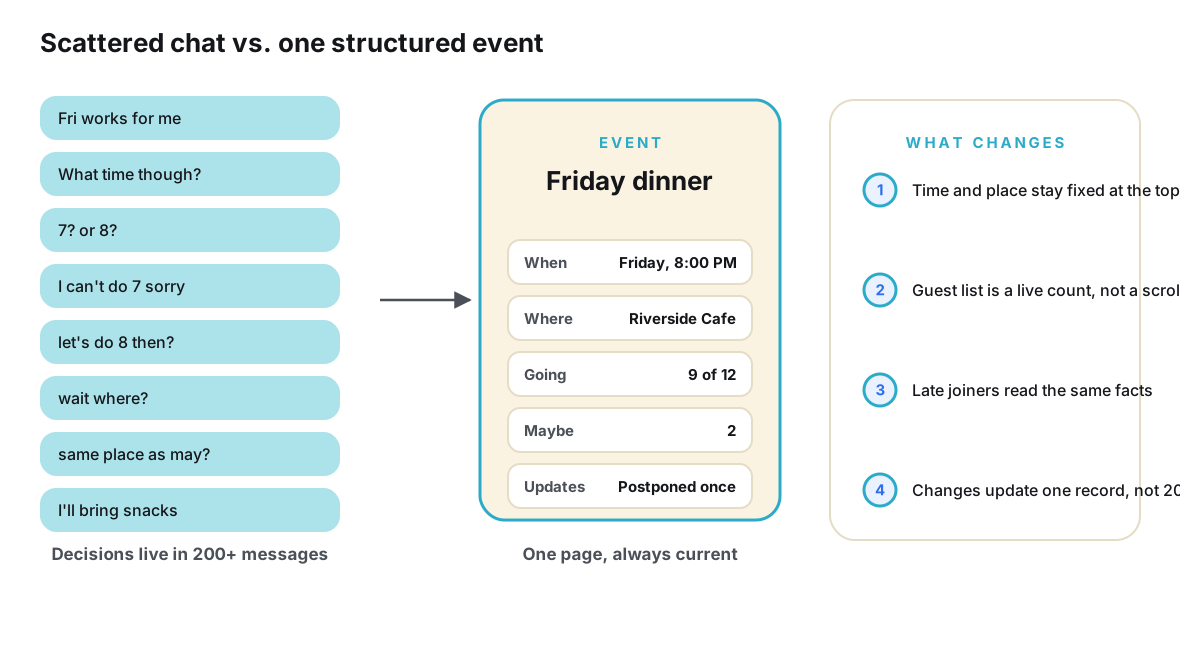
What a real headcount requires is per-person state: each member holds a going or maybe status that they set themselves and can revise without posting anything. Then the count is not a reading of the thread’s mood but a property of the list — and “can I bring my cousin?” stops being a message and becomes a plus-one on a record. Large groups that run successful events almost always turn out to be running exactly this pattern quietly in the background while the main thread carries on being gloriously social.
Announcements are not a record
It is worth pausing on the announcement model, because it is the design most large groups converge on — one authorized voice, posting updates — and it deserves a fair assessment. Discipline about who posts genuinely helps: it reduces contradiction, concentrates authority, and makes the feed scannable. As damage control inside a chat, the announcement model is about as good as it gets.
Its limits appear the moment anything changes. Each announcement is a frozen snapshot: true when posted, stale after the next decision, and contradictory toward every earlier announcement still sitting in the feed. A member who reads the announcement feed on Monday and returns on Thursday has no marker saying “superseded.” The organizer manages staleness by re-announcing, which re-enters the attention economy — and around it goes, the familiar loop wearing a more official hat.
| Problem at scale | Common in-chat workaround | The workaround’s ceiling | Structural fix |
|---|---|---|---|
| Basic questions repeat daily | Answering patiently, again | Each answer helps one member once; the loop never ends | A link members open themselves, showing current facts |
| Announcements sink | Re-posting, pinning, group description | Pins hold one frozen message; re-posts re-enter the noise | An event page that is always current at one address |
| Headcount is a guess | Counting replies and reactions | Enthusiasm overcounts; silence undercounts; nothing updates | Per-person going / maybe statuses, set by each guest |
| Plan fragments across sub-groups | Cross-forwarding between groups | Each forward is a frozen snapshot that drifts instantly | One shared record every group points to |
| Late joiners are lost | “Scroll up” or a patient summary | The summary is immediately stale; scrolling is archaeology | The record onboards anyone in seconds, at any time |
| Day-of changes miss people | Re-broadcasting to every group | Whoever is traveling or muted simply misses it | One edit updates what every link points to |
Read down the last column and a shape emerges: every structural fix is the same idea applied to a different symptom — give the plan an address that always shows current state. That is the consistent conclusion large groups reach, each one independently, usually after one event organized through pure broadcast goes visibly wrong.
Running one event out of a very large group
None of this means the huge group is useless for events — it is, in fact, the single best distribution channel most organizers have. What it means is that the group’s job is announcing and pointing, while the plan lives elsewhere. A pattern that works for classes, buildings, and clubs of every description:
Create the event record first — the page holding time, place, cost, and the RSVP list — before posting anything to the big group. Then announce once, warmly, with the link and one line about what the event is. Pin the announcement if the group’s rules allow it, so late arrivals find the pointer without scrolling. From that moment, every planning question gets the same four-second answer: the link. No summaries, no re-broadcasts of changed details — because changed details are edits on the page, and the link someone saved last week shows this week’s truth.
The sub-groups, if they exist, get the same link. Drivers, food rota, out-of-towners: each room keeps its focused conversation, and each room points at the same record, which ends the cross-forwarding economy overnight. The announcement feed in a Community can carry the initial nudge to every linked group at once — distribution done well — while the record does the part announcements cannot: staying true.
Reminders are the one broadcast a big group genuinely excels at — provided they point rather than carry. A day-before nudge that says “tomorrow, details here: link” delivers urgency through the square and facts through the record. The nudge that attempts to carry the details must get everything right in one frozen message: the count, the time, the entrance, the weather plan. Pointing is one line and always accurate; carrying is a paragraph with a half-life measured in hours.
This is, deliberately, a small workload. One page created, one message posted, questions answered with a pointer. It is also the exact workflow that keeps a single activity from generating message storms at any group size, described step by step in how to plan a group activity without 200 WhatsApp messages. And for organizers who would rather not spin up the big group at all — keeping the event and its chatter entirely separate — the alternative is laid out in how to organize an event without creating a WhatsApp group.
Is anyone’s giant group different?
A fair question is whether the giant-group problem is WhatsApp-specific, and the honest answer is no — it is a property of broadcast chat at scale, wherever it runs. Telegram’s supergroups support up to 200,000 members, per Telegram’s own FAQ, and the groups that fill even a fraction of that capacity organize around channels and announcement patterns that echo everything described here. WeChat group chats cap at 500 members — WeChat’s super-app wrapper adds payments and mini-programs, but the group itself remains a chat thread, subject to the same physics. Signal supports a thousand members per group. The numbers vary; the experience of trying to hold an event’s current state inside a giant stream does not.
If anything, the bigger the platform’s capacity, the more sharply the distinction shows. A million-member channel can broadcast an event to a city — and still cannot tell the organizer how many people are coming, whether the venue changed since Tuesday, or what the fifteen members who joined yesterday need to know. Capacity distributes words; it does not maintain state. That division of labor — big pipes for reach, small records for truth — is where every large platform’s event organizers land eventually.
Frequently asked questions
How many people can a WhatsApp group actually hold?
Group chats on WhatsApp support up to 1,024 participants, per the WhatsApp Help Center. That is large enough for almost any class, club, building, or extended family — which is precisely why the information behavior of huge groups matters: the format comfortably holds the crowd, while the thread format struggles to hold the plan.
Do WhatsApp Communities solve event planning for large groups?
They solve distribution, which is a real part of the problem. Communities let organizers link related groups and share announcements with all members at once, which tames the splinter-group chaos and gives the membership a calmer feed. What they do not add is state: announcements are still messages that go stale. The plan’s current facts still need a home that updates.
Why do big groups go quiet when an event is proposed?
Because in a large group, speaking costs more socially — a question goes to a thousand people, not three friends — so most members default to reading, then to skimming, then to muting. Quiet is not disinterest; it is rationing. The organizer’s real audience for any message is a small fraction of the membership, and the planning method has to work anyway.
What’s the best way to collect RSVPs from a very large group?
Give each member a personal status — going or maybe — on a record they can set and revise themselves, and make the link to it easy to reach from the group. Counting replies or reactions in the thread does not scale: it overcounts enthusiasm, undercounts the quiet, and nothing updates when plans change. A self-serve status list produces the number the venue actually needs.
Should I split a huge group into smaller ones per event?
Splinter groups reduce noise but multiply fragmentation — now the plan lives in several rooms, and keeping them synchronized becomes the organizer’s unpaid job. A better split is by function, not by event: keep the big group for announcements and belonging, and let each event have its own record and link. The rooms can talk freely because none of them is the source of truth.
Does a bigger platform limit mean better event organization?
No — capacity and organization are different axes. Telegram supergroups hold vastly more members than WhatsApp groups, and the largest of them still rely on announcement channels and structured event posts to stay coherent. Bigger pipes move more words; they do not maintain a plan’s current state. Organized events at scale always come from structure, not from member limits.
Conclusion
Scale is kind to reach and cruel to facts. The same thousand-member group that can broadcast your event to everyone it matters to will bury that event’s details within the hour, resurrect the same questions for weeks, and split your plan across every splinter room its members create to escape the noise. Communities and announcement discipline genuinely help with distribution — and they still leave the plan’s current state living inside perishable messages.
The groups that run events well at scale all converge on the same division of labor. The giant thread does what only it can do: reach everyone, carry the social energy, make the event feel like a community affair. The plan itself lives at one address — a record with current facts and a self-serve RSVP list — and every message the group ever needs about logistics is either the link or an edit behind it.
You do not need a smaller group. You need the plan to stop depending on everyone reading everything — which is the one thing a thousand-member chat will never deliver.
Reach the whole group — with one link, not one thousand notifications.
Plan it with Ontaym