
Why Event Links Are Better Than Forwarding Messages
Forwarding feels helpful because it is — once. The tenth forward of a plan that has since changed twice is how a group ends up holding three different versions of Saturday, each one sent with the best intentions.
Quick answer
A forwarded message is a copy: it captures the plan exactly as it existed when you pressed forward, and from that moment it ages independently — nothing you do afterwards changes what it says. A link is a reference: it contains no facts itself, and every time someone opens it, it resolves to the plan's current state. That single behavioral difference decides which gesture survives contact with a living plan. Forwarding works when information is finished — a photo, a joke, an address that will never move. Sharing an event link works when information is alive — a time that might shift, a guest list that grows, a venue still under debate. Plans are alive by definition, which is why the link, not the forward, is the right tool for them.
The gesture we all default to
Forwarding is one of the oldest instincts in messaging, and for good reason. Someone asks what's happening; the answer already exists in another conversation; you press forward and you have been helpful in four seconds. The gesture crosses every boundary that normally complicates group planning — it works from WhatsApp to iMessage, from a group to a private chat, from the app your colleagues use to the app your family uses. No setup, no account, no asking anyone to install anything. As a piece of social technology, forwarding is close to perfect.
Its weakness has nothing to do with reaching people and everything to do with time. A forward is a snapshot that leaves your hands and stops being yours. Whatever changes afterward — the time, the place, the plan itself — cannot reach the copy you sent. The gesture that solved reach so elegantly created a small time capsule and addressed it to someone who needs current information. For a joke, irrelevant. For an event, eventually decisive.
There is a second, less discussed wrinkle: forwarding between apps is not even really forwarding. A true forward happens inside one messenger, from one conversation to another in the same system. The moment your plan needs to cross from WhatsApp to iMessage, or from either into a text message or an email, the gesture degrades into its manual imitations — re-typing the details, copying and pasting a block of text, or photographing the screen. Each imitation is another copy with extra steps, and the re-typing variant adds a fresh failure mode, because transcribed plans can acquire errors that exist in no original anywhere. The mixed-group case, where the problem is most common, is exactly the case where the feature is weakest.
This is worth dwelling on because the failure is invisible at the moment of forwarding. The copy is perfectly accurate when it leaves. It will remain perfectly readable forever. The only thing it will never be again is current — and the person holding it has no way to know which of those three properties they are trusting.
What forwarding actually does, technically
It helps to be precise about the mechanics, because the difference between the two gestures is not rhetorical — it is structural, the way a photocopy differs from a street address.
When you forward a message, the app duplicates its content into a new message and delivers it to new recipients. From that instant, the copy and the original are unrelated objects. If the original is corrected, the correction is a separate message that travels only where it is sent; the forwarded copy sits in a different conversation, possibly in a different app, possibly on a different operating system, still asserting the world as it was. Forwarding many times multiplies the effect: each recipient holds an independent snapshot, each snapshot ages on its own schedule, and no mechanism exists — in any messenger — for updating them together.
Messaging platforms have honestly documented the behavior; forwarding is designed for passing content along, not for maintaining shared state. You can see the boundary in practice in WhatsApp's Help Center, where forwarding is treated as a delivery feature — with limits added to slow misinformation — rather than as a way to keep information synchronized. The platform's own framing is the accurate one: a forward is delivery, not publication.
A link does something categorically different. It carries no plan at all — only an address. The facts live at the address, in exactly one place, and opening the link fetches them anew each time. Yesterday's open showed yesterday's state; today's open shows today's; the copy the reader holds is always zero seconds old. The web was built on this reference model, and it extends naturally to events: an event with a URL becomes an addressable object whose properties are read live — the same modeling the wider ecosystem uses in the structured definition published at schema.org's Event type.
One hike, three versions
A concrete story shows the mechanics at work. Tom is organizing a Saturday hike. The plan starts in a WhatsApp group of eight friends: trailhead parking, 10 am, moderate route, rain or shine. On Monday, his brother asks about it over iMessage, so Tom forwards the WhatsApp summary. On Tuesday, a friend who left WhatsApp years ago asks by text, and gets the same forward. So far: three accurate copies, zero problems.
On Thursday the forecast turns, and the group decides over WhatsApp to move the start to 9 am and switch to the sheltered route. The correction is posted in the group — where the plan was born — and Tom, reasonably, assumes the matter is closed. He does not think of the iMessage thread from Monday, because why would he; it is a finished conversation about a plan he has since changed. The text-message copy has been equally forgotten.
Saturday morning, his brother arrives at the trailhead at 10 for a 9 am start, cheerful and forty-five minutes late, holding a message that says 10 am in Tom's own words. Nobody lied; no app malfunctioned; every individual action was sensible. The system failed because two of the three copies were never told about the third state of the plan — and because forwarding, by design, creates copies that cannot be told.
Notice, too, where the original thread stands after all this. The WhatsApp group now contains the 10 am proposal, the confirmation of 10 am, the 9 am correction and assorted replies — every version permanently resident, distinguished by nothing except position in the scroll. His brother, told to "check the group chat," would have found both times and a fifty-fifty chance of choosing rightly. The correction did not replace the plan in anyone's record; it simply appended itself to a growing archive of assertions. That is the deepest difference between the two worlds: in the copy model, every change adds another version; in the reference model, every change replaces the only one.
Now rerun the week with the link. Tom posts a hike page in WhatsApp on day one and sends the same link to his brother and his SMS friend. On Thursday he edits the start time and route on the page — one action, no announcements. On Saturday, everyone who opens the link sees 9 am, because there is only one hike and one address, and it cannot disagree with itself.
Copies versus references, side by side
The table below compresses the two behaviors into the properties that matter when you are sharing a plan with people who need to act on it.
| Aspect | Forwarded message | Shared event link |
|---|---|---|
| What the recipient gets | A snapshot of the plan as it stood at the moment of forwarding | An address that displays the plan as it stands at the moment of opening |
| After a change | Nothing happens to the copy; it keeps asserting the old world until someone re-forwards | The next person to open the link sees the new state automatically |
| Cost of a second change | Another round of forwards, plus stale copies still in circulation | Zero — the same link keeps resolving to current state |
| Where responses go | Back into whichever chat each recipient replies from, unconnected | Onto the record itself, as RSVPs attached to names |
| Reach | Anyone you can message, in any app — its genuine strength | Anyone who can open a URL, which is nearly everyone with a phone |
| How it ages | Stale from the first change onward | Never older than the plan itself |
Read the reach row generously: forwarding does have the edge of familiarity, and for finished content it is unbeatable. The table is not an argument against forwarding as a human gesture. It is an argument for matching the gesture to the lifespan of the information — copies for finished things, references for living ones.
One test predicts which kind of information you are holding better than any other: ask whether the sentence you are about to send could become false. "Here's the photo from last night" cannot. "We're meeting at 8" can — and the probability that it will is not small; it is the normal life cycle of any plan with more than a handful of moving parts. Most people, mid-forward, never ask the question, because the gesture feels complete in itself. Building the habit of asking it is the entire content of this article in miniature.
Why copies multiply exactly when it matters
The costs of the copy model scale with the wrong variables. Copies multiply with recipients: forward to five people and a change now has five addresses to reach, in whatever apps those five use. Copies multiply with changes: a plan that moves three times produces, across the same five people, fifteen acts of re-forwarding — minus whichever ones the organizer forgets. And copies compound with screenshots, the copy of the copy: a recipient photographs the forwarded message to show a partner, and now a version exists that no re-forward can ever find.
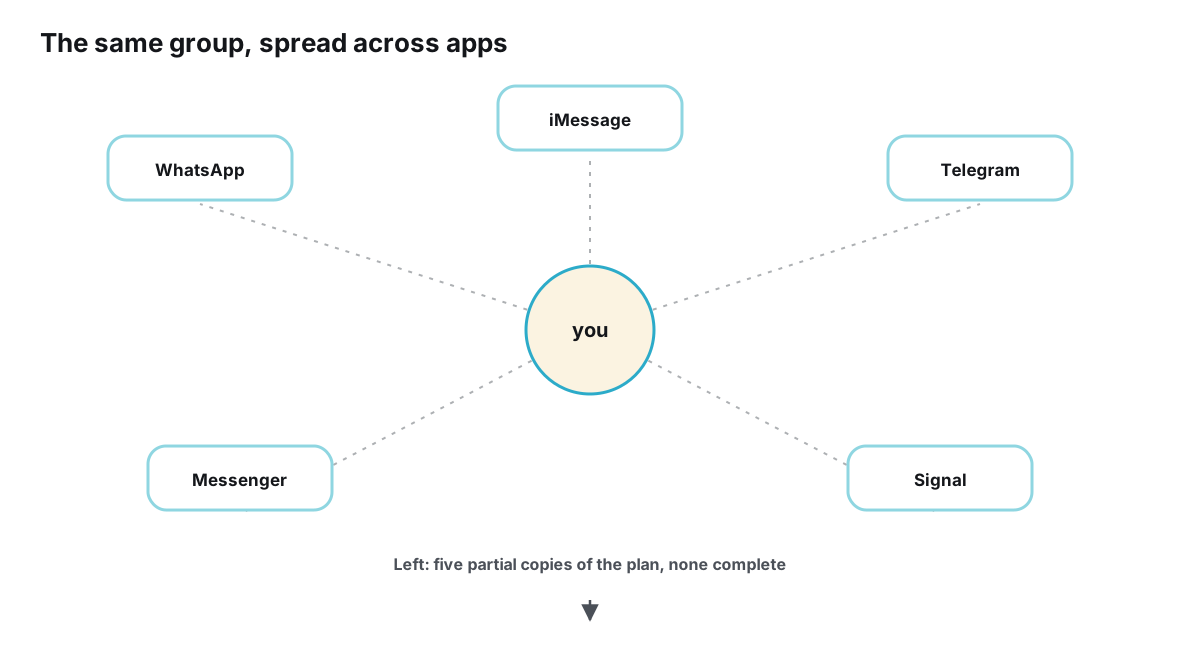
Notice the timing of all this multiplication. Early in a plan's life, when nothing has changed, forwards are harmless — which trains the group in a habit. Late in a plan's life, when everything is changing, each habituated forward becomes a liability. The gesture feels most natural precisely when it is most dangerous, because the urgency of "just tell them the plan" crowds out the question of how the plan should travel.
The group's coping mechanism is the "which one is current?" game: recipients compare message timestamps, ask the organizer privately, or — the tell that the system has fully failed — post screenshots of different versions into the chat for adjudication. At that point the group is spending its collective attention performing, by hand and badly, the synchronization that a reference does for free.
Behind the visible confusion sits a private one: the organizer's ledger. The person who forwarded the plan keeps, in their head, a list of everyone who holds a copy — and the list is always incomplete, because forwards beget forwards. When the time changes, that mental ledger converts into a round of re-telling: message the brother, text the friend, re-post in the group, wonder whether the friend's partner was also told. The labor is invisible to the group, who see only a competent host; the host experiences it as a rising dread of forgetting someone. Organizers under this load start doing what overloaded systems always do — batching updates, softening changes into hedges, avoiding small corrections that "can wait" — and the plan's precision decays exactly when the event needs it most.
There is a social cost as well, quieter than the logistical one. Being the person who sent the stale copy feels bad; being the person who received one feels worse; being the person who has to adjudicate a screenshot showdown on Saturday at 7 am feels worst of all. None of these small resentments would survive being named out loud, which is precisely why they accumulate unnamed. A group that never argues about the plan's details still manages, somehow, to have arguments about them.
What the link changes in daily use
Adopting the link is less a new tool than a new division of labor. The plan lives at one address — a page holding time, place, details and responses — and every conversation, in every app, carries the pointer. Chats stay exactly where they are, doing what they do: the WhatsApp group still argues about snacks, the iMessage thread still plans the playlist. But when anyone needs facts, the answer is one gesture that works identically everywhere: open the link.
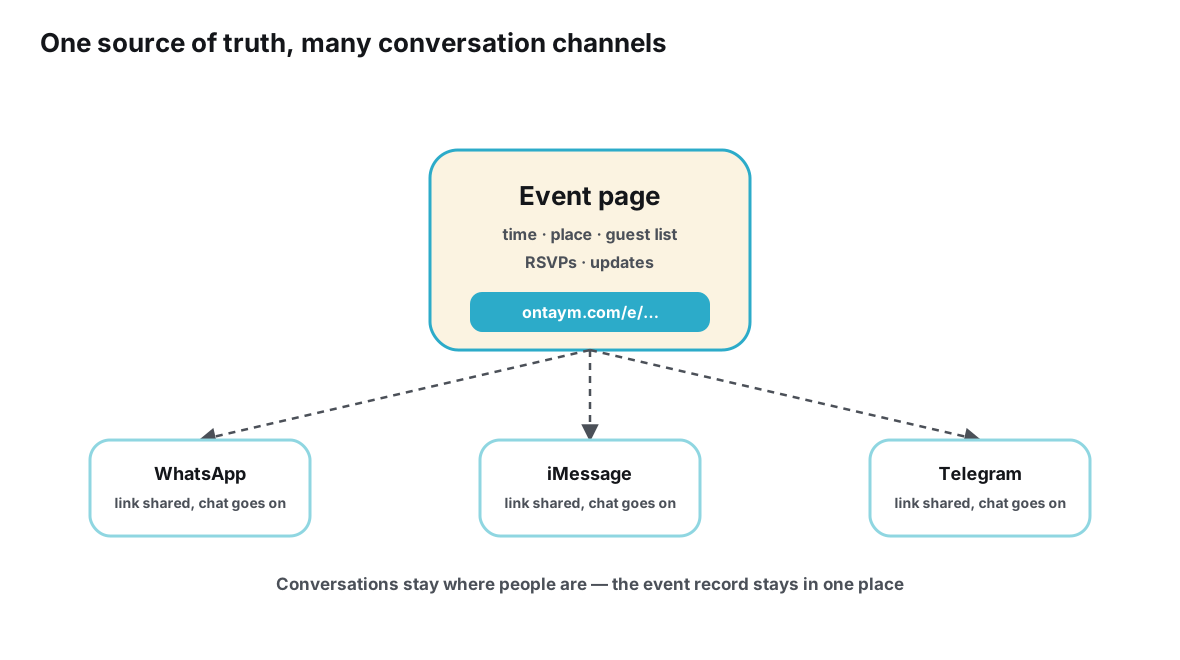
Updates invert completely. Instead of deciding who needs telling — the question that haunts every organizer of a scattered group — the organizer edits the page, and telling is no longer a thing that needs doing. An optional courtesy line in the chattiest thread ("start moved to 9 — link updated") serves the notification function without carrying the facts, so even the announcement cannot go stale. The deeper design pattern this rests on — conversations and events being different kinds of objects with different rules — is unpacked in the difference between a conversation and an event object.
Responses move onto the record as well, which is the quiet second win. A forwarded plan invites replies wherever it lands, fragmenting the headcount across apps; a linked plan collects RSVPs at the address, beside each name, updatable by each guest without a public announcement. The difference shows up most clearly in the organizer's week: instead of assembling a headcount from reactions, replies and remembered conversations, they read one list that guests maintain themselves. A maybe that becomes a going at midnight changes the list without waking anyone. Tools like Ontaym build for exactly this — one page per event with one link, going and maybe statuses that maintain themselves — though the mechanics belong to the pattern rather than any product: wherever the plan has a fixed address, they arrive with it. Setting such a record up from scratch is covered step by step in how to create one source of truth for a group event.
It is worth being honest about what does not change. A link does not make people reply faster, care more, or check anything at all; it only guarantees that checking is worth their while. Nor does it eliminate the day-of surge — the last-minute questions, the "where exactly are you all?" messages — though it gives them a better answer than any forward could, because the answer arrives with the current state attached. What the link removes is not human flakiness but mechanical obsolescence: the strange situation where a perfectly delivered message becomes a liability through no one's fault and everyone's inconvenience.
The etiquette of a link people will actually open
Links solve accuracy, not attention, and attention is won socially. A few habits make the difference between a link that becomes the group's reflex and one that dies unread.
Send the link with one human line attached — "dinner's planned here, RSVP when you know" rather than a bare URL dropped into silence. A naked link looks like spam or a form; a linked sentence is an invitation. Keep the link identical every time you share it, in every app, so that its appearance becomes recognizable and its singularity is visible: one event, one address. When the plan changes, repeat the address rather than the details — "updated on the page" with the link — so the habit you are training is checking, not hoarding snapshots. And put the link where the people are: the WhatsApp group, the iMessage thread, the family email, wherever each subset already lives, since the whole point of a reference is that it does not care where it travels from. If your group is scattered across apps entirely, the same logic applies to the invitation itself, as organizing an event without asking everyone to download the same app lays out.
The day of the event has its own rules. By then, the link should have been seen enough times to be familiar, and the fast-moving details — leaving in ten minutes, table moved to the terrace — belong in direct messages, where a notification does the work. The discipline is to keep the two layers straight: urgent news travels as messages, stable truth lives at the address, and the address is what you fall back on whenever anyone, at any hour, needs to re-ground themselves in what is actually happening.
When forwarding is still the right call
None of this makes forwarding wrong; it makes forwarding specific. The decision rule is the lifespan question asked once: will this information change? If the honest answer is no, forward freely. If it is yes or even maybe, send the address.
| Situation | Better gesture | Why |
|---|---|---|
| A photo, a joke, a finished document | Forward | The content is complete and cannot go stale, so a copy is harmless |
| The full plan for someone new to the event | Link | They need current state plus a way to respond, not a frozen digest |
| A day-of detail like "leaving in ten minutes" | Direct message | Urgency needs a notification that lands, not a page to check |
| A gate code or fixed address that will not change | Either | When information cannot age, copy and reference are equivalent |
| A friend who never opens links | Forward, and own the follow-up | A deliberate exception: one person to re-contact beats rebuilding the plan around them |
The last row deserves a word of caution, because exceptions metastasize. One link-averse friend costs one targeted forward per change — manageable. A sharing culture built on forwards for everyone, to avoid teaching one new habit, costs the group the entire benefit and quietly reassigns the synchronization work to whoever cares most. Keep the exceptions enumerated and small.
Frequently asked questions
Isn't a link just as easy to ignore as a message?
Attention and accuracy are different problems, and only the link solves the second one. A message can be ignored; a stale message can also be obeyed — which is worse. The link guarantees that whenever someone does look, including at 8:55 for a 9:00 start, they see the truth. For attention, use etiquette and previews; for truth, there is no substitute for a reference.
What if my friends don't trust links?
Distrust usually attaches to naked URLs from unknown senders, and both concerns are answerable: share the link from your own account with a personal line of context, and let the messenger's link preview do the credibility work by showing the event's title and details before anyone taps. Once the link has been right twice, it earns more trust than any forward, because it keeps being right.
Do event links work across apps?
Yes — a URL is app-neutral by nature. WhatsApp, iMessage, SMS, email and every other mainstream channel can carry a link and most render a preview card. That neutrality is the quiet advantage over every in-app alternative, which stops at its own membership boundary no matter how good its features are.
What about people without smartphones?
A link travels by ordinary SMS and email as well, so the population truly excluded is small. For the few who cannot or will not open links at all, treat them as the deliberate exception: relay the current details personally, and accept that staying current for them is now a named task rather than something the plan does automatically.
Can I forward and link at the same time?
Yes, and the combination is often ideal: forward the link itself. The gesture keeps its reach and its personal framing, while the content of what you forwarded is a reference rather than a copy. What to avoid is forwarding the plan's details — that recreates the snapshot problem inside the very act of being helpful.
Conclusion
Forwarding and linking look identical in a chat window — a thumb-length gesture, a delivered message — but they encode opposite theories of information. The forward says: here is a copy of the truth as I know it. The link says: here is where the truth currently lives. For finished things, copies are fine and always will be. For plans, which are alive by definition and change most when it matters most, every copy issued is a small future disagreement waiting for its Saturday morning.
The practical shift is one habit: when the subject is an event, share its address, not its contents. Post the link where your people already talk, repeat the address when things move, and let the plan's current state be something the group reads instead of something it reconstructs from timestamps. Invitations deserve the same treatment — one address each guest can act on privately, as covered in inviting people without adding them to another group chat. The friends who arrive on time will never know which gesture you chose. The ones who would have arrived forty-five minutes late, holding your Monday forward, are the entire argument.
Share one link that's never out of date.
Plan it with Ontaym