
How Event Links Solve Problems That Group Messages Can’t
Forwarding a message hands every guest a frozen copy. Sharing a link hands them an address. One quietly rots the moment the plan changes; the other can’t rot, because it never held the facts — it points at them.
Quick answer
A group message is a copy: once sent, it is frozen, it lives inside one app, and its relevance decays as the thread scrolls on. An event link is a reference: it points at a single event record — a page holding the current time, place, guest list and changes — that renders fresh every time anyone opens it, in any app, on any device. When the plan changes, every copy of a message silently goes wrong while the link simply resolves to the updated plan. That one mechanical difference solves the problems messages structurally cannot: retrieval (finding the plan without scrolling), consistency (one current truth instead of many diverging copies), and reach (a single object that travels across apps to people who were never in the group). The working pattern is short: chat announces, the link holds the plan.
One plan, many copies
Picture a plan that leaves home the ordinary way. Maya posts the details in the WhatsApp group. Tom forwards them to his partner on iMessage. Priya, who isn’t on WhatsApp, gets a screenshot over Telegram. Someone pastes the address into the climbing club’s Discord, and one friend who avoids group chats entirely is told the essentials verbally and scribbles them on a receipt. Six people now hold the plan. Zero of them hold the plan — they hold six artifacts, each frozen at the moment it was made, each about to be wrong in its own private way.
Then Thursday happens, and the start moves from eight to nine. Maya posts the change to the WhatsApp group — which reaches the group, at the moment they read it, until it scrolls away. Tom’s partner still has the forward that says eight. Priya still has the screenshot that says eight. The Discord paste says eight, and the receipt in a jacket pocket is beyond help. The correction itself becomes one more copy in one more place, chasing five stale copies through the world. This is not a story about careless friends. Every individual action was reasonable. The failure is in the medium: a message, by nature, is a copy — and copies diverge.
What forwarding actually does
Forwarding feels like sharing, but mechanically it is duplication. The forwarded message becomes a new object, independent of the original, frozen at the moment of sending. If the original is corrected, the copy is not — it has no ongoing relationship to its source. There is no pointer, no subscription, no way for the source to reach back. A forwarded message is a photograph of a fact, and photographs do not update. The platforms are transparent about this: forwarding, as described in the WhatsApp Help Center, moves a copy of a message into other chats — the operation is named for duplication because duplication is what it is.
The same is true one level down. A screenshot of the thread is a copy of a copy: it preserves what the plan looked like at one instant, striped with a status bar and a battery icon. A reposted summary is a copy with editorial loss. Even the humble “did everyone see the time changed?” is an attempt to patch copies with more copies. Every mechanism a chat offers for spreading a plan is, at bottom, another duplication event — each one expanding the surface area of things that can silently go stale.
Copies also lack a common identity. When Tom’s partner asks “wait, which is right, the forward or the screenshot?”, there is no principled answer, because the two artifacts are genuinely different objects that happen to describe the same plan. Nothing links them, so nothing can reconcile them. Reconciliation is left to the humans, over and over, forever — which is why “which time did you have?” is among the most common sentences in the last twenty-four hours before any group event.
Copying also fragments the conversation that should have surrounded the plan. Someone replies to the forward — on iMessage, to Tom personally, because that is where the copy lives — and the reply never reaches the group. Someone reacts to the screenshot with a thumbs-up, and the organizer, watching the WhatsApp thread, records silence. The discussion about the plan scatters across the same surfaces as the copies, so the organizer is now moderating a plan that lives in four rooms and answers in none of them. Copies don’t just duplicate facts; they duplicate audiences, and every duplicated audience is a place where questions go to be missed.
What a link actually does
A link behaves according to an entirely different law. It is not a copy of anything; it is an address. When Tom’s partner taps the link on Thursday night, her device asks the address a question — what is the current state of this event? — and the answer comes back fresh: nine o’clock, the new venue, fourteen going, two maybe. Had she tapped it Tuesday, the answer would have been Tuesday’s truth. The link held no facts at all; it held the question, and the record behind it answered. That is why the link cannot go stale: staleness is a property of copies, and a link is not a copy of the plan but a reference to it.
This single mechanic quietly reorganizes the whole Thursday scenario. Maya changes the time once, on the event page. The WhatsApp group gets the announcement; the forward, the screenshot, the Discord paste and the verbal briefing are never created, because the thing being shared was never a blob of text but an address that works everywhere. Tom’s partner taps her link and gets nine o’clock. The friend with the receipt gets sent the same link and is current in ten seconds. One edit, zero stale copies, zero reconciliation conversations. Nor is this some exotic arrangement: it is how the open web has always modeled things worth pointing at. When machines need to understand an event, the web’s shared vocabulary — schema.org’s Event type — describes it as an object with a URL and properties, an addressable thing rather than a passage of text. The event link is simply that idea, handed to a group chat.
| Property | A shared message | An event link |
|---|---|---|
| What it is | A copy of the facts, frozen at send time | An address to one live event record |
| What a reader sees | Whatever was true when it was sent | Whatever is true when they open it |
| After a change | Quietly wrong, with no outward sign | Correct, because it resolves to current state |
| How a correction travels | As another copy chasing the first ones | As one edit, instantly effective for everyone |
| Where it works | Inside the app it was sent in | Anywhere a link can be tapped, across apps and devices |
| How it ages | Decays with scroll depth and with the plan’s drift | Neither — addresses don’t scroll and records update |
| A late joiner’s experience | Archaeology: dig for the latest copy among many | One tap: the current state, no history required |
One row of that table does more work than the rest put together: what a reader sees. Every other advantage — consistency, reach, longevity — is a consequence of the fact that a link re-asks the question every time it is opened, while a message answers once and then stops being asked.
Scroll decay and the permanent address
Even inside a single group, without any forwarding, the message loses a fight against geometry. A message’s location in the world is a scroll position. Every subsequent message pushes it deeper, and its findability decays with depth — not because the app hides it, but because retrieving it costs effort proportional to how far away it now sits. The plan’s importance doesn’t decay at all; its accessibility does. The gap between those two curves is where “scroll up” lives, and “scroll up” is the least scalable sentence in group coordination.
A link’s location is an address, and addresses don’t scroll. The link that was posted on Tuesday is the same distance from everyone on the following Sunday — one tap. This is why the pin was invented, and why the pin is a patch rather than a fix: pinning freezes one message’s content at pin time, and the moment the plan changes, the pinned copy is either stale or needs a human to re-pin it, which is the copy-maintenance problem again in miniature. The deeper trouble is that the pin solves position, not state. It keeps the message near the top; it cannot keep it true.
Search doesn’t rescue the message either, because chat search operates on words, not on fields. Searching the thread for “Friday” returns the proposal, the confirmation, the correction and the joke about always choosing Fridays — ranked by recency or relevance, but not by truth. The link sidesteps the problem: it is not a search result, it is a destination, and it doesn’t compete with the words that discuss it.
One edit, ninety stale copies
The change scenario deserves its own examination, because changes are where copy-semantics hurt most. In the copy world, a change is an event that happens to some copies and not others. Everyone who read the correction holds the new time; everyone who missed it holds the old one; everyone who read a partial correction (“later than planned!”) holds something in between. The group now contains multiple versions of the plan, and — this is the cruel part — every version looks equally plausible from inside. A wrong copy doesn’t render in red. It renders as a normal message, in the same font as the truth, radiating the same confidence it had when it was correct.
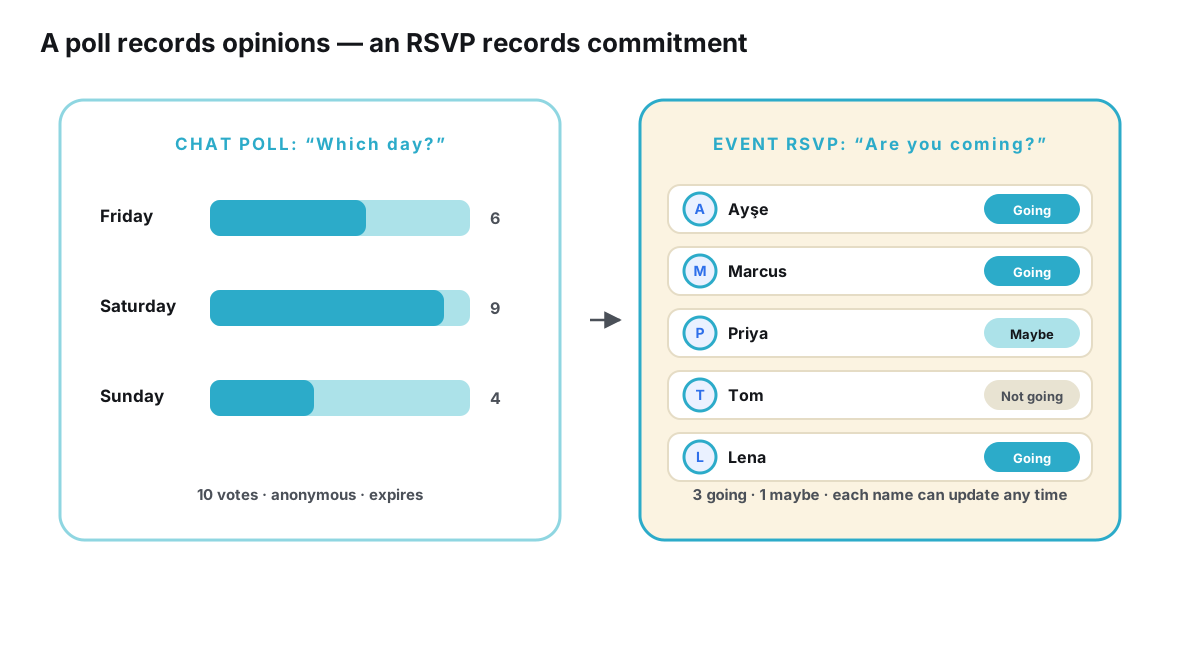
In the reference world, a change is an edit to the one record, and the copies problem never gets its chance to exist. What replaces it is subtler and better: the record can even tell you what changed, because it knows its own history — “time moved from 8 to 9, venue unchanged” — whereas a thread can only present you the two messages and let you perform the diff yourself. For events where people’s commitments shift as the facts do, the record behind the link carries the answers: who’s going, who moved to maybe, who dropped after the change. The difference between that live list and the gestures a chat produces — reactions to a message that may itself be obsolete — is laid out in event RSVP vs. group chat reaction.
It is worth pausing on why this feels so much calmer in practice. In the copy world, every guest is responsible for their own currency: it is each person’s job to have noticed the latest message. In the reference world, currency is centralized: one person edits, and everyone’s next tap inherits it. The group stops distributing a synchronization burden across fifteen phones and concentrates it where it belongs — in one place that was built to be edited.
The link as a neutral object between apps
The copy problem compounds the moment a group spans apps, which is to say: most groups. A WhatsApp message cannot be received on Telegram; an iMessage thread cannot be joined from Android; a Discord announcement is invisible to someone who has never joined the server. The usual workarounds — screenshots, retyping, keeping a parallel “shadow group” on a second app — are copy-making with extra steps, and they inherit every property of copies, including divergence. Meanwhile, pressuring everyone onto one app is its own social cost: it asks people to change tools, expose phone numbers or join communities, all to receive information that could have simply been addressed.
A link is the rare object that is native to all of these systems at once, because every messaging app is also a browser-adjacent environment: links render, previews unfurl, taps open pages. The event link therefore becomes a neutral meeting ground — not a neutral venue for the conversation, which can stay wherever each clique already talks, but a neutral venue for the plan itself. WhatsApp people, iMessage people, Telegram people and the no-app friend can all hold the same address and see the same current state, without joining anything, installing anything, or sharing a single contact detail.
This neutrality matters most exactly where communities are most locked-in. A Telegram channel can broadcast to an enormous audience, but a channel post is only ever a channel post — a member of a different platform cannot so much as see it, never mind act on it. A Discord server can host an event listing, but reading it requires being inside that server. These are reasonable boundaries for community spaces, and they are exactly the boundaries a link steps over: it can be dropped into a channel, a server, a group and an email in the same minute, and it brings the event — not an invitation to migrate — to each of them. The platform-specific audiences stay where they are; only the plan travels.
This is the point where the argument connects to a broader one: messaging apps were never built to hold the structured, current, cross-app record of an event, and the link is how the record escapes that limitation. The fuller case — what a message stream can and cannot store, and why — is made in why messaging apps were never designed to be event databases, and the deep structure behind it, the difference between a stream of messages and a record with fields, in the difference between a conversation and an event object.
| Moment | Message answer | Link answer |
|---|---|---|
| “What’s the plan?” | “Scroll up” — or someone retypes it, creating copy number three | Re-share the link; it already says the plan |
| The time changes | New message; old messages stay wrong; some people never see it | One edit; every future open is correct |
| Someone joins late | Backlog reading and a private catch-up chat | One tap to the current state, history optional |
| The group spans three apps | Screenshots and shadow groups, drifting apart | Same address shared in each app, same state everywhere |
| Day-of confusion (“where exactly?”) | Someone digs for the address message while standing in the rain | Open the link; the location is a field, not a memory |
On the day itself
The link’s advantages peak at the moment stress does: the day of the event. The morning-of questions — “did it move?”, “where do we actually meet?”, “is it still raining-plan or park-plan?” — arrive from every direction at once, and in the copy world each one is answered by a human digging through a thread, possibly while walking, possibly while the answer is already changing again. In the reference world, every one of those questions has the same two-second answer: open the link. The organizer, instead of running a dispatch desk from a bus stop, makes one edit if something moves and trusts the address to carry it.
The day is also when the copies do their final, most embarrassing damage. People arrive at the old venue because the forward on their phone still says the old venue. They arrive at the wrong time because their screenshot was taken Tuesday. Each of these people did nothing wrong — they consulted their copy, which faithfully reported a world that no longer existed. The link’s quiet promise is that this category of failure simply has no mechanism: nothing any guest holds can contradict what the record currently says, because guests don’t hold facts at all. They hold an address, and the address cannot be out of date.
What links can’t do
An honest account needs the boundaries, because the link is not a plan’s social life — only its address. A link cannot negotiate. It can hold two candidate dates, and even show votes on each, but the argument about why Saturday is better than Sunday — the persuasion, the in-jokes, the “I can only do after five” — lives in conversation, and always will. A link also doesn’t chat back: if a guest opens the page with a question, the answer comes from a human, ideally in whatever room the group already uses.
This boundary is not a weakness; it is the design. The pattern that works is a division of labor, not a replacement. Chat carries everything human — the debate, the banter, the social gravity that makes the event worth attending. The link carries everything factual — the decided time, the place, the list, the latest change. Each is degraded when asked to do the other’s job: a thread asked to hold facts produces stale copies, and a page asked to host conversation produces a comment section nobody wanted. The pair, wired together — the link dropped into the chat, the chat announcing the link’s changes — covers everything either missed alone.
There is a practical footnote on link hygiene, learned by every group that has tried this: one event, one link. The moment two addresses describe the same plan, the copies problem is reborn at the level of addresses. Create the event once, share that address everywhere, and treat any second link as a bug. This is precisely the discipline Ontaym is designed around — each event gets one page and one link, holding options, votes, RSVPs and final details, so the address shared on day one is still the whole truth on event day.
Making the link the answer
Adopting the pattern is less a tooling change than a habit change, and the habit has three moves. First, create the record early — the moment a plan stops being hypothetical, give it a page, even if half its fields still read “to be decided.” An address with gaps beats a perfect paragraph with no address. Second, answer questions with the link. Every “what time?” answered by the address instead of a retyped fact is a copy not born and a reader made current. Third, announce changes once, in the chat, pointing at the link — the announcement’s job is attention, the record’s job is truth, and neither should do the other’s work.
Groups that hold this habit for one event tend to keep it, for a reason worth stating: it changes the emotional texture of planning. Questions stop feeling like interruptions, because answering them is free. Changes stop being dreaded, because they cost one edit instead of an evening of chasing. The organizer’s memory stops being the group’s database. And the friend on the wrong app stops being the friend who misses things. None of this required anyone to talk less — only to stop asking messages to be what they were never going to be.
Frequently asked questions
Isn’t a link just a shorter message?
No — the difference is mechanical, not cosmetic. A message carries its facts inside itself, frozen at send time; a link carries an address that resolves to current state on every open. The message is a snapshot, the link is a live feed. That difference determines everything downstream: what late readers see, what happens after a change, and whether copies can diverge.
What if people don’t click links?
Then the preview does part of the work — most messaging apps unfurl a snippet with the event’s title and details — and the group’s habit does the rest. In practice, people click links that reliably answer questions and stop clicking retyped messages that reliably don’t. The first week of “it’s all at the link” builds the trust the pattern runs on.
Do event links expire?
It depends on the service behind the link, not on the link concept. A well-designed event keeps one stable address for its entire life — creation through aftermath — because the whole value of the address is that it keeps working. If you’re choosing a tool, that stability is a feature to check for.
Are event links private?
Access depends on how the service scopes the page. Many event links work as unguessable addresses — effectively keys: anyone holding the link can view, and the protection is the link’s unguessability plus whatever restrictions the organizer sets. Treat an event link the way you’d treat the invite itself: fine to give to invited people, not fine to post publicly unless the event is public.
Can’t we keep planning in chat anyway?
You should — chat is the right medium for the negotiation and the nonsense that make group events worth having. The change is only that outcomes leave the chat: each settled fact goes onto the event page once, and the page becomes the answer. Planning stays conversational; the plan becomes addressable.
What’s the difference between pinning a message and sharing a link?
A pin fixes a message’s position; a link fixes the plan’s state. The pin keeps one chosen message near the top of a thread, but its content is still a copy — frozen at pin time, wrong after the first change, and dependent on a human to re-pin. The link needs no maintenance because it never held the facts in the first place; it points at the place that does.
Conclusion
Every recurring pain of chat-based planning — the scroll, the stale forwards, the “which time did you have?”, the friend on the wrong app — traces to a single mechanism: messages are copies, and copies diverge. The link replaces that mechanism with a reference: one address, one record, resolved fresh at every tap. Nothing about the group needs to change — not the apps, not the banter, not the people.
The takeaway fits in a sentence: share the address, not the facts. Create the event once, early, with gaps if necessary. Let the conversation be the conversation, and let every question about the plan be answered by the same tap, forever current. A copy is a fact frozen at send time; a link is the plan, alive and on duty until the night itself.
Give your next event one address instead of a dozen drifting copies.
Plan it with Ontaym