
What Happens When Your Event Has Multiple Communication Channels?
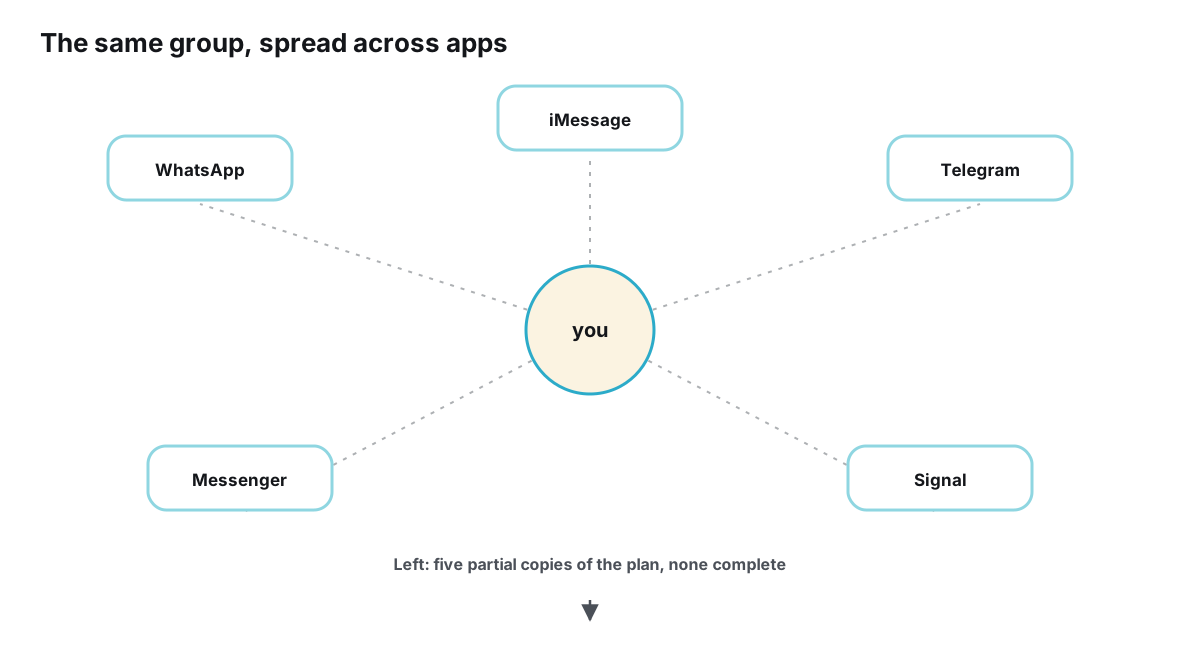
A WhatsApp group, a Telegram chat, an email thread and a Discord channel — all about Saturday. Extra channels feel like inclusivity, but left unmanaged they turn one event into several slowly diverging copies of itself.
Quick answer
When a single event is discussed across several channels, three failure modes appear. Duplication: every change must be manually reposted to each channel, and any channel that gets missed quietly holds an outdated plan. Precedence confusion: members can’t tell which channel carries the official version, so they trust whichever one they saw most recently. Fragmentation: questions, answers and RSVPs scatter, until the organizer is the only person who sees the whole picture. The fix is a channel protocol — one authoritative record for the facts, usually a link everyone can open, with each remaining channel assigned an explicit role such as announcements or discussion, and every channel pointing back to the record instead of trying to replace it.
How one event quietly grows extra channels
Watch a real event take shape and count the places it gets discussed. Diego is organizing a weekend group ride. The core crew already lives in a WhatsApp group, so the first message lands there. His brother prefers Telegram and doesn’t use WhatsApp, so a second thread starts for “just the logistics.” Three club members answer only by email. Someone mentions the ride in the cycling club’s Discord server, and a small crowd starts asking questions in that channel too. By Wednesday, one ride is being planned in four places, and Diego is the only person who knows what all of them say.
Notice that no step in that story was a mistake. Each new channel was added for a good reason: to include someone, to respect a preference, to avoid making people install something. Channel growth is the price of a diverse guest list — and it is nearly unavoidable the moment your event crosses circles. Families, workplaces and hobby communities each settle on different tools, and an event that spans them inherits every choice.
The trouble is that every channel comes with a hidden assumption: that it is the place where this event lives. Members of each channel treat it as the plan’s home, because from where they sit, it is. The WhatsApp group believes the start time is 8 because 8 was announced there. The Telegram thread believes the route changed, because the change was mentioned there. Neither is wrong about what they saw; they are wrong about what they didn’t.
The three failure modes of parallel channels
Unmanaged parallel channels fail in consistent, predictable ways. It is worth naming the patterns, because organizers usually notice the symptoms long before they can name the cause.
Duplication: every update becomes a copy-paste job
The moment an event spans channels, the organizer inherits a manual broadcasting job. A venue change must be typed into WhatsApp, pasted into Telegram, emailed to the list and dropped into the Discord channel — four posts, four formats, four chances for a typo or a forgotten audience. Each update also ages separately: the WhatsApp copy scrolls away under banter within an hour, the email version sits in a thread that nobody reopens, and the Discord message competes with every other topic in a busy server.
Platforms have noticed this and built megaphones, which genuinely help — within their walls. WhatsApp Communities let organizers link related groups and push announcements to all their members at once, as the WhatsApp Help Center explains. Telegram separates one-to-many channels from many-to-many groups precisely so a broadcast isn’t drowned by replies, a distinction documented in the Telegram FAQ. These tools reduce the copy-paste burden dramatically — and then stop exactly at the app’s edge. A WhatsApp announcement reaches WhatsApp members; a Telegram post reaches Telegram subscribers. The seam between the apps still belongs to the organizer’s thumbs.
The predictable result is that organizers start economizing on updates. If every change costs four postings, changes get batched, softened or postponed — “probably still 8, will confirm tomorrow” — and ambiguity enters the plan not because anyone lacked the information, but because the medium made sharing it expensive.
Precedence: nobody knows which channel is official
Ask a simple question of a multi-channel group — “what time on Saturday?” — and you will get the anthropology of precedence. People answer from whatever channel they inhabit: the WhatsApp group says 8, because the WhatsApp announcement said 8. The email thread says 8:30, because the one revision went out by email. Two members who never saw any update repeat the original 7:30 suggestion from a conversation three weeks ago. Everyone is sincerely reporting what they know.
Precedence confusion is more corrosive than it sounds, because it corrupts trust in the plan itself. Once two different times exist in the wild, every channel becomes suspect — members start asking each other instead of the source, cross-checking in private messages, and holding a shadow vote about which version is real. The organizer’s answer, “I posted it in the group,” is both true and useless, because the question was never “was it posted?” but “posted where, and is that where I should look?”
The deeper issue is that no channel earned official status; each simply accumulated it by habit. The group where planning started feels official to its members. The announcement channel feels official to its subscribers. Officialness, in the absence of an explicit decision, gets allocated by each person’s own routing — which is to say, it isn’t allocated at all.
Fragmentation: the group’s knowledge splits
The third failure is quieter. A question asked in the Telegram thread gets answered in the WhatsApp group, where the person who asked never sees it. Someone RSVPs by replying to the email; someone else reacts with a thumbs-up in WhatsApp; a third marks “Interested” on the Discord event — three signals, three formats, no aggregation. The organizer’s head becomes the integration layer, and the headcount exists nowhere but there.
Fragmentation also silences people. A guest who only sits in the email thread never sees the enthusiasm in the group chat; the friends trading jokes on Discord never learn that the quiet email person is coming. An event’s social energy comes from the sense that something is being shared, and fragmentation quietly withdraws it — each audience experiences a smaller, deader version of the same plan.
| Situation | With unmanaged parallel channels | With a protocol |
|---|---|---|
| The start time changes | Retyped into each channel; one gets missed and now disagrees with the rest | The record is edited once; a one-line notice points every channel back to it |
| Someone asks “where do we meet?” | Answered differently depending on which channel they ask in | Anyone can reply with the same link; the answer is identical everywhere |
| A new guest joins mid-plan | Added to one channel, inherits that channel’s possibly outdated version | Gets the link and is instantly as current as the organizer |
| The RSVP deadline nears | Nudge broadcast to every channel; people who already replied read it too | Non-responders visible on the record and nudged privately |
| The event is cancelled | Four urgent postings, each racing word of mouth | Record updated, one announcement per channel, everyone equally informed |
The anatomy of a drifting update
Because duplication is the root failure, it deserves a slow-motion replay. Suppose the venue for a dinner changes on Tuesday afternoon, and the event currently lives in a WhatsApp group, a Telegram chat and an email thread. The organizer posts the new address to WhatsApp at 2 p.m. — complete, correct, immediately buried under eleven messages about parking by 2:15. At 4 p.m. she remembers Telegram and posts there, but paraphrases from memory and drops the door code. The email goes out Wednesday morning, and by then she has also changed the start time — so the email is the only channel that mentions it.
Trace the result. A WhatsApp-only guest knows the new venue but the old time. A Telegram-only guest knows the new venue but lacks the door code. An email-only guest knows both, and is quietly confident the group is organized. Three sincere readings, three different events — and no lie was told anywhere. The drift was manufactured by the medium: three copies of one fact cannot be edited in unison, so they age at different rates.
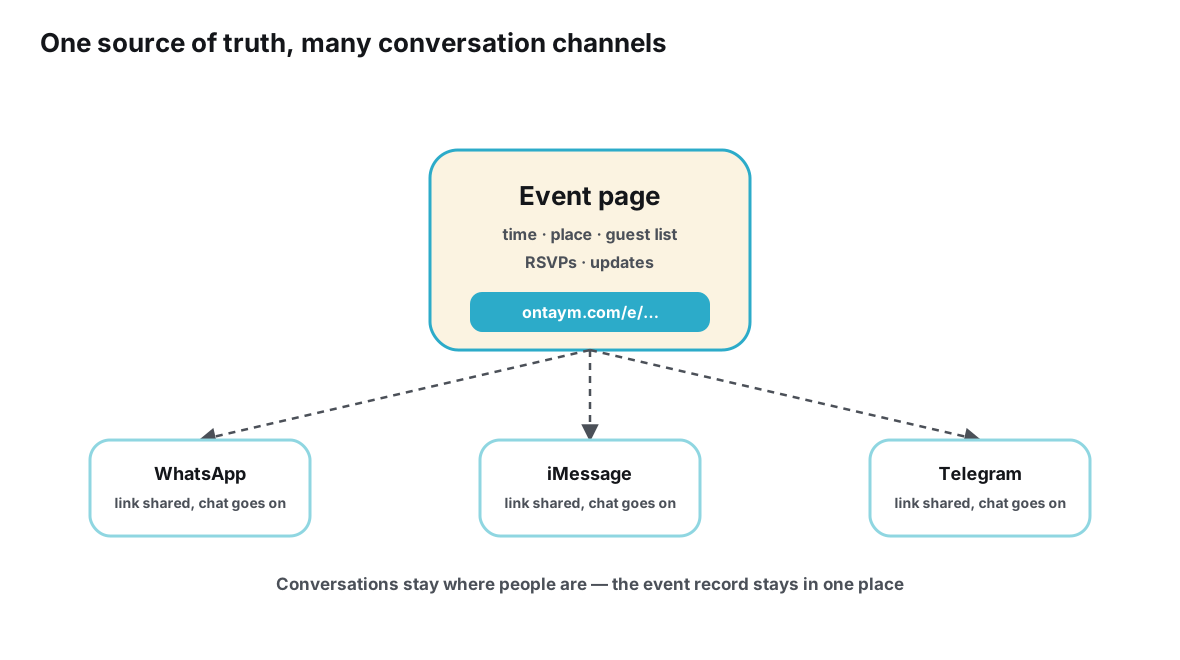
Now run the same Tuesday with a record. The organizer edits the venue field on the event page — once, correctly, with the door code — and posts the same one-line pointer to all three channels in under a minute. Every future reader, whether they look at 2:05 or the following Sunday, sees the same current state. The conversations stay where they are; only the duplication, and the drift it breeds, disappears.
Why the apps’ own tools don’t merge your channels
It is reasonable to hope that platform features will solve this, and worth being precise about why they can’t. Each major platform has invested heavily in helping organizers broadcast inside its borders. WhatsApp Communities link related groups and carry announcements to all members — but membership is based on phone numbers, and everything stays inside WhatsApp. Telegram channels broadcast to subscribers, but a subscriber is by definition a Telegram user. Discord servers offer announcement channels that push posts across servers, yet the reach still ends at people who have joined Discord — and its server features, described on Discord’s support pages, are designed to serve the server’s community.
None of this is a design failure. These are retention features: they make each platform more useful to the people inside it, which is exactly what a platform should do. But an event’s guest list is not a platform’s user base. The overlap between “everyone invited” and “everyone on one app” is partial at best, and it is precisely the non-overlapping guests — the uncle on SMS, the friend who left group chats, the colleague on a work-issued phone — who make the seam visible.
The conclusion is structural, not technical: a multi-channel event cannot be governed by any single channel’s tools. It needs something that belongs to none of the channels — a record that every channel can point to and no channel owns. That is the same insight behind building one source of truth for a group event; what follows is how to apply it when the channels already exist and are all, irritatingly, in use.
The protocol: give every channel one job
The workable pattern is to stop treating channels as duplicates of each other and start treating them as different instruments. Each channel keeps existing — nobody has to leave an app they like — but each is assigned exactly one role, and the roles are announced out loud, once, at the start. A workable assignment looks like this:
- The record. One address — typically a browser-based event page and its link — where time, place, guest list and changes live. It is the only channel with authority over facts. Reading it requires nothing to join.
- Announcement lanes. Channels whose job is carrying signals: “final details are up,” “start time changed, see the page.” They point; they never restate the full plan, because a restatement is a copy, and copies drift.
- Discussion lanes. Channels for banter, negotiation and side planning. Anything can be said here; nothing decided here counts until it lands on the record.
- Frozen channels. Older or redundant channels that get one final message — “we’ve consolidated planning over here” plus the link — and then go quiet.
The announcement that establishes the protocol costs one message: “Quick setup so nobody misses anything: the plan itself lives at this link — that’s always current. This chat stays for talk. Whenever something important changes, I’ll drop a note here pointing at the page.” That single message, sent once to every active channel, does more for coordination than weeks of diligent re-posting, because it tells members where to look when they are unsure — which is the exact moment that matters.
| Channel | Role | What belongs there | What never belongs there |
|---|---|---|---|
| Event page (the link) | The record | Current time, place, RSVP list, changes as they happen | Discussion; anything that isn’t a fact about the event |
| WhatsApp group | Announcement lane | Short pointers when something changes; day-of coordination | Full restatements of the plan that can drift from the record |
| Telegram chat | Discussion lane | Banter, ideas, side questions; conclusions copied to the record | Decisions that never reach the page |
| Email thread | Announcement lane for non-chat guests | The link; one notice per major change | Long back-and-forth threads that bury the current state |
| Discord channel | Discussion lane for the club | Community talk; a pinned link to the record | A parallel RSVP count that disagrees with the record |
| The old dormant group | Frozen | One final message pointing to the record | Anything — it is closed for a reason |
Roles are not permanent badges of honor; they follow function. A loud, chatty WhatsApp group makes a poor announcement lane because notices scroll away in minutes — pin what you can — while a quiet channel with the right audience can be trusted with announcements precisely because nothing else happens there. Assign roles to channels as they actually behave, not as you wish they did.
Expect a settling-in period, and don’t mistake early noise for failure. In the first days after the protocol is announced, someone will still post a factual correction deep inside a discussion lane, and someone else will answer a question fully in chat instead of pointing. The correction is gentle and always the same: repeat the answer in one line, add the link, move on. What you are watching is a group recalibrating its reflexes, and reflexes take repetition, not lectures. By the second or third event, members answer each other with the link before the organizer sees the question — which is the moment the protocol stops being yours and becomes the group’s.
One more practical note: write the protocol down where it lives. A short pinned version of the rules — “facts on the page, signals here, banter everywhere” — pinned in each announcement lane gives new and returning members the same onboarding. A protocol that exists only in the organizer’s head is just a preference; a protocol that is pinned is infrastructure.
Shrinking the channel count first
Before organizing channels, consider closing some. Protocol has a maintenance cost that scales with the number of lanes, and some lanes exist only by inertia: the Telegram thread that duplicated WhatsApp because two people hadn’t been added yet, the second email thread spawned by a reply-all accident. If two channels serve substantially the same audience, consolidate them — announce the merge once in each, post the record’s link in both, and let one go quiet without drama.
The test for keeping a channel is simple: does it reach people no other channel reaches, in a place those people actually look? If yes, it earns a role. If it reaches the same people through a different door, it is a duplicate, and duplicates are where contradictory versions of the plan are born. Fewer lanes, each with a clear job, beats many lanes with overlapping jobs — every time.
Closures deserve a moment of care, because channels accumulate feelings. The group someone created in enthusiasm, the thread that hosted the group’s best jokes — these are not just infrastructure, and shuttering them like unused apps can read as a small rejection. Frame consolidation as promotion rather than demolition: the conversation is moving somewhere everyone can reach, the jokes are welcome to come along, and the record will remember what the plan actually was. Retired channels should end with a pointer, not with silence.
Signs the channels have taken over the event
Because channel sprawl accumulates one reasonable step at a time, most organizers don’t decide to run five channels — they discover they have been. The warning signs are recognizable, and they compound:
- You retype the same message more than twice a week. Manual fan-out is the tax on having no record; the moment copying feels normal, the tax has gotten heavy.
- People ask which chat is the active one. A question about channels is never about channels — it is a member trying to locate the plan’s authority and failing.
- You hesitate before posting. If “where does this go?” has a longer answer than the message itself, precedence is already broken.
- Two channels show different details. The clearest possible signal that one channel is being missed in the update loop — find which one, fix the record, re-point everyone.
- No complete headcount exists anywhere. If you would need three apps and your memory to say who is coming, your RSVPs live in the worst possible database: several, plus you.
Two of these signals on a small event are a nuisance. All five, recurring on every plan, mean the group’s coordination layer needs to be redesigned rather than re-efforted — which is precisely what the protocol above is for.
A useful habit for catching the drift early is the outsider test. Hand your phone to a friend who isn’t in the group and ask them one question: what is happening on Saturday, and how sure are you? If they need to check more than one place, or if their confidence depends on which message they happened to read last, the plan has no single authoritative home — regardless of how hard everyone is working. Guests shouldn’t need context to find the facts; the moment they do, the channels, not the people, are running the event.
Frequently asked questions
Is it inherently bad to have a WhatsApp group and a Telegram chat for the same event?
No — multiple channels are often the only way to include everyone, and forcing a consolidation onto one app excludes people by design. The problem isn’t the number of channels; it’s channels without roles. Assign each one a job, point them all at a single record, and two channels are cheaper than one confused one.
Which channel should be the official one?
Preferably none of them. The official home of the plan should be the place with the fewest barriers to entry — a link anyone can open, regardless of which apps they use. Every messaging channel excludes someone by definition (no account, no entry), which is why chat threads make poor official records. This is the same reason messaging apps don’t work as event databases: they hold the conversation about a plan, not the plan itself.
How do I introduce a protocol without sounding bossy?
Frame it as a service, announce it once, and keep it short: “So nobody has to scroll: the plan lives here, this chat stays for fun, and I’ll flag anything that changes.” People rarely resent clarity about where to look; they resent being told to stop using a chat they enjoy — so don’t tell them that. The protocol assigns jobs to channels, not gag orders to people.
Should I close the extra channels?
Close duplicates, keep reach. If two channels serve the same people, consolidate them with a single farewell message and the link. If a channel reaches a distinct audience — the club on Discord, the relatives on email — keep it and give it a role. The goal is one record with as many pointing lanes as the guest list genuinely needs.
Does this work for recurring events, or just one-offs?
It works better for recurring events, because the roles stabilize. Each gathering gets its own record and its own link, so this month’s plan never collides with last month’s leftovers, while the channels — the WhatsApp group, the server, the email list — persist and learn their jobs. Organizers of recurring groups typically set the protocol once and then only ever post pointers.
What if a change is too urgent to wait for people to check the record?
Then use every lane at once — that is what announcement lanes are for. Update the record first so it is correct for anyone who arrives late, then push the one-line notice everywhere simultaneously. Urgency multiplies channels; the record is what keeps the multiplied messages from disagreeing with each other by nightfall.
Conclusion
Multiple communication channels are not a failure of planning — they are the natural shape of a guest list that crosses families, workplaces and communities. The failure is running those channels as parallel copies of the same plan. Duplicated updates drift, unassigned precedence rots, and fragmented answers leave the organizer as the only integration layer in the system.
The repair is architectural and small: one record that belongs to no platform, reachable by a single link; every channel assigned one honest job, announced once; signals in the lanes, facts on the page. Groups that adopt the pattern don’t reduce how much they talk — they reduce how much they repeat, how often they contradict themselves, and how much archaeology any member must do to answer the only question that ever mattered: what is actually happening on Saturday?
Every channel pointing at one current plan — that’s the whole trick.
Try it with Ontaym