
What Happens When an Event Is Planned Across Multiple Messaging Apps?
The birthday dinner starts in iMessage, continues on Messenger, picks up a side thread on Signal and ends with someone relaying updates by phone call. This is how real events are actually planned — and the cost lands almost entirely on one person.
Quick answer
When one event is planned across several messaging apps, the plan fragments: each app holds a partial, slightly different copy of the same event, and no copy is authoritative. As details change, the copies drift — a new time lands in one app, a correction in another — and divergence stays invisible until the day. Meanwhile a who-missed-what problem emerges: notification settings, checking rhythms and membership all differ, so every update reaches a different, unknowable subset of guests, and the organizer becomes a human bridge between rooms. The structural fix is to stop treating any chat as the plan’s home: give the event one neutral address — a page holding current details, RSVPs and changes — and let every app’s conversation link to it. Chat stays what it’s good at; the plan gains a single, checkable state.
Nobody chooses this, everyone lives it
It is tempting to imagine that a fragmented event is the result of a disorganized group. It almost never is. Fragmentation is the default outcome of ordinary behavior, and watching how it forms is the fastest way to understand why it is so hard to prevent.
It begins with the observation that people do not choose messaging apps the way they choose tools; they inherit them the way they inherit accents. Your oldest friends live in the iMessage thread that has existed since group texting was new; your university crowd never left Messenger; your football team runs on GroupMe — Microsoft’s group messaging app, with its basic polls and likes — because someone set it up years ago and no one had a reason to move; your most cautious friends reply only on Signal. Each cluster is rational. Each cluster is comfortable. And each cluster treats its own app as the obvious center of the universe.
Now ask all of them to one event. The invitation cannot land in one place, so it lands in four. Nobody did anything wrong — the organizer simply used the channel each group actually reads. The event has been plural from its first minute, and everything that follows — the drift, the missed updates, the organizer’s quiet exhaustion — flows from that initial, unavoidable pluralism. Even groups that start mono-app do not stay there: a two-person side conversation about a gift, a partner who prefers a different app, a subcommittee for the venue. Social graphs leak across platform boundaries, and plans leak with them.
Fragmentation: one event, several partial copies
Fragmentation deserves a precise definition, because its damage is often misread as individual carelessness. An event is fragmented when the information that constitutes it — the guest list, the options considered, the decisions made, the logistics in motion — is distributed across multiple communication channels, with no channel holding the whole and no mechanism keeping the parts synchronized.
Consider a composite but deeply ordinary example. Priya’s thirtieth has been brewing for a month. The core group of six plans in their iMessage thread: date settled, restaurant shortlisted to two. The university friends, four of them, hear about it on Messenger and start their own discussion — same date, different restaurant preferences, plus a question about whether partners are invited. Priya’s sister, coordinating the surprise element, runs a small Signal group with two people, where the restaurant was actually decided last week. And the football team, which shares three members with the university crowd, has a GroupMe poll about an away match the same weekend that is quietly shaping who can come.
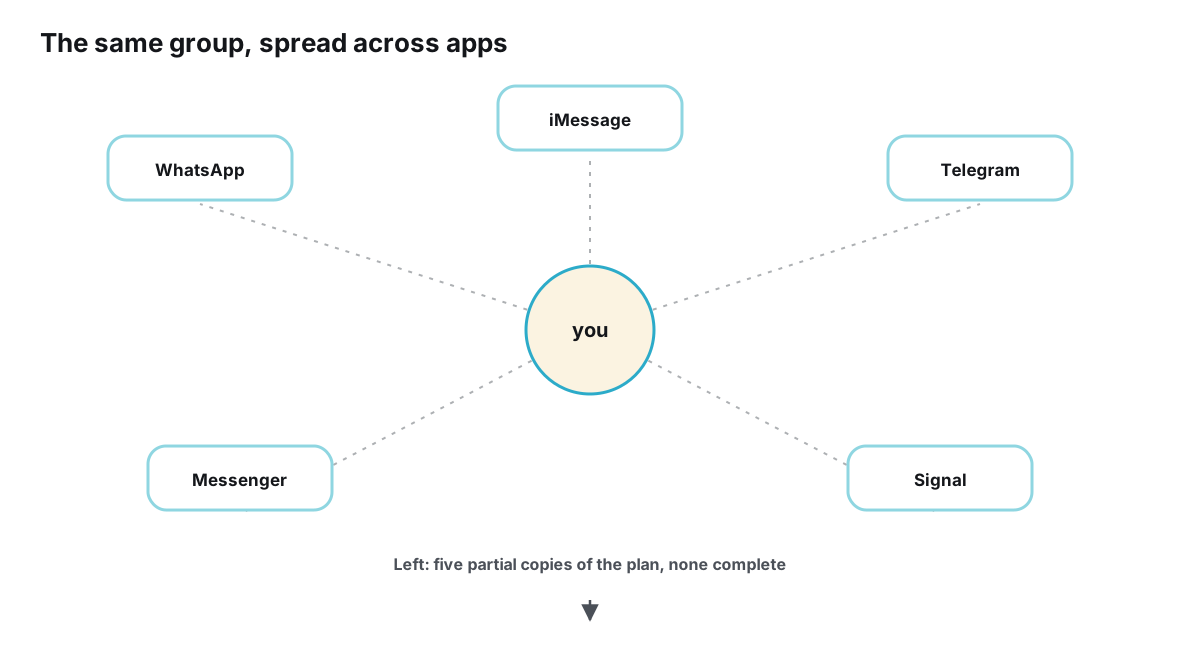
Notice what is true of this picture. Every conversation is functioning perfectly — the iMessage thread is warm and quick, the Messenger debate is thorough, the Signal group is discreet, the GroupMe poll is doing its job of surfacing a conflict. No app failed. What failed is the assumption that any of them could be the plan’s container. The event now exists as the union of four partial copies, and the only entity that holds the union is Priya’s sister, in her head, increasingly late at night.
Fragmentation also has a membership dimension that is easy to miss. Each app’s conversation implies a guest list, and the lists do not match: people in the iMessage thread who were never formally invited, people on Messenger who assume they are invited, people visible in GroupMe who have no idea the dinner exists. The event’s true guest list — the thing a restaurant will ask for — is not written anywhere. It, too, must be reconstructed.
Version drift: when the copies disagree
Fragmentation would be manageable if the copies were merely incomplete. They are also unstable. Every change to the plan — and every real plan changes — must propagate to every copy, and propagation is manual. When it fails, the copies drift apart, and drift has a property that makes it uniquely dangerous: it is invisible until it is expensive.
The mechanics are worth tracing. The restaurant decision lands in the Signal group on Tuesday. Priya’s sister mentions it in the iMessage thread on Wednesday, paraphrased — and the paraphrase drops a detail, because the new venue has two entrances and the message names the wrong one. The university crowd gets a screenshot on Thursday, which freezes Thursday’s state of the plan, including a start time that changes on Friday. Nobody in GroupMe is told anything. By Saturday there are at least four versions of the plan in circulation, each internally coherent, each confidently held by actual people: 7:30 at the first restaurant, 8:00 at the second, 8:00 “somewhere new,” and no plan at all.
Three properties make drift so corrosive. First, it is silent — a person holding a stale version has no indication anything is missing; their information feels complete because it once was. Second, it compounds — each change multiplies the number of possible stale states, so the fifth change is far costlier than the first. Third, it surfaces at the worst moment — drift is discovered when it collides with reality, which is to say at 7:40pm outside the wrong restaurant. Until then, everyone is having a smooth, pleasant planning experience in their own accurate-seeming room.
It is worth saying clearly that no participant is at fault here. The friend who paraphrased the venue, the guest who trusted a screenshot, the organizer who could not face posting the same update a fourth time — all behaved normally. Drift is not a failure of diligence; it is the predictable output of a system with multiple writers, no synchronization and human-bandwidth propagation. Any group of sufficiently busy people will produce it.
| Piece of the plan | Where it typically gets decided | Who ends up seeing it | Where it should live |
|---|---|---|---|
| The date | Whichever app has the most active members that week | That app’s members, plus whoever they mentioned it to | One current field, visible to everyone invited |
| The venue | A side thread with the two most opinionated people | The side thread, until someone paraphrases it outward | The event record, edited when the choice changes |
| The start time | Announced once, adjusted in replies | Whoever was reading during the adjustment window | One field with a change history |
| Attendance | Reactions and replies, scattered per app | Nobody — it must be assembled by hand | Per-guest statuses, self-updated, rolled into a tally |
| Plus-ones and dietary needs | Private messages to the organizer | The organizer’s memory, mostly | Structured fields guests maintain themselves |
| Cancellations and last-minute changes | Wherever panic posts first | A random subset, depending on timing and mutes | One update at the address, notified once |
The who-missed-what problem
Underneath drift sits a subtler failure that deserves its own name, because it explains the peculiar anxiety of organizing across apps: you cannot know who knows what. In a single-app event, an announcement at least has a defined audience — the group’s members. In a multi-app event, every piece of information has a different, unknowable audience.
The audiences differ along three axes. Membership: the person who was added to the Messenger group but never to the iMessage thread experiences an event with holes in it — decisions keep arriving as faits accomplis, and they cannot say whether that is because they were forgotten or because nothing happened. Notification settings: each app has its own mutes, priorities and badge behaviors; the same announcement can be a lock-screen alert in one app, a buried badge in another and a months-old mute in a third. Checking rhythms: people open different apps at different frequencies — the friend who lives in Messenger all day may open Signal weekly, and the announcement that was “obvious” in one room never reached them at all.
For the organizer, this produces a genuinely novel workload: not just communicating, but audience accounting. Did the venue change reach the football crowd? They are in GroupMe, and the change was posted in iMessage — someone overlap-capable must relay it. Has the cousin who never joins groups heard the date? A private message is needed. The organizer maintains, without ever writing it down, a matrix of people crossed with channels crossed with messages, and is the only person in the event for whom the matrix exists. This is the quiet truth of multi-app planning: the event is distributed, but responsibility is not. It pools on whoever cares most.
Guests feel the who-missed-what problem from the other side as a low hum of uncertainty. People who did miss something compensate in predictable ways: they re-ask questions that were answered elsewhere (“sorry, what time is it again?”), they demand confirmation of things already confirmed, or — most damaging — they disengage slightly, sensing that the plan is something happening to them rather than with them. An event that cannot tell its guests what it is, reliably, taxes exactly the goodwill it is trying to celebrate.
The update fan-out tax
Every update to a multi-app event must be published N times, once per app, by hand. This is the update fan-out tax, and it quietly reshapes organizer behavior in ways that make drift worse — a genuinely vicious circle.
The sequence runs like this. The first change is posted everywhere, dutifully. The second change is posted in the two apps that seemed to be paying attention. By the third change, the organizer — who has watched each announcement earn a trickle of reactions and no end of ambiguity — starts softening the message: “probably 8 now, will confirm,” hoping to avoid another round of relitigating. The softness is rational; it is also how ambiguity enters the system. Meanwhile the apps that stopped receiving updates hold versions that are not just stale but confidently wrong, and the screenshot economy takes over: guests forward fragments to each other, each fragment freezing a different moment of a moving plan.
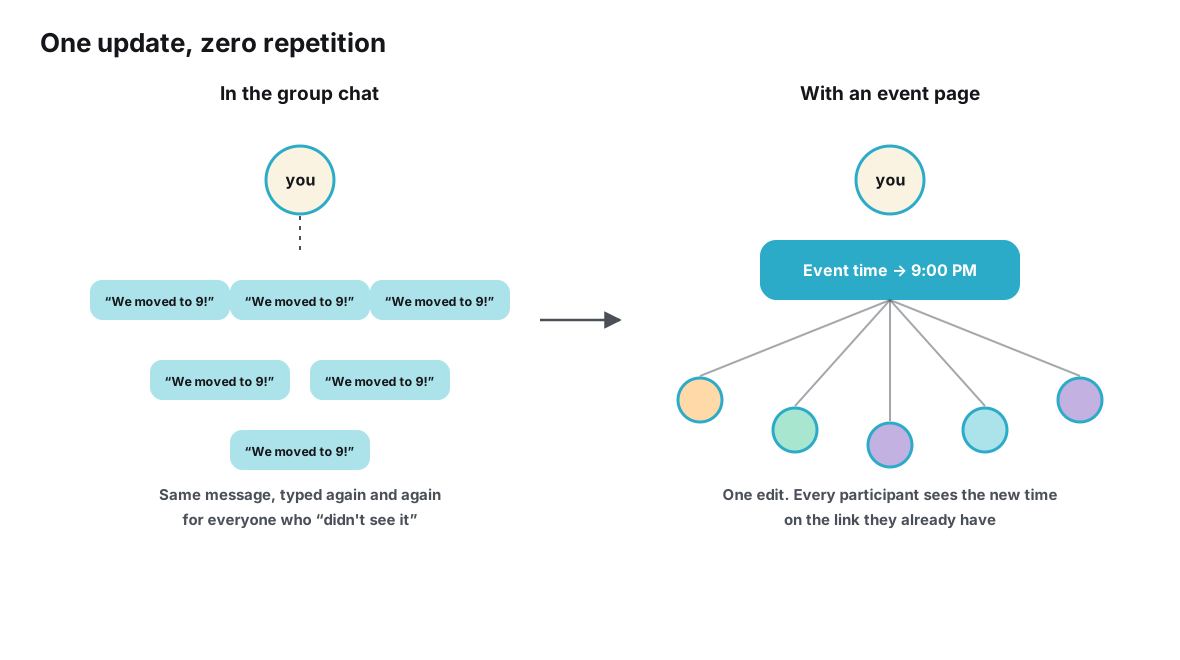
Compare the arithmetic of the alternative. With a single event address, a change is one edit, and notification happens once to everyone who matters, regardless of which app they call home. The cost of the Nth change is the same as the first. Nothing about the organizer’s goodwill is spent on distribution, so all of it remains for the parts of hosting that actually need a human: choosing the restaurant, seating the feuding friends, making the speech. The difference between the two models is not effort in the abstract; it is where the effort goes — into repeated broadcasting, or into the event itself.
| Single-app chat, others relayed in | Manual bridging across every app | One shared event address | |
|---|---|---|---|
| Where the plan lives | In the one privileged app’s thread | Nowhere — it exists between the copies | At the address; every app links to it |
| Updates | Reach insiders instantly, outsiders never | Posted N times by hand, decaying with fatigue | One edit, notified once, current for every later visitor |
| RSVPs and headcount | Countable only for the in-group | Aggregated by the organizer from fragments | A live tally that guests maintain themselves |
| Late joiners | Insiders catch up by scrolling; outsiders never do | Depend on someone remembering to brief them | Open the address; current state in seconds |
| Drift risk | High and permanent — outsiders hold frozen versions | High and invisible — every copy drifts on its own schedule | Low — there is only one copy |
| Organizer load | Low at first, then endless private relaying | Constant and growing with every change and app | Small setup, then roughly flat |
| Best for | Events that are genuinely single-cluster | Small events with few changes and a heroic organizer | Any event whose guests use more than one app |
Who actually pays the cost
Fragmentation’s costs are unevenly distributed, and naming the payers explains why the problem persists: the people best positioned to fix it are the people least hurt by it.
The organizer pays first and most, in the currency of attention — the matrix of who-knows-what, the relaying, the 11pm reconciliation of contradictory screenshots. The guests with the least information pay next: the peripheral participant, in one app only, who misses the venue change; the plus-one who was never in any group and received details secondhand; the older relative for whom none of the apps are native and who is, functionally, unplanned-for. Then there are the bystanders: the restaurant holding for twenty that becomes fourteen, the coach waiting on a confirmation that lived in a thread he was never added to. The people who pay least are the core insiders — active in the main app, present for every decision, for whom the event feels impeccably organized. Their experience is real; it is just not the average one.
This asymmetry is why multi-app events keep being run badly by competent, caring people. If the median experience were the organizer’s experience, the problem would be solved by self-interest immediately. Instead the pain concentrates on the one person whose response to it is to try harder — more relaying, more cross-posting, more private catching-up — which manages the symptoms while the structure quietly worsens.
Why “just pick one app” keeps failing
Every group suffering fragmentation eventually proposes the obvious fix: everyone moves to one app. The proposal is rational and almost never works, for reasons worth respecting rather than dismissing.
App choice is sticky because it is not really a choice — it is where a person’s life already is. Asking a household of iPhone users to conduct the family plan in WhatsApp, or a Signal-committed friend to accept a Meta app for one event, or a grandparent to install anything at all, is asking someone to pay a personal cost for a group benefit. Some will agree and silently under-participate; some will agree and forget; some will decline in the name of preferences they are entitled to. The organizer, who has no authority and merely enthusiasm, discovers that mandating infrastructure is not among a host’s powers. And note that no app is a neutral meeting point anyway: iMessage is tied to Apple devices, as Apple’s own documentation makes clear, which quietly excludes every Android guest from full membership; every other app has its own gravity and its own skeptics. The neutral ground, if it exists, cannot be anybody’s chat.
The realistic conclusion is not defeat but reframing: stop trying to unify the conversation, which cannot be done, and unify the plan, which can. Conversations can stay exactly where they are — warm, distributed, app-native — provided they all orbit one shared object. What follows is how to build that orbit.
Patterns that hold a multi-app event together
Groups that survive multi-app planning without casualties converge on a small set of patterns. None requires new etiquette or heroic discipline; each is a single, repeatable move.
Give the event one address, early. Before the plan has anything to fragment, create the event’s page or link — date, place, whatever is known, “to be decided” for the rest. The address is the plan’s home; every conversation thereafter links to it rather than containing it. This is the foundation, and how to create one source of truth for a group event walks through it step by step.
Announce in every room, decide in one place. The invitation and its updates may be posted in iMessage, Messenger, GroupMe and Signal — conversation stays native to each crowd — but every post carries the link, and every decision lands on the page. The apps become what they should have been all along: reading rooms, not record-keepers.
Route questions to the address. “What time Saturday?” is answered with the link, in whichever app it was asked. This one habit, applied consistently, retrains an entire group within two or three events — people learn the plan lives somewhere specific, and the questions thin out.
Name one owner per open question. Multi-app drift loves unresolved threads: the venue debate that never formally ends simply continues differently in each app. When a question is assigned to a person, and that person’s answer is recorded on the page, the parallel debates lose their fuel. Ownership is the anti-drift device.
Let each app keep its social life. The GroupMe thread keeps its jokes, the Signal pair keeps its conspiracy about the gift — the goal is not to concentrate conversation but to stop depending on it for state. Groups that over-correct, herding all talk into one channel, lose warmth and gain nothing; the pattern succeeds precisely because it demands so little change from anyone. The companion piece, how to coordinate people who use different messaging apps, turns these patterns into a full working routine, and how GroupMe handles group coordination shows the same dynamics inside one popular app.
A rescue plan for an event already spread across apps
Most readers of this article are not starting an event; they are midway through one that has already fragmented. The rescue is nearly always possible and rarely takes more than an evening.
- Inventory the copies. List every thread, group and side conversation that holds a version of the plan. Include the screenshots you know are circulating. The inventory is usually four to six channels, which is itself clarifying — most organizers have never seen the full number written down.
- Reconstruct the truth. From all copies, extract the current facts: the real date, the actually-decided venue, the latest start time, the known attendance signals. Contradictions get resolved by asking one person, not by polling the rooms.
- Create the single address. Put the reconstructed facts on one event page, with the open questions marked as open. This page is now the plan; everything else is history.
- Announce the move, once, everywhere. The same short message in every channel: “Quick reset — the full plan now lives here, I’ll keep it current. Please RSVP on the page.” One post per app, no debate, no apology.
- Hold the line. Answer every question with the link, edit the page for every change, and let the old threads sink into what they were always better at: talk. By the second event run this way, the group needs no convincing.
Frequently asked questions
Isn’t this just disorganized groups complaining?
No — fragmentation is the default state of any event whose guests use more than one app, which is most events. The groups it hits hardest are often the most socially active, because activity generates side conversations and side conversations generate copies. Organization is not the variable; structure is.
What if our group genuinely uses only one app?
Then enjoy one of planning’s rare luxuries. Do note two things: mono-app groups tend not to stay that way as the guest list grows, and even a single app cannot hold a plan’s state — a thread in one app has every weakness this article describes except the multiplication. Many groups adopt the single-address pattern before they need it, for exactly that reason.
How do I stop screenshots from spreading stale details?
You cannot police forwarding, but you can make the address more attractive than the screenshot. If every message about the plan carries the link, and the page is reliably current, screenshots lose their value — people learn they are freezing a moving target. The habit to build is simple: never post bare details; post details plus link.
Who should own the single address?
The person already doing the relaying — the de facto organizer — is the natural owner, and usually the only one with the full picture. Ownership here is light work: create the page, edit it when things change, answer questions with it. If hosting duties are shared, share the page’s editing too, but keep one named person accountable for its being current.
Does every guest need to install something new?
No — that is the point of an address over an app. A link opens in any browser on any phone. Guests keep chatting wherever they chat and consult the plan where it lives. The only install that ever happens is by the organizer, once.
How late is too late to consolidate a fragmented event?
Almost never. The rescue takes one evening and pays off immediately in fewer private questions. Even a same-day consolidation — one link, one message per app — beats spending the final hours relaying a venue change to four rooms one at a time.
Conclusion
An event planned across multiple messaging apps is not a badly planned event; it is a normally planned event with its architecture showing. The conversation was always going to distribute itself across the apps your people already love, and each copy was always going to drift, because copies that must be synchronized by hand eventually are not. The who-missed-what matrix, the fan-out tax, the 7:40pm discovery that two restaurants were believed in simultaneously — these are not character flaws distributed among your friends. They are the mechanics of a plan with no home.
Give it one. The moment an event has a single address — a page holding the current details, the guest statuses and the change history, linked from every conversation it touches — the apps revert to being what they are excellent at: places for people to talk. The organizer stops being a router and goes back to being a host. The guests, whatever their app, consult one thing they can trust. And the event, for the first time, exists in exactly one place: everywhere it is looked up, and nowhere it has to be re-explained.
However many apps your group loves, the event needs one home.
Give it one with Ontaym