
How Gaming Communities Organize Real-World Meetups
Gamers were meeting online friends in person before it was normal — hauling towers to LAN parties, cramming into function rooms for tournament finals, finding each other at conventions by a guild banner. The tools have changed; the pattern hasn’t.
Quick answer
Gaming communities organize real-world meetups by leaning on what they already have — strong shared identity, established roles, and years of practice coordinating play sessions — and then adding the one thing games don’t provide: a physical plan. The common formats are LAN parties, viewing parties for tournaments, guild and clan meets, and meetups attached to conventions. Organization almost always starts in a Discord server, but busy channels bury details and polls don’t produce headcounts, so experienced organizers give each meetup its own durable record — final time, place, and named RSVPs — and share one link back into the server. Local members anchor each gathering, online roles translate into on-site jobs, and photos or recaps flow back into the server afterwards to keep momentum for the next one.
The oldest online-to-offline tradition
Long before social media made “internet friends” a mainstream concept, gaming communities were meeting in parking lots and function halls. LAN parties predate widespread home broadband: players carried heavy desktop towers and CRT monitors to a shared venue because playing together in one room was the fastest network available — and, it turned out, the most fun. Clan members who had only known each other as names on a scoreboard arranged hotel shares for tournaments. Fan communities organized around a single game or series turned conferences and expos into annual pilgrimage points.
That history matters because it means gaming communities aren’t improvising when they meet offline — they’re inheriting. The formats, the etiquette, even the anxieties are established culture, refined over decades. What has changed is the coordination layer. The clan forum and the email chain gave way to the community server, and today a gaming group’s entire social life — chat, voice, announcements, event listings — usually lives inside a single Discord server, whose channels, roles, threads and bots are described in Discord’s own product material as the infrastructure of large communities.
The result is a slight paradox: gaming communities are among the best prepared for real-world meetups and, at the same time, regularly trip over the same coordination problems every other online community faces. Understanding both halves is what makes the difference between a legendary guild meet and a confusing Saturday in a pub function room.
Four formats that carry the tradition
Gaming meetups cluster into a handful of recognizable formats, each with its own planning profile. Choosing the format deliberately — rather than defaulting to “drinks?” — is the first decision that separates smooth meetups from shambolic ones.
| Format | What it looks like | Typical scale | Planning horizon | Chief difficulty |
|---|---|---|---|---|
| LAN party | Everyone brings or rents a machine; a shared room plays all weekend | 10–100+ | Months — venue, power, network | Infrastructure: tables, power strips, network, sometimes overnight rules |
| Viewing party | The community watches a tournament or showcase together | 5–50 | Weeks — synced to the broadcast calendar | A screen and sound that work; a program people can’t pause |
| Guild or clan meet | The roster of an existing team meets as people, often around a meal | 4–30 | Weeks to months | Geography — rosters are usually international, so meets are regional or opportunistic |
| Convention meetup | A time and banner at an expo or tournament anyone’s already attending | Any | Aligned with ticket sales | Finding each other in a crowd; a Plan B when halls are loud |
| Launch or patch night | A café or game store hosts play for a release the community shares | 10–60 | Weeks — fixed by the release date | Capacity and hardware for everyone who shows |
Two of these deserve a special note. The LAN party is the most demanding format in amateur event organizing — power, networking, seating, catering, sometimes a venue for two uninterrupted days — and communities that run them well usually have a veteran crew that has done it before. The convention meetup is the easiest to start and the easiest to fumble: announcing “let’s meet at the convention!” without a precise time, place and identifier strands members wandering a noisy expo floor, each assuming the others found each other.
Why gaming communities are unusually ready to meet
Most online communities must build trust before a first meetup feels safe. Gaming communities arrive with it pre-built, for structural reasons worth appreciating:
- Shared identity is already strong. Members have spent hundreds of hours inside the same world, using the same vocabulary, pursuing the same goals. A guild tag or clan tag is a real social identity, not a username.
- Roles already exist. Raid leaders, officers, recruiters, strategists — the community already knows who organizes, who executes and who supports. A meetup simply re-casts those roles for a physical room.
- Coordination is a practiced skill. Scheduling 20 people across time zones for a raid night is genuinely hard logistics. Communities that do it weekly have organizational muscle most friend groups lack.
- The activity comes free. A gaming meetup never suffers the “what do we talk about?” problem. The game is the program — played, watched, argued about, or celebrated.
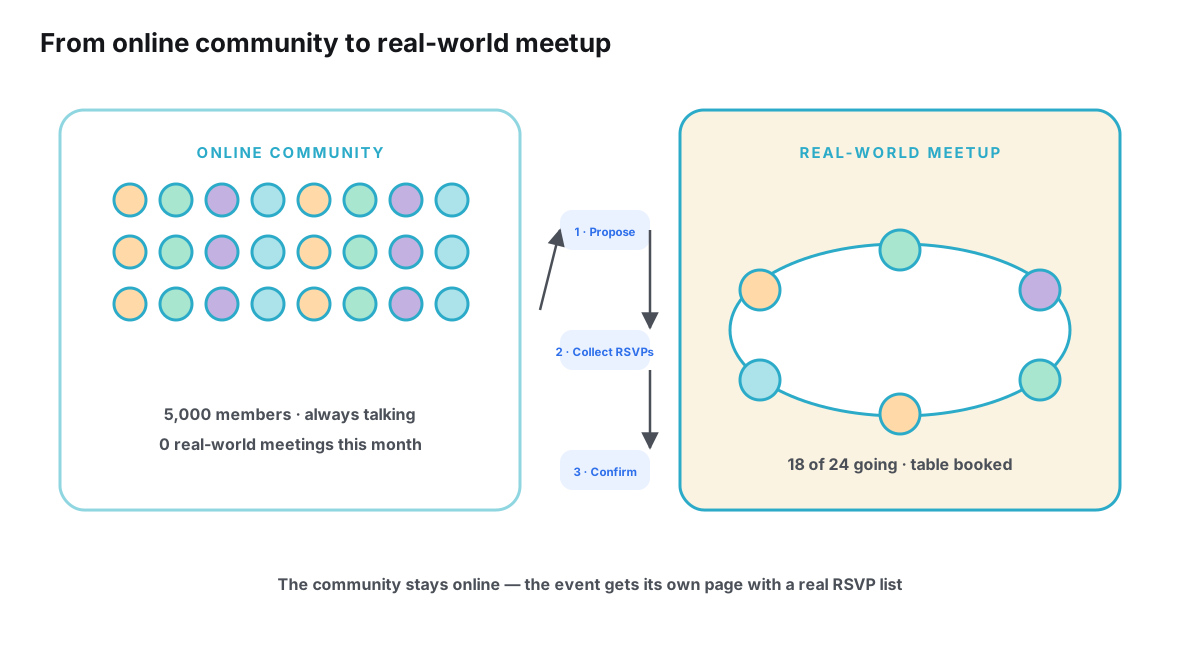
The caveat hides in the last bullet’s shadow. Gaming communities are international by default, and their most visible, most active members are often the most geographically scattered. Enthusiasm for a meetup is global; attendance is regional. The communities that succeed treat this as a design constraint from the first message — mapping who is actually near whom — rather than discovering it when the RSVPs come in. This is the same membership-versus-attendance gap that afflicts every large server, examined in detail in the gap between Discord membership and real-world participation.
Where the organization happens — and where it breaks
The lifecycle of a gaming meetup almost always begins in a server channel: someone floats the idea, the reaction emojis pile up, a thread opens. That impulse is exactly right. What happens next is where meetups diverge, because a fast-moving server is a hostile environment for event details.
A busy gaming server’s general channel can move so quickly that an announcement posted at lunch is hundreds of messages deep by dinner. The planning thread — where the real decisions get made — slides down the channel list and eventually archives out of view. Someone edits an old message with a time change, and no one is notified. A poll picks the date, the poll scrolls away, and the date survives only in the memories of whoever was present for the vote. Each of these is a small, mechanical failure; together they are why “wait, it was today?” is the most traditional sentence in gaming meetup history. We’ve devoted a full article to the mechanics: how Discord event information gets lost in active servers.
The root issue is architectural rather than social. A channel is a conversation — a stream of statements, each true when sent — while an event is a record: one current time, one current place, one list of who is coming. These are different kinds of objects, and a server full of channels is optimized for the first kind. The distinction is general enough that we’ve written about it platform-agnostically in the difference between a conversation and an event object; for gaming organizers, the practical translation is a division of labor. The server carries the excitement, the hype, the trash talk and the countdown. The event’s facts live somewhere stable — one page holding the final details and a named going/maybe list — and the server links to it, over and over, as the standard answer to every question.
Communities that adopt this split usually notice something counterintuitive: the server gets livelier, not quieter. When “what time?” is answered by a link instead of a paragraph, the channel stops drowning in logistics and returns to what it’s for — being a community. The meetup becomes content to talk about rather than a thread to excavate.
Online events are the stepping stone
Between “members of one server” and “people at one table” sits a stage communities often skip: the online event with faces and voices. A community movie night in a voice channel, a tournament broadcast watched together, a voice hangout during a patch drop — these convert lurkers into familiar presences at zero travel cost, and familiar presences are precisely what first meetups are made of.
The mechanism is simple. A member who has heard another member laugh in voice already has the beginning of a relationship; meeting at a venue extends that relationship rather than starting one from scratch. Communities that hold regular voice events tend to find their offline RSVPs filled with exactly the people who had been showing up online — not because online events replace meetups, but because they manufacture the social readiness that meetups require.
The planning timeline of a real meetup
Whatever the format, successful gaming meetups tend to follow a similar backwards timeline. It isn’t rigid — a guild dinner needs less runway than a LAN weekend — but the sequence of decisions is remarkably consistent, because each one unblocks the next:
| When | What gets decided | What goes wrong if it slips |
|---|---|---|
| 6–8 weeks out | Format, rough region, and the anchor team; a temperature-check on who could realistically attend | You plan a LAN for a community that wanted a dinner — or a dinner for people expecting a LAN |
| 4–6 weeks out | The date, by poll among realistic attendees; the venue hunt begins against a known headcount range | Venues book out; the date gets chosen by the loudest three members and half the roster is excluded |
| 3–4 weeks out | Venue confirmed; the event record goes live with final details and named RSVPs; the link drops in the server | The plan keeps living in chat; every later change fragments across messages |
| 2 weeks out | RSVPs stabilize; catering, hardware or seating planned against the committed list, with maybes as buffer | You provision against the poll tally instead of the RSVP list, and buy for a room that never arrives |
| Days out | Reminders against the event record; maybes chased personally; day-of logistics pinned (arrival, parking, banner) | Quiet members who fully intended to come forget; new people with no friend at the door stay home |
| Event day | Anchors greet by tag name; the record is the single source of truth for changes all day | A time or room change announced by mouth reaches a third of the room |
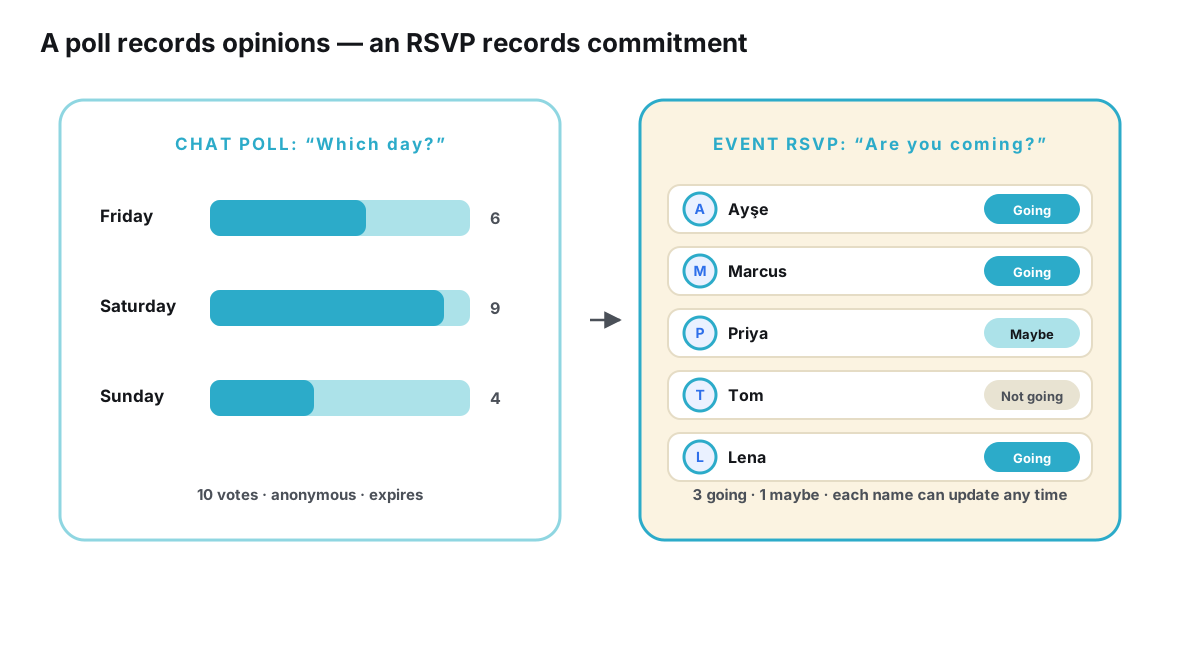
The poll moment in that timeline deserves its own warning, because it’s where gaming communities most often confuse two tools. Polls are superb for picking between dates or formats — the exact question they were built for. But the poll’s tally then needs converting into named commitments, and the conversion doesn’t happen by itself: the winning option must freeze into concrete facts, and attendance must be collected as an RSVP list that lives and updates until the day.
Roles: the roster translates to the room
The quiet advantage gaming communities hold is that their online org chart maps almost one-to-one onto event jobs. A meetup run purely by the founder tends to bottleneck and burn out; a meetup run by the community’s existing structure scales:
- The anchor. A local member who knows the venue and the neighborhood, greets arrivals, and holds authority over day-of decisions. Every location hosting a meetup needs one named person.
- The quartermaster. For formats with stuff — LAN tables and power, rented consoles, banners, merchandise — someone owns the inventory and the checklist. This is a natural job for the guild member who already manages shared resources.
- The treasurer. Any meetup that touches money (venue deposits, group bookings, shared catering) needs one keeper of the numbers and a transparent ledger. Ambiguity about money is the fastest way to sour a community’s trust.
- The greeter. Distinct from the anchor: someone whose only job is noticing arrivals, especially first-timers, and folding them into a conversation. The raid leader who calls targets is often the wrong personality for this; the person who welcomes new recruits is perfect.
- The chronicler. Whoever photographs, clips and recap-posts afterwards. It looks like a luxury role until you see how much of the next meetup’s turnout is built on the last one’s photos.
None of these jobs is heavy alone. Distributed across people who already hold status in the community, they add up to an event that runs itself while the founder enjoys the thing they built — which is the difference between a community that hosts one meetup and one that hosts an annual tradition.
Money, tickets and venues
Small meetups can dodge finances entirely; anything bigger has to face them honestly. The conventions that have served long-running communities well are simple. Costs are shared transparently, announced before anyone commits, and collected through one channel so nobody is chasing twenty DMs. Deposits are paid by the community treasury or advanced by one trusted member and reimbursed — with the ledger visible to all. Tickets, when a format genuinely needs them, are sold against a stated capacity derived from the committed list, not from enthusiasm metrics like interested markers or poll counts.
Venues follow the format. Game cafés and board-game bars are the natural first stop: they already have the tables, the hardware and a culture of groups. Community halls and function rooms suit LAN gatherings, provided someone has genuinely checked the power situation. Convention meetups need no venue at all — just a precise time, a fixed meeting point, and a banner or recognizable object, because “near the main stage at noon” fails exactly when it’s most needed, in a crowd of thousands wearing the same shirt as your guild.
One caution belongs in every gaming meetup plan: underage members. Communities with mixed ages should keep meetups in public, all-ages venues, expect parents to be informed or present, and write the expectation down where everyone can see it. The etiquette around this is established and unglamorous, like most good safety culture — and it protects the community’s reputation, which is its most valuable asset.
Handles to faces
The first hour of a first meetup has a predictable arc. People who have trash-talked each other for three years discover they are shy in person. Someone’s mental image of a guildmate’s age turns out to be off by two decades. The server’s loudest text personality is quiet in a corner, and its quietest member turns out to be the social glue. All of this is normal, and it passes faster when the event has structure — name tags with tags on them, a greeter working the door, a first activity that gives hands something to do.
The safety frame travels unchanged from any online community meetup: public venues, community rules restated, hosts identified, no obligation to share personal contact details, and moderation expectations that don’t pause because the venue changed. What gaming adds is a gift — the instant common ground of the shared game. An anchor who seats newcomers next to compatible guildmates, opens with the game everyone knows, and lets the in-jokes do the icebreaking will find the room warm within the hour. The community already knows each other. The meetup just removes the screens.
After the meetup: the content loop
The event ends; the community keeps going. The meetups that compound are the ones deliberately fed back into the server. The chronicler posts the album. The anchor writes three sentences about what happened. Someone tags the group photo, someone else posts the joke that was funnier in person, and — before the warmth cools — the next date goes up, even provisionally. A community that meets once had an event; a community that posts the photos, thanks the anchors, and announces the next gathering has a tradition.
The loop also pays forward into attendance economics. Members who see a photographed meetup understand what saying yes actually buys them, which converts maybes at the next event better than any announcement. New members join a community with visible, real-world texture — one that seems worth the train ticket. And the organizers get the quiet reward that keeps the whole culture running: a room full of people who found their people through a game, and found out they were real.
A first year, told in three gatherings
Consider a fan-server community — a few thousand members, scattered across countries, devoted to a long-running strategy game. Its offline life begins when Priya notices in a region channel that six members share her metro area. Gathering one is a Wednesday-evening table at a board-game bar: five people, one anchor, three hours. The event record shows five going and two maybes all week; one maybe converts on the day. By every metric that matters — did it happen, was it pleasant, is there a next one — it is a triumph, whatever a comparison against the member list would say.
Gathering two, six weeks later, is a viewing party for a tournament final, timed to the broadcast calendar. The events channel — one post, restricted posting, one link — does the announcing; the RSVP list does the counting; the greeter meets two first-timers at the door and seats them next to the loudest voice in the server, who turns out to be delighted to adopt newcomers. The group photo posts that night, tagged, mid-laugh.
Gathering twelve, a year on, is a weekend LAN in a rented community hall, organized by a small crew with a treasurer and a hand-drawn power diagram, seeded from the same city cluster the first table proved. Nothing about that weekend would have been schedulable from a cold start — venues don’t book against enthusiasm, they book against demonstrated, counted attendance. It was schedulable because a year of small, counted, well-recorded gatherings had built the thing every large event actually rests on: a list of people who have learned that this community’s events happen as promised.
Frequently asked questions
What’s the easiest real-world meetup for a gaming community to start with?
A viewing party or a game-café gathering. Both need only a reservation, a date and a greeter, both come with a built-in program, and both work at ten people or thirty. LAN parties and ticketed events are wonderful traditions but poor first events — they demand infrastructure and budget before the community has proven its turnout.
Our guild is spread across the world. How do we meet in person?
Regionally, not globally. Map where members actually live, seed clusters around the densest areas, and let each cluster host its own smaller gathering under the community’s banner. Many international communities also anchor an annual gathering to a convention or tournament that members travel to anyway.
How do we stop the meetup details from getting lost in the server?
Keep conversation and record separate. Let the channels carry hype and discussion, but hold the final time, place and RSVP list on a stable event page, and make its link the standard reply to every logistics question. Discord’s features — pinned messages, announcement channels, server events — help, and Discord’s support pages document how each works, but busy servers still bury static facts under new messages.
How many people should we plan for if the poll got a big response?
Plan against named commitments, not poll responses or interested markers. Polls measure enthusiasm while they’re visible; attendance comes from people who confirmed against a concrete date and place. Book for the committed list with maybe-responders as buffer, and expect the room to be smaller — and better — than the tally.
Who pays for what at a gaming meetup?
Whatever the split, make it transparent before anyone commits: shared costs announced in advance, collected through one channel, tracked by a named treasurer, and kept visible to the community. Deposit money handled in DMs with no ledger is the single most common source of meetup drama, and it is entirely avoidable.
Should the community leader host every meetup?
No — anchor each location with a trusted local member and let the leader act as sponsor. The anchor knows the venue and the city, greets arrivals, and makes day-of calls; the leader keeps the culture consistent and the roles staffed. Communities that centralize hosting in one person usually stop hosting when that person gets tired.
Conclusion
Gaming communities don’t need to be convinced to meet in person — the tradition predates the tools they now use. What they need is to respect the two gaps that survive the transition: geography, which makes attendance regional no matter how global the enthusiasm, and architecture, which makes fast-moving servers the wrong place to store an event’s facts. Meetups that go well are almost always ones where the community leaned on its existing strengths — identity, roles, practiced coordination — while giving the plan itself a durable home: one record, one link, named commitments, and a planning timeline that freezes the details before it asks anyone to travel.
Run the formats that fit your community, staff the event from the roster you already have, handle money in daylight, feed the results back into the server, and put the next date up before the photos stop getting reactions. Do that twice, and your community stops being a server that once had a meetup and becomes something older and stranger: a group of people, with a shared world and now a shared table, continuing the oldest tradition gaming has.
Your guild already knows each other. Give the meetup one link, one page and one real headcount.
Plan it with Ontaym