
Why Group Chat Isn't the Same as an Event
A group chat and an event share the same app, the same members and often the same name — “the Saturday hike group.” They are different objects with different shapes, and most planning chaos comes from treating one as the other.
Quick answer
A group chat is an open-ended conversation: it has no deadline, no roster of obligations and no state to maintain — it simply continues. An event is a bounded commitment: it happens at a set time, at a set place, with a specific group of people who have said they will be there, and it imposes consequences — reservations, headcounts, money — on those facts. You can and should talk about an event inside a chat; the negotiation genuinely lives there. But the chat cannot be the event, because a conversation records what people said while a commitment records what people agreed to. The moment a plan has real consequences, it needs to live in something shaped like a commitment: a record with a time, a place and a named roster that always shows its current state.
Two objects wearing the same interface
Open a messaging app and everything on the screen looks the same. A joke, a photograph, a time change, an address, a thumbs-up — all of them are bubbles in a vertical stream, visually equal, equally scrollable. When the talk inside a group turns to Saturday, the event begins its life as those bubbles, and because the bubbles live in the group, the group starts to feel like where the event lives. The container and the content fuse in our intuition long before anyone checks whether the container can actually hold the content.
In WeChat this fusion is stronger than almost anywhere, and for good reasons. The app is a super app — messaging sits alongside payments, mini-programs and official accounts — and for hundreds of millions of people it is the default container for social life itself: family, workmates, classmates, neighbors, all in one place, per WeChat’s own description of the platform. When the whole of your social world already lives in one app, creating a group is the path of least resistance for any shared intention. The group becomes the event’s birthplace, its discussion hall and, by default, its recorded memory.
The confusion is reinforced by the fact that the early phase of an event genuinely is conversation. Should it be Friday or Saturday? Does everyone like hotpot? Who can drive? This stage belongs in chat, works wonderfully in chat, and cannot happen anywhere else. The mistake is not starting there — it is assuming that because the conversation produced the plan, the conversation is the plan.
What a conversation actually is
It helps to be precise about the thing we’re dealing with. A conversation — any conversation, in any medium — has a set of properties so familiar they feel like air. It is open-ended: it has no finish line, no moment when it is done, only pauses. It is unowned in its obligations: nobody is required to have read it, and being absent from it carries no formal consequence. Its relationship to time is flow: the newest utterance is the most relevant one, and older material naturally recedes. Its meaning is negotiated as it goes — tone, jokes, half-serious suggestions all get interpreted by people who know each other.
Every one of those properties is exactly right for what conversation is for. Open-endedness is what makes talk feel free; the absence of obligation is what makes participation voluntary and pleasant; the flow of time is what makes a thread feel alive. These are features of the medium, not shortcomings.
Now hold those properties up against what an event needs, and watch each one turn from feature into friction. An event is the opposite of open-ended: it has a hard finish line, after which it is over and its facts are fixed. It is full of obligations: once you have said you are coming, someone is setting a chair. Its relationship to time is not flow but boundary — a deadline before which everything must converge. And its meaning is not negotiated; it is stated: 7 p.m., the east gate, fourteen people. The two objects are not variations of each other. They are opposites that happen to be able to talk about each other.
What an event actually is
An event is best understood as a commitment object: a bounded thing that people promise to participate in, and whose facts have consequences in the physical world. Strip it to its skeleton and you get a short list — a time at which it starts and stops, a place where bodies must physically arrive, a roster of who has committed to being there, a cost, and a status that changes as reality does (planned, changed, cancelled, happened). None of these fields is exotic. All of them are things a restaurant, a trailhead or a coach driver will ask you for, in exactly this form, without any interest in the conversation that produced them.
There is a quiet piece of evidence that events are structured objects rather than vibes, and it comes from outside any single platform. When engineers anywhere on the open web need to describe an event so that machines can understand it, they reach for a defined vocabulary: schema.org’s Event type, with fields for the start time, the location, the organizer, the attendance mode. And when they need to describe one person’s answer to one event, they reach for a separate type entirely — RsvpAction — because a commitment from a specific person is its own object, not a sentence. Nobody modeled an event as a chat transcript. The shape of the thing, when you have to build with it, is fields and records.
This is not an argument that your dinner needs machine-readable markup. It is an argument from design convergence: whenever anyone is forced to be precise about what an event is — venue systems, calendar makers, search engines — they independently arrive at the same small set of labeled fields with current values. That is the event’s true shape. A conversation, forced through the same exercise, would arrive at something else entirely: participants, timestamps, and text.
| Dimension | A group chat is… | An event is… |
|---|---|---|
| Lifespan | Open-ended; it continues indefinitely and never “finishes” | Bounded; it starts, it ends, and afterward its facts are fixed |
| Membership | Loose; being in the group obligates you to nothing | Committed; the roster is the list of people who said yes |
| Relationship to time | Flow; the newest message matters most | Deadline; everything must converge before a fixed moment |
| State | None to maintain; there is only history | Current values that must stay accurate as they change |
| Exit | Leave or mute whenever; socially lightweight | Withdrawing has consequences — a seat, a share, a team |
| Measure of success | Warmth, frequency, liveliness | Bodies present at the right place and time |
The table is not a ranking. Both columns describe good, necessary things — a community needs warmth and an evening needs bodies. The failure mode is expecting the left column to produce the right one because the left column is where the right one got discussed.
Membership is not attendance
The single most common confusion between the two objects is arithmetic: assuming the group’s membership has anything to do with the event’s headcount. A hiking community of two hundred members is a lovely thing, and on any given Saturday perhaps eleven of them will stand at the trailhead. Neither number is wrong; they are measures of different objects. Membership measures belonging. Attendance measures commitment — this date, this time, this level of energy, this babysitting arrangement.
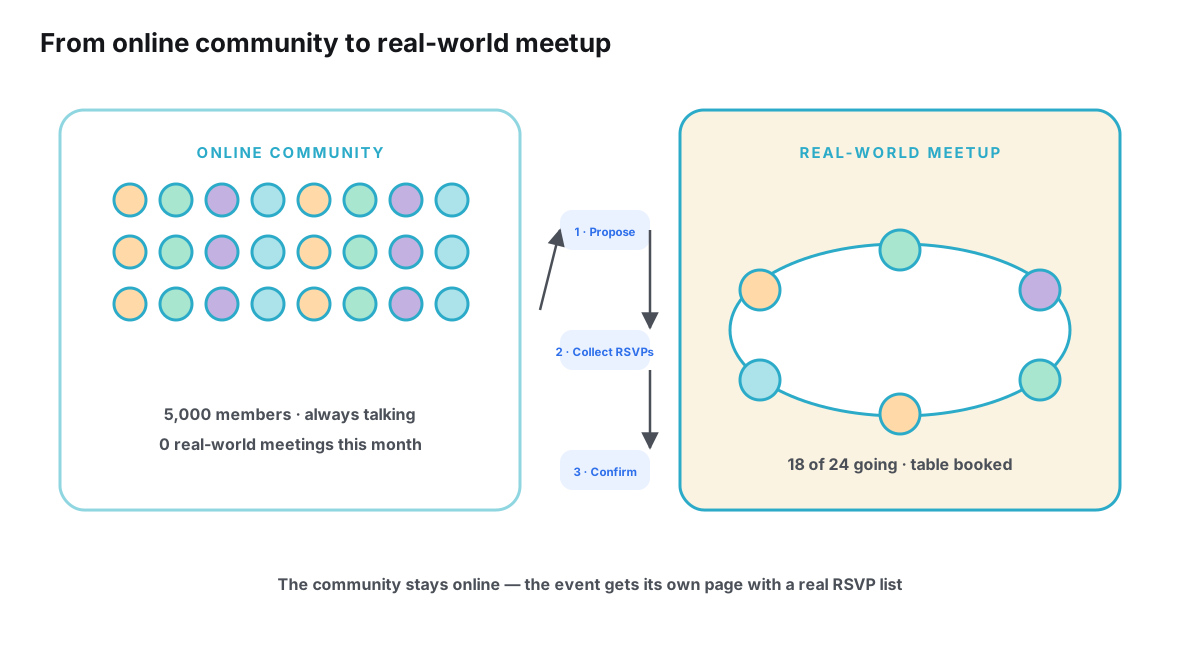
Group chats blur this because they give every member a voice in the event’s social life without any stake in its outcome. Enthusiasm in a thread is genuine and costless: “sounds amazing!”, a fire emoji, a “let’s do it!” — these are ways of participating in the conversation, which is a real and friendly act. They are not commitments. The member who writes “count me in” on Tuesday and quietly doesn’t come on Saturday has not lied; they have expressed a Tuesday feeling that decayed by Saturday. A headcount assembled from thread sentiment is therefore not a slightly noisy version of the truth — it is a measurement of a different quantity altogether.
The reverse confusion exists too, and it is the quieter one: people who fully intend to come but never say anything in the thread, because they are muted, busy, or simply not talkers. The organizer who reads the chat for a vibe check will overcount the enthusiastic and undercount the quiet, and both errors land on the same evening: a reservation for the wrong number. An event object fixes the arithmetic by asking each person one direct question — going, maybe, or not — and letting the answers stand as data rather than mood.
A small illustration makes the two measures irreconcilable. Maya runs a book club out of a WeChat group of sixty members. The thread before each meeting is lively — fifteen people react to the announcement, eight reply with enthusiasm, three post the fire emoji. On meeting night, seven people arrive, two of whom never wrote a word in the thread, while six of the loudest supporters are absent without a mention. Nothing about this is hostility or even carelessness; it is two populations being measured by the wrong instrument. If Maya books a room based on thread energy, she overpays every month. If she books based on who actually appears, she needs an attendance record, not a sentiment sample — and the only place a thread can keep one is nowhere.
The weight of a promise
What separates a commitment from a sentiment is that other people act on it. A restaurant holds a table for fourteen because you said fourteen. A hike leader waits at the gate because nine people said nine o’clock. A friend declines a better invitation because they told you they would come. Every one of these is a promise extended on credit — and the credit is backed not by the warmth of the conversation but by the accuracy of the record.
This is why chat is not merely an imperfect vessel for commitments but an unfair one. When the plan lives in a thread, the person who breaks their word can half-believe they never gave it — after all, “count me in!!” was just a message among messages, sandwiched between a photograph and a joke, with no signature and no ledger. And the person who kept their word gets no record of having done so. Over time, a community that keeps its commitments in conversation has to spend social energy compensating — gentle reminders, apologetic recounts, the organizer’s memory standing in for a system. A community that keeps them in an event object spends that energy on the events themselves.
There is a financial shadow to the same problem. The moment an event involves money — a deposit, a split bill, prepaid tickets — the conversation stops being a soft record and starts being a disputed one. Who paid, who owes, who cancelled after the cutoff: these are questions with answers, and threads do not hold answers, only assertions. A commitment object does, which is why the moment money enters an event, structure stops being optional politeness and becomes bookkeeping.
Time behaves differently in each world
Inside a conversation, time has no authority. A topic can be reopened at any moment; a decision made on Tuesday can be casually re-litigated on Thursday; nothing is ever formally closed. This is a feature — it is what allows conversation to be diplomatic, exploratory, humane. Half the pleasure of planning with friends is the negotiation itself.
An event, by contrast, is a deadline wearing a social disguise. At some specific moment — when the reservation must be made, when the car must be booked, when people must physically leave their houses — the window for re-litigation closes. After that moment, a reopened question is not discussion; it is damage. The planning conversation needs a mechanism to mark questions as settled and keep them settled, and a chat thread has no such mechanism. Every earlier assertion stays in the scroll, equally visible, equally confident, with no flag saying “this one was superseded.” Two days before the dinner, the thread still contains every option ever floated, in the order they were floated, and the only thing distinguishing the winner is that people who were present remember which one won.
This is the precise point where “we discussed it in the group” diverges from “it’s decided.” A conversation can contain a decision the way a river can contain a footprint. An event object is the stone: the decision carved into current values — this date, this place, this roster — which remain readable by anyone, at any time, including people who were not there when the river flowed past.
It is worth noticing that groups already know this, because they invent folk mechanisms for it constantly. Someone types the final plan in all caps. Someone screenshots the confirmation and pins it somewhere. Someone says “last call — silence means yes,” importing a deadline into a medium that doesn’t have one. These rituals are the group’s own recognition that a thread cannot close a question by itself. They work about as well as any improvised tool works: honorably, temporarily, and at the cost of whoever maintains them. A dedicated event record is simply the same recognition, built properly — finality as a property of the object rather than a habit of the loudest member.
Why chat absorbs events anyway
Given all this, why does nearly everyone plan in chat at first? Because for the first stretch of any plan, chat is unambiguously the right tool. The population is small, everyone is reading, the facts are still fluid, and the negotiation is the work. The group chat is where the event is conceived, and conception feels like a strong claim of custody.
The second reason is the absence of a better-shaped object within arm’s reach. In WeChat, the natural building blocks at hand are groups, more groups, and messages — so the event gets expressed in the only medium available, the way people once wrote shopping lists on whatever envelope was nearby. The envelope holds the list fine until someone needs this week’s list and finds three weeks of them. If you want the anatomy of exactly how that decay proceeds as threads grow and details multiply, it is covered in why WeChat group chats become difficult for event coordination — the mechanics of buried details, contradictory corrections and silent forking.
The third reason is social: declining to plan in the group can feel like declining the group. Creating a separate place for the event can read as bureaucracy, or as a slight to the room where everyone hangs out. This feeling is worth taking seriously, because the fix has to be social as much as technical — the event’s separate home must be presented not as a replacement for the conversation but as its completion. The talk continues exactly where it was; the outcome just gets a place to stand still.
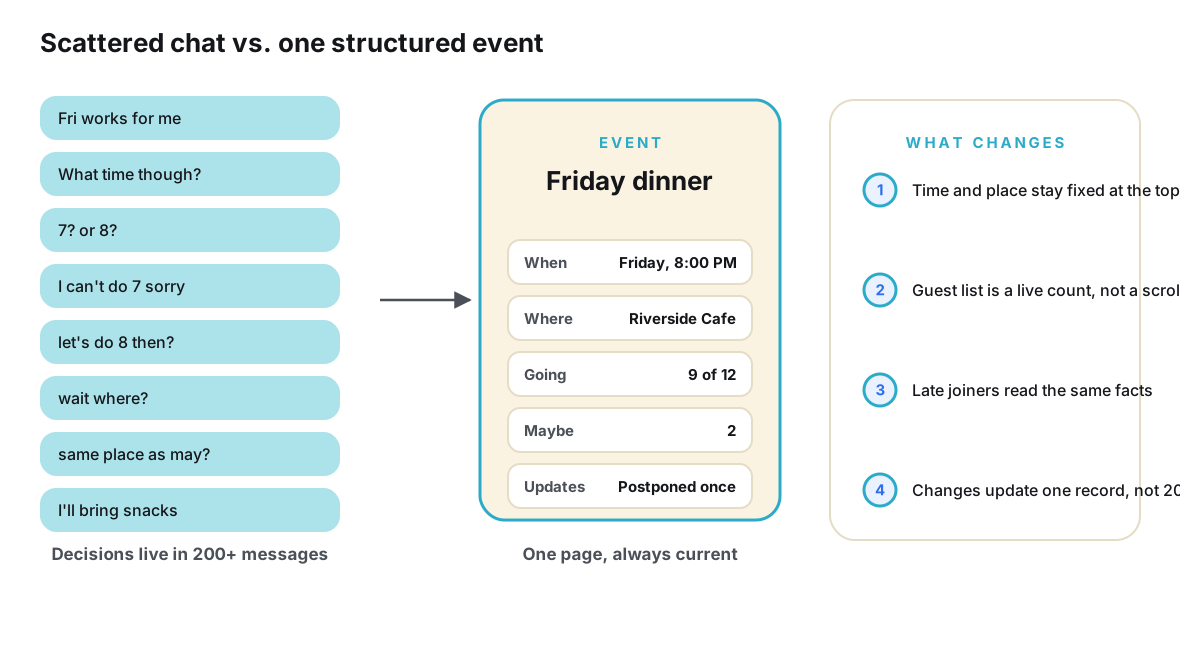
| What the event needs | What the thread offers | What gets lost |
|---|---|---|
| One current final time | The most recent related message | Every earlier time remains visible and equally plausible |
| A definitive roster | “+1”s, reactions and enthusiasm | Tuesday feelings measured as Saturday facts |
| Controlled changes | A correction message | Old facts are superseded only for whoever reads the correction |
| A headcount for the venue | The organizer counting replies | Silent intenders missing; loud non-comers included |
| A point of entry for late joiners | “Scroll up” | Archaeology instead of an answer; history instead of state |
| Finality before the deadline | An ongoing negotiation | Settled questions can reopen at any moment |
The working relationship between the two
None of this is an argument against group chats, and it is emphatically not an argument against WeChat groups, which remain one of the great containers for community life. It is an argument for a division of labor that treats each object as what it is. The conversation negotiates; the event object commits. The group chat is where options are floated, enthusiasm is expressed, jokes are made and the social texture of the plan is woven. The event record is where the outcomes stand still: the settled time, the place, the named roster of the going and the maybe, the change history, and nothing else.
The bridge between the two is an address. When the group’s discussion has produced a plan worth keeping, the plan gets a home of its own — a page with one current version — and the group receives that home as a link. From then on the thread does what threads do best: it stays warm, it reacts to news, it hosts the banter of anticipation. And every material question — what time, where, who’s coming, has anything changed — is answered by the same two-tap gesture, for the veteran who was there at conception and the newcomer added yesterday, alike. This is the reasoning behind why an event needs its own digital space: not because the conversation failed, but because the commitment deserves a container shaped like a commitment.
Tools exist that embody exactly this split — Ontaym, among others, gives each event a page with going and maybe statuses, polls for the still-open options, updates and reminders, and a single link to carry into any chat — but the principle is tool-agnostic. Whatever holds your event’s current state and can be reached by one link will do the job; the group chat then becomes what it was always best at, which is the place where the event is loved into existence.
There is a natural sequel, too, for communities whose events repeat. A weekly hike or monthly dinner is not one event but a series of them, and the conversation-versus-commitment split has to be re-established for every occurrence — the roster changes, the details rotate, and the series itself needs a rhythm. That extension of the idea is worked through in how WeChat communities can organize recurring activities. And if what you want is the concrete, step-by-step version of keeping talk and details apart inside your existing WeChat workflow, it is laid out in how to separate conversation from event information in WeChat.
Frequently asked questions
If the group chat contains all the event discussion, why isn’t it the event?
Because discussion is the input, not the object. A conversation records what people said while a plan was forming; an event is the bounded commitment those statements add up to — a time, a place, a roster. The thread can contain every word ever spoken about Saturday and still not contain Saturday, the same way a transcript of a negotiation is not the signed contract.
Isn’t a pinned message basically an event record?
A pin is a frozen snapshot of one message. It works until anything changes, at which point someone must remember to replace it — and the people who saw the first pin but missed the replacement hold the old facts with full confidence. An event record is different in kind, not degree: it has labeled fields that are edited in place, so there is only ever one version, and it is always the current one.
What does an RSVP actually mean, compared with replying in chat?
An RSVP is a personal commitment attached to a specific event: it names you, it persists, it can be changed deliberately, and it rolls up into a headcount other people act on. A chat reply is a message — sincere, but momentary, buried by the next message, and invisible to anyone assembling a count later. When a venue needs fourteen chairs, it needs the first kind of object.
Should my WeChat group stop being used for planning?
No — and this is the point most worth getting right. The group should stay exactly where it is for the parts of planning that are genuinely conversational: floating options, testing enthusiasm, working out who can drive. What should move out is only the outcome. Post the plan’s address into the group, let the talk continue around it, and answer material questions with the link.
How does this change for recurring activities?
A series multiplies the split. The community group remains the permanent audience, but every occurrence is its own event object with its own date, its own roster and its own headcount, because the twelve people who come this week are not the same twelve as last week. The series itself then needs a rhythm and standing rules that outlive any single thread.
Conclusion
A group chat is one of the best inventions social software has produced, and nothing here subtracts from that. It is a room that is always warm, always populated, always available for the negotiation that every real event begins as. The error is subtler than “chat is bad for planning”: it is a category error, treating a conversation — open-ended, obligation-free, flowing — as though it were a commitment — bounded, rostered, deadline-bound — because the commitment happened to be born inside the conversation.
The practical correction is small and durable. Let the two objects coexist with different jobs. The group chat negotiates, jokes and belongs; the event stands still somewhere with an address, holding one current version of the time, the place and the roster of people who actually said yes. Communities that internalize the split stop measuring their evenings in scrollback and start measuring them in chairs correctly counted — and, just as often, find that the conversation gets better, because it is finally free to be only a conversation.
Let your group chat do the talking — and give the plan a place to stand still.
Plan it with Ontaym