
How GroupMe Handles Group Coordination
GroupMe earned its place in group life by doing one thing well: giving every circle — roommates, teams, cousins, trivia squads — a shared space that asks almost nothing of its members. That same lightness is also why coordination inside it stays conversational, and why plans with moving parts eventually want somewhere more structured to live.
Quick answer
GroupMe is a genuinely good coordination tool for groups whose plans are simple and whose people are already there. It gives you a persistent shared space, basic polls for small either/or decisions, and likes that let people signal without typing a word. It stops helping when a plan acquires state: a final time that changed twice, a headcount a restaurant is waiting on, options that need comparing, or guests who arrive after the decisions were made. Those are record-keeping problems, and a message stream keeps records only implicitly. The practical answer is a split — keep GroupMe as the conversation layer, and give each real event its own page that always shows the current plan, linked from the group.
What GroupMe is actually good at
GroupMe is Microsoft’s group messaging app, and its design center shows: it is built around groups rather than one-to-one chats. Where many messengers treat the group as one of several conversation types, GroupMe’s whole experience — creating a group, naming it, living in it — treats the group as the primary unit. For a rec league team, an extended family or a set of roommates, that framing fits how the group already thinks about itself. You don’t assemble a conversation; you join a place.
The app’s coordination features are deliberately light. There are basic polls, there are likes on individual messages, and beyond that the group is mostly a stream of messages from people who already know each other. This restraint is a strength more often than it gets credit for. A poll with two options — Saturday or Sunday — takes seconds to create and even less to answer. A like on “I can drive if we go at 7” is a fast way to say “good with me” without adding another message to the pile. For the daily weather of group life, this vocabulary is enough: who’s around, who’s bringing what, does anyone object to the usual place.
The third thing GroupMe does well is continuity. A standing group outlives any single plan. The team chat from last season is still there when the next season starts, still carrying the same people, the same running jokes, the same shared context. Coordination that leans on continuity — recurring hangouts, weekly games, annual trips — benefits from a home that never gets deleted. That’s something a one-off planning tool can’t replace, because half of what makes recurring groups work is the relationship layer, not the logistics layer.
You can see the app describe its own scope on GroupMe’s product site: group messaging with a few conveniences attached. Read as an organizer, that description is accurate and useful. It tells you the tool considers its job finished at “messages reach the group” — which is precisely the job it does well.
How coordination actually happens in a GroupMe group
Watch a real plan form in a GroupMe group and you can usually spot the same sequence, even though nobody designed it. Someone floats an idea in a sentence. Two or three people reply with variations of enthusiasm. Somebody proposes a concrete option — a day, a place, a time — and someone else proposes a rival. If the group is organized, a poll appears and settles it. If not, the loudest consensus wins by implication. The final detail, whatever it is, now exists as one message among hundreds, findable mainly by whoever remembers roughly when it was sent.
This process works because of a property that’s easy to overlook: for small plans, shared attention is enough. While everyone is reading everything, a message stream is a perfectly adequate record. The proposal is seen, the confirmation is seen, the objection is seen. Nobody needs structure because everybody is present for the whole conversation. Groups instinctively scale this up — and it keeps working right up until shared attention runs out: someone muted the group for the afternoon, someone was added on Thursday to a plan that started Monday, someone’s notifications buried the one message that mattered.
There’s a second property worth naming: in a stream, agreement is invisible. Suppose Maya asks “8 work for everyone?” and gets six likes. That looks like consensus, and functionally it is — but the record shows only that a question was asked and liked. It doesn’t show who specifically agreed, whether the agreement survived a later time change, or whether the two people who never reacted were agreeing silently or never saw it. For a casual plan, nobody cares. For a plan with a reservation attached, the organizer suddenly does care, and discovers the stream can’t answer.
| Task | How the group typically does it | When it holds up | When it strains |
|---|---|---|---|
| Quick “who’s in tonight?” | A message, replies, and likes on the proposal | Small group, same evening, everyone active | Bigger group, quieter members, plans made days ahead |
| Choosing between two options | A basic poll inside the group | Genuine either/or decisions settled once | Options that change, need discussion, or vary per person |
| Sharing an address or time | One message with the detail | Posted once, never changes | Details that get revised as the plan firms up |
| Changing a decided detail | A new correcting message | Everyone sees it soon after sending | Late readers, muted members, several changes stacking up |
| Counting heads for a venue | Counting replies and reactions by hand | Rough, small, flexible counts | Any count someone must defend to a restaurant or captain |
| Catching up a late joiner | “Scroll up” or a re-typing of the plan | Short, calm threads | Long threads mixing decisions with chatter |
Notice the pattern in the right-hand column. The group never fails at talking. It fails at remembering on behalf of people who weren’t paying attention at the right moment — which is a fair description of what event coordination becomes the moment a plan matters.
The moment a plan becomes a plan
There is a threshold in group planning, and it’s worth knowing exactly where it sits. On one side are plans that are really just agreements: dinner Friday at the usual place. One decision, one message, no dependencies. On the other side are plans that have become plans: a weekend trip with a cabin deposit, a car count and a grocery list; a birthday dinner where the restaurant wants a final number; a tournament with registration deadlines. These have multiple decisions, dependencies between them, and outside parties waiting on outputs — headcounts, arrival times, payments.
GroupMe’s vocabulary was sized for the first kind. Polls handle one decision at a time; likes handle one message at a time; the stream handles everything conversationally. A multi-part plan doesn’t break the group in one dramatic moment — it degrades it, decision by decision. The cabin poll happens in one week of the thread, the car discussion in another, and by the time someone reasonably asks “wait, what did we land on?”, the answer requires reconstructing several mini-histories at once. The group did its job; the plan simply outgrew a format that stores outcomes as conversational by-products.
This is also the point where groups typically reach for half-steps. A common one is a scheduling poll — the pattern made familiar by long-standing scheduling-poll services like Doodle, which exist specifically to find a date and time across many calendars. It’s a real improvement over debating dates in prose, because it gives one narrow decision a proper structure. But a date poll solves exactly one field of the event. The place, the headcount, the what-to-bring list and the three changes that follow all still live in the stream. Half-steps help with symptoms; the underlying gap is that the event as a whole has no home.
Likes, polls and the headcount problem
The headcount deserves its own discussion because it’s where conversational coordination meets real-world consequences. A restaurant wants a number. A team captain needs to field a side. The person booking the canoe rental needs to know whether it’s four boats or seven. In GroupMe terms, that number gets assembled from replies (“in!”, “maybe”, silence), likes on a proposal, and the organizer’s private guesses about the silent ones.
The trouble isn’t laziness — it’s that none of those signals mean what the organizer needs them to mean. A like on “who’s coming Friday” is often just moral support. A “maybe” typed on Tuesday says nothing about Friday evening. Silence is ambiguous in both directions: no, or yes-but-hasn’t-seen-it. And every one of these signals is anchored to a moment in the stream, so it ages silently. The organizer ends up running a manual census, messaging people one by one, and apologizing for the hassle — work the medium was supposed to prevent.
A structured RSVP flow inverts this. Instead of signals scattered across moments, each person holds one current status — going, maybe, not going — that they can change and that rolls up into a live count the organizer can read at any time. The difference is not politeness or effort; it’s data shape. Reactions are annotations on messages. RSVPs are per-person fields on an event. The first kind can’t be counted reliably no matter how disciplined the group is, and the second kind can’t be produced by a message stream no matter how featureful the chat app becomes.
The correction pile: how changes behave in a stream
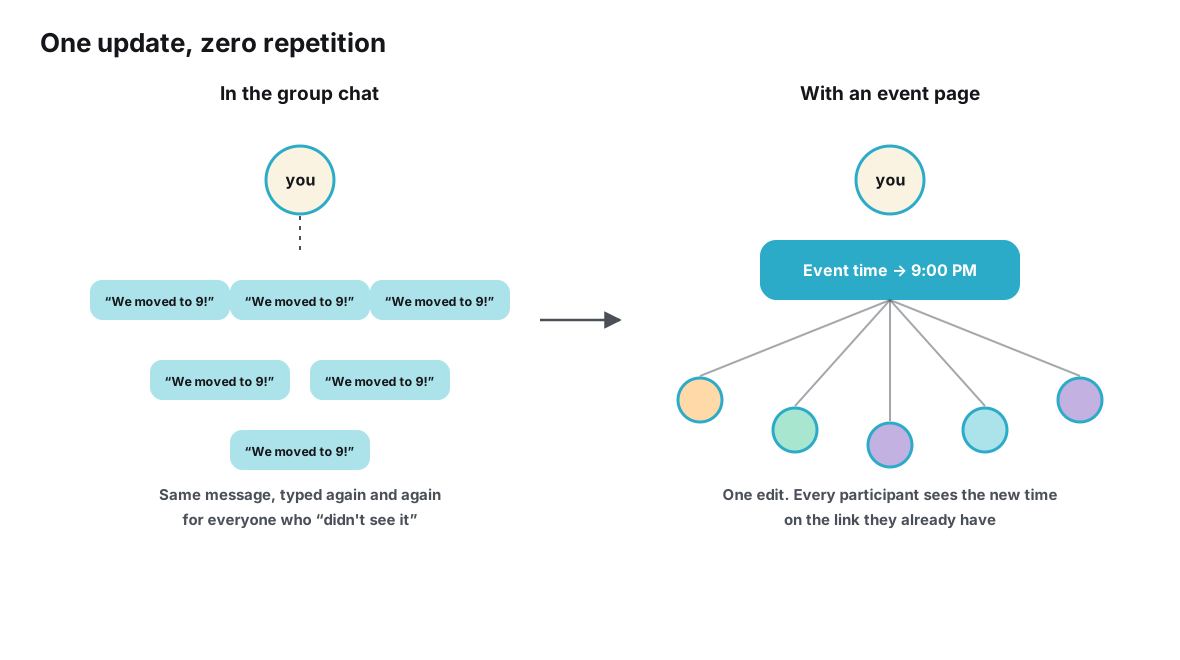
Every plan changes, so a coordination tool is judged less by how it starts a plan than by how it survives revising one. In a GroupMe group, a change is a message. “Actually 8:30, not 8” enters the stream like any other message, and from that moment the group contains two facts about the start time, distinguished only by their order. That works while everyone reads everything. It fails in the gaps: the friend who opened the app at lunch, saw the original plan near the top, and closed it again; the person replying to an older message from their notifications; the group member glancing at a screenshot someone sent them privately.
Organizers respond to this predictably, and each response costs something. Repeating the correction works but trains the group to expect noise, and the repetition itself buries other details. Pinning or re-sharing the latest version helps for a while, but every new change restarts the cycle, and the group’s pinned truth ages the moment it isn’t re-pinned. Answering people individually works best and scales worst — the organizer quietly becomes a dispatcher, relaying the same fact in a dozen private conversations.
What no chat-based response can do is replace the old fact. In a stream, corrections don’t overwrite; they accumulate. A plan that changed its time, then its place, then its car arrangements leaves every earlier version intact in the record, each one still confidently asserting itself. The diagram above shows the structural alternative: a change made once on an event page, which every reader sees the next time they look, with no repetition and no stale copies left behind. Groups that plan one-off dinners never feel this. Groups that plan anything with a timeline — bookings, deadlines, travel — feel it almost immediately.
Recurring groups: one thread, many events
GroupMe’s standing groups shine brightest in recurring settings — the weekly game night, the season-long team, the monthly dinner club — and this is also where the stream’s memory problem compounds. Each new gathering is planned in the same thread as the last one, so the conversation that matters this week is separated from the conversation that mattered last week by nothing but volume. A newcomer to the group joins not one plan but the sediment of ten, and the regulars’ shared memory quietly substitutes for the record they don’t have.
The recurring case also exposes a subtle accounting problem: each event needs its own RSVP list, but the group has only one continuous conversation. Last week’s “I’m in!” sits a screen away from this week’s, and even the organizer can’t reliably tell them apart at a glance. Multi-event weeks — a Tuesday practice and a Saturday match — interleave in a single thread until neither is cleanly readable. Groups work around this with heroic message hygiene, timestamped summaries, or a fresh subgroup per season, each a patch that acknowledges the missing structure.
The fix, again, is per-event structure layered under the standing conversation: one page per gathering, each with its own guest list and details, all linked from the same group. The thread keeps its role as the clubhouse; the pages keep the weeks from blurring into each other. Regulars stop answering “which week is this?” and newcomers stop digging for the current plan through the archaeology of previous ones.
When the group isn’t the whole guest list
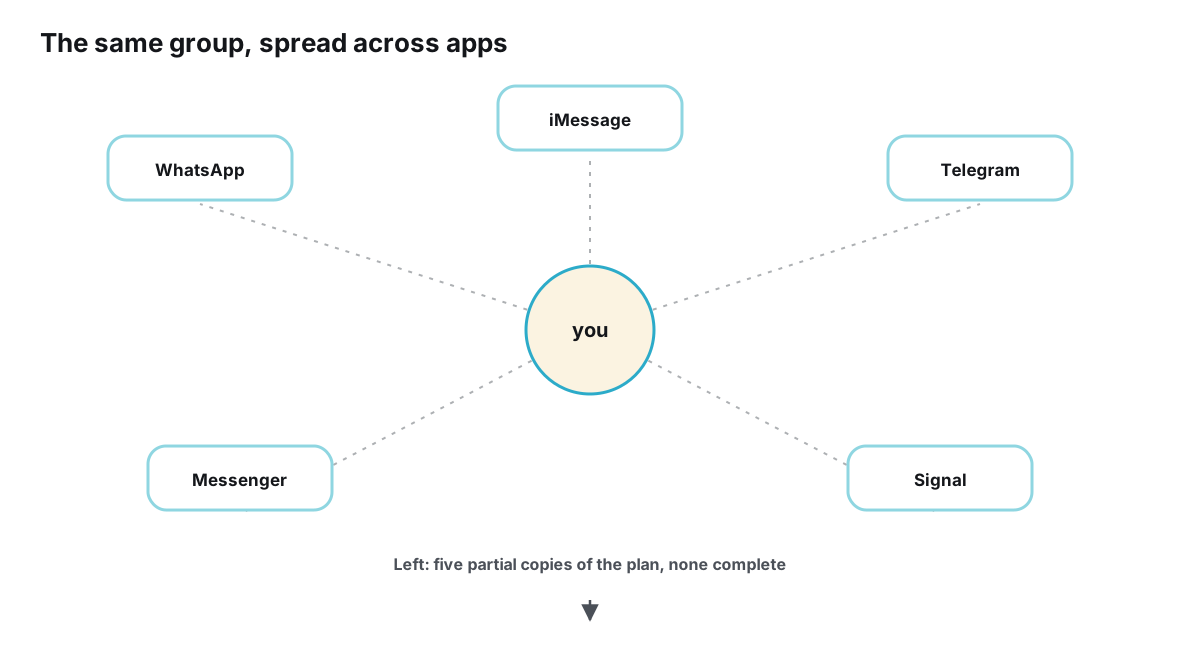
Everything above assumes the GroupMe group and the guest list are the same set of people. Often they aren’t. The birthday girl’s college friends live in another app. One cousin never installed anything beyond text messages. The new teammate joined the group, but the plus-ones never will. The organizer’s reflex is to solve this socially — create a parallel group in the second app, or forward screenshots — and that works, at the cost of splitting the plan’s memory in two.
Split memory is more expensive than it looks, because every update now has two publishers and two audiences. The time change posted in the GroupMe group must be manually mirrored to the other app; the question asked in the other app must be answered back in the group; and any detail that diverges — one thread says 7, the other says 8 — is discovered only when it hurts. The organizer becomes a human sync service between conversations that were never designed to share state. This failure mode is common enough that we treat it in depth elsewhere: see what happens when an event is planned across multiple messaging apps.
The alternative worth knowing is the neutral link. Instead of trying to make one app reach everyone, the organizer gives the event itself an address that opens anywhere — a page carrying the time, place and RSVP list, which each person reaches through whatever app they already use. The GroupMe group stays exactly as it is; the link simply removes its border. For groups that keep bumping into the not-everyone-is-here problem, this single change tends to accomplish more than any amount of cross-posting discipline.
| Situation | Best home for the plan | Why |
|---|---|---|
| Same-week casual hangout, small active group | The GroupMe group alone | Shared attention covers it; structure would be ceremony |
| Small dinner with fixed details that won’t change | The group, plus a clearly worded confirmation | One decision, one message, low stakes if re-read |
| Event with options to compare and a venue headcount | A dedicated event page linked from the group | Needs current state and per-person RSVPs the stream can’t hold |
| Recurring club or team with rotating events | Group for community, one page per event | Keeps the standing conversation and the per-event record separate |
| Guest list spanning several apps or non-users | A neutral event link shared everywhere | One address reaches all apps; no cross-posting required |
| Plan that has already changed twice | Move it to a page now, announce once | Stops the correction pile-up before the third change lands |
A division of labor that keeps the group fun
None of this argues for planning less in GroupMe. It argues for splitting two jobs the group was silently doing at once: being the social space and being the record. The split is simple to run. Keep the group exactly as it is — the jokes, the polls, the momentum. When an idea firms into a real plan, create one event page for it with whatever is known so far, and drop the link into the group. From then on, the group debates and the page remembers. Questions about what was decided get answered with the link; changes get made once on the page instead of announced repeatedly in the thread; the headcount reads itself off the RSVP list instead of being counted by hand.
The payoffs arrive exactly where the stream was weakest. Late joiners catch up in seconds by opening the current state, not by excavating the backlog. The venue gets a number the organizer actually trusts. And the group chat gets quieter in the best way — less repetition of logistics, more of whatever made the group worth having. Tools like Ontaym are built around this pattern: each event gets its own page with options to vote on, RSVP statuses, an invite link and updates, while the conversation stays wherever the group already lives. For a fuller treatment of the underlying idea, see how to create one source of truth for a group event.
The same logic generalizes across the other chat apps your circles use, because they share the same architecture — a stream of messages doing its best to hold a structured object. If your crowd lives in Apple’s ecosystem, the dynamics are covered in why iMessage groups are difficult for complex plans, and if your group centers on Meta’s messenger, the practical patterns — and their limits — are laid out in how Messenger groups can be used for event coordination. Different apps, same threshold: conversation carries a plan until the plan needs a memory.
Frequently asked questions
Is GroupMe a good tool for planning events?
For simple plans among people who are already active in the group, yes — the persistent space, quick polls and low-friction replies are genuinely well matched to that job. It becomes the wrong primary tool when a plan has moving parts: options to compare, details that change, a headcount a third party needs, or participants who join after decisions were made. Those need a current-state record, which a message stream doesn’t provide.
Can a GroupMe poll work as an RSVP list?
Not reliably. A poll captures a vote at the moment it was cast; it doesn’t track whether that answer still stands as the date approaches, doesn’t distinguish going from maybe, and doesn’t update when circumstances change. Use polls for preferences (“which day?”) and a real RSVP mechanism for commitments (“are you coming?”). The two look similar in a chat window and behave very differently by event night.
What’s the best setup for a recurring group?
Keep the GroupMe group as the standing home — it carries the relationships and the day-to-day talk that make the group work. Give each individual gathering its own event page and share the link in the group as it approaches. This keeps history readable (this Friday’s plan isn’t buried under last month’s), gives each event a clean RSVP list, and leaves the group free to stay conversational.
How do I include people who aren’t in the GroupMe group?
You have two basic options. The social one is a parallel group in their app, which works but makes you the manual sync between two copies of the plan. The structural one is a neutral event link that opens in any browser — the GroupMe group keeps talking, and everyone else reaches the same current plan through whatever app they already use. The second option scales much better as the guest list grows.
What about last-minute changes on the day itself?
The day of the event is when the stream’s weaknesses and strengths collide. A quick message is still the fastest way to reach an active group — that part of chat works. What you want in addition is one stable destination for the final state, so that “check the event page” resolves every follow-up question at once: the new time, the meeting point, who’s already en route. Message for speed, page for truth; the two together beat either alone.
When should a plan move out of the group chat?
Watch for three signals: the same question returning from different people, a detail that has changed at least once, or a number you’ll have to give to someone outside the group — a restaurant, a captain, a ticket site. Any one of them means the plan now has state, and state belongs on a page with an address, not in a stream of moments.
Conclusion
GroupMe does its real job — hosting a group’s ongoing conversation — very well, and its polls and likes are honest, useful conveniences on top of that job. The difficulties people attribute to it are really difficulties of asking a message stream to double as an event record: to hold one current time, one countable guest list, one visible latest version. No amount of group discipline fully fixes that, because the format itself doesn’t store outcomes.
The durable setup is a division of labor. Let the group be the group: the place where ideas spark, options get debated, and the social energy lives. Give each plan that graduates into a real event its own page — with the final details, the RSVP list and the changes — and let the group link to it. Groups that adopt this split don’t enjoy each other less; they just stop paying the repetition tax on every decision, and organizing stops being a second job.
Keep the group chat for talking — give the plan its own page.
Plan it with Ontaym