
How to Invite People Without Adding Them to Another Group Chat
Every group chat asks something of its members: attention, identity, permanence. An invitation doesn't have to ask for any of that — and learning to invite without conscripting people is one of the kindest upgrades an organizer can make.
Quick answer
To invite people without adding them to another group chat, put the event somewhere addressable — a page with the details and an RSVP list — and send each person the link through whatever channel you already share. The invitation itself should be self-contained: what, when, where, who is hosting, and how to respond, all readable without joining anything. Responses happen on the event as going, maybe or not going, so the headcount maintains itself while each guest keeps their existing chats intact. Conversation remains optional rather than structural: whoever wants the banter can use an existing thread, and no one's participation requires membership, an app install, or a phone-number exchange. The result is opt-in participation — people come because they chose to, say maybe without ceremony, and leave nothing behind when it's over.
What "just add them to the group" really asks
The reflex is understandable. The event needs a home, groups are homes, adding someone is one long-press away. What the reflex hides is the size of the request being made — because joining a group is never just joining a group.
Start with identity. WhatsApp builds its membership on phone numbers, so being added means your number becomes part of the group's fabric — visible to the admin, entangled with the app's model of who you are, as the WhatsApp Help Center explains in its coverage of how groups work. iMessage inverts the cost: rather than asking for a number, it asks for hardware, since iMessage groups are tied to Apple devices — anyone on Android cannot join at all, as Apple's own support pages make clear. A phone number is personal data in the plain sense, and in the legal sense too under regulations like the EU's GDPR and California's CCPA, which exist partly because numbers travel further than the people who own them expected. None of this makes either app improper; it makes membership a real ask with a real price, rather than the nothing it is usually assumed to be.
Continue with attention. A new group means a new stream of notifications from a dozen strangers, arriving for a fortnight around an event the invitee is still deciding about. The polite defense — muting — quietly defeats the group's entire purpose, because a muted member misses the updates that were the point. And finish with permanence: groups outlive their events. The birthday dinner happens once; the chat persists, an artifact on everyone's home screen, waiting to be scrolled, archived or guiltily abandoned. Some groups earn long lives. Most event groups simply linger.
The cumulative effect has a name your friends already use, usually with a sigh: group-chat fatigue. Most people belong to more chats than they can honestly attend to, and every new addition — however welcome the occasion — spends from the same depleted account. An organizer who adds rather than invites is drawing on that account before asking whether the event itself justifies it.
What an invitation actually needs
Strip the occasion down to its mechanics and an invitation needs remarkably little: the information a guest requires to decide (what, when, where, roughly who else, what it costs or requires), a signal of who is inviting them, and a way to respond. That's the whole contract. Everything else — membership, presence in a conversation, visibility to strangers — is packaging that group chats happen to bundle in by default.
The table below compares the two bundles honestly. It is not an argument that group chats are bad; it is a clarification of what each approach costs the person you're inviting, which is the cost an organizer actually controls.
| To… | Being added to a group chat | Receiving an event link |
|---|---|---|
| Take part at all | Have — or install — the right app, then be added to the group | Open a link, in whatever browser or messaging app they already use |
| Be identifiable | Attach their phone number to the group's membership | Appear as a name on an RSVP list, nothing more |
| Handle what follows | Every message from every member, indefinitely, until they leave | Only the updates the organizer publishes to the event |
| Change their answer | Announce a change of heart in front of the whole room | Switch their own status, silently, in seconds |
| Decline | Leave visibly, or stay muted while messages keep arriving | Mark not going; nothing else changes for them |
| After the event | A group persists, awaiting a quiet exit or an eternal archive | The record settles and asks nothing further of anyone |
Read the right-hand column as a design brief rather than a sales pitch: self-contained, identity-light, low-volume, reversible, and temporary. Those five properties are what make an invitation feel like hospitality instead of an obligation.
The opt-in principle
Underneath the mechanics sits a principle worth making explicit: participation should not require membership. A person's relationship is with the event — the dinner, the hike, the game night — not with a chat created around it. When the invitation and the membership are fused, declining the event means leaving the group, and leaving the group means a visible exit; small frictions, but they accumulate into the pressure that makes people say yes to things they will later quietly abandon.
Separating the two changes the psychology in both directions. Guests who RSVP know they chose to, which makes the yes more durable. Guests who hesitate can hold a maybe without narrating their hesitation to an audience. And the organizer, freed from the sense that every invitee owes presence in a shared room, can cast a wider net — inviting the marginal friend, the new colleague, the friend-of-a-friend who would never be added to a chat but might happily come to a dinner. Opt-in widens the guest list precisely because it narrows the ask.
None of this is hypothetical hospitality engineering; it's how most real-world invitations already work. A wedding invitation does not enroll you in the couple's family group chat. A party invite arrives, you reply to the host, and your participation ends when the evening does. The digital group chat fused two things that offline life had always kept apart — and the fix is simply to un-fuse them.
The eight steps
The practice of opt-in inviting is a short procedure. Run it in order; each step makes the next one easier.
- Give the event an address before you invite anyone. Create the event page first — what, when, where, RSVP — so every invitation can carry a destination instead of a promise.
- Write the invitation so it works for a stranger. Include what, when, where, who is hosting and how to respond, all inside the message itself, so nothing depends on joining anything or scrolling anything.
- Send it through the channel you already share. Deliver the invitation by whatever route you already use with each person — WhatsApp, iMessage, SMS, email — and treat the channel as an envelope, never as the destination.
- Let responses happen on the event. Point every answer — going, maybe, not going — at the event page, so replies accumulate in one list instead of scattering back into chats and DMs.
- Keep conversation optional, never structural. Let whoever wants the banter use an existing thread or start their own, while the invitation itself asks for nothing beyond an RSVP.
- Update the record, not the crowd. Change details on the event page once, and mention changes only in the places where the affected people already talk.
- Make joining and leaving cost nothing. Require no membership, no permanent group and no explanation — a guest's relationship is with the event, not with a chat that outlives it.
- Close the event cleanly when it ends. Let the record settle as the final summary, so no one carries a leftover group for something that already happened.
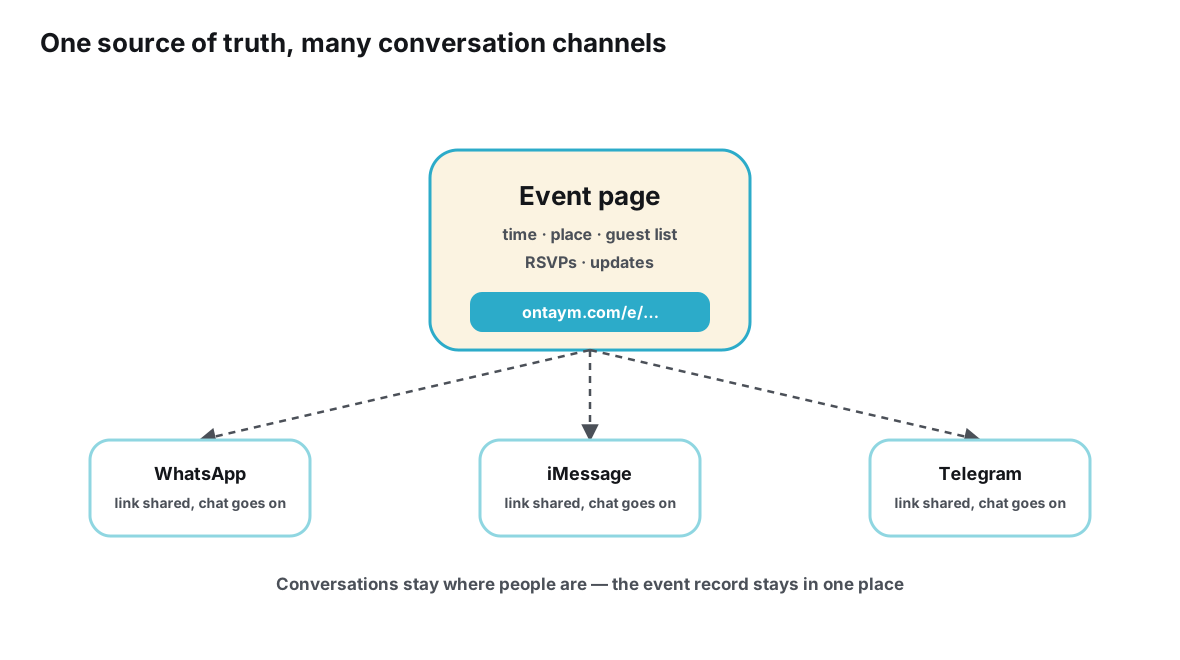
The order matters most at the start. An invitation that arrives before the event has an address is forced to carry its own details — time, place, logistics — which means it becomes a copy that can go stale, and the organizer has re-created the forwarding problem one message at a time. An invitation that arrives after the address exists is short, personal and immortal: it can say everything a friend needs and still never contain a fact that could become false.
The middle steps are where most organizers feel the unfamiliarity. Sending through existing channels feels almost too easy — no group to create, no members to add — and taking RSVPs on the page means resisting the reflex to launch a poll in some chat. The discipline is to remember which job each piece is doing: the channel delivers, the record remembers, and the two should never trade places.
Edge cases and how to meet them
Every opt-in organizer meets the same edge cases. None is fatal, and each has a proportionate answer.
The friend who never clicks links is the classic. Meet them where they are: deliver the details personally, in their preferred channel, and accept that staying current for this one person is now a small named task rather than something the event does automatically. One exception is a person; a policy of exceptions is just the old system back again.
Older relatives or the deliberately offline deserve the same respect with different packaging. A phone call that ends with "I'll text you the details" — where the text is the link — often works better than any explanation of why a link is better than a group. The plus-one question answers itself under opt-in: a guest can pass the link to their partner, who RSVPs like anyone else, rather than being extracted from a group chat's membership and added to yours.
Then there is the friend who always replies in DMs regardless of where the question was asked. Let them. The RSVP list will show their answer, and the private thread can stay private; the point of the record is not to force everyone into one room, but to make sure one room contains the truth. Workplace events add one wrinkle — the boundary between professional and personal channels — and opt-in handles it naturally, because a link in a work channel asks for nothing beyond a click, while adding colleagues to a personal group chat asks for quite a lot.
A final edge case deserves its own mention because it is really a test of the whole method: the person who wants to come but hates committing early. Under the group-chat model they are the organizer's recurring headache — the enthusiasm without an answer, re-counted every time the headcount is tallied. Under opt-in they are simply a maybe, legible on the list, welcome to resolve whenever life clarifies. The event holds a place for their indecision instead of punishing it, which is, when you think about it, the more hospitable arrangement.
What opt-in does to your headcount
The effect most organizers notice first is not fewer notifications but truer numbers. A headcount gathered under social pressure is inflated: people say yes to the room, then quietly negotiate with themselves for a week. A headcount gathered in private — tap a status, no audience — is closer to what will actually happen, and the gap between the two is precisely the gap organizers used to discover on the night.
The maybe status does quiet, valuable work here. In a group chat, maybe is a paragraph: an explanation, an apology, a negotiation. On an event page it is one tap, which means people use it honestly and early, and the organizer sees the true shape of the evening while there is still time to shape it — nudging the maybes, adjusting the reservation, moving the date if the maybes cluster around a conflict. Honest maybes are worth more than enthusiastic yeses that decay.
Decay is the right word for what happens to a pressured yes. Social momentum carries a guest from "sure!" to the calendar entry, and then life intervenes: a work thing runs long, energy is low, the couch wins. The guest who committed in public now has to exit in public or simply not appear — and the quiet disappearance, repeated across a guest list, is how organizers end up with a headcount that was true on Tuesday and fictional by Saturday. An opt-in event loses less between Tuesday and Saturday, because the commitment was made in private, to the event, at the price of one tap rather than one announcement. What arrives on the day is closer to what the list said all along.
Reminders, when the platform offers them, complete the loop without adding a room: a nudge before the date lands wherever the guest chose to receive it, and the RSVP list quietly tightens as maybes resolve. The old workaround — re-posting "still on for Saturday?" into the group and counting the enthusiasm — did the same job by spending everyone's attention instead of a notification.
| Objection | The honest response |
|---|---|
| "A link feels impersonal" | The warmth lives in the sentence you send with it; a group chat only feels warmer to the people who enjoy groups, and it asks more of everyone else |
| "Nobody clicks links" | People click links from senders they trust when the link arrives with context and a preview — sender behavior, not the link, decides |
| "The group chat builds hype" | Hype is for members; pressure is for everyone else. Genuine excitement shows up as RSVPs, which the page displays better than any thread |
| "I'll lose track of who's coming" | The opposite — the RSVP list is the tracking mechanism, while group chats are where headcounts go to be guessed |
| "My friends expect to be added to things" | Some do, and they can be — personally, and after the guest list settles, as a choice rather than a toll |
Notice what the honest responses have in common: none denies the objection. Groups do build atmosphere; some circles do expect to be added; senders do determine whether links get clicked. The claim is smaller and sturdier — that the costs of bundling membership into every invitation have grown past what most invitees will say out loud, and that the unbundled version serves the event just as well.
Fatigue is the real enemy
It is worth being precise about what opt-in inviting defends against, because it is not group chats. Group chats are lovely. The enemy is the assumption that every occasion deserves one — the quiet arithmetic by which a person's messaging life fills with rooms they never chose to enter, each individually reasonable, collectively deafening.
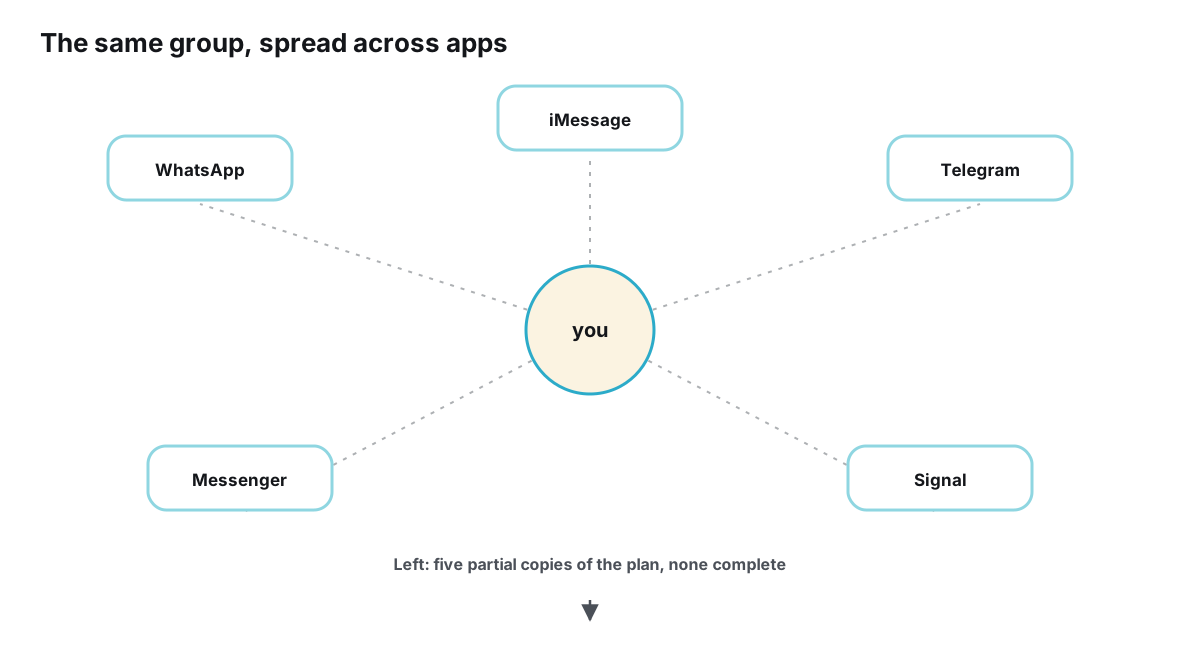
From inside the organizer's head, adding people feels like generosity. From inside the invitee's phone, it arrives as one more badge on one more icon, joining the family chat, the school chat, the two work threads and the group from a trip three years ago that no one has left because leaving would mean something. The invitee never experiences your event's chat in isolation; they experience it as the newest resident of a crowded building. An organizer who sends a link instead is not being cold. They are being legible: here is the thing, here is how to say yes or no, and here is nothing else to carry.
This is also, quietly, why opt-in events age better. The chat-based event peaks in noise and then decays into silence that everyone can see. The link-based event simply concludes — the record shows what happened, the guests keep their evenings, and the next invitation, when it comes, is greeted as an invitation rather than as a summons to a familiar kind of room. For groups that gather often, that accumulated goodwill compounds into the difference between events people attend and events people look forward to. The wider pattern — why events deserve a space of their own rather than a borrowed chat — is argued in why an event needs its own digital space.
Bringing it together: Priya's hike
A small composite example shows the whole method in motion. Priya wants to organize a Saturday hike drawing on three circles: her climbing gym friends (a WhatsApp group), her university friends (an iMessage thread), and two neighbors she sees at the dog park. The old reflex would create one new group and add eleven people to it — two of whom lack WhatsApp, three of whom would mute it by Tuesday.
Instead she creates the event first: date options as a poll, a starting point, a note about pace, and an RSVP list. Then she sends three messages. To the gym group: "Hike on Saturday — details and voting here," with the link. To the university thread: the same link with a line of her own. To each neighbor: a personal message, because that is the channel they share. Total effort: one event page, three sends, zero memberships created.
The week runs itself. Votes settle the date; RSVPs accumulate from all three circles onto one list; a forecast scare moves the start time once — an edit, not a broadcast. On Saturday, nine people meet at the trailhead, including a neighbor who would never have joined a chat and a university friend who flipped from maybe to going at 10 pm the night before without waking a soul. No one was added to anything. Tools like Ontaym exist to make exactly this flow light — one event, one link, polls and RSVP statuses and reminders attached to the record — though the principle works with any page your guests can reach. The full mechanics of building the record itself are in how to create one source of truth for a group event, and the case for not standardizing everyone onto one app first is made in organizing an event without asking everyone to download the same app.
Frequently asked questions
Isn't a link invitation impersonal?
The personality of an invitation lives in the message that carries it — the sentence you write, the context you add, the fact that it came from you. The link is just where the facts live. Meanwhile, the supposedly warmer alternative asks the invitee to install an app, expose a phone number and join a permanent room of strangers, which is more ask, not more warmth.
What if my event genuinely needs ongoing discussion?
Let discussion attach to what already exists: an existing chat, a thread among the committed, or comments on the event itself. The key change is sequencing — conversation follows the RSVPs, among people who have opted in, rather than preceding them as the price of participating. Discussion that only happens inside a mandatory group is usually discussion the event didn't need.
How do I keep track of who's coming without a group?
The RSVP list is the tracking. Each guest's going, maybe or not going sits beside their name on the event page, updates when they change their mind, and rolls up into the headcount you need for bookings. Compared to assembling a tally from reactions, replies and memory, it is less work, not more — the group was never actually tracking anything; it was performing tracking in public.
Do people actually click event links?
They click links that arrive from people they know, with a line of context and a readable preview — which describes a well-sent invitation. They hesitate over bare URLs dropped without explanation, which describes spam. Sender behavior is the variable. The first link you send teaches your group what your links mean, and a link that has been reliably current twice earns more trust than any group chat's scroll-back.
Can I still make a group chat for the event?
Yes — make it optional and late. Once the guest list has settled, offer the chat to whoever wants the running commentary, and let each person decide. What changes is the toll structure: joining a chat becomes a choice the excited make, rather than a fee everyone pays for the privilege of being invited. Most events discover they never needed the room at all.
Conclusion
The default invitation of the messaging era — I'll add you to the group — bundles together three things that were never inseparable: telling someone about an event, enrolling them in a conversation, and making them a member of something that outlives it. Unbundling them costs one event page and a handful of personally written messages, and it returns invitations that people can accept, defer or decline without an audience, headcounts that tell the truth, and evenings that end cleanly instead of lingering as archived rooms.
Run the eight steps once and the method becomes self-explanatory: address before invitations, self-contained messages, existing channels as envelopes, RSVPs on the record, conversation optional, updates as edits, membership never required, and a clean close. Your friends will not articulate what changed. They will simply notice that saying maybe got easier, that the organizer seems calmer, and that Saturday arrived without anyone standing at a wrong door. Hospitality has always been the art of asking less while offering more — the opt-in invitation is that art, updated for phones full of rooms nobody chose. For groups whose plans also span multiple channels at once, the same architecture extends naturally, as described in what happens when your event has multiple communication channels.
Invite with a link, not a membership.
Plan it with Ontaym