
How to Manage Event Changes When Everyone Has Different WhatsApp Messages
Changing a detail of a plan in WhatsApp looks effortless — you type a line and hit send. The hard part arrives later, when it turns out that line reached six of your eleven guests, and the other five are still living by the old version of the event.
Quick answer
When an event detail changes inside a WhatsApp group, the new fact travels as one more message — and messages are easy to miss, mute, or half-read. Some members absorb the update, some saw only the earlier plan, and a few heard about it verbally from a friend. The group now holds several versions of the same event, and the differences surface at the worst possible moments: at the wrong door, at the wrong hour, with the wrong headcount. Managing changes well means doing three things: publish each change exactly once in a place that supersedes everything before it, make the current plan effortless to check, and stop treating repetition as the fix. A pinned message buys time. An event page or link that always shows the current details actually solves it.
How one group ends up holding several versions of the plan
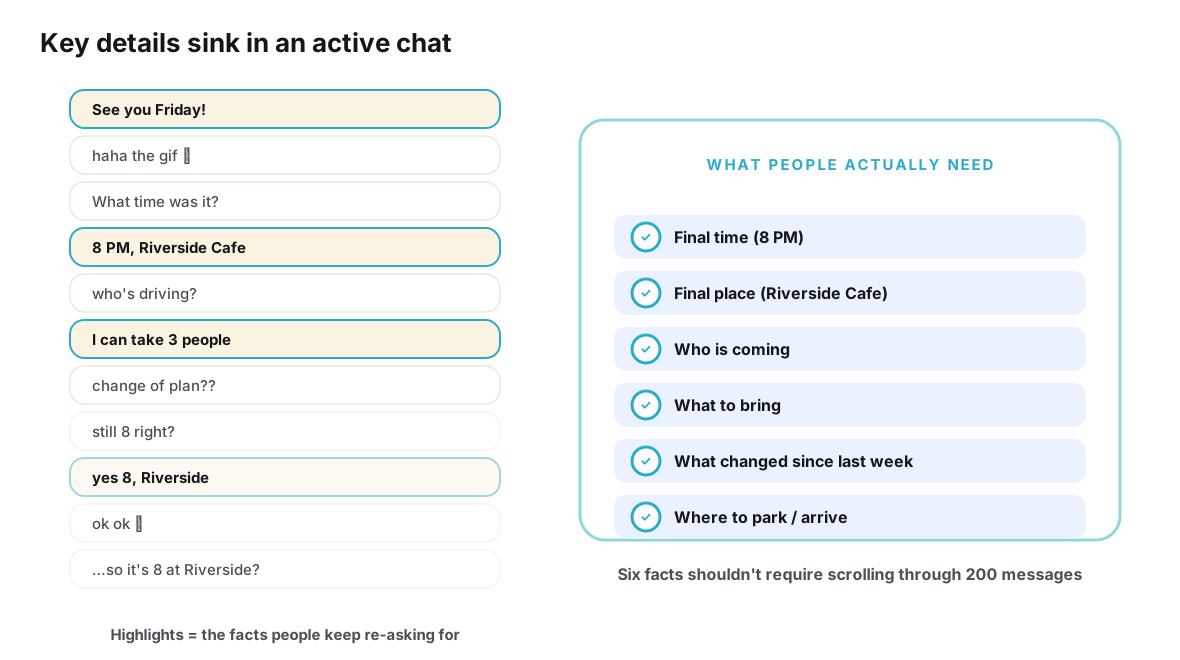
WhatsApp, as its own product pages are quick to say, is a messaging service — and a superb one. Its entire design serves the act of exchanging messages in real time. That heritage explains the first reason plans fork: inside a chat, a change is not an operation on the plan. It is just another message. The medium has no concept of superseding. A message that says “meet at 8” and a later message that says “actually 9” both remain in the thread, equally visible, equally quotable, distinguished only by their vertical position. The app will never mark the first one as obsolete. Every reader performs that judgment themselves, and readers perform it differently.
Attention, meanwhile, is distributed unevenly. A group of twelve contains twelve different reading habits. One member opens the group the second it buzzes; another checks in on Sunday evenings with the patience of an archivist; two have the group muted since the second week because the jokes got loud. A change posted at 23:40 on a Thursday reaches a fundamentally different audience than the same change posted on a Sunday afternoon. And “reaching” is a graded spectrum: a message can be delivered, glimpsed, half-read, and forgotten — four different fates, all of which look identical from the sender’s side.
Copies make it worse. Threads leak. A guest forwards the venue message to their partner’s private chat. Someone screenshots the time and drops it in the family group. A friend who left the planning group still has the old details in their chat list. Every copy is a frozen snapshot that will never receive the correction, because corrections only flow to the place they were posted. The plan forks physically, not just in people’s heads.
The important thing to hold onto is that nobody in this story misbehaved. The organizer sent the change. The app delivered it. The members are ordinary busy people. The divergence is a property of the system, not a failure of the people in it — which is also why exasperated follow-ups (“I literally posted this!”) fix nothing. If you want to see the full anatomy of how threads decay into mess, the companion piece on why WhatsApp groups become messy when planning events maps the whole process; this article stays focused on the moment things change.
A birthday dinner that quietly forked
Picture a dinner that Maya is organizing for twelve friends. Three weeks out, she posts the restaurant with a menu link, and the thread hums along happily — jokes, dietary requirements, a debate about dessert. The plan is stable, so the thread’s chattiness costs nothing. Then, on the Thursday before, the restaurant calls: the large table is double-booked. Maya finds a new place ten minutes away and posts the change at 23:40, right after a burst of forty messages about something else entirely.
Five people read the new venue that night. Tom was driving home; his glance at the phone the next morning starts from the newest messages, which by then are three jokes about something else, and he never scrolls far enough. Priya sees the venue message in her morning skim, but by lunch it is buried under fresh replies, and what sticks in her memory is the restaurant she had been picturing for three weeks. Two guests muted the group weeks ago and only return for the final details. One guest, Daniel, had already told his partner the original restaurant over dinner — a verbal copy, the most durable copy of all.
Saturday evening: three people arrive at the old restaurant. Priya is one of them, and she is mortified, but she did nothing unreasonable — she read the thread, she simply read it like a human. Tom arrives twenty minutes late at the right place, annoyed at everyone. Maya spends the first half hour of her own birthday dinner apologizing, and by the end of the night she has privately decided never to organize anything again.
The detail that stings most is that nothing was lost. All of the information existed, in writing, in the group. It was simply distributed unevenly across twelve people, and the evening ran on the union of everyone’s partial views. That is the signature failure of change management in chat — not missing data, but asymmetric data.
| Type of change | How it spreads in chat | Where it breaks |
|---|---|---|
| Time change | A correction message that must outrun the original message in the scroll | The old time keeps asserting itself; people quote it back with confidence |
| Venue change | A new name and address, ideally with a map link that must be re-found later | The old address resurfaces through screenshots, memory, and verbal retellings |
| An option dies | A reply inside the options discussion, noticed mainly by whoever was debating it | The eliminated option keeps collecting adherents who never saw the verdict |
| Headcount or plus-one rule | A request for confirmation that reads like optional chatter | The organizer receives partial, ambiguous replies and no definitive list |
| Postponement or cancellation | The highest-stakes message of all, sent exactly once | Whoever missed it arranges their whole week around an event that no longer exists |
Why “I’ll just send it again” makes it worse
The obvious remedy is repetition: send the update again, louder, with more exclamation marks. Repetition feels responsible, and in the short term it works — some of the people who missed the first send catch the second. But each resend is a new message competing for the same finite attention, and a group’s patience for messages about the plan tends to be lowest exactly when the plan is changing the most. The update starts to feel like spam, and spam gets muted.
Muting is the quiet engine of divergence. After two or three update bursts, the members who find the thread noisy silence it — and they are frequently the least invested members, the ones who were already borderline about attending. From that moment, every further update systematically misses the people with the weakest grip on the plan. Repetition reaches the attentive twice and the inattentive never. The louder you get, the wider the fork grows.
Organizers sense this, and their instinctive response is to soften the updates. Instead of “moved to 9”, they write “probably still 8, will confirm tomorrow!” — hedging as a form of courtesy, an attempt to spend less of the group’s attention. The hedged message is well-meant, but it manufactures a second kind of fork: now even careful readers hold a probabilistic plan. Ambiguity multiplies versions inside a single message. The group’s facts degrade from wrong-versus-right to maybe-versus-probably, which is far harder to untangle on the night.
There is a social cost, too. Once a thread contains three versions of the time, members stop trusting any of them. The rational move for a guest who wants certainty is to message the organizer privately — and dozens of private questions later, the organizer has become a human switchboard, relaying the same answer one-to-one that failed to hold one-to-many. The thread, meanwhile, sits there containing everything, useful to no one.
What a change has to accomplish before it counts as managed
It helps to be precise about what you are actually trying to do. A change is not “sent.” A change is managed when it has completed five distinct jobs, and chat is weak at four of them:
- Reach. Every affected member encounters it, including the muted, the skim-readers, and the currently absent — not just whoever happened to be online.
- Supersede. The old value stops being true everywhere it previously lived: in the thread, in screenshots, in forwards, and in memories.
- Persist. A member checking three days later lands directly on the current state without re-reading the week’s messages.
- Date itself. Any reader can tell which statement is the latest without comparing timestamps or counting intervening jokes.
- Stay singular. There is exactly one canonical version of the plan, and every member knows where it lives.
Scored against that list, a chat thread achieves partial reach, weak supersession (the old messages keep asserting their old facts forever), persistence only by position, dating only implicitly, and singularity not at all once the first screenshot escapes. None of this is a knock on WhatsApp; a conversation medium is under no obligation to do any of it. But it does mean that a group which keeps its plan in chat is doing change management without change management tools.
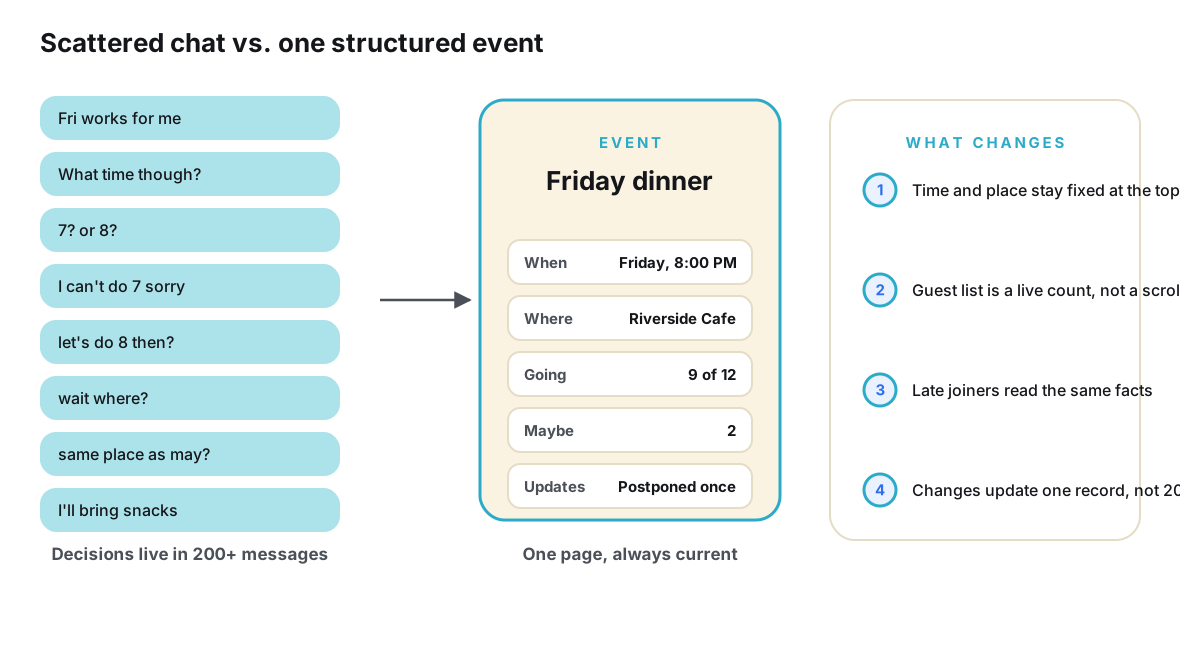
The five jobs point toward what a real fix looks like: the plan needs a home where a change is an edit rather than an announcement — one place where the venue, the time, and the list are always current, so that reaching, superseding, persisting, dating, and singularity are all handled by the container instead of by the diligence of twelve individuals.
A change protocol you can run inside WhatsApp
Plenty of events will live and die inside the chat, and that is fine; small, stable plans do not need infrastructure. What they do need is discipline, because discipline is the only substitute for structure available in a thread. If your event is staying in WhatsApp for now, this protocol will absorb most changes without forking:
- Give the plan one voice. Agree — openly, in the group — that only the organizer posts changes, while everyone else discusses freely. A group with five people posting corrections builds five competing streams of truth; a group with one clearly designated voice builds one.
- Use a fixed change format. Every change message follows the same shape: what changed, from what, to what, effective when, and a line voiding the previous messages. Identical structure every time trains the group to recognize a change message at a glance, even mid-scroll, and makes the message screenshot-proof.
- Pin the current plan — and only the current plan. Unpin the previous version before pinning the new one. Two pins are two truths; the moment a stale pin survives next to a fresh one, you have rebuilt the fork you were trying to prevent, this time pinned to the top of the screen.
- Ask for one explicit acknowledgment. For the big three — time, venue, cancellation — ask members to react to the change message once they have read it. Not for every detail, or it becomes noise. The unreacted names are not shirkers; they are your follow-up list, and you can chase them directly before the event instead of discovering them at the wrong restaurant.
- Keep the pointer in the group description. A line like “current plan: pinned message” gives every visitor, including people returning after a week of muting, a one-tap path to the facts. The description does not scroll away, which makes it the most durable surface the group has.
Two practical notes from WhatsApp itself: the WhatsApp Help Center documents how pinned messages, descriptions, and polls actually behave, and it is worth knowing the mechanics of your tools before trusting a plan to them — including the limits, such as how few messages can be pinned at once.
| When | What the organizer does | Why it matters |
|---|---|---|
| The moment something changes | Post the formatted change, unpin the old plan, pin the new one | Two versions of the truth must never coexist at the top of the thread |
| Within the hour | Check acknowledgments and chase the silent names directly | Silence is the seed of every fork; catch it while it is one person, not three |
| The day before | Re-post the full current plan — the whole plan, not just the latest diff | Everyone re-syncs from one complete message instead of reconstructing from fragments |
| The morning of | Send one message with the final facts and a pointer to the pinned plan | The last full synchronization before everyone’s attention fragments into travel mode |
Giving the change a home the thread can point to
Honestly assessed, the protocol above is labor simulating a record. It works, the way a hand-drawn map works, right up until the terrain changes twice in one week. The structural fix is smaller than most groups expect: move the plan itself somewhere with an address, and let changes be edits. When the venue changes, you edit the venue. Every person who opens the record sees the new venue, full stop. There is no race between messages, because there is only one message-equivalent, and it is always current.
Notice what edit semantics do to the five jobs on the earlier list. Reach becomes “everyone who looks at the plan,” which is everyone who needs it. Supersession is automatic — the old venue no longer exists anywhere, because there was only ever one venue field and it now holds the new value. Persistence is trivial: the record shows the same current state at midnight and three days later. Dating is unnecessary, since there is nothing to order. Singularity is architectural rather than behavioral.
The chat keeps the job it is genuinely great at. The negotiation, the jokes, the “can I bring my cousin?” — all of that stays in WhatsApp, where it belongs. What changes is the answer to the question “what’s the plan?” That answer stops being a summary you retype for the sixth time and becomes a pointer. This division — conversation in the thread, state in a record — is exactly the distinction explored in the difference between a conversation and an event object, and it is worth internalizing before your next big plan.
In practice, a tool like Ontaym gives each event its own page and link for exactly this purpose: details updated in place, RSVP statuses visible at a glance, and reminders that go out from the record rather than from your thumbs. The specifics of the tool matter less than the shape — one address per event, edits instead of announcements.
The morning of: changes under pressure
Day-of changes are the cruellest test, because the two curves cross: the stakes are at their highest exactly when attention is at its most fragmented. People are traveling, parking, herding children into coats. A message posted at 18:50 competes with a dozen other channels of life. The same update that would sail through on a quiet Tuesday afternoon vanishes without a trace on the evening itself.
Two rules absorb most of this. First, the record is authoritative and the message is merely a nudge: a single line — “table ready early, we’re inside, page updated” — that points rather than contains. Anyone who misses the nudge and opens the link later still lands on the truth, which is the entire point of having the record. Second, genuine emergencies are synchronous: if the event is being cancelled with ninety minutes’ notice, call the people it affects most. Chat is asynchronous by design, and the morning of an event is no time to rely on it.
Contingencies deserve early publication, not day-of invention. If there is a rain plan, publish both branches in advance with their trigger — “if it’s raining at five, we’re at the Bavaria instead; the page will show which one is live.” A decision made and published ahead of time is one less fork to manage while standing in drizzle.
When copies of your plan live in other apps
Most real groups are not contained by one app. The dinner gets forwarded to the cousins’ group on Telegram, mentioned in a partner chat, summarized to a colleague. Each copy is frozen at the moment of forwarding and will never learn about the venue change. Multi-app leakage multiplies the fork problem by the number of apps involved, and the pattern holds across every chat platform, because the stream-plus-messages architecture is shared — Telegram’s own FAQ describes its groups and channels in essentially the same conversational terms as any other messenger.
The defense is the same as within one app, just more emphatic: the plan’s address must be independent of any single messenger. A link travels anywhere a message travels, but unlike a forwarded screenshot, what it points to keeps updating. Whoever receives it — in any app, in any country, on any phone — gets the living version rather than a frozen one. That portability is the single strongest argument for moving the plan out of the thread, and if your group has already drifted into multi-app chaos, the step-by-step path back is described in how to turn a WhatsApp conversation into an organized event.
One more connection worth making: the deeper reason chat resists this shape at all is a matter of design intent, not missing features — messengers are optimized for conversation, and plans are not conversations. That argument, with the design trade-offs spelled out, is the subject of why WhatsApp is great for chatting but bad for structured event planning.
Frequently asked questions
Isn’t a pinned message enough to manage changes?
A pin works beautifully between changes and fails at the moment of change. The pin freezes one message; the next update makes it stale, someone must remember to unpin and re-pin, and everyone who saw the first pin but missed the re-pin now holds the old facts with confidence. Pins are worth using — they are the best surface a thread offers — but they are snapshots, not records.
Should I delete the old message with the wrong details?
Deleting for everyone removes one copy of the old value from one thread. It cannot reach screenshots, forwards, other apps, or human memory, and it strips the context that tells careful readers what changed. It is a reasonable cleanup move for dangerous misinformation, but as a change management strategy it is hygiene, not structure.
How do I word a change so people actually absorb it?
Use one voice, one fixed format, and one change per message. State the field, the old value, the new value, and the effective time, then void the earlier messages explicitly. Ask for a single acknowledgment reaction on the big three: time, venue, cancellation. The format matters more than the urgency — a message that looks different from every other message gets skimmed like every other message.
What about guests who never check the group?
Every group has members who treat the chat as a rumor mill and check facts elsewhere. For them, the answer is the same as for everyone else, delivered differently: send the plan’s link once in a direct message, and let reminders come from the record rather than from the thread. People who ignore groups will still open a link sent to them personally, especially when it is the only thing they need to open.
How many changes can a group absorb before it needs a different system?
There is no fixed number, but the pattern is recognizable: the second change to the same field, or the first discovered fork — someone acting on outdated facts — is usually the signal. Before that point, disciplined chat management holds. After it, every additional change costs more than the last, because each one adds another version that some subset of the group will never see.
Do WhatsApp Communities help with managing changes?
They help with distribution, which is one of the five jobs. Communities let organizers link related groups and push announcements to all their members at once, so a change reaches more people in one action. But an announcement is still a message in a stream — it does not supersede, persist as current state, or stay singular once forwarded. Distribution gets better; state does not appear.
Conclusion
Treat every change as a small event of its own, with its own publication requirements: it must reach, supersede, persist, and remain singular. A chat thread can host the conversation about a change, but it cannot host the change itself — the moment the plan moves, the thread holds two truths and no arbiter.
If the event stays in WhatsApp, run the protocol: one voice, a fixed change format, a single current pin, explicit acknowledgments, and a pointer in the description, all layered over the day-before and morning-of resynchronization messages. It is effort, but it is honest effort, and it prevents most forks for plans that change rarely.
The moment a plan changes twice, or spans more than one app, or outgrows the group’s patience for repetition, stop simulating a record and use one. Give the event an address, let changes be edits, and let WhatsApp go back to what it was doing beautifully all along: carrying the human noise around the plan, while the plan itself lives somewhere that never goes stale.
Change the plan once — and have it stay changed.
Plan it with Ontaym