
Why Messenger Conversations Aren’t Ideal Event Records
A Messenger thread remembers everything your group said about the event, word for word. What it can’t remember is the event itself — a final time, a final place and a headcount you can still trust a week later.
Quick answer
A Messenger conversation is a stream: an append-only sequence of messages, newest at the bottom, each true only at the moment it was sent. An event record is state: one current value for the time, one for the place, a named status per guest, and a clean history of changes. A thread can contain all of those facts as words, but it cannot hold them as data — so anyone who needs the current plan must reconstruct it by reading, and different readers reconstruct it differently. Days later, with the thread still growing, reconstruction turns into research. The durable fix is to give the event a page or link that always shows its current state, and let Messenger keep doing what it is excellent at: hosting the conversation around the plan.
What we mean by an event record
“Record” is a word worth slowing down on, because it is doing more work than it appears to. A record is not a memory of a discussion. It is information arranged so that a specific question gets one authoritative answer, now and later. A restaurant’s ledger, a doctor’s file, a booking confirmation — each shares the same properties: the values are current, labeled, attributable to someone, complete, and retrievable without listening to everything that was ever said on the subject.
An event, planned properly, produces exactly this kind of information. When does it start? Where do we meet? Who is coming, who bowed out, who is a maybe? What changed since last week, and who approved the change? Five questions, each deserving one answer. The organizer’s real job in the week before an event is to be the custodian of those answers — and the question of where they live is the whole ballgame.
A Messenger thread holds a transcript of the process instead. The transcript is honest and even valuable — it documents how the group thought, negotiated and joked its way to Saturday night. But a transcript answers the five questions only implicitly, in fragments, distributed across however many messages it took to produce them. Reading a transcript to learn the final plan is like reading a parliament’s full debate transcripts to learn what the law currently says. It is technically possible and practically unreasonable.
How the thread ends up holding the plan anyway
Nobody appoints Messenger the system of record. It gets the job by gravity. The app is already on the phones of more than a few of your friends, groups form in two taps, and the first message about Friday appears in a thread that already exists for other purposes. Messenger — Meta’s Messenger — was designed around exactly this ease: conversations with people and groups you already know, with reactions, replies and polls layered on top, all documented in its Help Center. For the first stretch of planning, none of this causes any trouble, and the group rightly feels efficient.
The arrangement starts to wobble when the plan grows properties that chat was never asked to support: alternatives under discussion, a guest list that changes, a venue that falls through, a member who joins late, a headcount someone actually needs. At that point the group is no longer using Messenger as a conversation with a plan inside it; it is using it as a database with a conversation on top. The app keeps working perfectly. The plan is what degrades.
Five questions a stream cannot answer cleanly
Run the five record questions against a busy Messenger thread and watch each one fail in a characteristic way. The failures are mechanical, not social — they would happen to any group of diligent, intelligent friends, because the medium, not the members, is the constraint.
| Question | What the thread returns | The failure mode |
|---|---|---|
| When does it start? | A proposal, two replies, a counter-proposal, a “yes!” and a later “actually can we do 9?” | Every value ever suggested remains visible; only the last one counts, and readers must guess which messages were superseded |
| Where do we meet? | Options debated in prose, a decision implied by the conversation moving on | The decision was never stated as a fact; it must be inferred from what people stopped arguing about |
| Who is coming? | Reactions to one message, replies to another, “I’ll try” from a third, silence from several | Signals live on different messages, mean different things and expire at different times; no tally exists |
| What changed since I last looked? | All history, equally weighted | The thread has no diff; every reader must compute the difference against whatever slice they remember |
| Who agreed to what? | Mixed messages: one person’s “fine by me” replying to another’s “shall we?” | Attribution dissolves into reply chains; commitments and opinions look identical on the surface |
Notice the pattern across the table: in every row the information exists, somewhere, in some message. The thread is not missing data — it is missing structure. Nothing in the medium distinguishes a decision from a suggestion, a commitment from a mood, or the current value from a discarded one. Those distinctions are exactly what a record exists to enforce.
Currency: the newest message is not the current plan
The deepest of the five failures deserves its own treatment, because it is the one people find genuinely surprising. A messaging interface makes a quiet promise: the bottom of the screen is the present. For conversation, the promise holds — the latest joke is the most relevant joke. For a plan, the promise breaks. The message that matters most might be three days and two hundred messages up, indistinguishable in form from the jokes around it, while the freshest messages could be entirely about something else.
Worse, the thread actively preserves the wrong answers. When the group moves dinner from Friday to Saturday, the Friday messages do not delete themselves; they sit there forever, formatted with the same confidence as everything else, ready to convince the next person who scrolls with too much faith. A record handles the same event by replacing one field — from that moment, “Friday” no longer exists anywhere authoritative. The stream handles it by adding one more voice to a debate that was already settled. Same event, two opposite information outcomes.
This is the core of the state-versus-stream distinction: state replaces, stream appends. Every planning task that involves change — and all interesting plans involve change — collides with the append model. It is also why the problem worsens precisely when the group is most engaged: livelier threads push the load-bearing messages away faster. Activity should make a plan easier to follow; in a stream, it does the opposite.
Attribution and the headcount that never adds up
The guest list is where record-keeping matters most and where chat delivers least. In a Messenger thread, attendance signals scatter across surfaces: a thumbs-up on the original suggestion, a “count me in” reply two days later, a poll vote that was really about the date, a heart that might mean “loovely idea” or “I’ve read this.” Each signal is individually human and collectively uncountable. The organizer who needs fourteen covers for the long table does not need sentiment — they need names against statuses, current as of today.
Attribution decays alongside. Priya’s “I’m in!” was true on Monday; by Thursday her situation changed and she said so in a voice note while commuting, which three people heard and the record never did. Tom never explicitly declined — his silence could mean anything from babysitting to apathy, and no interface will tell you which. A dedicated record gives each of these people a lever to update their own status, and gives the organizer a tally that maintains itself. The thread gives the organizer a research project with a deadline.
The scramble is familiar to anyone who has hosted: a private message here, a “quick question, is Marco still coming?” there, a final count assembled from memory at 5pm on the day. It works, in the sense that dinner eventually happens. But the effort was spent compensating for the medium, and every future event starts the same climb from zero because nothing accumulated into a reusable, correct state.
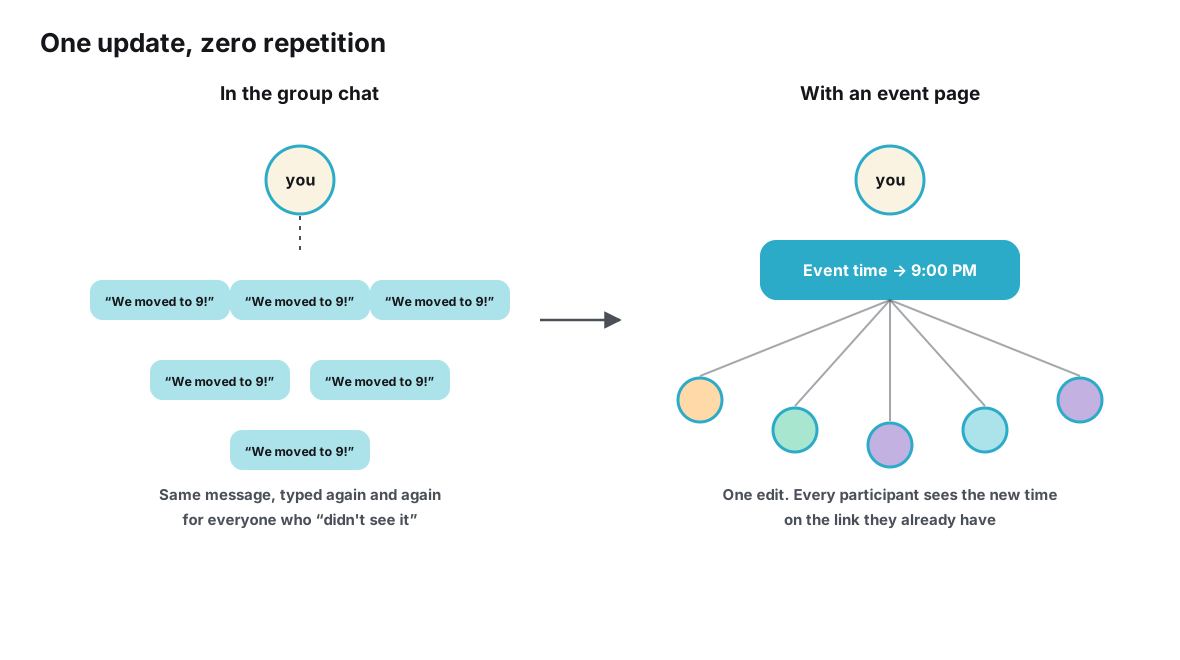
The organizer’s shadow ledger
Every thread-planned event runs on a second, invisible system: the one the organizer maintains in their head. It holds the running tally (“twelve confirmed, three maybe, Marco unaccounted for”), the open questions (“still no venue for the Saturday crowd”), the private side-channel agreements (“Priya’s partner confirmed by text, not in the group”), and the change log (“time moved once, venue twice”). Nobody asked for this ledger and nobody else can read it. It exists because the thread cannot hold the information and someone must.
The costs are easy to underestimate because they are paid in attention rather than hours. Every glance at the thread is a reconciliation: has anything changed that must be copied into the mental model? Every private question is a write operation on a database with one user, no backup and strictly limited working memory. And the ledger’s contents are precisely what evaporate under stress — the night before, mid-juggle, when the organizer is tired and the thread is at its fastest. The failures that look like absentmindedness (“I forgot Ana said Wednesday doesn’t work for her”) are almost always the shadow ledger exceeding capacity, not a person failing.
A record externalizes the ledger. The tally becomes the page’s RSVP list; the open questions become visible fields; the change log becomes the page’s history. The organizer does not become less central to the event — hospitality and judgment stay human — but they stop being its database, and the event stops depending on one person’s memory holding up at eleven at night.
A week in the life of a Messenger-planned event
The individual failures are easiest to feel in sequence. Below is a composite week — no group will match it exactly, but most organizers will recognize the shape of it.
| When | What happens in the thread | What a record would have held instead |
|---|---|---|
| Monday | Idea lands mid-conversation; enthusiasm; three possible dates floated in ten minutes | Three date options as a question awaiting answers; everything else marked “to be decided” |
| Tuesday | Date debate continues across forty messages; consensus forms around Saturday but is never declared | Saturday marked as the leading option, then confirmed by one edit when consensus formed |
| Wednesday | Venue suggested, questioned, defended; a poll gathers five votes and two arguments | Venue options with a real tally; the winner promoted to the venue field when chosen |
| Thursday | Venue falls through; replacement announced at lunchtime; evening messages bury it | One field edit; every later visitor sees the new venue as the only venue |
| Friday | “So what time tomorrow?” — asked separately by three people; answered three times, slightly differently | One time field, consulted instead of re-asked |
| Saturday, morning | Organizer counts attendees from memory and reactions; messages two maybes privately | A live list of going, maybe and not going, current as of the last guest update |
| Next week | “What was that place called?” “Which restaurant did we end up at?” | The finished record, still at its address, answering every such question in one visit |
Read down the right-hand column and a different kind of week appears: same event, same people, same fun — but every question answered by consulting rather than re-litigating, and the organizer’s effort spent hosting instead of re-broadcasting. That column is not a fantasy of better-behaved friends; it is the same information, stored where it can be looked up.
Longevity: the week after, and the next time
The record question grows sharper after the event ends. Threads do not stop when the plan completes — the same Messenger group rolls on toward the next topic, and Saturday’s final details sink steadily beneath it. Within a month, “what was the name of that place we loved?” is a search through a long conversation, and the answer that surfaces first is just as likely to be the venue that was rejected on Wednesday as the one the group actually visited.
Recurring groups feel this most. The football crowd, the monthly book club, the family that gathers each spring — each iteration re-asks the same questions because the previous answers live entombed in a thread that has since moved on. A record inverts the economics: last event’s details remain at their address, complete and settled, and the next event starts from structure instead of from a blank chat. Over a season, the difference compounds into hours and, more importantly, into a shared habit — “check the event page” — that every member can rely on regardless of how chatty the group is.
There is also a quieter, structural side to longevity: a conversation is anchored to the accounts having it. People leave groups, change phones, drift between apps; a thread that spans months carries its history in ways that are convenient to reread but impossible to consult at a glance. A plan that matters beyond the night deserves an address that does not depend on scrolling through anyone’s message history — which is the simplest summary of why an event needs its own digital space.
And there is an accountability angle. Group events generate small obligations — deposits, shared costs, the friend who paid for the whole table on the understanding it would even out. Settling those fairly requires a shared memory of what was agreed and who actually came, which is exactly what a dissolved transcript cannot supply. A settled record settles arguments: not because it adjudicates them, but because it prevents two people from being certain of two different versions. The same property resolves gentler questions — which restaurant it was, whose partner attended, what the walking route had been — and it is the reason groups that keep records argue less about money and trivia, not more.
When the thread forks into other apps
Long before a thread fails as a record, it often fails as a container. Messenger groups assume membership; plans assume reach. The moment the guest list includes someone without Messenger — or someone with it who prefers something else — the plan spills sideways: a sibling gets screenshots over WhatsApp, a colleague hears about it by the coffee machine and is added to a parallel chat, one couple coordinates in a private thread. The original conversation continues to feel like the center of the universe to its members while quietly becoming one province of the actual event.
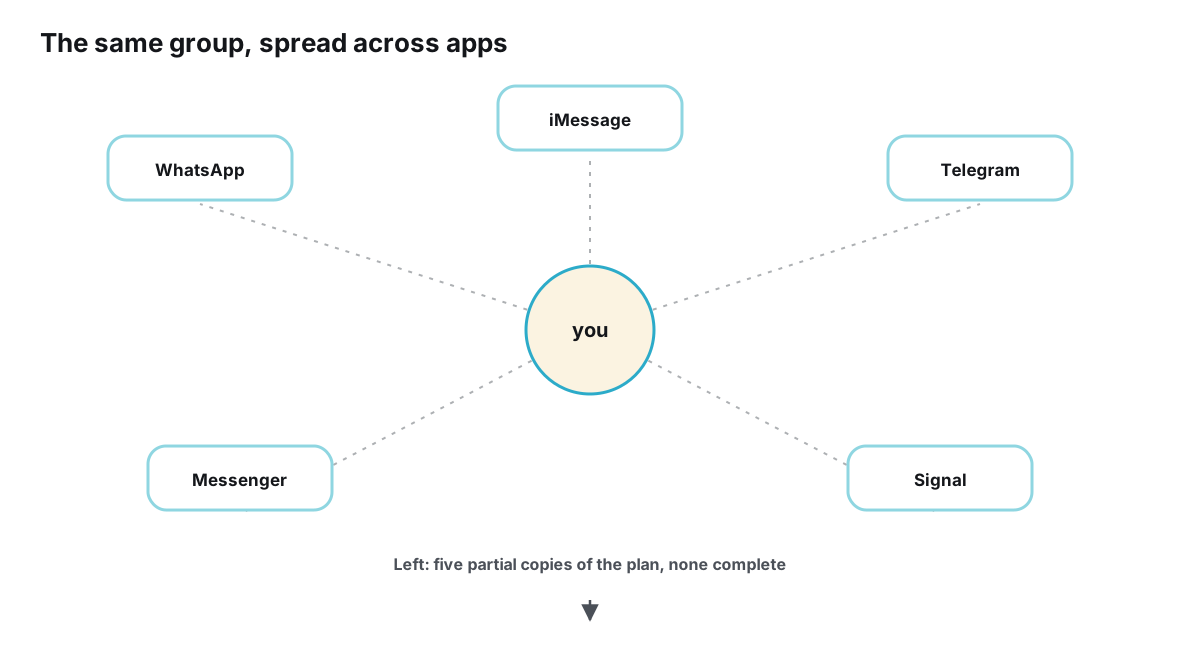
At that point the record problem multiplies. There is no longer one transcript to misread but several, each with its own partial version of the truth, reconciled by whoever happens to span them — usually the organizer, usually by memory. The full anatomy of that situation, including the version drift and the who-missed-what accounting that follows, is covered in what happens when an event is planned across multiple messaging apps. The privacy-focused variant, where a community deliberately keeps its coordination out of big-platform chat, is explored in how Signal communities can organize offline gatherings.
When a Messenger thread is genuinely enough
Fairness requires the other column of the ledger. For a plan that is small, settled and short-lived — four friends, a bar they visit weekly, a time proposed and instantly accepted — the thread is not a degraded record; it is a perfectly proportioned one. The information fits in a screen, everyone saw it arrive, and the group’s social memory covers the rest. Building anything heavier for such plans is ceremony, and ceremony has costs of its own: guests experience the machinery, and the organizer pays setup for a problem that never materialized.
A useful rule of thumb: the moment a detail changes for the first time, or a new person needs to catch up, or a headcount matters to anyone outside the thread — the thread has reached the edge of what it can hold. Below that edge, chat is not the lazy option; it is the right one. The skill of a seasoned organizer is noticing the edge exactly once, not pretending it does not exist or erecting infrastructure everywhere in anticipation of it.
Keeping the conversation and adding the record
The fix is not to abandon Messenger — the conversation around a plan is a real part of the plan’s success, and groups that enjoy their thread should keep it. The fix is to stop asking the conversation to also be the archive. In practice this means moving four things out of the thread and into a small page that each event owns: the final details, the per-guest statuses, the changes, and the address people visit to check all three. Tools like Ontaym exist precisely for that split — one link per event, going and maybe statuses guests update themselves, and edits that reach everyone who opens it — though any system giving your event a stable, current-state page achieves the same division.
Two habits make the split durable. First, create the record early — before the first change, ideally at the first serious proposal — so it never has to catch up with a thread that started without it. Second, answer questions with the address. Every “what time?” met with the link teaches the group where the plan lives; every answer typed from memory teaches it the opposite. The thread then gets to do what it does best, which is what the record can never do: be the place where the group actually talks.
Groups sometimes worry that the new habit will feel bureaucratic to friends who have planned in chat for years. In practice the announcement is the only visible change, and it reads as consideration: “everything’s on this page, and I’ll keep it current” is a promise guests quietly appreciate. The second event needs no announcement at all — people simply ask for the link. What began as the organizer’s discipline becomes the group’s reflex, which is the only kind of process that survives a busy month.
Frequently asked questions
Can’t I just search the thread when I need something?
Search finds words, not state. Searching the conversation for “Saturday” returns every message that ever contained it — proposals, corrections, cancellations and jokes — with nothing marking which one is current. You are looking for the value of a field, and the thread offers you every sentence that ever mentioned the topic instead.
Do reactions count as RSVPs?
No — they are gestures attached to one message at one moment. A thumbs-up means something between enthusiasm and acknowledgment, it cannot be updated when circumstances change, and it expires silently as the message scrolls away. An RSVP is a named, current, self-updatable status. Confusing the two is how hosts end up counting sentiment instead of guests.
Doesn’t pinning the key message solve this?
Pinning buys you one frozen message at the top of the thread. It works until the first change, after which the pin is either stale or replaced — and members who saw the first pin but missed the replacement hold confident, wrong information. A pin is a snapshot of one message, not a record; it cannot hold several changing facts or anyone’s current status.
How long can I keep planning in chat before it becomes a problem?
Until the first change, the first late joiner, or the first time anyone needs a headcount — whichever arrives soonest. Before those events, chat is proportionate and pleasant. After them, every additional message makes the plan harder to reconstruct rather than easier, which is the medium’s way of telling you it is full.
What’s the fastest fix for an event already deep in the thread?
Extract the current facts — final time, place, likely attendees, open questions — onto a fresh event page, and post the link once with one sentence: “From here on, the plan lives here.” Nothing about the conversation changes; the archive simply stops being the authority. It takes five minutes and pays for itself by the next change.
Conclusion
Messenger is one of the great conversation tools, and nothing in a thread’s design is broken. The mismatch is quieter: a conversation is a stream of moments, and an event is a bundle of current facts, and the second will never be comfortably at home inside the first. The transcript remembers everything that was said — which is precisely not the same as remembering what was decided, what changed, and who is coming.
Treat the two accordingly. Let the thread carry the talk, the jokes and the negotiation — the parts of planning that are genuinely conversational. Give the event’s facts a small record with its own address, where the time is one value, the guest list is a tally that updates itself, and a change is an edit that reaches everyone who looks. Groups that make this split stop re-reading their own history to find out what they decided, and discover that the plan was never really in the chat at all — it was just waiting for somewhere to live.
Keep the banter in chat — and give the plan a page that holds its state.
Start an event page with Ontaym