
How to Create One Source of Truth for a Group Event
The definitive guide to giving a group event a single authoritative record: what a source of truth is, what belongs on it, where it should live, and how to run your group so the record — not the loudest message — always wins.

Quick answer
A source of truth for a group event is one record — usually a page reachable by a link — that always shows the plan's current state and that every conversation points to instead of copying. Creating one is a repeatable process: set up the record before planning heats up, fill in what is known and mark what is not, give it a stable address, share that address in every channel the group uses, move every settled decision onto the record, take RSVPs there, publish changes as edits rather than announcements, and close the record when the event ends. Done consistently, the record becomes self-reinforcing: because it is always current, people learn to check it, and because people check it, the organizer keeps it current. The whole method fits in one sentence — debate anywhere, decide once, share the address.
What a source of truth actually is
The term comes from engineering, where it names a simple idea: in any system, each piece of information should have exactly one authoritative home, and everything else that mentions it is a pointer, not a second copy. Databases have one canonical row per account. Maps have one official route graph. When copies are unavoidable, the system knows they are copies and treats the home record as the winner of every disagreement.
Group events need the same arrangement, for the same reason. An event is a set of live facts — a time, a place, a guest list with each person's answer — and those facts change. If each change lives in a conversation, every reader holds a private, slightly different reconstruction of the plan, and the group discovers the differences at the worst moments. If each change lives on a record, everyone holds a pointer to the same thing, and disagreement about the plan becomes impossible in principle. The test is brutally simple: when two versions of the plan disagree, does everyone in the group know, instantly and without asking, which one wins? If the answer involves scrolling, recency or asking the organizer, there is no source of truth yet — there is a contest of copies.
It is worth pausing on what the record is not. It is not a summary of the conversation; summaries age. It is not a pinned message; pins are snapshots. It is not a shared memory of what was decided; memories diverge politely. The record is the event's current state, expressed in fields, at an address — which is, pleasingly, how the wider web already models events: as addressable objects with properties, in the standard vocabulary you can inspect at schema.org's Event definition. The concept is not exotic. It is what "an event" means once you take it out of a chat window.
Why the group chat can't play the role
The objection worth answering first: the group chat already holds everything about the event — why add anything? The answer is that a chat holds everything that was said, which is a different asset from what is true. A thread is an append-only stream: every message, including every superseded one, remains present and equally readable forever. The proposal for Friday and the correction to Saturday coexist, distinguishable only by position, and each reader performs their own archaeology to determine which is current. Two diligent readers can reach different verdicts without either of them misreading a word.
The stream also has no fields. The final time is not a value the thread maintains; it is an implication distributed across several messages, and it must be re-derived by every person who needs it. When the guest list is expressed as reactions and replies, the headcount is an estimate. When the address is posted once on Tuesday, it is findable only by the people willing to scroll to Tuesday. None of this is the app misbehaving — it is a conversation doing conversation things, asked to do record-keeping.
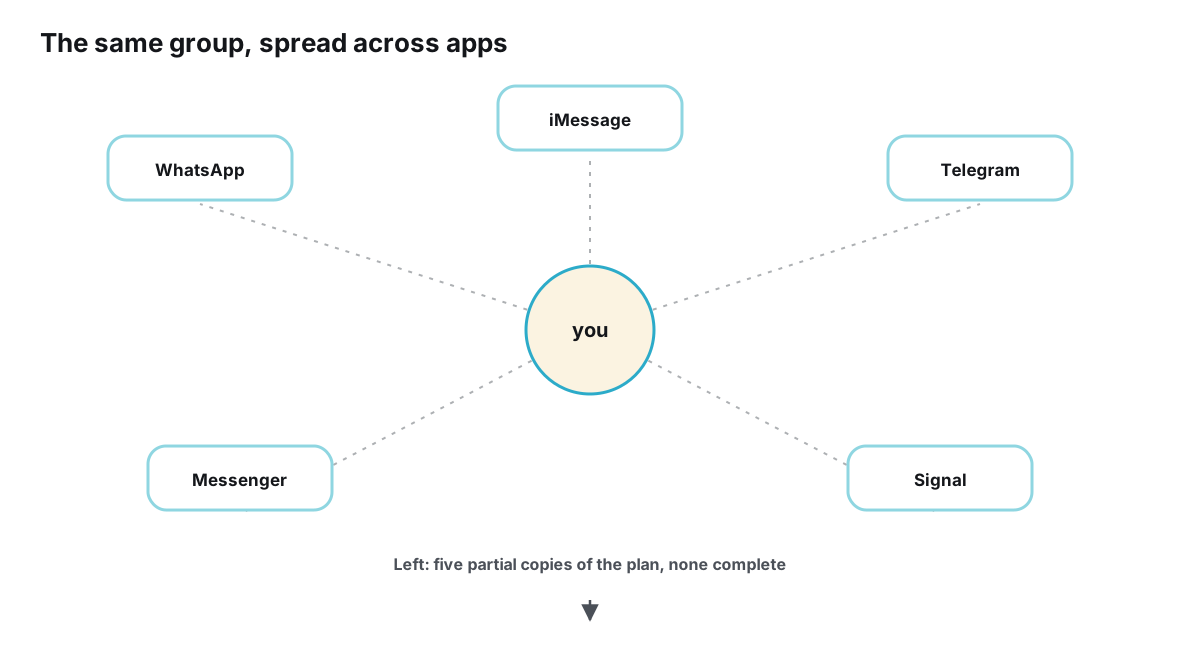
Add a second app and the problem squares. Now the archaeology exists twice, the two reconstructions drift apart, and every update must be manually published in each place — the pattern dissected in the problem with having event information across multiple apps. The chat's failure to be a record isn't a reason to abandon chat; it is the job description for the thing you build beside it.
What belongs on the record
The record should be small and complete rather than exhaustive — every field must justify the attention it asks of guests. The table below covers the fields that earn their place, why each one belongs on the record rather than in conversation, and the mistake most groups make with it.
| Field | Why it must live on the record | The common mistake |
|---|---|---|
| Date and time | The most-asked question and the most-changed field; one current value ends drift before it starts | Letting the final time exist only as the most recent message that mentioned it |
| Place, with a map link | Guests need it at the door, on the day, from any phone they happen to hold | Posting an address once mid-thread and trusting twelve memories |
| RSVP list | Bookings run on headcounts, and commitments must roll up by name | Counting reactions, or treating a poll's tally as who will appear |
| Costs and what to bring | Money and logistics questions arrive from every direction until answered once | Answering each question individually, forever, in every channel |
| Organizer and day-of contact | Problems on the day need one name attached to decisions | Assuming everyone knows who is running things |
| Open decisions | Undecided fields should be visible as undecided, with options if you have them | Letting silence mean both "settled" and "forgotten" |
| Change notes | A one-line history stops old versions from resurfacing as fact | Relying on members to remember what changed and when |
Two omissions are deliberate. Full conversation history does not belong on the record — the reasoning lives in the chats, and the record holds outcomes. And personal details beyond what guests need (addresses of homes, phone numbers as identity) do not belong either; the record should ask for the minimum it requires to function, which is names, answers and a contact route for the organizer.
Choosing where the record lives
The record's home matters less than its properties, but the properties are non-negotiable. It must be reachable by anyone in the group without joining anything — from any phone, in any messaging app, ideally without an account. It must display current state on arrival, not history. It must be editable by the organizer in seconds. And it should let guests register their own response — going, maybe, not going — against their name, because that is the field organizers most need help maintaining.
Measure the familiar candidates against those properties and the hierarchy becomes obvious. A pinned message fails reach and currency. A poll answers one question for one app's members. A shared document improves matters but buries itself and holds prose rather than fields. A calendar invite keeps the time current on calendars and covers nothing else. A dedicated event page — one address per event, with structured details and RSVP statuses — is the shape that satisfies all four requirements at once, which is the pattern tools like Ontaym are built around: an event page with one link, option polls before decisions harden, and going/maybe answers that maintain themselves.
| Option | What it does well | Where it falls short |
|---|---|---|
| Pinned message in a group chat | Instant to create and pinned in front of members | A snapshot that stales on the first change; invisible to anyone outside that one chat |
| Poll in a messaging app | Settles a single question among that app's members | One question, one audience, one moment — no home for the rest of the event |
| Shared document or note | One editable copy with room for any detail | The link gets buried like any message, and prose has no RSVP list or statuses |
| Calendar invite | Puts the time on calendars and updates it there | Covers only the when; acceptance is not attendance, and place and plan stay in chat |
| Dedicated event page | One address, structured fields, RSVPs, current state for anyone with the link | Asks the group to open a link rather than scroll — a habit worth teaching once |
One nuance on inputs: while a decision is still open, use whatever gathering tool fits the question. If the open field is purely a date, a scheduling poll such as Doodle can collect availability cleanly. The discipline is to treat any poll as an input whose result you then write into the record — not as the record itself, because polls freeze at the moment they close while events keep moving.
The eight steps
Everything above compresses into a procedure you can run for any event, from a dinner for six to a weekend for thirty. Each step is small; the sequence is what makes it hold.
- Create the record before the debate starts. Give the event its page or link while the plan is still one sentence, because the record earns its authority by being older than every argument about it.
- Capture the knowns and the unknowns. Fill in every field you can and mark the rest explicitly as undecided, so "not yet chosen" can never be confused with "forgotten."
- Give it one stable address. Choose a link that will survive every change of time, place and guest list without being replaced, so the answer to "where's the plan?" never changes.
- Announce the address in every channel the group uses. Post the same link — unchanged — in WhatsApp, iMessage, email or wherever else your people talk, with one line explaining that the plan lives there now.
- Debate in chat, decide on the record. Let the conversation range as freely as it likes, and the moment a question settles, update the corresponding field instead of declaring victory in the thread.
- Take RSVPs on the record itself. Have every guest register going, maybe or not going beside their name on the page, so the headcount is a list anyone can read rather than an estimate the organizer re-derives.
- Publish changes as edits, not announcements. When a detail moves, change the field once — and if the change is significant, drop a single line in chat pointing back to the link.
- Close the loop when the event ends. Let the record settle into its final state so anyone asking what happened has one place to look, and start the next event from a clean slate.
The early steps matter more than they appear to. A record created before the first disagreement is neutral ground — it predates every faction and preference. A record created after three days of heated thread-negotiation arrives carrying a history, and half the group treats it as one side's summary rather than shared ground. Likewise, the address announcement is not bureaucracy; it is the record's birth announcement, and skipping it is the most common way an otherwise perfect record dies unread.
Pacing is forgiving. Steps one through four take ten minutes on the day the event is a twinkle; steps five through seven repeat naturally whenever the plan moves, which is exactly when a chat-only workflow would be paying repetition costs; step eight takes a minute and quietly teaches the group what to expect next time.
Keeping the record authoritative
A record becomes the source of truth through social mechanics, not ownership declarations. The engine is a feedback loop: people check the record because it is reliably current, and the organizer keeps it current because people are checking. Your job in the first week is to feed that loop until it runs on its own.
Three habits do the feeding. First, answer every factual question with the link — including, and especially, questions you could answer in five words. "What time?" earns "it's on the page" with the link attached, every single time, because each ask is a free lesson in where answers live. Second, never maintain a parallel version: when someone asks you to "just tell them the plan" in a message, resist writing the details out again — the sentence you write becomes a new drifting copy the moment anything changes. Third, be scrupulous about step five: the instant something settles, it appears on the record, ideally before it appears as a conclusion in any thread. A record that is even occasionally behind the gossip forfeits the trust the loop depends on.
Expect one true test in every group's first record: the staleness event. Someone will post an outdated detail — an old time, a rejected venue — usually in genuine helpfulness. The correct response is a single message with the link and no scolding, and if the mistake was yours because the record lagged, fix the record and say so. How a group survives that moment determines whether the record becomes infrastructure or ornament. Related guidance for the update side of the loop — saying it once instead of twenty times — is covered in why event links beat forwarding messages, which dissects the copy-versus-reference mechanics underneath.
When the group spans several apps
Everything above assumes, correctly, that the record must be neutral ground — and neutrality is tested hardest by mixed groups. If half your friends are on WhatsApp and half on iMessage, no chat can host the record, because each app's groups are bounded by that app's membership: WhatsApp builds membership on phone numbers, as its own documentation of groups explains at the WhatsApp Help Center, while iMessage groups are tied to Apple's devices and simply cannot include friends on Android at all.
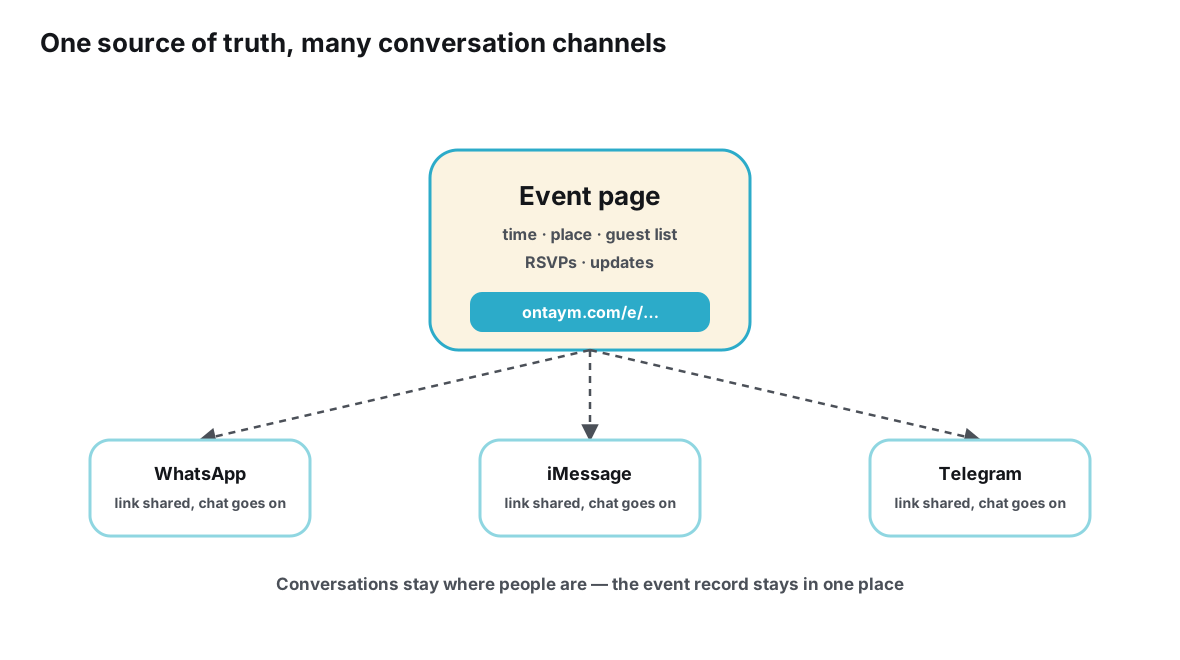
A link is the only object both apps treat identically. It opens from a WhatsApp message on an Android phone and from an iMessage bubble on an iPhone, previews in both, and resolves to the same current state in both. So for split groups, the pattern is unchanged but intensified: the record cannot live in either camp, so it lives at the address, and each conversation keeps its accent while pointing at the same facts. Invitations should work the same way — reaching people wherever they are without requiring anyone to join anything, which is its own discipline described in how to invite people without adding them to another group chat.
Common failure modes and how to catch them
Records fail in four predictable ways. None is fatal if caught early; all are fatal if ignored.
The stale record is the most common: planning energy moves back to the threads, updates stop reaching the page, and within two weeks the record is one more outdated copy — worse than the copies, actually, because it wears the costume of authority. The cure is the loop from the previous section, plus a simple rule of thumb: if you would announce a change in chat, you can update a field, and the field update is faster.
The rival record appears when a well-meaning member posts "the plan so far" as a message or screenshot. Now two versions exist and both feel official. The response is not territorial; it is procedural — reply with the link and fold any genuinely new details from the rival into the record, so the contribution is honored and the copy dies young.
The kitchen-sink record fails by ambition: every message, joke and side note gets archived, the record becomes a chore to read, and guests stop checking because checking costs more than asking. The cure is the field discipline from the table above — outcomes on the record, conversation in the chats, nothing else.
The hidden record fails socially: it exists, it is current, and half the group has never seen the link because it was posted once on a busy Tuesday. The cure is repetition of the address, not the details — pin the link where each app allows pinning, include it in every invitation, and make it the standing answer to factual questions until everyone has asked once.
A quick audit for your own event
However your event is currently organized, you can score it against the source-of-truth standard in under a minute with four questions. Is there one place a guest can look, right now, and see the current time and place? Does that place show each guest's own answer, by name? If the plan changed in the next hour, would the change need to be published anywhere other than that one place? And would a friend added tomorrow reach the current plan faster by reading or by asking you?
Three or four confident "yes" answers mean you already have a source of truth, whatever it is built from. Any "no" marks the exact seam where copies will begin to drift — and the step, from the eight above, that would close it.
Frequently asked questions
Does this mean my group has to stop using chat?
No — the opposite. The record exists so chat can go back to being genuinely conversational: jokes, anticipation, negotiation, everything that makes a group feel like a group. Only the plan's current state moves to the record. Most groups find their threads get more pleasant, not less, once facts stop competing with banter for the same space.
Can the WhatsApp group itself be the source of truth?
Only in the weakest sense. A chat can contain every fact as words inside messages, but it cannot maintain current state as data, it is bounded by that app's membership — built on phone numbers, which keeps some people out — and its record of decisions is an archaeology site rather than a list. Within a single-app group that never changes plans, a disciplined pinned message approximates a record; the approximation collapses the moment anything moves.
Who should be able to edit the record?
Usually one organizer, or two at most, with everyone else responding rather than editing. Open editing reintroduces the copy problem inside the record itself — two people updating the same field from different beliefs — and blurs accountability for what the plan currently says. Guests contribute through RSVPs, comments and suggestions; the organizer arbitrates what is written. For genuinely collective events, rotate the organizer role rather than the edit rights.
What about recurring events?
Use one record per occurrence, with the same pattern each time, and let the group learn the rhythm. The address discipline matters most here: if every occurrence has its own page, always share the current one's link and retire the old pages when they pass. A book club that meets monthly should never have a stale link in circulation for the meeting that already happened.
How do I get a resistant group to respect the record?
Through consistency, not enforcement. Answer every factual question with the link, without exception and without commentary; never write the plan out in a message again, even as a favor; and keep the record so reliably current that checking it is visibly cheaper than asking. Most groups convert within one or two events. The groups that never convert are almost always groups where the organizer quietly resumed parallel-publishing the details.
What's the minimum viable version?
A single page holding the time, the place and a by-name RSVP list, kept current by one person, beats an elaborate system nobody checks. If you build only that — and share its link everywhere the group talks — you have eliminated drift, duplicated updates and headcount guessing, which are the three failures that actually hurt events. Everything beyond it is refinement.
Conclusion
A source of truth is not a tool you buy or a rule you announce; it is a decision about where facts live, followed by the small daily habit of honoring that decision. Create the record before the debate, capture the unknowns as visibly as the knowns, give the plan one stable address, announce it everywhere, decide onto the record, take RSVPs on it, edit rather than announce, and close it when the day is done. Run that loop for one event and your group will expect it for the next; run it for three and the question "wait, which time is final?" starts to sound like a memory of an older, more apologetic era.
The test to carry with you is the disagreement test. When two versions of the plan collide — and in any group with more than one conversation, they eventually will — everyone involved should know, instantly and without negotiation, which version wins. A group with a source of truth answers that question with a link. A group without one answers it with a scroll, a debate, and a small avoidable chance that someone they love stands outside the wrong restaurant. The eight steps above take about ten minutes to start. They are among the best-organized minutes an organizer ever spends.
Give your event one authoritative address.
Set it up with Ontaym