
Why Event Participation Shouldn’t Require Joining a Community
Attending an event is a bounded act: one evening, one answer. Joining a community is an open-ended relationship. When platforms make the first conditional on the second, the people you lose are rarely the ones who declined the event — they declined the membership.
Quick answer
Attendance and membership are different acts. Attendance is bounded — you show up, you participate, it ends. Membership is ongoing — an account, a visible roster, notifications, and an exit that can feel like a statement. When an event is only reachable through a community, would-be guests must accept the bigger commitment to perform the smaller one, and many quietly decline the bundle. The fix is structural: give every event its own address — a link with the plan and RSVP statuses — so anyone can attend without enrolling. Offer membership separately, as something people graduate into after they have tasted the event. Organizers who split the two typically see wider participation and, paradoxically, stronger communities, because the members they gain actually chose to be members.
One evening versus a relationship
Say a friend invites you to a board-game night. What are you agreeing to? An evening. You will show up, play badly, eat someone’s guacamole, and go home. The commitment has clean edges: it begins at seven and ends around eleven, and next month you are free to never think about it again.
Now say the same invitation arrives as a link to a Discord server. Before you can see what game, what time, or who else is going, you are asked to join — to become a member of a community with channels, roles, rituals, regulars, and, in a large server, a crowd of people who are not at the event and never will be. The evening is in there somewhere. But the doorway to it is a relationship with no defined end.
These two asks are not variants of each other. They differ in duration, in exposure, in what they say about you, and in how you can undo them. A guest who would happily give an evening will often balk at giving an identity, a notification channel, and a line on a roster — and the organizer never hears why. The no looks like indifference to the event. Frequently it is a perfectly reasonable reluctance to join one more community.
| Dimension | Attending an event | Joining a community |
|---|---|---|
| Duration | Bounded — from start time to end time | Open-ended — until you leave or it dissolves |
| What you share | Your presence, and whatever name you attach to an RSVP | A platform identity — often a phone number or account — visible to the roster |
| What you receive | The event itself | A standing channel: conversation, notifications, culture, obligations |
| How you exit | You simply go home; nobody is informed | Leaving is a legible act that can be read as a judgment |
| Cost of declining | Near zero — a private no, or silence | Refusing the join can look like rejecting the people |
| What it implies about you | You were interested in one evening | You identify with the group and its ongoing life |
The table reads as an argument against communities, so let us be clear before going further: it is nothing of the sort. Communities are among the best things the internet has made possible — a running club, a language-exchange circle, a parents’ association are genuinely more than the sum of their events. The argument is only against conflating the two acts. Membership should be a meaningful choice, not a toll paid on the way to a single Tuesday.
How the two got merged
The conflation is not an accident of design laziness; it is where the incentives point. Communities retain. A member is a person the platform can reach next week; an attendee is a person who had one good evening. Every major platform has therefore grown features that anchor events inside standing groups. Discord’s servers host scheduled events that live among the server’s channels and roles — Discord’s own support pages describe events that members mark as interested, and Discord is explicit in its design that such markers are expressions of interest rather than attendance commitments. WhatsApp Communities let organizers link related groups and broadcast announcements across them, with membership resting on phone numbers, per the WhatsApp Help Center. Telegram’s vast groups and channels work similarly as standing rooms in which events are announced as messages.
None of this is a criticism — these are honest features built for honest purposes, and for a community that already exists, they work. The problem is the direction of the dependency. In these architectures the community is the container and the event is content inside it. To touch the content you must enter the container. Attendance is gated on membership because that is the only shape the container knows.
And so an organizer who just wants to run one board-game night reaches for the nearest tool and discovers that hosting requires founding a society first. The infrastructure answers a question nobody asked — “will you join us forever?” — before it will answer the one that matters tonight: “are you coming?”
The invisible clause in the membership agreement
When a guest joins a community to reach an event, what do they actually accept? More than the join button suggests. There is the visible part — the roster, the channels, the norms — and the invisible part, which is the clause nobody reads because it is never written down:
You agree to be reachable. Notifications, pings, and event announcements will find you wherever the community lives. You agree to be listed. Your identity — username, avatar, or phone number — appears to the membership at large. You agree to a permanence you did not price in: the community will outlast the event, and your tie to it will too, until you perform an exit. And you agree to ambiguity about scope: the community will discuss things far beyond the event that brought you, and silence about them may be read as a position.
None of these clauses is outrageous in itself. Plenty of people accept them gladly for communities they love. The issue is consent architecture: the guest was asked about an evening and enrolled in a residency. The mismatch is felt most by exactly the people healthy communities should want — busy people, careful people, people with boundaries learned the hard way, people who would be superb on a Tuesday but who have learned what “just one more group” costs them by March.
Where this shows up
The pattern is easiest to see in miniature. The board-game café runs an open night; someone helpful creates a Discord server for it, and within a month the regulars are chatting happily while the first-timers who came once and meant to return never join — they experienced the server as paperwork for a hobby they had tried exactly once. The school fundraiser needs volunteers for a Saturday; coordination happens in a WhatsApp Community of hundreds of families, and a father who would gladly have carried boxes for two hours does not volunteer, because volunteering apparently means having his number visible to every household in the school. The fitness coach announces drop-in sessions in a channel, and the casual Saturday crowd — the exact people the sessions exist for — slowly thins to the inner circle who were already members.
In each case the event is fine. The people are friendly. Nothing about the community repels anyone. The door is simply heavier than the evening, and the crowd filters itself at the threshold where nobody is watching. If you run any recurring activity and have ever wondered why your roster is large but your turnout comes from the same dozen faces, this is a hypothesis worth taking seriously: it may not be apathy. It may be the doorway.
The silent cost: the people who would have come
Here is the practical wound, and it is worth stating plainly because it is nearly invisible in the data organizers see. When attendance requires membership, the drop-off happens before the RSVP. There is no record of the colleague who opened the Discord invite, saw fourteen channels, and closed the tab. No trace of the parent who would have loved one quiz night but would not join the parents’ WhatsApp community — because their number would be exposed to a hundred households, the concern explored in how to invite people without exposing everyone’s phone number. The organizer counts the members and reads the missing as uninterested. The event looked small; actually, its door was heavy.
Heavy doors select for a particular guest: the one already inside the platform, already comfortable with the culture, already paying attention to the channel. That guest is wonderful — and insufficient. Newcomers, cross-app friends, occasional participants and privacy-careful people all thin out at the threshold. Communities gated this way drift toward their existing core, then wonder why the core ages and no one new seems to arrive.
The loss is doubled by the measurement problem. A Discord event’s “interested” markers, as Discord itself frames them, are not RSVPs — they are soft signals inside a membership. An announcement in a WhatsApp Community is a message in a stream, not a headcount. The organizer planning snacks is working with vibes, and everyone who might have come but didn’t join doesn’t even exist as a number. Participation gated on membership isn’t just smaller; it is unknowably smaller.
When membership genuinely earns its keep
After all that, the honest case for membership-gated events deserves its own hearing, because it is real. A recurring club with shared equipment, shared norms and shared memory genuinely benefits from a standing home: the channels carry the between-session life, the roster is the club, and moderating a known membership is easier than hosting an open door. Servers and communities also solve problems a bare event page cannot — identity over time, reputation, roles, a place for the jokes to accumulate. For a weekly football team or a class with a curriculum, continuity is the product.
The mature position is not “never gate.” It is “gate on purpose, and know what each gate costs you.” The table below is an attempt to make that judgment explicit.
| Situation | Reasonable gate | Why |
|---|---|---|
| One-off social gathering — dinner, hike, game night | Attendance only | Nothing carries over; membership would be a toll, not a bond |
| Event with newcomers and friends-of-friends | Attendance only | The threshold is exactly where new people are lost |
| Public session — workshop, open meetup, community class | Attendance only | Reach matters most; every membership requirement shrinks the funnel |
| Recurring club with shared gear, norms and memory | Membership reasonable | Continuity is the point; the roster has a job to do |
| Team with a season, schedule and roster limits | Membership reasonable | Commitment is inherent to participation |
| Community that also runs events for the wider public | Both, side by side | Members keep their home; outsiders attend without enrolling |
Notice the last row. It is the pattern most healthy organizations converge on once they notice the problem: a two-door design in which the community keeps its inner life while every event also has an outer door — a link, a page, an RSVP — that asks nothing but the evening.
RSVPs deserve to stand alone
Strip the problem to its data and you can see why the two-door design works. What is an RSVP, really? A small structured fact: this person, for this event, currently intends this. It is meaningful only if it is current, personal, and attached to the event rather than to a channel’s chatter. It is, in the formal vocabulary of the web, its own kind of object — schema.org, the vocabulary behind much of the structured web, models it explicitly as an RsvpAction attached to events, precisely because a response is not a message, a membership, or a reaction.
Messaging platforms blur this because their only native gestures are messages and reactions. A “+1” in a thread is an RSVP wearing a message’s clothes: it scrolls away, it can’t be updated without a new message, it can’t be counted without a human reading the thread. An “interested” click in a server is a soft signal, not a commitment — by design. Neither is wrong; both are conversation-native. But a headcount needs an object that holds going and maybe per person, updates when plans change, and rolls up into a number the organizer can trust. That object belongs to the event, not to the community and not to the chat.
This is why separating participation from membership is not merely a politeness — it is the precondition for counting people accurately. The guest who answers on the event’s own page, without joining anything, has generated exactly the datum the organizer needs. The guest who would have joined a community to answer may or may not exist; the one who answers freely always does.
The two-door design
How does this look in practice? A structure with two entry points and one shared object between them.
- Give the event its own address. One link, one page: the plan, the open questions, the RSVP statuses. This door is open to anyone you or your guests share the link with — no account in your community, no roster, no phone number exchanged.
- Keep the community as a second, optional door. Regulars who want the between-event life join the server or chat on purpose. Membership is offered, never extracted — an invitation into the inner circle, extended after the event rather than demanded before it.
- Let both doors write to the same RSVP list. Whether a response comes from a member or a stranger with a link, it lands on the same headcount. The event’s truth lives in one place — the pattern described in why an event needs its own digital space.
- Let conversation happen everywhere. The community’s channels discuss the event among themselves; guests discuss it in whatever chat they already share; the page quietly holds the current state for all of them. Conversation is optional atmosphere, not the container of the plan.
- Invite newcomers into the community after, not before. The person who came once and loved it is the strongest membership candidate you will ever have. Let them ask to come back — that “ask” is the difference between a member and a hostage.
The design reads as extra structure, but in practice it subtracts. The organizer stops maintaining parallel announcement channels and starts maintaining one plan. The community stops carrying guests who never wanted to be there — the muted, the enduring, the ones present only for one event — and its conversation gets more genuine. The event’s headcount finally reflects intent rather than enrollment. Tools built on this shape, Ontaym among them with its one-link-per-event pages and RSVP statuses, exist precisely because the two acts deserve two doors.
A note on safety and moderation
The objection with real weight behind it is safety: doesn’t an open event door mean less control? Look closely and the two-door design holds up, because it separates speaking rights from attendance. A guest responding on an event page leaves a mark on a list — not a voice in a room, not a channel into anyone’s inbox, not a membership that outlives the evening. The organizer sees every response and controls the link’s distribution; misuse of the page itself has a small blast radius, since the page shows a plan, not a roster of people.
The community’s moderation story is actually stronger than before, not weaker. Servers and groups can keep their rules, vetting and culture for the inner door — now applied to people who chose membership, which is a far easier population to moderate than a crowd that joined under duress for one event. And the boundary between the doors is explicit: the community moderates its own channels; the event page mediates attendance; neither has to do the other’s job. Openness at the event layer and standards at the community layer are not in tension. They never were — they were only fused.
Wider gates, stronger walls
A worry sometimes surfaces here, usually from the people who run communities with care: doesn’t making events open to non-members weaken the community? The observed pattern is closer to the opposite. Open events widen the top of the funnel — more people taste the thing, more people return, and the ones who eventually ask to join are self-selected and sincere. What the community loses is only the appearance of size: rosters swollen by people who joined for one evening and muted the rest. A smaller list of real members outperforms a larger list of captives, in energy, in moderation load, and in the quality of what gets said in the channels.
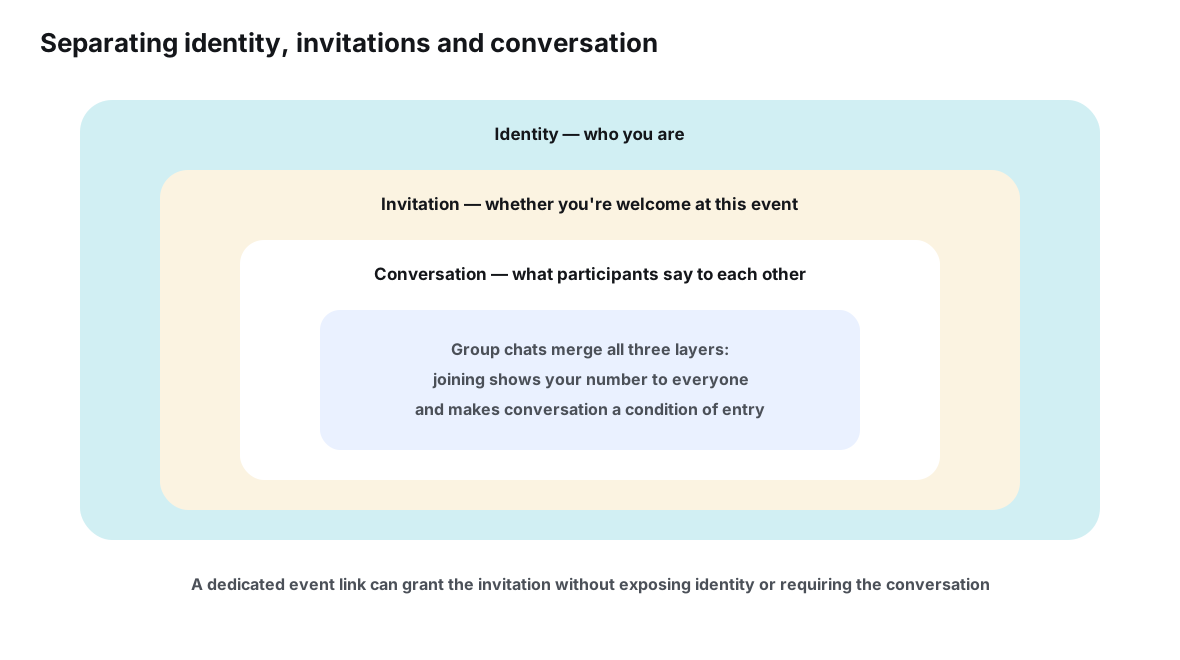
And the walls that matter — privacy, boundaries, the ability to be a member without being public property — are not weakened but strengthened, because now they guard something people chose. The member who opted in after attending holds a real membership. The guest who declined it kept their evening and their number. The boundary between the two states is clear, which makes it respectful rather than restrictive. The architectural view of that separation — identity in one layer, invitations in another, conversation in a third — is the subject of how modern event platforms can separate identity, invitations and conversation, and it is the natural next step if this argument has landed.
Frequently asked questions
Isn’t joining “just one click”? Why make a principle of it?
The click is small; what the click does is not. It creates an account-level tie, exposes an identity to a roster, opens a notification channel, and sets up an exit that will eventually require a decision. People are not objecting to the click — they are declining, reasonably, the relationship behind it, for one event they may never attend again.
How do I stop non-members from spamming or crashing?
Scope the event’s surface, not its membership. A link you share with chosen people admits chosen people; RSVPs on the page are marks on a list, not speaking rights in a room. If the event is genuinely open, a link per event still gives you a cleaner boundary than a standing community whose roster every past attendee holds forever.
My community is the event — a weekly club where the group is the point. Does any of this apply?
Then membership is honest, and you should keep it. The argument targets the bundling, not the belonging. Even a real club benefits from a light outer door for trial sessions: newcomers attend once via a link, and join only if they want the Tuesdays — which makes every subsequent member a deliberate one.
How do updates reach people who never joined anything?
Through the event’s own page, which is the one address every guest already holds. Update the page and it is current for everyone; tools built around event pages can also notify or remind people who opted in by responding. Nobody needs to be a member of a community to be told the time changed.
Doesn’t this fragment the conversation across the community and everyone else’s chats?
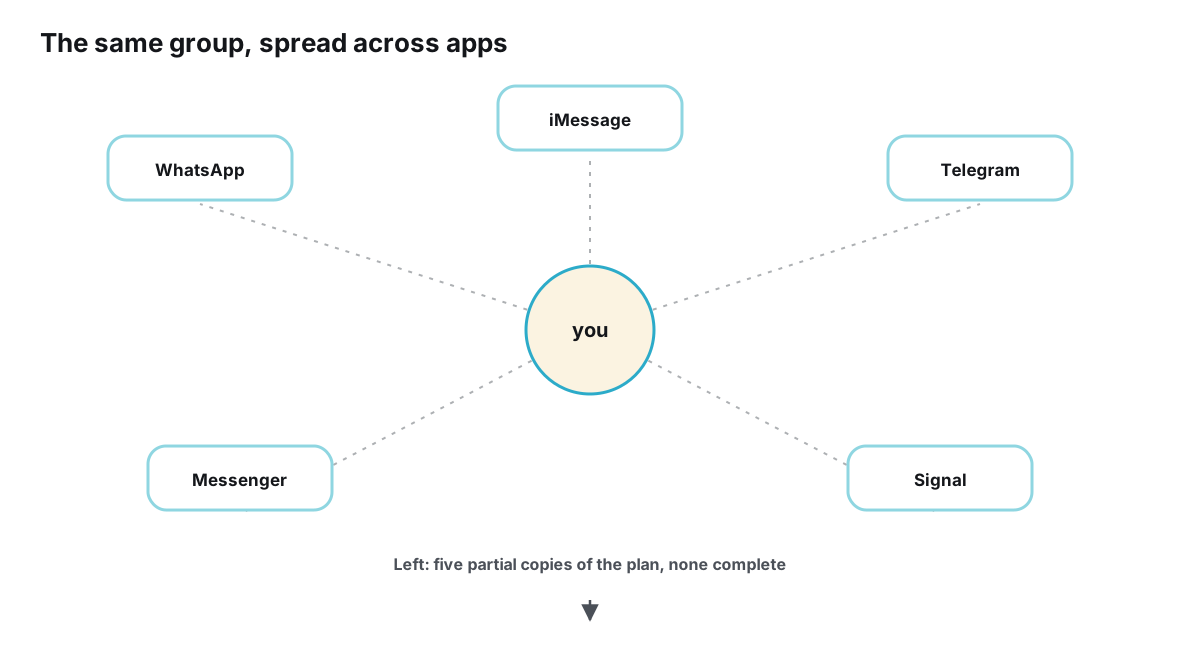
Conversation is already fragmented — it lives in whatever apps each subset of guests shares. Fragmentation only becomes a problem when the plan fragments with it. As long as one page holds the current state, distributed chatter is just atmosphere; the plan stays whole, which is the part that matters at six o’clock on the night.
Won’t organizers lose the sense of who their “real” audience is?
You gain it. A community roster conflates one-time guests, muted captives and genuine regulars into one number. An event page separates them: respondents are people who actually engaged with that event, and members are people who chose the relationship. That is a truer picture of your audience than any membership count.
Conclusion
Attendance and membership are both good things. The failure is selling them as a bundle — making the smaller, bounded commitment conditional on the larger, open-ended one, and then reading the resulting drop-off as indifference to events.
The practical prescription fits in three sentences. Give every event its own address that anyone can open, see, and answer without joining anything. Keep the community for what it is uniquely good at — continuity, identity, the life between events — and let membership be an invitation people accept after attending, not a toll they pay before. Count intent through RSVPs attached to the event itself, and you will finally know who is coming, who is drifting, and who is quietly saying no to a relationship they were never offered on its own terms.
Lower the gate to the evening and the door to the community stays what it should be: something people walk through on purpose, and are glad they did. For the privacy dimension of the same design — what members and guests respectively expose, and why — the companion piece is how event invitations can protect participant privacy.
Let guests come to the event without marrying the community.
Open a door with Ontaym