
Event RSVP vs Group Chat Reaction: What's the Difference?
The thumbs-up is probably the world's most common RSVP — and the least reliable one. This is the complete comparison between a reaction inside a group chat and a real RSVP: what each one is, what each one can and cannot tell an organizer, and why the difference decides whether your headcount survives until the event.
Quick answer
A group chat reaction is a gesture attached to a message: fast, expressive, and meaningful mostly at the moment it's made. An RSVP is a record attached to a person and an event: a named commitment with a status — going, maybe, not going — that persists, stays current, and rolls up into a headcount. The reaction tells the organizer someone interacted with a message; the RSVP tells them who intends to be in the room. Reactions fail as attendance data in five structural ways: they bind to the wrong object (a message, not the event), they decay silently, they can't be updated without ambiguity, they can't be aggregated into a count, and they're visible only inside one app's membership. Use reactions for warmth; use RSVPs for anything a reservation, quorum or guest list depends on.
Two signals that grew up doing the same job
Before any software is blamed, it's worth admitting that this confusion predates smartphones. Someone shouts “drinks on Friday?” across an office; three people wave; the organizer counts waves. The wave is a reaction — a gesture in a live conversation, cheap to give, gone the moment the conversation moves on. It was always understood as approximate, which is why traditional invitations, from wedding cards to evites, formalized the reply: a named response to a named occasion, expected by a date, updatable by apology. The French phrase those four famous letters abbreviate — “répondez s'il vous plaît,” please respond — encodes the whole idea: the host needs an answer, from you, about this.
Messaging apps gave the wave a button and the reply a chat thread, and the boundary between them blurred. Reacting to “who's in for Friday?” with a thumbs-up feels like replying; it even produces a warm social moment, visible to the group, at essentially zero effort. The reaction inherited the convenience of the wave and the apparent formality of the reply, while containing the substance of neither. Understanding exactly what a reaction is — and what an RSVP is — is the way out of counting gestures as guests.
The anatomy of a reaction
A reaction, as implemented across WhatsApp, iMessage, Messenger, Telegram and most modern chat apps, has a specific technical shape, and every property of that shape matters to the organizer who tries to count it.
It is attached to a message, not to an event. The thumbs-up lives on “who's in for Friday?” — a message that exists at one position in the timeline, among thousands of others. There is no link between the reaction and any persistent object representing Friday's dinner; if a second message later says “moved to Saturday,” the old reactions do not migrate, update or invalidate. They simply remain, asserting enthusiasm for a message that no longer describes reality.
It is expressive rather than semantic. The same thumbs-up can mean yes, seen, thanks, hi, solidarity, or “I acknowledge this exists.” Emoji are deliberately open-ended — that openness is what makes them wonderful for social texture and useless for data. No one, including the person tapping, is committing to a specific interpretation.
It is ephemeral in effect. Reactions influence the moment — the sender sees a burst of approval and feels good — and then the conversation continues. The reaction does not persist as a queryable fact anywhere. It cannot be listed, summed, filtered or compared. Asking “who reacted yes to the Friday message three weeks ago?” is an archaeology question, not a lookup.
And it is scoped to one app's membership. The reaction is visible to people in that chat, in that app. Anyone invited by other means — the friend on a different messaging app, the guest who never joined the group — doesn't exist in the reaction's universe at all.
The anatomy of an RSVP
An RSVP, in any system that implements it properly, is a different kind of object altogether. Strip away interfaces and it has five load-bearing parts: a person (who is answering — identity, not anonymity), an event (what they are answering about — a specific occasion with a date and place), a status (going, maybe, or not going — a small controlled vocabulary, not a free gesture), a current-answer semantics (one status per person that replaces earlier statuses), and an aggregation role (the statuses exist to be counted: the headcount is the point).
Those five parts are not arbitrary. Each one exists because organizers kept getting burned by its absence. Identity, because “eight people are coming” is useless without knowing which eight. Event binding, because answers about one occasion shouldn't contaminate another. A controlled status set, because “maybe” and “no” are planning information, not rudeness. Current-answer semantics, because plans change and the record must track the latest truth. Aggregation, because the end consumer of an RSVP is arithmetic: tables, seats, portions, quorum.
The strongest evidence that this is a genuinely different data structure is that the web's shared vocabulary treats it as one. schema.org — the structured-data schema that search engines read — defines RsvpAction as its own type, alongside Event and FAQPage, as documented at schema.org/RsvpAction. A reaction, by contrast, has no schema anywhere as an attendance record, because it isn't one. The distinction isn't a marketing invention; it's settled data modeling.
| Dimension | Group chat reaction | Event RSVP |
|---|---|---|
| Attached to | A specific message in a timeline | A person and an event record |
| What it expresses | A gesture — acknowledgment, warmth, vague assent | A status — going, maybe, not going |
| Identity | The reactor's account, loosely, at that moment | A named participant the organizer can act on |
| Meaning over time | Decays silently; never updates with the plan | Persists as current state until changed |
| Update path | Remove and re-add, or a new gesture elsewhere | Change status; old answer replaced everywhere |
| Aggregation | Cannot be summed — emoji are not countable units | Rolls up directly into a headcount |
| Audience | Members of that one chat, in that one app | Everyone invited to the event, wherever they are |
| Visible to late joiners | Buried in history, meaning unclear | Current status readable at a glance |
| Safe to book on | No | Yes — with human slack, and with changes tracked |
Difference one: the reaction binds to the wrong object
The deepest problem is what the reaction is attached to. Attendance is a relationship between a person and an event; a reaction is a relationship between a person and a message. Those coincide only while the message happens to be about the event — and messages are a terrible substrate for a relationship, because they multiply, contradict each other, and age at the speed of conversation.
Consider the life of a single plan in an active group. “Dinner Friday?” … “who's in?” … “same place as last time?” … “actually let's do Saturday” … “Saturday works for me” … “final headcount by tomorrow please.” Each of these messages attracts its own constellation of reactions. By the end, the person-to-event question — is Priya coming? — has been answered by gestures scattered across six messages, four of which describe an outdated version of the plan. There is no single place where Priya's current answer lives, because no single object in the chat represents the event her answer is about.
This is why the reaction's meaning degrades precisely when accuracy starts to matter. Early in planning, a thumbs-up on “dinner Friday?” is harmless enthusiasm. Late in planning, after two time changes and a venue swap, the same thumbs-up sits on a message that may no longer describe the event — and nobody, including its author, intends it to. The gesture didn't change; the plan did. Only a record bound to the event itself changes with it.
Difference two: decay without expiry
Every piece of planning information has a shelf life, and good systems make the shelf life visible. An RSVP given a week ago is still nominally current, but the system that owns it can re-confirm, remind, and show its age. A reaction has no clock at all. The thumbs-up given Monday on the Friday message looks identical on Friday morning, whether its giver has spent the week firming up babysitting or silently resolving to bail.
Worse than the reaction's own decay is what it does to the organizer's confidence. Because reactions never expire, they never stop asserting. A screenshot of “twelve thumbs on the invite!” remains quotable forever, even as the twelve drift apart in private. The record can't distinguish firm answers from stale ones, so the organizer compensates the only way chat allows — by polling the thread again, starting the whole gesture cycle over. Re-confirming by message is what a system without state does instead of having state.
Attrition is the natural shape of every plan: the invited narrow to the interested, the interested to the going, the going to the arrived. A reaction-based headcount captures one slice of the funnel at one moment and then freezes it, mislabeled as a final count. An RSVP-based record observes the funnel all the way down, which is why its numbers, though softer than organizers wish, at least move in the right direction as the date approaches.

Difference three: there is no update path
Plans change, so answers must change — that is not an edge case but the ordinary life of an RSVP. The question is what changing your answer costs, and what it communicates. In a real RSVP system, changing is a first-class action: Priya switches from going to maybe, her earlier status is replaced, the headcount ticks down, and the organizer sees the current truth without anyone performing an announcement. The change is quiet, shame-free, and recorded.
In a chat, changing your reaction-answer has no graceful form. Removing a thumbs-up is nearly invisible — who notices a reaction disappearing? — so it communicates nothing to the person who needs to know. Leaving the stale reaction and adding a new one elsewhere produces contradictory signals that must be reconciled by reading. Typing a correction message (“so sorry, can't make it after all”) works socially but lands as a new event in the timeline, one more statement in the archaeology pile, superseding an earlier statement only for whoever reads both.
The result is a systematic bias toward stale yeses. Removing a reaction costs a little attention and communicates almost nothing; leaving it costs nothing and misleads silently. Rational, kind people therefore leave their thumbs-ups in place while privately planning not to attend. The medium quietly converts honest drift into invisible no-shows. We treat this whole dynamic — what actually happens downstream when someone changes an RSVP, and why graceful change produces honest data — in what happens when someone changes their RSVP.
Difference four: gestures don't aggregate
The organizer's final question is arithmetic: how many? An RSVP answers it — count the goings, note the maybes, done. A reaction field cannot be counted, for several compounding reasons.
First, polysemy: the same emoji means different things to different tappers, so “fourteen thumbs” is not a number of people but a number of gestures with mixed meanings. Second, duplication: the same person may react to the invite, the re-confirmed invite, and the “final numbers please” message — three gestures, one human, no way to dedupe. Third, dispersion: relevant signals live on multiple messages, and no tool exists to collect them, because chat apps don't treat reactions as data to query. Fourth, absence of negatives: a reaction can't express a considered no, so the people who checked their calendar and firmly can't come are filed, by the counting logic, alongside the people who never saw the message — invisible in the same way.
The organizer reduced to counting reactions ends up doing what organizers have always done in this situation: opening the thread, scrolling, keeping a tally in a notes app or in their head — a human performing a database's job, with a database's fatigue and none of its accuracy. This is the point where the missing structure becomes unpaid labor, and it's the single clearest sign a group has outgrown reaction-based planning.
Difference five: scope stops at the app's edge
A reaction lives inside one app's walled membership. WhatsApp reactions are visible to the WhatsApp group; iMessage reactions live with Apple's Messages on Apple devices, as covered by Apple Support; Messenger reactions belong to the Facebook account that gave them. Each is a fine feature of its platform, and none travels.
Real guest lists rarely respect app boundaries. The birthday dinner includes the college friend on a different app, the aunt who doesn't join groups at all, the colleague who'd rather not exchange contact details with twenty strangers. For every one of those guests, the in-chat reaction universe doesn't exist — yet the headcount must include them. The organizer bridges by hand: forwarding screenshots, keeping a side list, double-entering answers. The reaction system's scoping, invisible on a good day, becomes manual work the moment the group is cross-platform, which for most adult friend groups is the default state.
An RSVP on an event record doesn't have this boundary, because the event is an object with an address rather than a room inside an app. Whoever can reach the event — by link, by invite, on any device — can hold a status in it. That single property is a large part of the argument for giving events their own digital space in the first place, which we make separately in why an event needs its own digital space.
How the major platforms treat the gap
It's worth surveying how familiar platforms position themselves, because the survey shows the industry converging on the same distinction from different directions — and treating each platform fairly matters here: none of these tools is misdesigned for its purpose.
WhatsApp offers reactions and polls inside group chats — quick expressive tools for conversations, as the WhatsApp Help Center documents — and for larger structures, Communities that link related groups and share announcements with their members. It's a strong conversational stack; the attendance layer simply isn't what it's for. Apple's iMessage supports message reactions within its ecosystem, with the platform boundaries that implies, and Facebook's Messenger offers reactions and polls similarly. Telegram separates one-to-many channels from many-to-many groups and offers polls that can be anonymous or public with visible votes — genuinely useful for community questions. GroupMe provides basic polls and likes in the same lightweight register.
Discord is the most instructive case, because it names the line explicitly. Server events let members mark themselves as interested, and Discord frames those markers as expressions of interest — not RSVPs — a distinction maintained in its support documentation. Community platforms at Discord's scale learned that “interested” and “attending” diverge so reliably that conflating them produces actively misleading event planning, so the vocabulary keeps them apart even when the feature looks RSVP-like.
| Platform signal | Reliably tells you | Cannot tell you |
|---|---|---|
| WhatsApp / iMessage / Messenger reaction | A member saw and warmly acknowledged one message | Attendance intent for the event, now or later |
| Chat poll vote | A member's preference on the polled question | Whether the voter shows up for the winning option |
| Telegram poll (public or anonymous) | Group sentiment, with or without named votes | Commitment that survives the poll's moment |
| GroupMe poll or like | Light group preference or acknowledgment | Any headcount semantics |
| Discord “interested” marker | An event is on a member's radar | Attendance — it is interest by design |
| RSVP status on an event record | A named person's current answer for a specific event | Certainty — but changes are captured, so the count stays honest |
When a reaction is genuinely enough
None of this argues for ceremony at every scale. There is a real regime where reactions do the job: small groups, high trust, short horizons, single questions. When four roommates react to “pizza tonight?”, the group is small enough that everyone's status is socially known, the event is hours away so decay has no time to operate, and the question is binary and immediate. The reaction works precisely because the conditions suppress its failure modes — nothing has time to change, nobody is missed by the app boundary, and the headcount fits in everyone's head.
The honest way to decide is to check the conditions, not the vibe. Ask: could the plan change between now and the event? Is anyone invited outside this chat? Does any decision depend on the number? Will the thread still be findable in a week? A single yes to any of these suggests the gesture is being asked to carry weight it wasn't built for — and a yes to two or more makes the mismatch a certainty. Reactions scale socially and fail structurally; RSVPs add a little ceremony and hold their value exactly where reactions lose theirs.
The bridge: from gestures to records
Moving a group from reaction-counting to real RSVPs is less about tools than about a changed question. The pattern that works:
Give the event an address before asking for answers. The RSVP needs something to attach to — an event page or record with the known facts, even if some are still undecided. The address is what makes status, update and headcount possible; without it you're back to gestures about messages.
Ask each person exactly once, on the record. The invitation names the stakes — going, maybe, or not going, by a certain date — and answers land on the event, attached to names. The chat stays open for enthusiasm; the page holds the count.
Let changes be cheap and visible. The system's job is to make “actually, Saturday doesn't work anymore” a two-second status change rather than a guilty announcement. Every change updates the headcount for everyone at once. This is the property that keeps the data honest all the way to the door.
Report the count, not the thread. Organizers should never have to scroll to answer “how many are we?” The event page's going and maybe lists are the answer, always current, always reachable by link — from any chat, to any guest, on any app.
Ontaym implements this pattern directly — event pages with RSVP statuses and updates behind a single shareable link per event — but the pattern is tool-agnostic: any system that binds named answers to a persistent event record will do. The gesture doesn't disappear; it gets promoted from data to warmth, which is what it was good at all along.
Frequently asked questions
Can a thumbs-up reaction count as an RSVP if we all agree it does?
Group conventions work until the conditions that make them cheap change. With four people deciding tonight's pizza, agreed meanings hold. As the group grows, the horizon lengthens, or the plan changes once, conventions quietly stop being shared — new members don't know them, and old ones forget. The reaction also can't update when plans change or express a considered “no,” so the convention lacks the two behaviors RSVPs exist to provide.
What's the actual harm in counting reactions?
Overcounting, mostly, plus stale yeses that never expire. Enthusiastic taps inflate the headcount; the inflated number gets booked; reality shows up smaller. The organizer then compensates by re-asking in the thread, which produces more gestures to count, and the cycle repeats. The harm isn't any single miscount — it's planning on a number that degrades silently in one direction.
Doesn't WhatsApp's events feature solve this inside the chat?
In-app event features add real structure for members of that one app, and they're a genuine improvement over raw reactions. The boundaries remain: the event lives inside the platform's membership, so cross-app guests and non-joiners can't hold status in it, and the event's address isn't a neutral link you can send anywhere. Whether that matters depends on whether your guest list matches the group's membership exactly — for friend groups, it usually doesn't.
Why do “maybe” answers matter so much?
Because maybe is where uncertain people go instead of pretending. Without a visible maybe, the uncertain face a binary — a cheap yes that inflates the count, or silence that reads as absence. A maybe keeps them in the plan, tells the organizer how much of the headcount is soft, and gives late deciders a legitimate place to stand. Reactions have no maybe; that alone corrupts the count.
What about polls — aren't they the same problem?
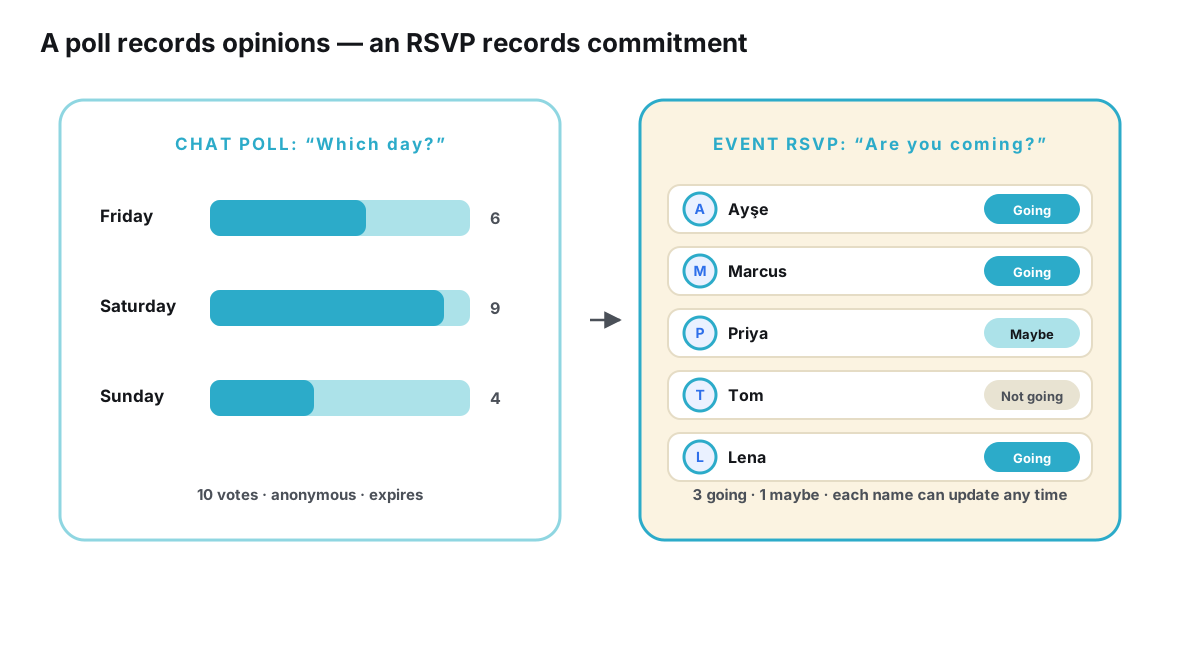
Related but distinct. A poll is a structured question with options, which is better than a free gesture, but it still measures preference at a moment, inside the chat, without update or headcount semantics. The full treatment of that boundary — vote versus commitment — continues in our related articles on reactions as attendance records and on the poll/RSVP divide elsewhere in this cluster.
How do we move a group off reaction-counting?
Stand up the event record with its known facts, share the link once with a single sentence — from now on, answers live here — and let the chat keep doing banter. Guests answer on the page in going, maybe or not going; the organizer stops counting gestures and starts reading a list. Expect a transition period where both systems run; the group follows the count, and the count lives on the record.
Conclusion
A reaction and an RSVP both feel like saying yes, but they are different objects doing different jobs. The reaction is a gesture in a conversation: attached to a message, expressive, immediate, and unable to persist, update, aggregate or travel. The RSVP is a record on an event: named, current, exclusive, changeable, and countable. Nothing in the chat's design is broken — the failure only appears when a gesture gets promoted to data, a role it was never shaped for.
The practical takeaway is a division of labor. Let reactions do what they're excellent at: warmth, acknowledgment, the social hum that makes a group feel alive while a plan forms. When a plan acquires a date, a place and consequences, move the answers onto the event itself — one address, one status per person, changes welcome, headcount always current. Organizers who make that switch stop performing archaeology on their own threads, stop booking against inflated numbers, and stop discovering the truth of their guest list when the door opens. The thumbs-up was never lying; it was only ever answering a different question.
Let the chat keep the warmth — put the answers on the event.
Plan it with Ontaym