
How Signal Communities Could Organize Offline Gatherings
Plenty of real communities — climbing clubs, mutual-aid networks, support groups — keep their conversation on Signal and their gatherings in the real world. Privacy-first messaging suits those groups beautifully. Organizing an actual meetup, though, asks for things a private chat was never asked to provide.
Quick answer
Signal groups are a strong home for the conversation side of a community: private by design, calm, and large enough — groups support up to 1,000 members — for serious communities. For the gathering side, they face structural limits: every participant must join and be reachable through a phone-number-based identity, occasional attendees are pushed into permanent membership, updates reach only whoever reads the thread, and there is no shared, current record of the event that guests or future members can consult. The working pattern is a pairing: keep the community’s talk on Signal, and give each gathering a neutral link — a page holding time, place, RSVPs and updates — that anyone can open or forward without joining anything. Privacy is preserved twice: once by the channel, once by not requiring anyone’s number to take part.
Why some communities plan on Signal at all
To understand the limits, start with the appeal, because it is not a niche preference — it follows directly from what certain communities are. A neighborhood mutual-aid network discusses who needs what and who is home on which evening. A support group shares things members have not told their families. A local advocacy circle organizes around issues that members would rather not have indexed, profiled or inferred from their social graph. For groups like these, the choice of channel is a values decision, not a feature comparison. Signal was built for exactly this posture: end-to-end encryption by default, a famously minimal approach to retaining data about who talks to whom, and no advertising business that benefits from engagement.
The result is a communication space with a particular character. Signal threads stay calm — there is nothing algorithmically amplifying the loudest voice, no feed to game, no discoverability machine pulling strangers in. For a community that meets in person, that calm is close to the atmosphere of a good village hall: you know who is in the room, the room keeps no score, and the conversation is the point. Communities that move their coordination onto Signal usually describe the same relief — the channel finally matches the group’s instincts.
And the scale is real. Signal groups support up to 1,000 members, with shared invite links and admin controls for admitting people — enough capacity for a city-scale hobby community, a large volunteer network or a sprawling neighborhood association. On paper, nothing stops a community like that from running monthly meetups entirely inside its Signal group. In practice, the friction appears not in the talking but in the meeting.
What Signal groups handle well for organizers
Before the limits, the credit — because a fair assessment shows how much of the gathering problem a Signal group genuinely solves. The strengths are not incidental; they follow from the same design choices that attract these communities in the first place.
| Strength | Why it matters for offline organizing |
|---|---|
| Privacy by default | Members discuss personal logistics — homes, schedules, vulnerabilities — without wondering who beyond the group can read it |
| Capacity for real communities | With groups up to 1,000 members, a whole association fits in one room instead of fragmenting across chapters and side threads |
| Controlled admission | Invite links plus admin oversight let a community grow deliberately, keeping the gathering’s guest list aligned with actual membership |
| Calm, chronological conversation | No engagement mechanics means announcements are not buried by an algorithm; diligent members really can read their group |
| Cost and independence | Organizers are not building their community’s home inside someone’s marketing channel, which matters to privacy-minded members |
For announcing a recurring meetup to a known, trusted circle — the Thursday run, the monthly repair café — this is nearly a complete solution. The announcement lands in a room where everyone belongs, the discussion happens among people who already trust each other, and nothing about the plan leaks beyond the membership. Many communities stop here and are right to.
From announcement to attendance: the pipeline problem
Announcing a gathering and convening it are different jobs, and the distance between them is longer than it looks. Between the message that says “picnic on the fourteenth, one in the afternoon, the big park” and a person standing in that park with a blanket, a small pipeline runs. The announcement must be seen — among everything else the thread produced that day — then understood (date, time, meeting point, what to bring), then acted on (a decision to come, blocked out in a calendar), then maintained (remembered a week later, adjusted if details shift), and finally executed. Each stage is a place where a chat-native announcement quietly loses people, and none of the losses are visible to the organizer until the day itself.
A Signal group handles the first stage about as well as anything can: the message lands in a room the member chose to be in, with no algorithm deciding its reach. But the middle stages are where the stream’s structure shows. Understanding means reconstructing the current plan from wherever it sits in the thread. Acting produces a reaction or a reply — a gesture with no persistence, no place in a tally, no way to revise when Saturday falls apart. Maintenance depends on re-reading. And execution depends on whichever version of the plan the person happened to see last. The pipeline does not break dramatically anywhere; it seeps.
A record steadies each stage instead of just the first. The link states the plan once, permanently current; acting on it is a status with a name on it; maintenance is a glance rather than a scroll; execution follows the same page everyone else consulted. The privacy-focused community gains something particular from the arrangement, too. Attendance expressed as data means the thread no longer doubles as the attendance register — fewer “are you coming?” messages chasing people in public, less social pressure to perform enthusiasm, and no need to explain a change of heart to a room full of neighbors.
The structural limits
The limits appear the moment a gathering behaves less like a club night and more like an event — new faces, changing details, a headcount, guests of members. None of these are exotic requests; each is ordinary event mechanics. Each also collides with a structural property of a private, membership-based chat.
The first limit is membership as the ticket. In a Signal group, participating in the conversation and participating in the event are the same act: to learn the meeting point, you join the group. But real gatherings have a long tail of legitimate partial participants — the friend a member brings once, the newcomer who wants to try the hike before committing, the former member back in town for a weekend. Forcing each of them into permanent membership of a private community inverts the social proportions: one evening of attendance buys an indefinite seat in the group’s ongoing conversation. Some will decline, quietly, and simply not come. A gathering that only members can conveniently attend is smaller than the community it belongs to.
The second limit is identity through a phone number. Signal, like the messaging systems it sits among, anchors accounts to phone numbers — a design that keeps onboarding simple and spam low, but which makes the number itself the ticket to membership. That has two costs for organizers. Socially, members who joined the community to attend a picnic are now mutually reachable in a way some would not have chosen; the privacy the community came for is subtly different from the privacy inside the group. Legally, a phone number is personal data in the plain sense used by Europe’s GDPR and California’s CCPA — a modest point for a friends’ group, but a real one for a community with hundreds of members, where the organizer is, in effect, operating a member directory and probably has never thought of it that way.
The third limit is the one every messaging group shares: a thread is not a record. The final meeting point is a message among thousands; the change from the north entrance to the east gate is one more line in the stream; the headcount is reconstructed from reactions and replies that mean different things to different readers. The deeper mechanics of this mismatch — state versus stream — are covered in why messaging apps were never designed to be event databases, and they apply to Signal exactly as they apply to any other chat. Encryption changes who can read the transcript; it does not turn the transcript into a source of truth.
| The gathering needs… | The typical Signal-group answer | The gap |
|---|---|---|
| Occasional guests without permanent membership | “Just join the group for now” | Over-membership: attendance priced as belonging; some guests simply stay home |
| A current set of details anyone can check | The relevant message, somewhere in the thread | Reconstruction instead of lookup; newcomers inherit the scroll |
| A dependable headcount | Reactions, “I’m in” replies, silence | Signals scatter and expire; no named, updatable statuses |
| Changes that reach everyone | A new message in the stream | Read by whoever was looking; everyone else holds the old plan |
| A record of what was decided | The full conversation history | A transcript to reread, not a state to consult |
| Reach beyond the membership | Screenshots forwarded elsewhere | Copies drift; the privacy perimeter and the information perimeter stop matching |
The membership paradox
There is a quiet irony worth naming, because it shapes real behavior in privacy-minded communities. The members most committed to privacy — the ones who chose Signal deliberately — are often the least willing to be added to yet another group, share their number more widely, or leave a permanent trace of their social graph. These same members are the lifeblood of the community’s offline gatherings. The channel the community chose to protect its members’ boundaries can, when used as the invitation mechanism, quietly press on exactly those boundaries.
The paradox plays out in small, familiar refusals. The photographer who happily documents every hike but never joins the group chat. The couple who attend the monthly dinner yet ask a friend to relay the details. The newcomer who came once, enjoyed it, and went quiet after being invited to “the Signal group” rather than to the next event. None of these people are being difficult; they are being consistent. A community that can only welcome through membership will systematically under-welcome the most privacy-considerate people in its orbit — and a privacy-focused community has more of them than average.
The resolution is not to abandon Signal, and certainly not to compromise the community’s privacy values. It is to separate the two roles the group has accidentally fused: belonging to the community, and attending a gathering. Belonging lives in the private channel, where the community’s real conversation happens. Attending needs nothing more than a link — which is the natural next section.
The organizer is caught in the middle of this. Welcoming generously is the community’s stated value; the channel’s mechanics turn each welcome into a membership grant. Declining to add someone feels exclusive, while adding them feels intrusive — and either choice gets made alone, in a private message, with no policy to fall back on. Communities rarely discuss this openly because it sounds petty next to privacy and belonging, which are supposed to be the serious topics. It is not petty. The perimeter policy — who may be admitted to what, and what admission exposes — is one of the defining decisions a community makes, and most communities make it one invitation at a time, by feel, until the feel runs out.
Three kinds of gathering, three different answers
Not every offline event makes the same demands, and the honest answer to “can we run this on Signal alone?” depends on which kind of gathering is being asked about. Three types cover most of what real communities organize, and each lands differently on the limits above.
The standing ritual — same day, same place, same faces — barely asks for structure at all. The Thursday run or the monthly repair café has its details engraved in the community’s collective memory; the thread’s job is mainly to say “see you Thursday.” A neutral event address here is optional furniture: genuinely useful for newcomers, unnecessary for the core. Communities that build one anyway usually do it for the newcomer’s sake, which is a legitimate reason rather than over-engineering.
The open community event — a seasonal picnic, a talk, a volunteer day — inverts every assumption: the guest list is fuzzier than the membership, details are genuinely in motion, a headcount determines quantities, and welcome extends past the group’s perimeter. This is the type the structural limits of this article are about, and the type where a neutral link stops being an optimization and becomes the difference between an event that welcomes and one that merely convenes its insiders.
The sensitive gathering — where the fact of the event matters as much as its details — adds a third axis. A surprise, a support-group session, a meeting with real consequences for those attending: here the community’s instinct is exactly right, keep it off the record. But “off the record” argues for care about where the details live, not for entrusting them to a fast-moving thread. A link shared deliberately with the few people who need it, carrying only what each of them needs to know, is easier to control than a message that gets quoted, screenshotted and buried in an archive — and far easier than the memory of whoever posted it.
A privacy-respecting workflow for offline gatherings
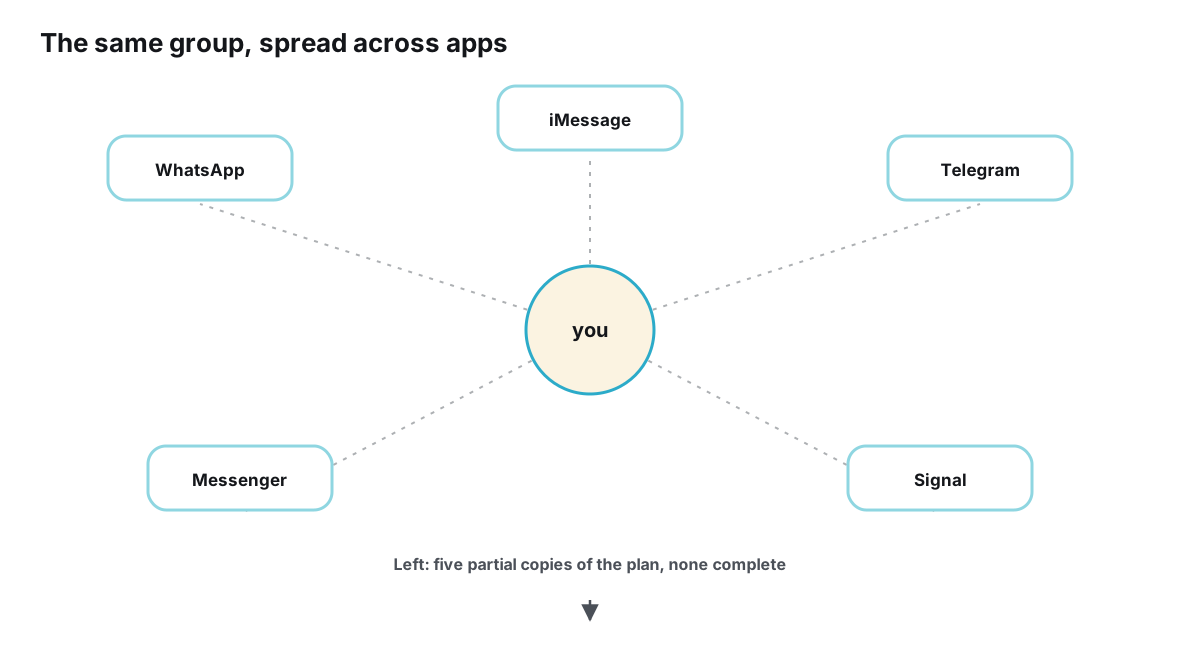
The workable pattern keeps Signal as the community’s living room and gives each gathering a small, neutral address outside it. Concretely, the routine looks like this:
- Announce in the group, host elsewhere. The gathering is announced where the community lives — Signal — but the announcement’s payload is a link to a page holding the date, time, meeting point and everything still to be decided. The conversation stays private; the plan becomes reachable.
- Let the link carry the details, not the membership. Members forward the link to a partner or a curious friend without adding anyone to the group. The guest consults the same page as everyone else and needs no number, account or belonging to take part.
- Collect intent on the page, not in the thread. Going, maybe and not-going are statuses guests set themselves — sparing the organizer the reaction-archaeology, and sparing members the need to declare themselves publicly in a group they did not choose to join.
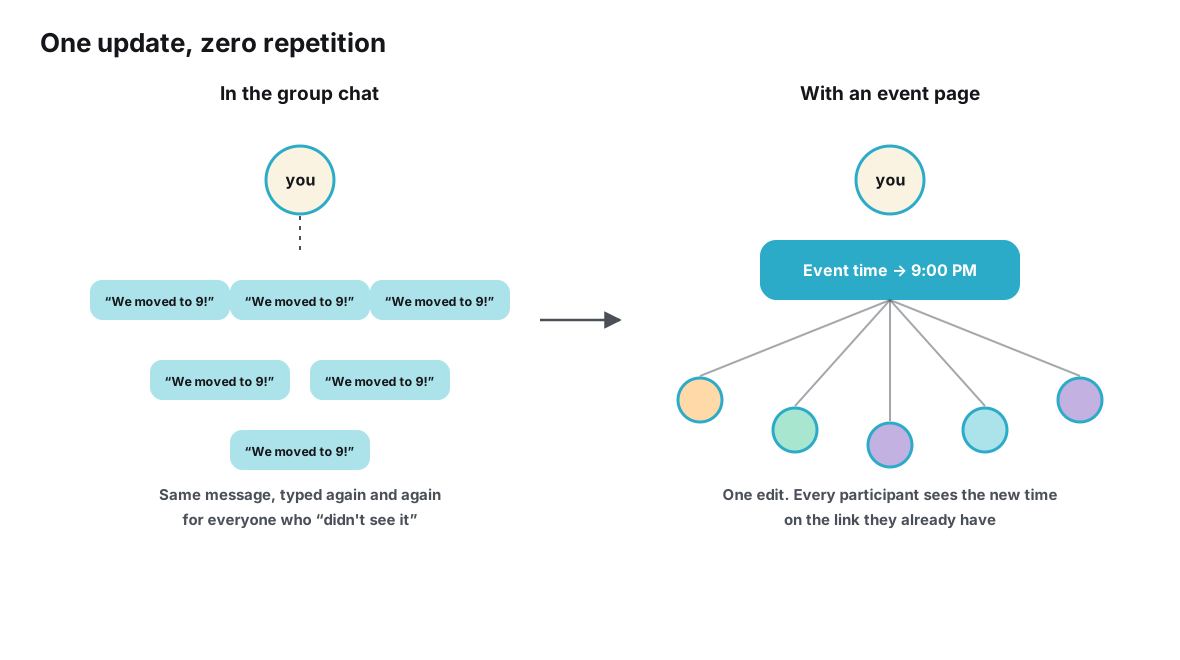
- Update once, at the source. When the venue shifts or the start time moves, the page is edited. A one-line note in the Signal group can flag the change, but the page is the authority — so the member who checks at midnight and the guest who checks at dawn see the same current plan.
- Keep the after-story in the community. Photos, reflections and the next round of ideas return to Signal, where belonging is the point. The gathering page simply holds what happened, for whoever needs to look it up.
Notice what this does not do: it does not move the community anywhere, does not ask anyone to install a second messenger, and does not publish anything about the gathering to the world. A link shared person-to-person is as private as the people sharing it. Tools like Ontaym implement exactly this shape — one link per event, self-updated RSVP statuses, edits that reach every visitor — but the principle is tool-agnostic: the event gets a neutral address so the community can keep its perimeter.
One subtlety of the routine deserves emphasis: information flows out of the community, never back in by accident. The Signal group remains the venue for the community’s own conversation; the event page holds nothing about the community beyond what a guest needs in order to attend. Members who forward the link are sharing a gathering, not a directory. And because the page is current by construction, the thread’s privacy perimeter stops being load-bearing: a guest entirely outside Signal holds exactly the same plan as the most devoted member. For a community that chose its channel to protect boundaries, that symmetry — the same information, equally current, for everyone, with no membership required — is the design goal stated plainly.
When a Signal group alone is genuinely enough
As with every tool in this series, proportionality is the mark of a good organizer. A standing group that meets weekly at the same place and time — the Tuesday run, the chess evening — needs almost nothing beyond the thread: membership is stable, details barely change, and the community’s shared memory covers the rest. Adding an event page to a plan that never varies is not organization; it is paperwork.
The signal to add structure is the arrival of the second condition: a guest who is not a member, a detail that actually changes, a headcount the venue cares about, or a gathering larger than the group’s active core. Any one of these pushes the plan past what a private thread can hold. Two or more make the case overwhelming — and by then the community has usually felt it already, in the form of missed updates and members asking “sorry, where are we meeting?” for the third time.
Between the two poles sits the growth path most communities actually travel: the standing ritual that slowly gains guests, the open event that recurs often enough to become standing. The transition point is worth watching rather than dreading — the first time someone attends who is not in the group, or the first time the ritual changes venue, is the moment the neutral address starts earning its keep. Communities that add it at the transition barely notice the change; communities that add it only after the third missed-update incident notice it as a rescue.
Frequently asked questions
Doesn’t using a separate event link undermine the community’s privacy?
Not if the link is shared like an invitation rather than published like a poster. A link sent person-to-person travels exactly as far as the people who hold it. What it removes is the requirement to join the community’s private group in order to attend one gathering — which protects privacy in the other direction, by not collecting the numbers and membership of casual guests at all.
Can Signal communities handle large events, given the 1,000-member group limit?
The limit comfortably covers most real communities, so capacity is rarely the binding constraint. The harder ceiling is social rather than technical: a large event needs a current, checkable plan and a headcount, and a 900-member thread is precisely where announcements drown and reactions stop meaning anything. Bigger gatherings need a record, not a bigger group.
Why do phone numbers matter so much in this discussion?
Because they are the identity layer under most messaging groups: joining the group means being reachable through yours, and that is personal data in the plain sense used by privacy laws like GDPR and CCPA. For a friends’ group this is background noise; for a community with a duty of care to cautious members, minimizing who-must-share-what is part of the organizer’s job.
Should the gathering details stay out of the Signal thread entirely?
No — the thread is where the community discusses the gathering, and that discussion is part of its life. The distinction is between discussion and state: talk freely in the group, but make the current facts live at the link, so the thread’s privacy settings don’t become the event’s access control and the plan survives the scroll.
What about members who refuse to click external links?
Every community has a few, and the answer is ordinary hospitality: a member who saw the details relays them privately, once. The link still pays for itself across the wider group — the reluctant clicker is the exception the group absorbs, not the design constraint it organizes around.
Should RSVPs happen inside the Signal group?
They can, but the group is a strange place to keep a tally: replies arrive as messages, mean different things to different readers, and leave no durable list behind. Collecting statuses on the event page instead produces a live headcount that guests update themselves — and it keeps a personal decision from becoming a performance in front of the whole community. The thread carries the enthusiasm; the page holds the count.
Conclusion
Signal gives privacy-minded communities something they struggled to find elsewhere: a place to be a community without renting that identity to an advertising machine. For the ongoing life of such groups — the conversation, the mutual support, the shared rhythms — it is hard to imagine a better-fit default, and nothing here suggests leaving it.
Gatherings, though, are where communities meet the world, and the world includes guests, changes, headcounts and plans that must stay current. Those needs are structural, not social, and no amount of thread discipline substitutes for them. The communities that solve this well keep two things deliberately separate: the private channel where they belong, and a neutral address where each gathering lives — open to exactly whom they choose, current for everyone who looks, and collecting nothing from the people who simply came along for the evening. That separation is not a compromise of the community’s values. It is those values, applied to the part of community life that happens face to face.
Keep the community private. Give every gathering its own open address.
Plan it with Ontaym