
The Missing Layer Between Telegram Communities and Offline Events
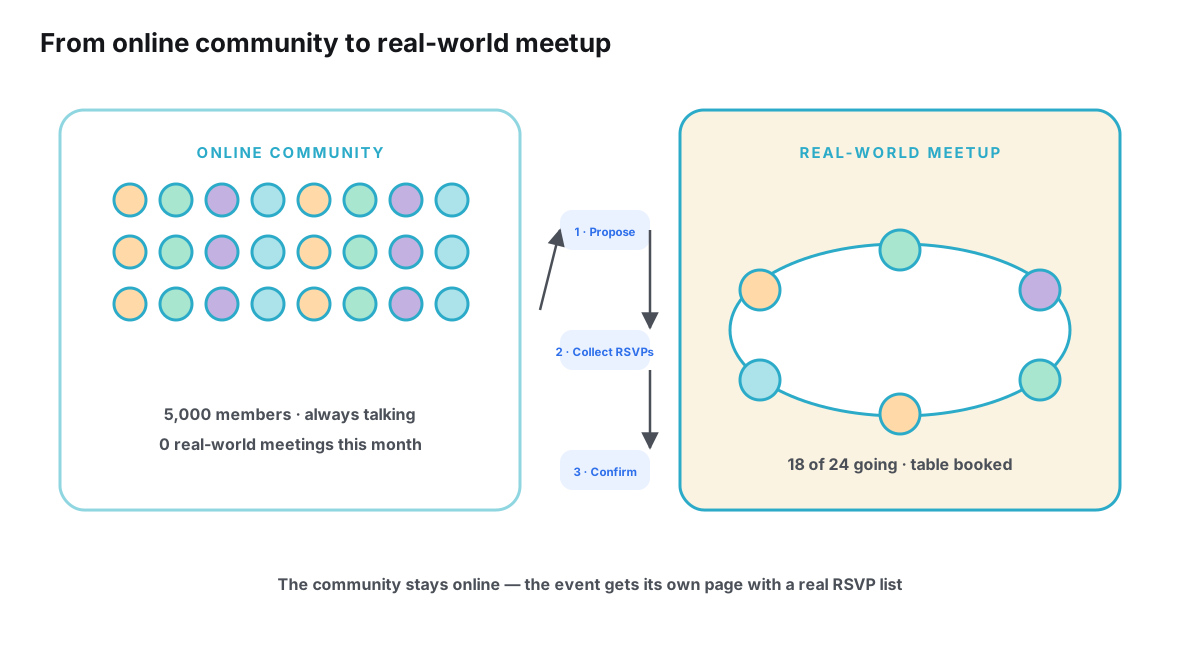
Telegram is one of the best platforms ever built for online community. Offline events are not online communities — they are time-boxed logistical machines — and the space between those two facts is a missing layer, not a missing feature.
Quick answer
Telegram solves the online side of community superbly: channels broadcast, groups discuss, supergroups hold up to 200,000 members, and joining costs one tap. Offline events run on different requirements the platform was never shaped to carry: binding headcounts that venues act on, membership per event rather than per community, time-boxed state with deadlines, and logistics that must reach exactly the committed subset on the day. These are not absent features in the chat — they belong to a different category of software, the event record, which holds current facts, named commitments and updates in one addressable place. The gap stays structural no matter what conveniences a messenger adds, because streams store conversation while events need state. The working architecture is a pairing: community in Telegram, structured event layer beside it, linked by one shareable address per event.
Two problems wearing one name
“Community” and “event” are used almost interchangeably in casual speech — a community hosts events, events build community — and the blur hides the reason organizers keep hitting the same wall. As problems for software, they are near opposites. A community is open-ended and evergreen: it has no deadline, no final state, no size that must be exactly right. Its health is measured in warmth, recurrence of conversation and slow growth. An event is closed and terminal: it has a date before which everything must be decided, a headcount that must be accurate at a specific moment, and a hard end after which its information stops changing and starts aging into history.
Software shaped for one is not merely imperfect for the other; it is oriented the wrong way. Community tooling optimizes for low-friction belonging — join once, participate whenever, leave whenever, nothing is ever due. Event tooling optimizes for converging state — decisions close, options vanish, commitments firm up, and on the day, the system must know precisely who is expected at the door. An organizer working inside community tooling is therefore always swimming against the current: every event task they perform — closing a date, counting a room, reaching the committed — is a task the medium treats as slightly unnatural.
Recognizing this reframes the familiar frustrations. The poll that overcounts, the details that sink, the pinned facts that go stale — none of these are bugs to be reported or habits to be corrected. They are what community software looks like when it is asked, event after event, to be something else.
What Telegram genuinely solved for online community
The fair starting point is how much Telegram got right. The channel-and-group split matches the actual anatomy of a community: there are things one voice needs to say to everyone, and there is everything else. Broadcast and conversation are separated cleanly, which most platforms achieve only through norms and moderation. Supergroups scale to 200,000 members, per the Telegram FAQ, an order of magnitude beyond what most messaging platforms contemplate, and membership itself is low-friction — a link, a tap, and a newcomer is inside. Much of the platform is even open to automation, as Telegram’s developer documentation makes plain. Polls, whether anonymous, public with visible votes, or quiz-style, give communities lightweight instruments for collective opinion. This is a serious, coherent design for the problem it chose: letting very large groups of people talk, cohere and persist.
That strength is exactly why the offline gap is so visible on Telegram in particular. A community with thousands of members, a daily conversation and an announcement channel that reaches everyone generates enormous appetite for real-world gathering — and then hands that appetite to instruments built for talk. The better the community platform, the more pronounced the mismatch at the moment of the meetup. The platform’s success manufactures the gap’s severity.
| Dimension | Online community needs | Offline event needs |
|---|---|---|
| Time | Evergreen — always open, nothing due | Time-boxed — decisions close, a date arrives |
| Membership | Belonging, once, to the whole | Attendance, per event, by specific people |
| Numbers | Rough scale — bigger is healthier | Exact counts — the venue acts on the number |
| Information | Flowing conversation, no final state | Converging state — one final time and place |
| Reach | Everyone, all the time | Exactly the committed, at the right moment |
| Afterwards | Conversation simply continues | Records close — who came, what changed |
| Failure mode | Quiet — the group goes dormant | Loud — empty seats or people turned away |
Read as a row-by-row contrast, the table explains something organizers feel but rarely articulate: running an event inside community software is not one big difficulty but a dozen small orientational mismatches, each trivial alone, compounding together.
Membership is not participation
The deepest single strand of the gap is identity. Community platforms have one unit of belonging: you join the group. Every subsequent capability — seeing the conversation, receiving the announcements, taking part in a poll — hangs off that single membership. It is an elegant model for community, and a distorting one for events, because events need a different unit: the per-person, per-event commitment. “I am in the hiking group” and “I will be on Saturday’s hike” are different facts held at different times by different people, and the second one changes while the first stays put.
Fusing them produces the familiar distortions. To take part in an event’s coordination, a guest must join everything else — the daily chat, the notifications, the community’s entire life — which prices a single evening’s attendance at a subscription. The member who would happily attend one quiz a month declines, because attending means joining, and joining means noise. Meanwhile the committed and the curious occupy the same container indistinguishably: the member who has paid a deposit and the member who once tapped a poll sit side by side in the group, and no view of the community can tell the organizer which is which. A per-event RSVP is precisely the separation the architecture lacks — participation recorded against the event, not against the community.
The headcount as the binding constraint
Every offline event eventually collides with the physical world’s favorite data structure: the integer. A restaurant holds a number of seats; a tour guide takes a number of people; a pitch fields a number of players; a room has a fire capacity. These numbers are not approximations and do not accept enthusiasm as currency. The venue asks once, with a deadline, and someone must answer with a figure they can defend.
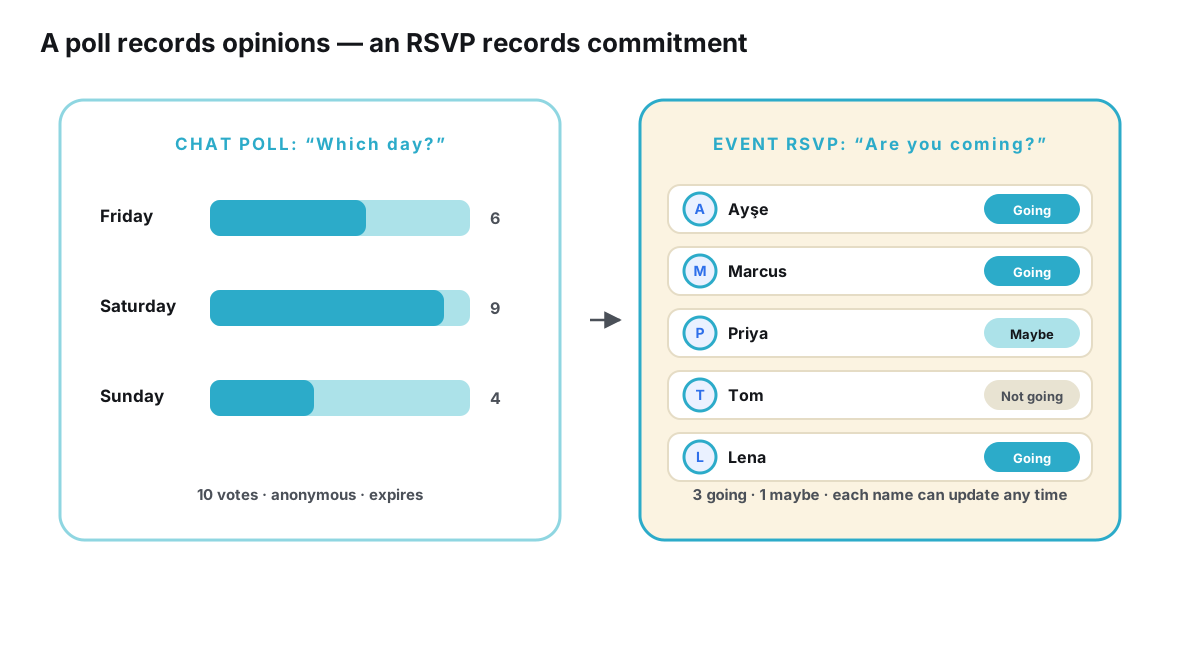
This is the moment the community toolkit runs out. A poll produces a tally of leanings, anonymous or visible, frozen from the week it was posted — the anatomy of that divergence is covered in detail elsewhere in this cluster. A headcount needs per-person commitments that persist, can be revised as plans change, and roll up into a number on the eve of the event. Note the shape of the requirement: it is not a better aggregate of opinion but a registry of individual states. Aggregation is what streams do naturally; registries are what they cannot do at all.
Time-boxing: the deadline the chat doesn’t have
A subtler requirement is temporal. Communities are continuous; events are bounded, and their information has a lifecycle: propose, discuss, decide, lock, execute, record. Each phase has different needs — openness early, firmness late — and the late phases have a property the chat world lacks entirely: closure. At some point the date stops being negotiable, the list stops growing, and the organizer needs everyone to be working from the same frozen-but-current snapshot. Then, on the day, the snapshot must survive a flood of messages, and afterwards it must quietly become an archive: who was expected, what actually happened, what the next edition should know.
A chat thread has no clock and no phases. It treats a message sent three weeks before the event and a message sent three minutes after with identical permanence and identical weight. Nothing in a stream ever closes; it only recedes. Organizers compensate with rituals — final confirmations, last-call messages, the ceremonial re-pinning — which are human attempts to impose a lifecycle on a medium built to defy one. The missing layer is, among other things, a clock: deadlines that mean something, states that transition, a record that knows it is over.
Reaching everyone vs. reaching the right ones
Community platforms solve reach magnificently and indiscriminately: a channel post lands in front of the entire membership, which is exactly right for announcements and exactly wrong for event logistics. Event information has an audience that changes by the hour. Early on, everyone should see the proposal. Near the date, the people who need the final details are precisely the committed — and only the committed. On the day, the audience narrows further: the eleven people at the meeting point need the gate change, and the other forty thousand members of the community emphatically do not.
A chat has one dial — post to everyone — and the organizer’s only controls are volume and repetition, which is why day-of coordination in a busy group feels like shouting seat numbers across a stadium. The polite workaround, private messages to each participant, solves precision by sacrificing the organizer’s afternoon and creating parallel one-to-one threads that no one else can see. What the missing layer provides is targeting as a native property: reminders and updates attach to the event and reach its committed participants, while the community channel stays quiet and the group stays fun. It is the difference between a public address system and a tap on the shoulder — both are communication, but only one belongs at a dinner table.
The archive problem: what the community forgets
The gap has a fourth face, visible only in retrospect: the record. A community that runs recurring events accumulates genuinely useful knowledge — which venues worked, what turnout a format draws, who hosted the edition that everyone still mentions, what the entry fee was, which date collided with a holiday. Inside a chat, that knowledge is scattered across threads that recede at the speed of conversation. Every new host starts closer to zero than the community’s actual experience justifies, and the same lessons — book the back room, avoid the first week of the month — are relearned as private wisdom instead of shared infrastructure.
An event record closes its lifecycle into an archive naturally: the page that held the plan becomes the page that holds what happened, and the next organizer inherits it. This is why the gap matters even to communities that have made peace with chat-based coordination for any single event: the cost is not only per-event friction but compound amnesia across events. Programs — recurring, host-rotating, growing — are built from memory, and memory is a property of records, not of streams.
Why the gap is structural, not a missing feature
The natural rebuttal is that messengers will simply add event features, and the gap will close the way gaps close in software. But examine what an in-chat event feature can be, structurally. It can attach a listing to the community — helpful, and a real convenience for groups that live entirely inside one app. Yet the boundaries remain: the event exists only for members of that app and usually that community; its address is not a neutral object that opens for a guest on any device; and its data still lives alongside the stream, subject to the same scroll, the same notifications, the same fusion of joining with belonging. The feature softens the gap’s edges without relocating the plan.
The general form of this argument — that chronological streams and structured records are different categories, and no feature set converts one into the other — is laid out in why messaging apps were never designed to be event databases, and the Telegram-specific field guide to which information belongs where is in chat vs structured event information in Telegram groups. The essential point survives every platform comparison: an event needs an object — addressable, current, per-event — and objects are a different kind of software thing than messages.
| Symptom in the community | Underlying need | What fills it |
|---|---|---|
| Poll tallies that miss the door | Binding per-person commitments | RSVPs with going / maybe / not going, updatable until the day |
| “Details are somewhere up there” | One current, findable state | A per-event page that always shows the plan as it stands |
| Location changes that miss half the group | Reaching exactly the committed | Updates and reminders attached to the event, not the thread |
| Guests who won’t join the chat | Participation without membership | One link that works for anyone invited, member or not |
| Late joiners lost in the backlog | Instant onboarding to the current plan | An address readable in seconds, no history required |
| Next event rebuilds from scratch | Program memory across events | Records of what past events planned and drew |
One week inside the gap
The abstractions land harder with a concrete week. Picture a city photography community on Telegram — a channel with an announcement audience in the thousands, a discussion group that never sleeps. Maya, a volunteer, proposes a golden-hour walk. The channel post is written, posted, and does its job perfectly: hundreds read it, dozens react, and the group lights up with route suggestions. So far, the platform is performing at its best.
Then the week of the event arrives and the geometry inverts. A poll Maya posted to pick between two meeting points fills with visible votes — but when the cafe she wants to end at asks for a rough number for the terrace, the tally of twenty-nine leans on nothing; her private sense is that a dozen are serious. Two days out, the forecast changes the route; she posts the revision, pins it, and watches it begin to sink under a debate about lens caps. On the day, eleven people she can name turn up — three of whom never voted, two of whom voted for the other meeting point and were reached only because a friend forwarded them the correction. The walk is lovely. The cafe seats everyone. And Maya spends the evening narrating logistics by phone to Tom, who arrived at the original meeting point and waited forty minutes.
Nothing in that week is exotic — it is a normal week for a normal community, and every individual tool behaved as designed. But notice what actually carried the event: not the channel, not the poll, not the pin, but Maya — her memory of who was serious, her judgment of the tally, her corrections, her narration. The community ran its event on a human bridge across the gap. The missing layer is simply the software version of Maya’s effort: the count she assembled by feel, the update that reached only some people, the knowledge of who was actually expected at the gate.
What the layer looks like in practice
Describing the missing layer positively: it is a thin, boring, crucial set of capabilities sitting beside the community rather than inside it. One addressable page per event, holding the current facts. A vote where options genuinely compete. Per-person RSVPs that persist and update. Reminders that reach the committed. An invite link that works for a guest who belongs to no chat at all. And a quiet archive when it is over. Nothing here is exotic — the structured-data web has modeled the core of it for years, and schema.org’s Event type is essentially this list compressed into a definition: an occurrence with a time, a place and participants. All of it is the event-shaped counterpart to what the community platform already does for conversation.
The pairing, not replacement, is the architecture that works. Telegram keeps the channel that announces, the group that argues and the daily life that makes the community worth meeting in; the event layer keeps each gathering’s state. How groups divide labor between the platform’s own containers is its own subject — the broadcast-versus-discussion split is examined in why Telegram channels and groups are different for event communication, and the platform’s coordination features are inventoried in how Telegram groups handle event coordination. Tools like Ontaym exist to be the thin layer in that pairing — event pages, votes on options, RSVP statuses, one link per event, reminders — while the community stays exactly where it grew up.
What the layer should not try to be
Symmetry demands honesty about the other direction: the event layer has its own failure mode, which is overreach. A tool that begins by holding the plan creeps toward hosting the conversation, then the photo album, then the community itself — and the community wakes up inside a second platform it never wanted, discussing things in a place with none of the warmth the original chat spent years developing. The result is a different gap, self-inflicted: infrastructure everywhere, community nowhere. The layer earns its place by refusing the temptation.
The discipline is easy to state. The layer owns state — facts, commitments, updates, records — and nothing that is merely talk. It is where the community checks, decides and commits; it is not where the community lives. By the same token it should demand nothing of participants beyond the commitment itself: no app adoption for a guest, no profile to maintain, no leaving of one home for another. The test of a well-sized layer is that a member could attend every event for a year, hold a commitment on each one, and still experience the community as existing in exactly one place — the chat where it always did. Structure should be felt at the moment of deciding and at the door, and nowhere else.
Frequently asked questions
Isn’t this just a criticism of Telegram?
No — Telegram is excellent at the job it chose: large-scale community conversation with a clean broadcast/discussion split. The gap appears because offline events are a different category of problem, with requirements — binding counts, per-event membership, deadlines — that no conversation platform carries. The same analysis applies, with local variations, to every messenger.
Couldn’t Telegram add event features and close the gap?
In-chat event features genuinely help groups that live entirely inside one app. But the boundaries are structural: the event remains inside the community’s membership, its address is not a neutral object outsiders can open, and its data still lives beside the stream. Features soften the gap; they don’t move the plan out of the conversation.
What exactly is the “missing layer”?
A thin event-record layer beside the community: one addressable page per event holding current facts, per-person RSVPs that update, reminders to the committed, an invite link that works for non-members, and a record of what happened. It is the event-shaped counterpart to what community software provides for conversation.
Why can’t polls just count as RSVPs?
Polls aggregate opinions at a moment — anonymously or with visible votes — while venues need named commitments that persist and change. The tally has no identity, no obligation and no update path, so it drifts from reality as the date approaches. Polls choose options; RSVPs fill rooms.
Does filling the gap mean leaving Telegram?
The community should stay in Telegram — it is the social engine and the announcement channel. Only the events’ state moves to the layer beside it: one link per gathering, shared in the channel and group. The chat gets better when it stops doubling as the plan.
Does this matter for small communities too?
Less urgently — a table of friends can absorb the friction socially. The gap scales with members, with logistics and with recurrence: bigger communities, booked venues and repeating programs feel it first and hardest. But even small groups notice the two fixes that cost nothing: one link per event, and commitments instead of tallies.
Conclusion
Telegram built one of the best homes online community has ever had, and nothing about that is in dispute here. The missing layer is what the meetup discovers on the platform’s behalf: that a binding headcount, a per-event membership, a deadline and a current plan are not conversation features. They are state, and streams do not hold state — by design, for reasons that make the chat good at being chat.
The mature architecture is therefore a pairing rather than a platform. Community in Telegram: channel, group, daily warmth at any scale. Events in a thin structured layer beside it: one address per gathering, commitments that persist and update, reminders that reach the committed, records that outlive the day. Organizations that adopt the pairing stop experiencing the gap as a series of mysterious failures — overcounted polls, buried logistics, exhausted hosts — and start experiencing it as what it always was: two problems, correctly solved by two tools, joined by a single link.
Your community lives in Telegram. Give your events the layer they’re missing.
Plan it with Ontaym