
How Telegram Communities Can Handle Real-World Meetups
Plenty of large Telegram communities already meet in the real world — hiking clubs, language exchanges, fan groups, professional circles. This is how those meetups actually get run today, where the chat stops carrying the weight, and what experienced organizers add on top.
Quick answer
Most Telegram communities run meetups with a four-step workflow that already exists inside the app: announce in the channel, discuss in the group, gauge interest with a poll, and coordinate on the day in the chat. That workflow carries meetups a long way, because broadcasting and discussing are exactly what Telegram was built for. It weakens at two specific points: converting interest into a reliable headcount, and holding time-sensitive logistics on the day, when details change faster than a stream can keep them visible. The communities that scale beyond occasional gatherings keep the chat as their social home but give each meetup a small structured layer — one link holding the final details, RSVPs and updates — so the thread never has to serve as the plan.
Why online communities start wanting to meet offline
Every large Telegram community eventually discovers the same impulse. The group talks daily about trail routes, or vintage cameras, or a shared language, and at some point a member types some version of “we should all just meet up.” The suggestion always lands well, and that should not surprise anyone: conversation creates acquaintance, acquaintance creates trust, and trust wants a physical counterpart. People who have traded advice for months want to put faces to usernames.
Telegram is unusually good at producing this impulse because its communities are unusually large and durable. With supergroups supporting up to 200,000 members, per the Telegram FAQ, a community can keep growing for years without anyone needing to leave, and the separation between broadcast channels and discussion groups means even a huge membership can stay coherent — announcements reach everyone, conversation stays in its own place. A community like that is a standing audience for any member brave enough to organize something.
What the community wants, though, is not what the meetup needs. The community wants a good event: a known place, a known time, a manageable crowd, and the feeling that showing up was easy. The organizer needs something the chat alone cannot produce: a count they can act on, and a way to reach exactly the people who committed. That gap between what communities want and what chat tools hold is where meetup organization actually lives.
The meetup workflow as communities run it today
Strip away the local variations and most Telegram-organized meetups follow the same sequence, assembled from the tools the platform already provides:
- The announcement. A post goes out in the community’s channel, or a pinned message in the group, floating a date and a rough idea — a picnic, a bar meetup, a group hike.
- The discussion. The group takes over: dates get debated, venues proposed and shot down, newcomers ask whether they can join, and enthusiasm builds in public.
- The poll. To narrow options or gauge turnout, the organizer posts a poll — anonymous or with visible votes — and the community votes on the date, the neighborhood or the activity.
- The day. On the day itself, the group becomes live coordination: “we’re at the third table,” “running ten minutes late,” “park at the side entrance.”
It is worth pausing on how well steps one, two and four fit Telegram. Broadcasting an invitation to tens of thousands of people in one tap is something channels do natively and brilliantly. The discussion phase is a genuine strength — energy and banter are the community’s own currency, and a meetup announced into silence is a meetup that never happens. Day-of chatter is what group chat was invented for: short, urgent, disposable messages whose meaning expires within the hour. Three of the four steps sit squarely inside the platform’s design.
| Stage | What the stage actually needs | What Telegram provides | Fit |
|---|---|---|---|
| Announcement | Reach everyone once, without noise | Channel broadcast | Excellent — a native fit |
| Discussion | Open debate, energy, belonging | Group chat with replies and reactions | Excellent — the platform’s core job |
| Commitment | A named, current list of who is coming | Polls with anonymous or visible votes | Weak — votes are opinions, not commitments |
| Day-of logistics | One visible, current set of final details | Group messages that scroll away | Mixed — great for chatter, poor for state |
The table’s weak row is the interesting one, and it is not a small row: commitment is the stage where the community decides its own size. A meetup that gets commitment wrong does not fail quietly — it fails in front of a venue, with a reservation for thirty and eleven people in the room, or a table for eight and twenty-four arrivals.
The commitment stage: where a poll does a reservation’s job
Organizers reach for the poll because it is the closest thing the platform offers to a headcount, and for a first event it is genuinely useful — a visible signal that the idea has energy. But a poll tallies opinions at a moment in time. It records who leaned toward yes on the Tuesday it was posted, not who has arranged a babysitter for Saturday. Votes accumulate early from the most enthusiastic and stay on the books forever, including from members whose plans changed, whose enthusiasm cooled, or who voted for a different date that lost. Anonymous polls, which many organizers prefer for their low pressure, make the tally even less actionable: the organizer cannot follow up with individuals, because the votes have no names attached.
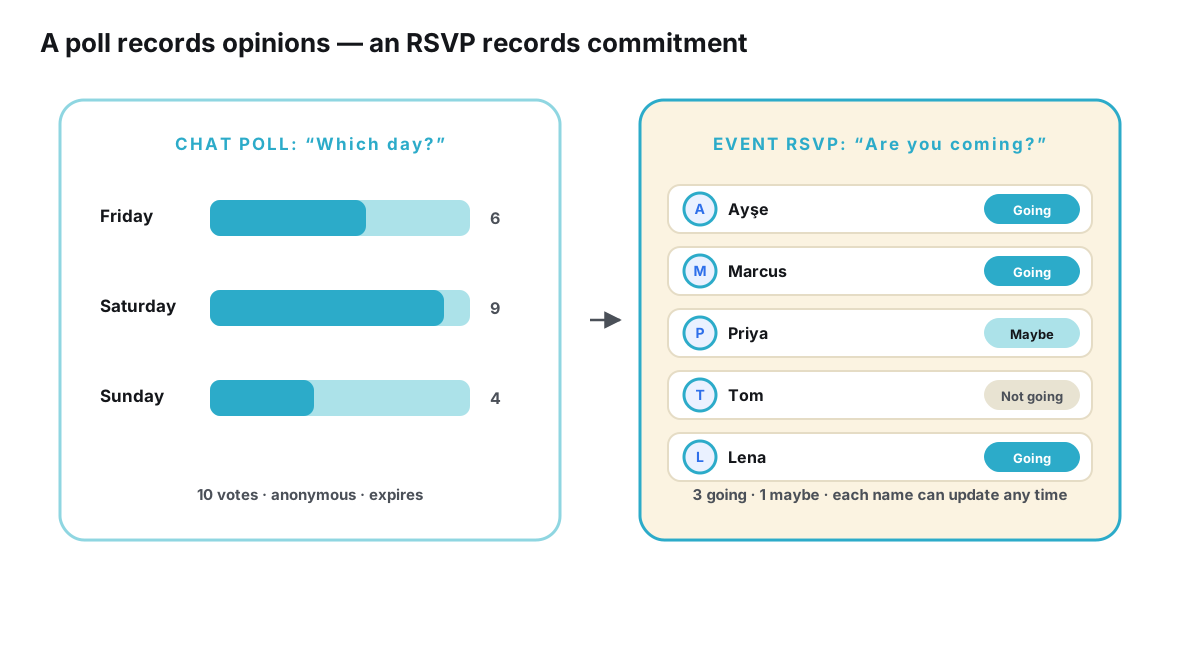
The mechanics of this divergence — anonymity, the absence of obligation, and the way old votes quietly stop meaning anything — are laid out in why Telegram polls don’t tell you who will actually attend. For the organizer planning a meetup, the practical translation is a rule of thumb that experienced hosts apply without ever naming it: treat a poll as a ceiling, not a forecast. The community’s real headcount is built afterwards, from people who explicitly commit — and the collection of those commitments is a job for structured RSVPs, not for another message. When the dates themselves genuinely compete, some organizers add a dedicated scheduling poll at this stage — Doodle is the long-standing example of the genre — which settles the calendar question cleanly and leaves the headcount question exactly where it was.
Reach is not the same as attention
There is a quieter problem hiding inside the commitment stage: the announcement reached everyone, but attention is distributed very unevenly across a large community. The members who vote in the poll and reply in the thread are overwhelmingly the active tail — the same few hundred people who open the group daily. The long tail of the membership, thousands who joined for the topic and muted the chat months ago, may never see the announcement at all, or see it once and file it mentally under “maybe.” That is not a defect; it is how anyone sane survives membership in a community of thousands. But it means the poll measures the enthusiasm of the loudest slice, not the intentions of the community — and organizers are often surprised by members who appear at events they never seemed to know about, while the poll’s most vocal voters stay home.
Practical organizers design for this asymmetry instead of resenting it. They announce more than once, with meaningful gaps, because a single post competes with everything else in the feed. They make joining the event independent of following the conversation — a link someone can act on in thirty seconds, without reading a week of threads to understand what is being proposed. And they treat silence from the muted majority as unknown rather than as a no, because in a community of thousands the mute is the default state and the unmuted reader is the exception.
Different formats stress the workflow differently
Not all meetups ask the same things of the system, and organizers pick their battles accordingly. An open gathering in a public park — a picnic, a photography walk — is the most forgiving format: no reservation, no cap, no headcount anyone acts on, and the entire workflow can live in chat because the cost of a wrong number is roughly zero. This is why first meetups so often take this shape, and why they work: the format absorbs the community’s organizational overhead.
A reserved-venue meetup — a restaurant table, a booked room, a guided tour with group rates — imports a hard constraint from the physical world: a number that must be right, by a deadline, with financial consequences in either direction. Reserve for the poll tally and the community pays for empty seats; underbook and committed members are turned away at the door. The moment this constraint arrives, the informal workflow stops being adequate, because the venue is not interested in the group’s enthusiasm — only in its count. Between these poles sit recurring activities with practical limits: football needs exactly eleven per side and stops being fun at twenty-two; a boardgame evening needs tables and copies of games; a cycling group has safety ratios. Every one of these formats is really a headcount problem wearing a hobby’s clothes.
The useful exercise for any organizer is to ask, before choosing tools or methods: what number does this event actually depend on, who needs it, and by when? Formats whose answer is “none” can live entirely in the chat and lose nothing. Formats whose answer is a specific count on a specific date need commitments that update — and that is precisely the line where the chat-native workflow ends and a structured layer begins.
The day-of crunch
The second weak spot arrives late, and arrives fast. On the day of the meetup, the information the group needs changes character: it is no longer opinions or enthusiasm but state — the confirmed place, the meeting point, the headcount the venue now needs, the update that the venue changed. A stream handles this badly for a structural reason: every state change enters the chat as one more message and immediately starts sinking under the very chatter that made the community lively. The message saying “we moved to the upstairs room” competes for attention with arriving members posting photos from the tram.
The result is the meetup’s most familiar comedy of errors. Half the group saw the location change; the other half walks to the original address. A member who arrives late asks “where exactly are you?” and the answer is buried three scrolls up. The organizer spends the first forty minutes not hosting but dispatching — repeating the same facts to a sequence of individuals, each of whom asks privately because asking one person feels politer than making twenty people re-read. Day-of chatter is wonderful, and no one wants to remove it. The failure is asking the same channel to also be the single source of truth while it is at its most flooded.
A meetup in practice: the hiking community
Consider a typical case, assembled from patterns any organizer will recognize. Maya helps run a city hiking community on Telegram — a channel for announcements and a discussion group that never sleeps. She proposes a Saturday route and posts a poll to choose between two trails. The poll fills quickly with visible votes; the northern route wins. A week of cheerful route talk follows, plus the usual drift: someone asks whether dogs are welcome, someone else asks about train tickets, and both answers sit mid-thread where only dedicated readers find them.
Two days before, the forecast turns. Maya swaps the route to a shorter southern path and posts the change, plus a new meeting point. On Saturday morning she is answering the same questions in private — which station? what time? is it still on? — while also trying to count who is actually coming, because the trailhead car park needs a rough number and her poll has been telling her one number while her gut tells her another. Twenty-two people voted; seventeen say they are definitely coming when she asks directly; fourteen appear at the station. The meetup itself is a joy. The organizing of it was a second job.
Nothing in that story is a failure of Telegram; nearly every step used the right tool for some part of the job. What the story shows is the missing middle: between an enthusiastic community and a joyful meetup, there is a stretch of pure administration — final details, per-person commitments, changes that must reach exactly the committed — that no stream is shaped to hold. Tom, who runs the same community’s monthly pub quiz, long ago stopped fighting this: each quiz gets its own page with the final details and RSVPs, the channel posts the link, and his day-of messages answer questions the page already would have. The quiz runs on ninety minutes of his attention instead of a week of it.
| Pitfall | How it shows up | What prevents it |
|---|---|---|
| Inflated headcount | Reservation for the poll tally; far fewer arrive | Collect explicit RSVPs after the poll shortlists the date |
| Buried final details | “Where are you exactly?” asked all morning | One link holding the current time, place and meeting point |
| Changes that miss people | Half the group at the old location | Updates applied to a single record, with a nudge to the committed |
| Organizer as switchboard | The same five questions answered privately all day | A page that answers them publicly and permanently |
| Late joiners lost | New members unwilling to scroll weeks of chat | An address that shows the current plan in seconds |
| No-shows with no signal | Committed people silently drift away before the day | RSVPs that members can update, plus a reminder near the date |
When the meetup is full of strangers
Friend-group planning and community planning differ in one more respect that organizers underestimate: at a community meetup, most attendees do not know each other. The warmth of the group chat creates a feeling of acquaintance, but feeling acquainted and being acquainted are different states, and the difference shows up in practical decisions. Some members will hesitate to commit to a room full of usernames. Some will want to bring a friend — someone outside the community entirely — and will feel awkward asking whether that is normal. A member who joined the group a day before the event may be the most eager attendee and the least informed.
The chat-native workflow handles none of this particularly gracefully, because joining an event and joining a community are fused: to take part in the meetup’s conversation, you take part in everything else the group discusses. Organizers who think about this deliberately tend to separate the two doors. The event gets its own identity — a link anyone can open, see what the gathering is, who is hosting, and what to expect — so that participating in one Saturday walk does not require subscribing to a community’s entire daily life. Newcomers self-select comfortably, plus-ones have an obvious way in, and the community keeps its own bar for membership untouched. It is the same separation that makes real-world events work generally: you can attend a lecture without joining the society that hosts it.
Who actually runs the thing: admins, hosts and volunteers
A meetup is not just information; it is labor, and large communities solve the labor problem in recognizable ways. The healthiest pattern is a rotating host — a member who takes ownership of one event, backed by the admins for legitimacy and reach. Rotation spreads the work, but it also multiplies the number of people who must each invent a planning method, which is why communities with recurring meetups converge on a shared template: a known format, a known rhythm, and a known place where each event’s facts live. Technical members sometimes script the repetitive parts — scheduled announcements, refreshed pins — with bots built on what Telegram’s developer documentation exposes; the automation genuinely helps the labor, though it still operates inside the stream. When Priya hosts the January walk, she should not need to rebuild Maya’s December system from scratch.
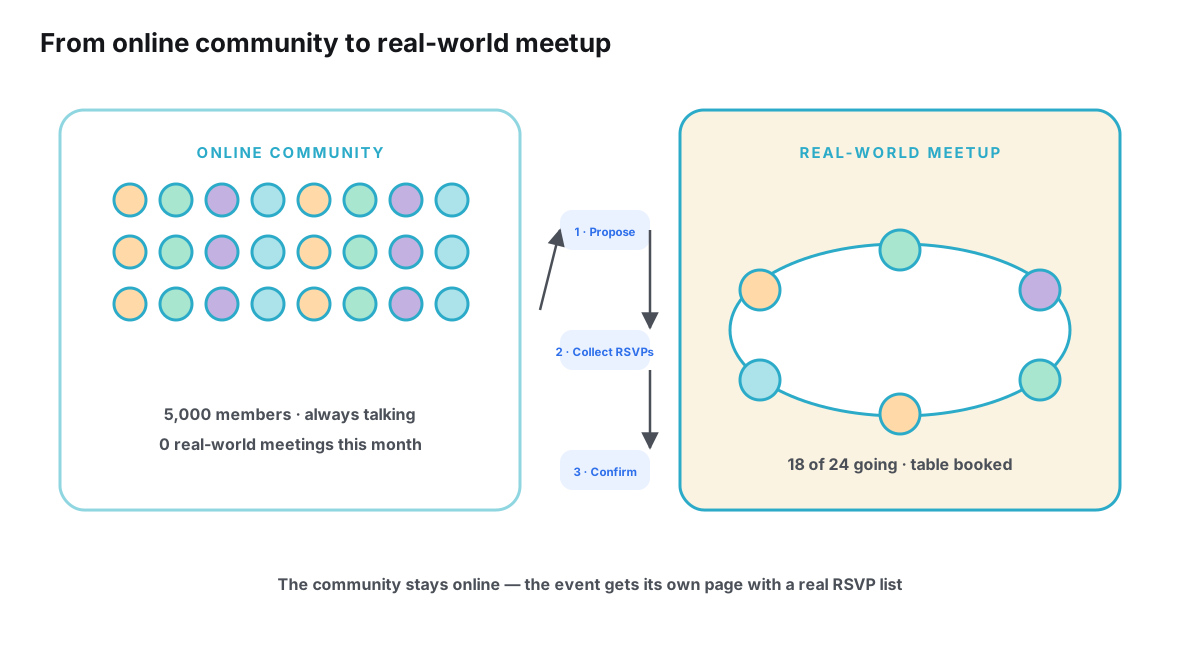
The template question is really a tooling question. Some communities keep their methods entirely in-chat and accept the overhead; it works, at the cost of every host re-performing the same manual maintenance. Others formalize the layer just outside the chat: each event gets a page or listing that holds the details, collects RSVPs, sends reminders and survives the scroll — while the channel and group keep doing what they are unbeatable at. That outside layer is exactly what a coordination app like Ontaym provides — event pages, votes on options, going and maybe statuses, one invite link per event — but the principle is tool-agnostic, and the fuller argument for building one source of truth for a group event applies to meetups more than to any other event type, because meetups combine big communities with hard logistics.
From one-off gathering to recurring program
The first meetup is an event; the fifth is an institution, and the demands shift. A one-off survives on enthusiasm and one organizer’s memory. A recurring program needs the mechanics to survive handover: a stable rhythm members can internalize, records of what past events actually drew, and a way for newcomers to join the sequence mid-stream without a personal briefing. Communities that crack this — a monthly quiz, a standing Sunday walk — report the same observation from opposite directions: the chat stays essential for keeping the community warm between events, and the events only became reliable once their facts moved out of the chat.
Communities earlier on that journey — active discussion group, no events yet, unsure where to start — face a slightly different set of problems, from picking a first format to converting lurkers into attendees. The step-by-step version lives in how to move a Telegram community from discussion to real-world events, and the underlying comparison of what chat holds versus what events need is mapped in Telegram group planning: chat vs structured event information.
Frequently asked questions
Can a Telegram community run a meetup without any tools outside Telegram?
Yes, and many do — channel announcement, group discussion, poll, day-of chat. The workflow carries small, simple meetups reasonably well. What it does not provide is a reliable headcount or a stable place for final details, so organizers pay for that with manual counting, repeated answers and a buffer of hope when booking venues.
Should the meetup be announced in the channel or the group?
The channel, if the community has one, because announcements are exactly what channels exist for — one-to-many reach without triggering discussion noise. The group is the right place for everything that follows: debate, questions and day-of coordination. The two containers were designed as a pair, and meetups use them best as a pair.
How do I get a headcount I can book a venue with?
Use the poll to choose the date, then collect explicit commitments separately — a per-event RSVP where members mark themselves going or maybe, and can update as plans change. The number you can act on is the updated RSVP count close to the date, not the peak tally of enthusiasm.
What should change on the day of the meetup?
Let the group chat do live coordination, but keep one address holding the current facts — final meeting point, time, headcount — and point every question back to it. Day-of messages are perfect for “running late” and useless as a place where the plan lives, because they sink within minutes.
How large should a first community meetup be?
Small, deliberately. A first event converts strangers into acquaintances, which works best at a scale where everyone can actually talk — a table, not a hall. Cap the RSVPs, keep the format simple, and let demand justify growing the second event rather than the first.
Do recurring meetups need a different setup than one-offs?
They need a repeatable one. Recurrence means new hosts, newcomers mid-sequence and events overlapping in time, all of which punish any system that lives only in chat history. A stable template — same rhythm, same format, one link per event — is what lets a program survive its own success.
Conclusion
Telegram communities are among the best-positioned anywhere to meet in the real world: they have scale, durability, a clean split between broadcast and discussion, and members who already talk daily. The meetup workflow most of them run — announce, discuss, poll, coordinate — plays to the platform’s real strengths, and no part of it should be abandoned.
The work is in the two places the workflow thins out: turning interest into commitments that can be counted and booked against, and holding final details where a flooded day-of chat cannot bury them. Communities that handle both keep everything that made them communities and add the one small piece chat was never going to provide — a structured, current home for each event’s facts. The channel still announces, the group still argues and jokes, and the meetup stops being a heroic act of memory performed by whoever was brave enough to host.
Your community already talks. Give your next meetup one link that holds the plan.
Plan it with Ontaym