
How to Move a Telegram Community From Discussion to Real-World Events
Plenty of Telegram groups talk brilliantly and meet never. This is the transition playbook: the formats, rhythms and small structural choices that carry a discussion community across the line into one that actually gathers — and keeps gathering.
Quick answer
Communities that successfully move from discussion to real-world events rarely do it with enthusiasm alone; they do it with a sequence. Start with a format that matches the conversation the group already has — a walk for an outdoors group, a table for a hobby group — and keep the first event deliberately small. Fix a rhythm before fixing a date, because recurrence is what turns an event into a program. Announce in the channel, debate in the group, but hold each event’s facts in one structured place with real RSVPs rather than poll votes. Run the first gathering simply, close the loop afterwards with thanks and the next date, and lift future hosts from the people who showed up. The chat keeps its role throughout: it is the community’s living room, not its filing cabinet.
Why talking groups never quite meet
The distance between a chatty Telegram community and a meeting one is shorter than it looks, and most groups never cross it. The obstacle is rarely interest. It is that meeting requires something discussion never does: a decision that survives the moment. A thread can sustain “we should totally do a hike” for years, because the sentence is true every time it is typed and costs nothing to agree with. Turning it into a specific Saturday, at a specific trailhead, with a specific number of specific people, converts a pleasant sentence into logistics — and logistics have a way of finding whoever mentioned the idea and appointing them organizer.
Most groups lack not a leader but a mechanism. The discussion is distributed — anyone can post, anyone can reply — while an event is concentrated: one time must be chosen, one place booked, one headcount trusted. Communities that keep saying “someone should organize something” are usually describing this asymmetry without knowing it. The fix is not more enthusiasm in the thread; it is a small amount of structure that lets enthusiasm convert into a date.
There is also a quieter blocker: many members enjoy the group precisely because it asks little of them. A community where showing up is optional reading is comfortable; an event makes participation embodied and countable. Groups that succeed at the transition treat this honestly rather than fighting it — they make attending easy, low-pressure and clearly optional, and they let the event prove itself rather than guilting anyone through the door.
What the community already has
Before building anything, notice the assets. A discussion group arrives at the transition with real advantages that cold-start event organizers would envy: a shared topic everyone cares about, accumulated trust between members who have traded advice for months, an established rhythm of conversation, and typically an active core — the handful of members who post, answer and react daily. Telegram’s structure adds reach: the channel can announce to the entire membership at once, and per the Telegram FAQ, supergroups can hold up to 200,000 members. Technical members can even script recurring announcements against what Telegram’s developer documentation exposes. The audience for a first event already exists; it has simply never been asked anything binding.
The honest inventory includes liabilities too. The active core is small relative to the membership, and the first event’s attendees will come mostly from it. The group chat is loud, and anything announced in it competes with everything else said that day. And the community has a culture — in-jokes, norms, a tone — that an event must respect, because a meetup that feels like a different community than the chat will confuse exactly the people it should delight. The transition works when the event feels like the group chat made physical: same warmth, same topic, same people, now at a table.
The playbook
The sequence below is deliberately conservative. Each step produces something the next step needs, and none requires the community to change its character.
- Pick a format that matches the conversation. Audit what the group actually talks about, and choose a first event that is the topic itself, not an abstraction of it. A photography group walks with cameras; a language group meets to speak the language badly together; a professional group gathers for one short talk and longer drinks. If the format requires explaining why it relates to the community, it is the wrong format.
- Set a rhythm before you set a date. Decide the cadence — monthly is the workhorse — before choosing any specific day. Recurrence is what makes attendance a habit and gives shy members a perpetual second chance: missing one event matters little when the next is already known. A one-off asks for courage; a series asks only for availability.
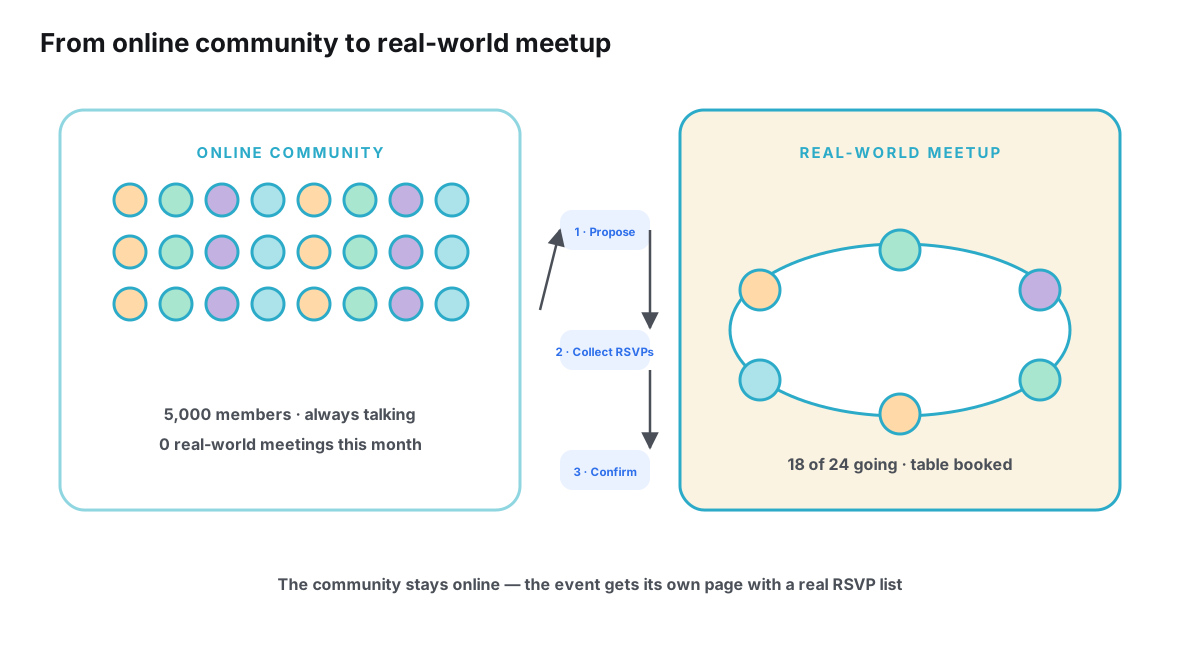
- Announce in the channel, decide in one place. Use the channel to tell everyone the series exists. Then give each event one structured page holding time, place, and the RSVP list — and make that link the answer to every question. The discussion group stays exactly as it is; the event gets an address that never scrolls away. The case for giving an event its own digital space is strongest at exactly this moment of transition.
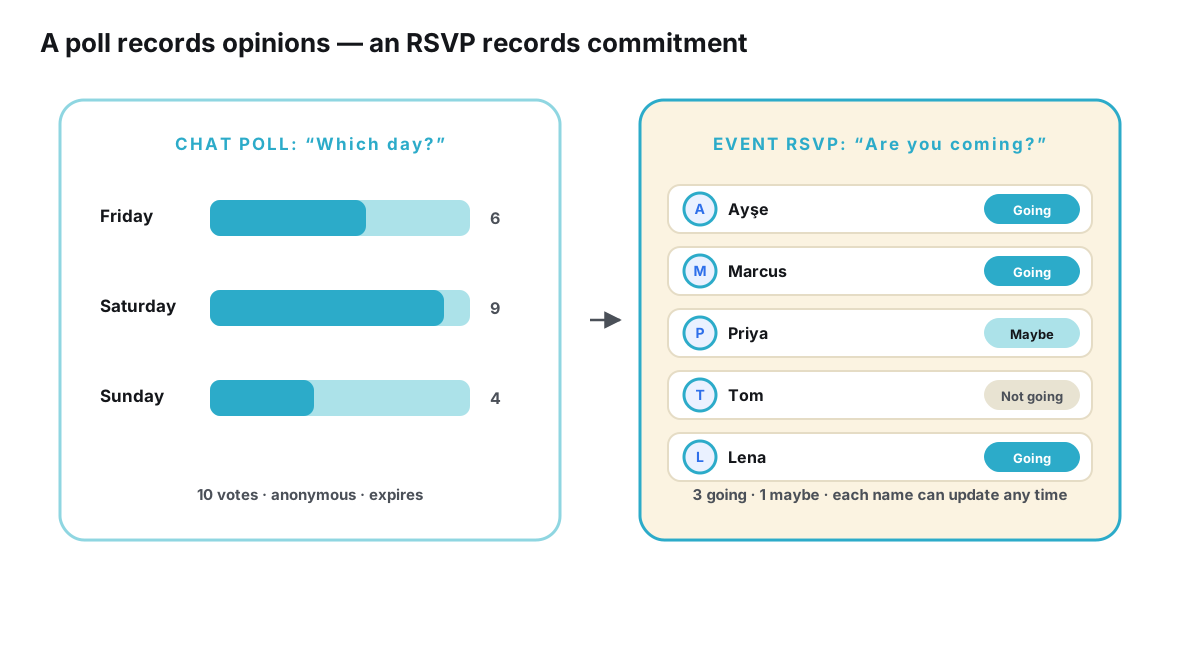
- Convert interest into commitments. A poll can pick the date if options genuinely compete — a dedicated scheduling poll such as Doodle does that job well too — but the headcount comes from RSVPs: going and maybe, per person, updatable until the day. This is the step communities are most tempted to skip, and skipping it is why first events under- or overshoot. A named commitment also gives the organizer the one thing a poll never will: a list of people to remind.
- Keep the first one small and simple. Cap it at a number a single table or a single conversation can hold. Simple formats — a walk, a cafe, a bar corner — forgive the organizer’s inexperience; ambitious formats amplify it. The first event’s job is not scale; it is proof: that members come, that it is enjoyable, and that the community’s warmth survives contact with the physical world.
- Close the loop and pre-commit the next date. Within a day or two, thank the attendees publicly, share a photo or two, and — crucially — announce the next date while the warmth is fresh. Communities that end an event with the next one already on the calendar convert a gathering into a program. Communities that end with “we’ll figure out the next one soon” usually restart from zero.
| Community talks about | Natural first event | Headcount sensitivity | Difficulty |
|---|---|---|---|
| Outdoors, trails, cycling | A short group route ending somewhere social | Moderate — safety and pacing | Low |
| A hobby with gear (photography, boardgames) | Cafe meetup with the gear as the agenda | Low — scales table by table | Low |
| Language learning | Conversation evening at a quiet venue | Low to moderate | Low |
| Professional or technical field | One short talk plus long drinks | Moderate — room booking | Medium |
| Fan community (a show, a team) | Viewing party or match screening | High — venue depends on numbers | Medium |
| Local neighborhood group | Park picnic, families welcome | Low — open space forgives | Low |
The right-hand columns carry the strategy. A low-sensitivity format lets the community learn to meet while numbers fluctuate; a high-sensitivity format makes the community’s first event also its first booking risk. Earn the second kind by surviving the first kind.
The cadence problem: from event to institution
One event is a memory; two are a pattern; six are an institution. The mechanism that performs this alchemy is cadence, and it works on the community’s psychology more than its calendar. A known rhythm — first Thursday, last Sunday — lets members plan around the community instead of negotiating with it, and it quietly recruits the hesitant: the member who missed January for a work trip was never lost, because February was already waiting. Irregular events, by contrast, must be re-sold every time, and each re-selling reaches a smaller, more tired audience.
Holding a cadence has a labor cost, and the playbook’s sixth step is the subsidy: announcing the next date at the current event borrows momentum instead of manufacturing it. The other subsidy is rotation. Once the rhythm exists, hosting an edition becomes a bounded, delegable task — one evening, one format, one venue — and the members who attended the first events are the natural next hosts, because they have standing, credibility and a clear picture of what the event is. A community whose events depend on one organizer’s energy has a ceiling; a community that grows hosts has a program.
| Risk | How it shows up | Countermeasure |
|---|---|---|
| Nobody commits | The announcement gets reactions but no RSVPs | Personally invite the active core first; a first event with known faces on the list is approachable |
| Turnout overshoot | More arrive than the venue holds | Cap the RSVP list at what one table or room supports |
| Turnout undershoot | Commitments quietly evaporate before the day | One reminder to the going list near the date; keep maybes warm without pressure |
| Wrong room energy | Attendees cluster in silence, event feels awkward | Choose formats with a built-in activity — walking, playing, watching — that converse for you |
| Details dissolve | Day-of questions flood the chat | One event page with final details; answer every question with the link |
| Energy dies after | Great event, then silence and no sequel | Post the thanks and the next date within a day |
Lurkers, and the ladder of participation
Every large group runs on a minority that talks and a majority that reads, and organizers who despair of the lurkers misread them. Reading is participation — the quiet member who has followed the community for a year arrives at a first event knowing everyone’s names and habits; they are not a stranger, only an unheard friend. What lurkers need is a ladder with rungs close together: react to a post, vote in a poll, RSVP maybe, attend once, attend again, bring a friend, host eventually. Each step should feel only slightly more committed than the last.
Events are the strongest rung precisely because they are optional and countable at once. The RSVP converts a year of ambient belonging into one small visible act, and the event converts the act into acquaintance. Organizers help the climb by making each rung cheap: polls that welcome anonymous votes, maybe statuses that welcome hesitation, first events that welcome observers. The community that treats a maybe with respect earns a going eventually; the community that treats hesitation as disloyalty keeps its lurkers exactly where they were.
What the group chat becomes
A subtle change happens to the discussion group itself once the community starts meeting, and it is worth steering deliberately. The chat stops being the community’s entire reality and becomes its living room — the place where the community lives between events. Conversation continues, but it gains a spine: dates to point to, events to reminisce about, photos to post, a next gathering on the horizon. Groups often find that chat quality improves after events, because members who have met in person talk to each other differently — more directly, more warmly, with fewer misunderstandings.
Steering means resisting the reflex to run the events from inside the chat. The announcement lives in the channel; the enthusiasm lives in the group; the facts live on the event page. Communities that keep this separation report the same relief: the thread returns to being fun, because it is no longer simultaneously the community’s home and its archive. How Telegram groups carry event coordination in general — and where the platform’s tools genuinely fit this divided workflow — is mapped in how Telegram groups handle event coordination, and the full chat-versus-structure comparison sits in chat vs structured event information in Telegram groups.
Where the events should live
The playbook’s third step deserves a brief defense, because it is the one communities argue about. Some prefer keeping everything inside Telegram — polls for dates, pins for details, the group for everything else — and for small, simple, high-frequency gatherings that genuinely works. The argument for a structured layer begins when commitments matter: reservations, caps, rotating hosts, members who attend without wanting to join the daily chat. Then the event needs things the stream cannot hold — a current headcount, an updatable plan, a reminder list — and bolting those on with pins and manual counting costs the host more each month than the event itself.
This is not a Telegram shortcoming; it is the shape of the problem, and it exists in every messaging platform — the deeper analysis is in the missing layer between Telegram communities and offline events. Practically, a coordination app like Ontaym gives each event in the series its own page — options to vote on, going and maybe RSVPs, one invite link, reminders — so the third step of this playbook is a setup task once, not a discipline every month. The Telegram community keeps doing what it does uniquely well: talking, daily, at scale.
Running the first event: a short field guide
The day itself rewards preparation of a very particular kind — not polish, but friction removal. The host arrives early, because a host waiting at a table is welcoming while a host arriving third is logistics. Somewhere visible — a group of tables, a corner, a landmark — is identified as the meeting point, and that point is the one fact the event page states most plainly, because it is the fact every newcomer lacks. A first-timer who finds the group in under a minute arrives feeling clever; one who wanders for fifteen arrives feeling like an outsider, and the event has not begun well for exactly the person it existed to convert.
Inside the event, the host’s job is matchmaking, not hosting in the ceremonial sense. The great asset of a discussion-community meetup is that people already share context; the host’s work is to surface it — “Priya, this is Tom, you two were arguing about lenses last week” does more for an evening than any welcome speech. Name tags feel corporate until they are optional and playful, at which point they quietly rescue the member who has known everyone by username for a year. And the host protects the exit: an event with a gentle, known ending — the walk finishes at the cafe, the talk ends when the venue says so — lets the hesitant leave honorably at the natural point rather than enduring an open-ended evening.
Afterwards, within a day, the loop closes in public: thanks in the group, a few photos, a named appreciation of the people who came, and the next date. This closing message is the highest-leverage paragraph the organizer will write, because it converts the event from a private memory of eight people into a public fact of the community — and public facts are what the next event’s attendance is built from.
How transitions fail
The failures of this transition are consistent enough to name. The false start is the most common: an announcement meets huge enthusiasm, a date is fixed loosely, the momentum dissipates in the thread before it converts to commitments, and the event quietly dies — after which the community concludes, wrongly, that its members do not want to meet. What died was not the desire but the conversion mechanism. The over-ambitious launch fails differently: the first event is a festival, complete with venues, schedules and expectations no first event can carry, and the organizational weight crushes the host before the community forms the habit. The playbook’s small-first rule exists because a modest success compounds and a spectacular struggle does not.
The third failure is the slowest and saddest: the single-host collapse. One person becomes the community’s event organist by default, runs three successful gatherings, and then a busy season arrives and the program stops entirely — because it was never a program, only a person. The defenses are built in earlier steps: the fixed cadence that makes editions routine rather than heroic, the event page that makes each edition repeatable by someone else, and the deliberate promotion of attendees into hosts while the founding host still has energy to hand over. A transition has not succeeded until the community can run an event the founder does not attend.
Growing past the first table
If the early events work, growth arrives on its own, and it changes the problems rather than solving them. A community that fills its table every month starts fielding the question of a second table, a bigger venue, a second simultaneous event in another neighborhood. The temptation is to grow the single event; the sturdier move is usually to replicate — two tables, two hosts, one format — because conversation does not scale, only programs do. The RSVP list teaches the same lesson from the demand side: a waitlist for a capped event is not a failure state but a growth signal, and the members on it are the natural seed of the next edition or the next city.
Growth also raises the stakes on the transition’s structural choices. At twenty attendees, manual coordination remains feasible if tedious; at recurring multiples of that, the community is running a real program with bookings, caps, rotating hosts and records of what past events drew — the point at which the structured layer stops being a convenience and becomes the infrastructure the program stands on. Communities that made the structural choice early tend not to notice the threshold; communities that deferred it tend to meet the threshold as a crisis of host burnout.
Frequently asked questions
How do I get my Telegram group to actually meet up?
Give the enthusiasm a mechanism: pick a format that mirrors what the group already discusses, choose a recurring rhythm, and personally recruit the active core to a first, deliberately small event. Commitments come from an RSVP with going and maybe statuses — not from reactions to an idea in the thread.
What is a good size for a first community event?
Small enough for one conversation — roughly a table’s worth. The first event proves that meeting is enjoyable; scale is a problem for later editions, once the community has learned to arrive. A cap also makes attending feel like a decision rather than a default.
How often should a community meet?
Monthly is the most durable rhythm: frequent enough to build habit, sparse enough not to exhaust hosts or attendees. Whatever cadence you choose, fix it and keep it — the predictability does as much work as the frequency, because members plan around a known rhythm.
Should the event be organized inside the chat or outside it?
Announce inside the community, run the facts outside it. The channel announces, the group debates and celebrates, and one structured page per event holds the time, place and RSVP list. That division keeps the chat enjoyable and the plan reliable — and it scales when hosts start rotating.
What if only a few people show up to the first event?
Treat it as a founding cohort, not a failure. Small first events are often the best ones — everyone talks, everyone matters — and their job is to generate the photos, stories and next date that make the second event feel established. Post the thanks and the next date promptly, and the community grows from the proof.
How do I keep the group active between events?
Let the chat be the living room, not the newsletter. Conversation continues on the community’s own topic; the events appear as dates to point to and moments to revisit. Avoid moving event logistics into the thread — the moment the chat becomes an announcement feed, it stops being the thing that made the community worth meeting in.
Conclusion
Moving a discussion community to real-world events is not a leap of enthusiasm but a sequence of small structural choices: a format that mirrors the conversation, a rhythm fixed before any date, one address per event holding facts and commitments, a first gathering kept small, and a next date announced while the last one still glows. None of it requires the community to become something it is not — it requires only that the community stop asking its chat to be a filing system.
Done this way, the transition compounds. The first event creates acquaintances; acquaintance deepens the chat; a warmer chat recruits the second event; the rhythm turns both into a program; and the program starts producing its own hosts. The discussion group that began the journey remains the engine throughout — talking daily, at whatever scale Telegram allows — while the community it feeds finally gets the counterpart its members always said they wanted: a table, a time, and the people behind the usernames.
Your community already talks every day. Give it somewhere to meet.
Plan it with Ontaym