
What Happens When a Telegram Event Has Hundreds of Participants?
A Telegram supergroup can hold up to 200,000 members — capacity almost no other messenger offers. But an event with hundreds of participants isn’t a big version of a dinner; it’s a different system, with different physics, and the interesting question is what those physics do to coordination.
Quick answer
As a Telegram event grows into the hundreds, four things change structurally. Message volume rises until important announcements decay within hours, so organizers shift toward channels, topics and slow-mode pacing to protect signal. A silent majority emerges — most members never post, so conversation no longer reflects the crowd, and polls measure the vocal few rather than the whole. Responsibility diffuses: with everyone assumed to be paying attention, nobody actually is, so updates must be engineered rather than hoped for. And the headcount problem sharpens, because interest signals — subscriptions, reactions, votes — diverge from attendance further at scale than at any smaller size. Telegram’s capacity makes the crowd possible; coordinating it requires deliberate structure: broadcast for reach, discussion for community, and one addressable record for the event’s facts and RSVPs.
Capacity is rarely the constraint
Start with the number, because it frames everything: Telegram supergroups support up to 200,000 members, per Telegram’s own FAQ. Across the messaging landscape, that figure is an outlier. WhatsApp documents a 1,024-participant ceiling for group chats in its Help Center; Signal’s documentation puts its groups at up to 1,000 members; WeChat, on its product site, describes a super-app ecosystem whose group chats cap at 500. Telegram’s room is, quite literally, orders of magnitude larger.
| Platform | Documented group capacity | What that means for events |
|---|---|---|
| Telegram (supergroups) | Up to 200,000 members | Any real-world crowd fits; organization, not room, is the challenge |
| Up to 1,024 participants | Large events overflow into linked groups and Communities | |
| Signal | Up to 1,000 members | Suits mid-size gatherings; big events strain the ceiling |
| Up to 500 members | Big events split across multiple groups by necessity |
The comparison is worth a moment of honesty, because it explains why big public events gravitate to Telegram in the first place: if you expect four hundred people and every other platform caps the room at a thousand or less, the platform with the giant room wins by default. But the table also shows the shape of the misunderstanding that follows. Capacity solves membership. It says nothing about announcements being read, decisions being known, or a headcount being real — and every one of those problems grows with the crowd, while the one problem capacity solved stays solved.
So the real question isn’t whether a Telegram event can have hundreds of participants. It plainly can. The question is what coordination looks like once it does — and the answer is that the group stops behaving like a conversation and starts behaving like a crowd.
How coordination changes as the crowd grows
The first change is velocity. Message volume doesn’t grow gently with membership; it compounds, because every participant is both a reader and a potential writer. Somewhere past a hundred active members, the thread crosses a threshold where reading everything stops being possible for anyone, including the organizer. From that point on, the group contains information no individual fully possesses — which is fine for a community, whose purpose is ambient connection, and hazardous for an event, whose purpose is shared facts.
The second change is the silent majority. In any large group, the people who post are a small, unrepresentative slice: the enthusiastic, the argumentative, the chronically online. The hundreds of others — many of whom fully intend to attend — say nothing, ever. This breaks the organizer’s intuitive instrument for reading a group. In a small chat, the mood of the conversation is a decent proxy for the mood of the event; at scale, the conversation is a sample distorted toward the loudest, and planning by it means planning for a crowd that doesn’t exist. Organizers often discover this only through the gap between the thread’s energy and the room’s actual turnout.
The third change is the diffusion of responsibility. In a group of ten, “someone should tell the new person about the parking” is a task someone picks up. In a group of four hundred, the same need dissolves into the assumption that surely somebody else has it covered — and the parking information never reaches anyone. Multiply by every small coordination task an event generates and you get the signature experience of large chat-based events: nothing is anyone’s job, so everything falls back on the organizer, who is one person with one scrolling thread.
Telegram’s own tools acknowledge these forces, which is why large groups lean on slow mode to cap how fast any member can post during heated periods, on topics to split one roaring river into navigable channels, and on admin teams to distribute moderation. These are real mitigations for conversation health. None of them, notably, addresses facts, decisions or attendance — the categories that events actually run on, and which are examined against chat’s structure in Telegram group planning: chat versus structured event information.
| Planning job | A dinner among friends | A club meetup | A community event, hundreds of people |
|---|---|---|---|
| Where the plan lives | The thread; everyone read it | A pinned message, kept by hand | Beyond any single message — needs a home of its own |
| How changes travel | One message, read by all | Announcement plus re-pinning | Engineered broadcast; repetition across channels |
| Who tracks attendance | Nobody needs to | The organizer, informally | Formal system, or the number is fiction |
| Questions from attendees | Asked and answered in-thread | Answered, with repetition | Repeated constantly; need a standing answer |
| Late joiners | Caught up by friends | Scroll back to the pin | Continuous influx; self-service is the only scale |
| Organizer’s real role | A participant | A coordinator | An operator of systems |
Read down the right-hand column and a pattern emerges: at scale, every mechanism that worked socially has to be replaced by a mechanism that works structurally. The plan needs an address, changes need broadcast, attendance needs records, questions need standing answers, onboarding needs self-service. The dinner runs on attention; the big event runs on architecture.
The attendance question, sharpened
Every problem in this article converges on the same cliff: how many people are actually coming? At small scale, the gap between interest and attendance is bridgeable by one person’s attention — the host knows Tom is flaky and Priya is certain, and adjusts mentally. At hundreds, the gap becomes structural in three compounding ways.
First, the interest signals available in chat are all one-directional and none are binding. A group member might be subscribed, present, occasionally vocal, quick to react and an enthusiastic poll-voter — and still not come, without ever having said so. None of those behaviors implied a commitment in the first place; at scale, the absence of commitment simply becomes too large to eyeball.
Second, attrition is silent and proportional. Whatever fraction of a crowd softly drops out between signing up and showing up — for weather, energy, competing plans — that fraction acts on bigger numbers the same way it acts on small ones. With a dozen people, silent attrition costs a couple of seats; with four hundred, it empties a room’s worth of expectations, and the venue contract, the catering, the printed materials all feel it.
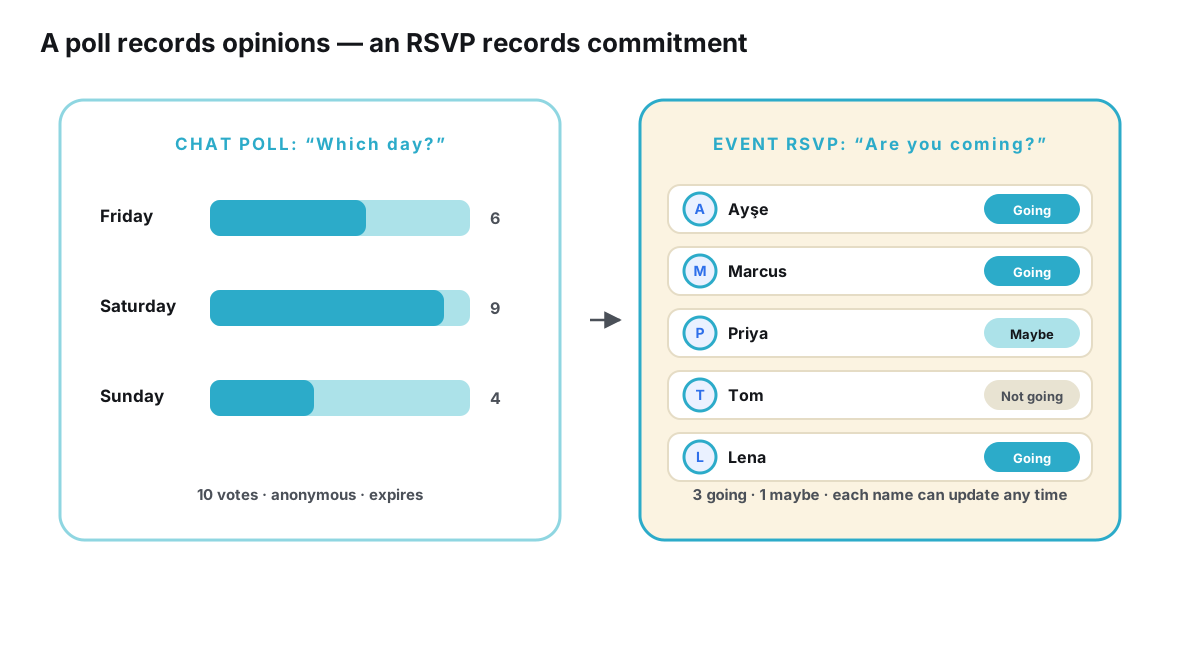
Third, the crowd’s own composition drifts. Large public Telegram events attract a broad spectrum of intent: definite attendees, curious browsers, people joining for the community rather than any single gathering, and passers-by who join groups the way one picks up a flyer. The event’s real guest list is a subset that no chat artifact identifies — which is why experienced large-event organizers stop asking “how big is the group?” and start asking “who has confirmed against this specific event, and how current is that list?” The mechanisms that answer that question — per-person RSVP states that guests themselves update — are exactly what a message stream doesn’t provide, however large it is.
What big Telegram communities actually do
The good news is that this territory is well mapped, because large Telegram communities have been running real-world events for years, and a set of working patterns has converged. The backbone is the channel-plus-group architecture: a channel for what must reach everyone — schedules, venue news, the day-of instructions — and a group, or several topical groups, for what benefits from discussion. The channel solves velocity by making announcement immune to noise; the group keeps the community alive, which at scale matters as much as logistics, because attendance follows belonging.
Around that backbone sit the operational refinements. Announcements are scheduled rather than improvised, so the information rhythm becomes predictable — members learn when to look. Moderation is delegated to an admin team with divided responsibilities. Bots handle the repetitive layer: welcome messages that onboard each newcomer, scheduled re-posts of the standing facts. And the trajectory that all of this serves — an online community converting itself into a physical gathering — has its own dynamics, covered in detail in how Telegram communities can handle real-world meetups.
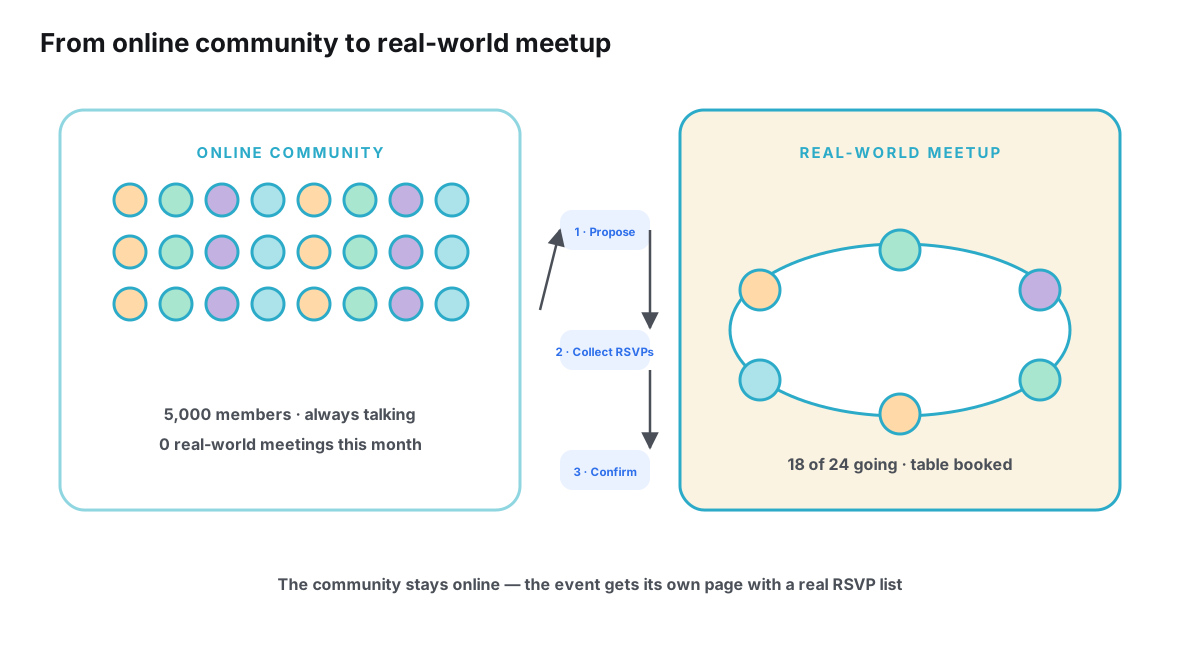
What the working patterns share is a division of labor by medium: broadcast for reach, conversation for community, records for facts. The communities that struggle are the ones that ask a single group to perform all three — and at hundreds of participants, the three functions actively interfere. The announcement drowns in the conversation it was posted into; the record dissolves into the scroll it was supposed to govern; the moderator policing signal fights the very energy that made the community worth gathering.
One-offs versus recurring series at scale
Size interacts strongly with frequency, and it is worth separating the two cases. A one-off large event — a conference, a anniversary gathering, a protest-adjacent picnic — assembles its crowd knowing the group will dissolve afterwards. Everything it needs must be self-service from the first hour, because there is no accumulated culture to lean on: the newcomer’s question cannot be answered by “ask around, everyone knows,” because nobody knows. One-offs therefore lean hardest on the record and the channel, and lightest on community: clarity is the product.
A recurring series has the opposite center of gravity. Its group accumulates norms, in-jokes, veterans who answer questions before admins see them — a genuine moderation subsidy — and its attendance problem shifts shape: instead of predicting strangers’ behavior once, the organizers must track a stable population whose members drift in and out across events. Regulars skip a month and return; the RSVP list for each gathering must be fresh without pestering the loyal. Series also compound their own history: last month’s pin, last quarter’s route discussion, all still sitting in the same container, making findability of current facts harder with every season. The recurring case rewards the same architecture with one addition — a per-event address that changes while the community stays — so that each gathering gets a clean record without fragmenting the group that gives it life.
The economics of one-to-many at scale
There is a deeper reason the division of labor wins, and it’s worth stating as a principle: coordination cost doesn’t scale linearly with people; it scales with people times messages times changes. A small event keeps all three factors tiny and can afford to run on pure conversation. A large event that keeps the same architecture multiplies all three, and the organizer pays the product — which is why running a four-hundred-person event out of one raw group feels like drinking from a firehose that is also on fire.
The structural answer divides the multiplication. Broadcast collapses the messages factor: one announcement, engineered once, reaches everyone identically. Topics and channels collapse the noise factor by giving each kind of traffic its own lane. And a record collapses the changes factor: one edit at one address replaces the reposting, re-pinning and repeating that otherwise eats organizer hours. What none of these collapse is the event’s need for its own identity — a place where the current facts and the current guest list simply exist, independent of any chat’s moment. That need is the quiet argument of why an event needs its own digital space, and scale is its loudest proof: the bigger the crowd, the less its questions can be answered by reading, and the more they must be answered by structure.
This is also where dedicated tooling earns a place in the stack, without displacing anything that works. Platforms like Ontaym attach one link to the event — the final details, the RSVP statuses, the updates and reminders — so that the Telegram channel broadcasts it, the group discusses it, and the record absorbs the load that neither chat could carry at scale.
Signs your event has crossed the threshold
Because growth is gradual, most organizers cross into large-event territory without noticing. The signs are consistent. The same question appears in the chat every day even though it was answered — answered, crucially, in a message, where answers go to die. The organizer’s private messages grow into a second, invisible help desk. The announcement that mattered gets acknowledged by a fraction of the group and the rest discover changes at the door. The headcount handed to the venue is a negotiation with yourself. And the group’s energy feels great while the event’s numbers feel soft — the signature split between a thriving conversation and an uncoordinated crowd.
Any one of these is a nudge; several at once are the system telling you it has changed state. The response isn’t more effort in the same container — it’s the architecture above: broadcast, lanes, and a record with an address. The groups that make the switch usually report the same surprise: attendance clarity arrives before anything else improves, because the headcount was the first thing the old structure could never actually see.
It is also worth resisting the instinct to prepare this architecture for its own sake. A group that has not crossed the threshold should not be administered like one that has — over-structuring a friendly meetup of thirty is how communities acquire bureaucracy before they acquire crowds. The tools described here are responses to observed strain, not prerequisites for growth. Watch for the signs; act when they appear; and enjoy the simplicity of the small group while it lasts.
A week inside a three-hundred-person event
To see the forces together, walk through a realistic week — an illustration, but composed from the standard pattern. A city cycling community announces a Saturday ride through its channel, and by Monday the linked discussion group is filling with questions: is the route hilly, is there a stop, what if it rains. The volume is already beyond any one person’s attention, and it doesn’t matter, because the standing answers live where the questions can find them: the channel’s announcement, the linked plan, a pinned FAQ topic.
By Wednesday the forecast shifts and the start point moves a kilometer to shelter under a bridge. In a single-group world this is a crisis — a message into a river. In the layered world it is one edit to the plan, one channel post, and a modest echo in the group, where the regulars reassure the nervous. Thursday, the café taking the mid-ride stop wants a number: the RSVP record says a hundred and forty going with thirty maybes, which is a decision-grade answer, not a guess. Friday evening brings one scheduled reminder through the channel, and the record absorbs the usual late drift silently — a dozen people flip their own statuses without messaging anyone.
Saturday morning is where the architecture pays its rent. The channel carries sequence and instruction — gates open, ride leaves, weather call. The group becomes the live floor: arrival reports, a lost-water-bottle moment, someone’s photo of the bridge. The organizers spend their attention on the handful of things that genuinely need humans, because everything repetitive was given a structural home days earlier. Sunday, the community is already arguing happily about next month’s route, which is the real sign the event worked: the crowd came, and the conversation survived it.
The day of the event: the group’s finest hour
It is worth underlining the one phase where chat is not merely adequate but unbeatable, because fair balance cuts both ways. On the day itself, a large Telegram group is a live operations floor that no event page can replicate: hundreds of people carrying the same app, already in the same room, able to report, ask and react in real time. The question “where exactly is everyone standing?” has no structured-data answer; it has a conversational one, arriving in seconds from the people physically present.
The failure mode of day-of chat is relying on it for what it can’t hold — the final instructions, which must be findable hours later by someone in a moving crowd, and which therefore belong in the channel announcement or the event record, not in message number four hundred of a fast thread. The working division is clean: the record says what is planned, the channel says what is happening, and the group says what it is like. Events that respect all three usually look, from the inside, almost calm.
Frequently asked questions
How many members can a Telegram event group actually hold?
Up to 200,000 in a supergroup, according to Telegram’s FAQ — by far the largest documented ceiling among mainstream messengers. The practical limit arrives much earlier and is about coordination, not capacity: announcement decay, question volume and headcount tracking become the binding constraints long before any membership ceiling is remotely near.
Do bigger Telegram groups mean better event turnout?
Not automatically. A large group is a large audience of ambiguous intent, and turnout is driven by commitment, not membership. Events with modest groups and firm RSVP lists routinely outperform events with huge groups and none, because the group’s size measures reach while the list measures intent. Reach helps; it just isn’t the same thing as attendance.
Should a large event run one big group or several smaller ones?
Usually one channel for announcements plus discussion split by purpose — either topics inside a group or separate groups per theme. One undivided group at hundreds of members combines the noise of conversation with the fragility of announcements. The exception is day-of operations, which benefits from a dedicated, focused space with only the people coordinating it.
How do I get a real headcount for a big Telegram event?
Move the counting out of the chat. Post the event once with a link to a page where each guest holds a going/maybe status they can update themselves, then remind the group before the venue’s deadline. Polls can stay for choosing date or venue — but the census needs per-person, updatable commitment, which is a record, not a message.
Won’t adding structure kill the community feeling?
Done wrong, yes — a group that becomes nothing but rules is a dead group walking. Done right, structure protects the feeling: the channel absorbs the announcements that were interrupting conversation, the record absorbs the questions people were embarrassed to re-ask, and the chat is left freer to be what it was good at. The community feeling dies from noise and confusion far more often than from organization.
Is Telegram the right platform for large events at all?
For reach and community, it is among the strongest options available — the capacity, the broadcast tools and the culture of large public groups are genuine advantages. The honest completion is that no messaging platform, Telegram included, is an event database, and large events expose that boundary fastest. Telegram plus one addressable event record is a stronger stack than Telegram alone, at any size.
Conclusion
Hundreds of participants is where event coordination stops being a social process and becomes an operational one. The conversation that planned the dinner cannot manage the crowd: announcements decay in hours, the visible chatter misrepresents the invisible majority, tasks dissolve into everyone-and-nobody, and the headcount — the number the whole enterprise balances on — floats free of anything the chat can express. None of this is Telegram failing; it is a messaging platform succeeding at scale at what messaging platforms are, and being asked for what they are not.
The organizers who run large Telegram events well treat the platform as one layer in a stack. Broadcast lives in channels, where one post can reach a crowd without being shouted down. Community lives in groups and topics, where the energy that drives attendance gets room to build. And the event itself — its final facts, its living RSVP list, its changes — lives at one address that every layer points to. Capacity gathered the crowd; architecture coordinates it. Groups that internalize the second sentence, not just the first, are the ones whose four hundred members become a room full of people at the right time, rather than a very large chat about one.
Your crowd deserves more than a loud chat — give the event one clear address.
Plan it with Ontaym