
Why Telegram Polls Don’t Tell You Who Will Actually Attend
The poll said thirty-one. The room held fourteen. Nothing went wrong and nobody lied — the tally and the turnout were measuring two different things, and this article is about exactly which two things.
Quick answer
A Telegram poll is an opinion instrument: it records what members leaned toward at the moment they voted, anonymously or with visible votes. Attendance is a commitment that each person must hold, update and sometimes revoke until the event happens. Three mechanisms keep the two apart. Anonymous votes cannot be attributed, so nobody can follow up with the individuals behind the tally. A vote obligates no one — there is no cost to voting yes and no step that makes yes feel binding. And votes decay: plans made the week of the poll quietly change, while the tally stays frozen at its peak. The result is a number that reads like a headcount but behaves like a mood meter. Use polls to shortlist options; collect explicit, updatable RSVPs for the number you actually act on.
The tally that looked like a headcount
Every organizer who has relied on a Telegram poll has some version of the same memory. The poll filled promisingly within a day — votes stacked on the winning option, a satisfying little bar chart growing in the thread. A venue was booked with that number in mind, or supplies were bought, or a route was chosen for a group of a certain size. Then the day arrived, and the door told a different story: substantially fewer people, occasionally more, and in either case a mismatch large enough to sting.
What makes this pattern worth understanding rather than merely surviving is that nobody behaved badly. The members who voted yes meant it when they voted. The organizer counted honestly. Telegram’s poll feature worked exactly as documented. The failure sits in the space between what a poll can record and what an event requires — and that space has a structure. Three mechanisms live in it: anonymity, obligation-free voting, and the slow decay of votes over time. Each one is a sensible design choice for an opinion tool; each one is a trap when the tally is used as a reservation.
What a Telegram poll actually records
Start with what the feature is. Polls in Telegram can be anonymous or public — with visible votes — and they can run quiz-style, which makes them partly a game; the range is documented plainly in Telegram’s own FAQ, and it tells you what the designers had in mind: quick pulses of group sentiment, icebreakers, light coordination of taste. Where should we order from? Which day suits more people? Who thinks the goalkeeper was offside? For all of these, a one-tap answer with optional anonymity is close to ideal — low friction, fast aggregation, instant readability inside the chat.
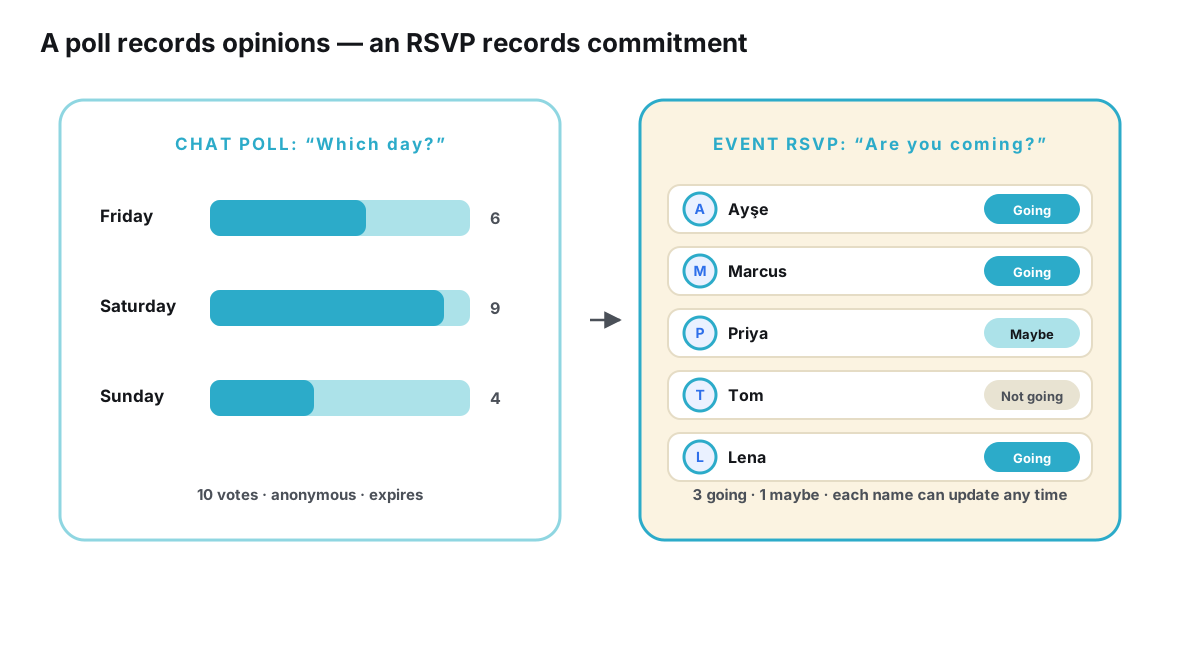
An RSVP answers a categorically different question. “Will you be at this place, on this date, at this time?” is not an opinion about the event; it is a personal commitment regarding the future, made against everything else in that person’s life. The two answers even fail differently. A wrong poll answer costs nothing and harms no one. A broken commitment ripples outward — a counted seat, a booked table, a teammate expecting a player. Because the stakes differ, the instruments must differ, and a poll has none of the machinery commitment requires: no per-person persistence, no update path, no deadline, no reminder, no consequence. It has a tally, and a tally is the beginning and the end of it. The wider web treats the difference as structural too: schema.org models an RSVP as its own type of action, distinct from any opinion, vote or reaction — a named commitment to attend, not a leaning.
| Property | Poll vote in Telegram | Attendance commitment (RSVP) |
|---|---|---|
| What it expresses | A preference at a moment in time | A personal plan for a specific date and place |
| Identity | Anonymous or visible, depending on setup | Named by necessity — commitments belong to someone |
| Cost of answering | One tap, instantly forgotten | A moment of calendar-checking and deciding |
| Update path | Revote, if the voter remembers and bothers | Switch to maybe or not going as life changes |
| Aging | Frozen at whatever the tally showed | Current — reflects the holder’s latest reality |
| Follow-up possible | Only with visible votes, and only manually | Built in: reminders and updates reach the committed |
| Rolls up into | A percentage of the group’s mood | A headcount the organizer can act on |
None of the rows in that table make polls bad. They make polls polls. The danger arrives only at the moment of misuse — when the organizer reads the tally row and books against the headcount row.
Mechanism zero: the poll question itself is ambiguous
Before the three mechanisms even engage, there is a prior problem: members do not agree on what the poll is asking. Post “Who’s in for Saturday?” as a poll and some members will read it as a request for a decision — I am treating this as my plan. Others will read it as a social gesture — I like this idea and want to encourage it. Others still will read it as a forecast — I would probably come if nothing better appears. All three groups tap the same button. The tally then sums three different mental acts into one number, and the organizer has no way to see the mixture.
Compare that with a well-formed RSVP, where the question is unambiguous because the interface enforces one meaning: marking yourself going is a status you hold, visibly, with your name on it, until you change it. Ambiguity is not eliminated by stricter wording in the poll — even a precisely worded question cannot change what a one-tap answer feels like. It is eliminated by changing the kind of answer being requested. This is worth internalizing early, because it reframes everything that follows: the poll-vs-attendance gap begins before decay or anonymity, at the moment the question is asked in a form that cannot distinguish enthusiasm from intent.
Mechanism one: anonymity removes the follow-up
Anonymous polls are a genuinely good option for many questions; members answer honestly about dates and preferences when nobody watches, and an organizer gets cleaner signal on sensitive choices. But anonymity has an organizational price: the tally becomes a number with no names under it. The organizer cannot see that a regular is missing from the count, cannot notice that the same member who always comes has not voted, cannot gently ask the six quiet abstainers whether the date is the problem. Every technique for turning interest into attendance — the personal nudge, the “haven’t heard from you,” the correction of a misunderstanding — requires knowing who is behind the numbers.
Anonymous counts also break the social physics that makes commitments hold. People honor stated intentions partly because they were stated — to a person, in front of a group. A vote that nobody can attribute was never stated in any socially meaningful sense. It is closer to a whisper into a bucket, and the bucket keeps the total but loses the promise. None of this argues against anonymous polls; it argues against building a headcount from data that was never designed to be traceable to a human being who can be looked in the eye.
Mechanism two: a vote creates no obligation
Watch what a member actually does when they vote in a Telegram poll. They see the poll while waiting for a train, tap the option that pleases them, feel a small pleasant participation, and return to their day. Nothing else happens. No calendar entry suggests itself, no mental note is made, no threshold is crossed where the event becomes a plan rather than a nice idea. The vote is complete at the moment of tapping — which is precisely the elegance of the feature and precisely why the tally cannot be trusted as intention.
An obligation, by contrast, is created by structure. When someone marks themselves as going on an event page, several things exist afterwards that did not exist before: their name sits on a list they can see, the organizer’s count changed in a way they caused, and a reminder is now possible because there is a specific person and a specific event to remind. The member can still change their mind — that is what maybe statuses are for — but the commitment has a persistent form. It can be inspected, updated and gently enforced. A poll vote has none of that persistence; it evaporates into the total, taking with it both the accountability and the follow-up. Voting is expressing; RSVPing is committing; and groups that substitute one for the other discover the difference on the night.
Mechanism three: votes decay, tallies don’t
The subtlest of the three mechanisms is time. A poll is a snapshot, but it is read as if it were a gauge — a number that still means now what it meant when each vote was cast. It does not. Every vote in the tally was cast at a different moment, under different circumstances, and every voter’s life has continued since. The colleague who voted yes before a work trip was announced, the student who voted yes before exam schedules came out, the member who voted yes the night the idea sounded magical and has since half-forgotten the event exists — all of them still sit in the count, radiating certainty.
The decay is asymmetric, and the asymmetry matters. Voters whose plans fall apart almost never return to revote; the poll is buried, the moment has passed, and updating a poll feels disproportionate to the change. Voters whose interest grows, meanwhile, also often fail to vote late — they simply show up. So the tally drifts in both directions while appearing perfectly stable on screen. A well-run RSVP list has the opposite property by design: it is expected to change, members know where to change it, and the number near the date reflects the date, not the launch week. The difference is not diligence; it is that one instrument has a built-in way to age and the other does not.
When the gap stays small — and when it widens
To be fair to polls, the divergence is not constant; it scales with the distance between the vote and the door. A poll posted two days before a small gathering, in an active group, with visible votes, behaves almost like an RSVP: members are voting against their actual week, the thread is still near the top of the chat, and the social visibility of a named yes still carries warmth. This is why small spontaneous plans — “drinks Thursday, who’s in?” — run perfectly well on polls and always have. The instrument’s weaknesses all need time to develop.
Every one of those conditions reverses as events grow. Longer lead times give decay more runway: a poll answered three weeks out is a photograph of a calendar that no longer exists. Larger communities introduce the anonymity of scale even when votes are technically visible — nobody knows all four hundred members, so a named vote from a stranger carries little social weight. Recurring events compound the problem, because each new poll competes with the memory of the last one, and members who meant to attend previously transfer their vague intention forward onto the fresh tally. And events with hard logistics — reservations, rentals, group rates — convert the gap directly into cost. The pattern is consistent: the bigger the event and the longer the runway, the less a poll can tell you about the room you will actually face.
What visible votes fix — and what they leave untouched
Telegram’s public polls, with visible votes, deserve their popularity with organizers, because they repair part of mechanism one. When votes carry names, the organizer can count real individuals, spot the reliable regulars, and follow up with the fence-sitters. Visibility also restores a portion of the social physics: a vote with your username on it feels slightly more like a stated intention than an anonymous tap.
But visible votes are a half-measure toward a headcount, not the thing itself. Mechanism two survives intact — a named vote still costs one tap, still creates no persistent commitment, still attaches to no calendar. Mechanism three survives intact — a visible vote ages exactly as badly as an anonymous one, and still offers no graceful way to take it back quietly. The organizer who follows up manually, member by member, is doing with labor what an RSVP system does with structure: converting a list of past leanings into a list of current intentions. It works, at small scale, until the organizer has a life too. The honest summary of visible votes is that they make the gap visible — you can see exactly who is on the list that will not become a room.
Planning on the tally: the organizer’s two failures
The divergence between votes and attendance is not a curiosity; it gets converted, always, into one of two organizational failures. Oversupply is the common one: the organizer plans for the tally, books the space for the tally, buys for the tally — and pays for the gap between the tally and the door in money, awkwardness, or both. Undersupply is rarer but crueler: an organizer who has been burned once plans defensively for a fraction of the poll, and then the community defies the poll in the other direction, and committed members are turned away from a full room. Both failures come from the same source — acting on a number that does not mean what it appears to mean — and both are avoided the same way: by never acting on the poll at all, only on commitments gathered after it.
There is also an emotional dimension that keeps the trap baited: the tally feels good while it climbs. Every new vote is a small public endorsement of the organizer’s idea, and it is genuinely hard — almost contrary to hosting instincts — to treat a growing number as unreliable. Organizers watch the bar fill and start imagining the room full; suppliers ask for numbers and the tally is right there, confident, screenshot-able. The RSVP path asks for more patience: it starts quieter, grows slower, and can move down as well as up. What it offers in exchange is that the number it shows on the day before is the number the organizer can defend. Learning to prefer the slower, honest count over the faster, flattering one is, in miniature, the whole discipline of organizing.
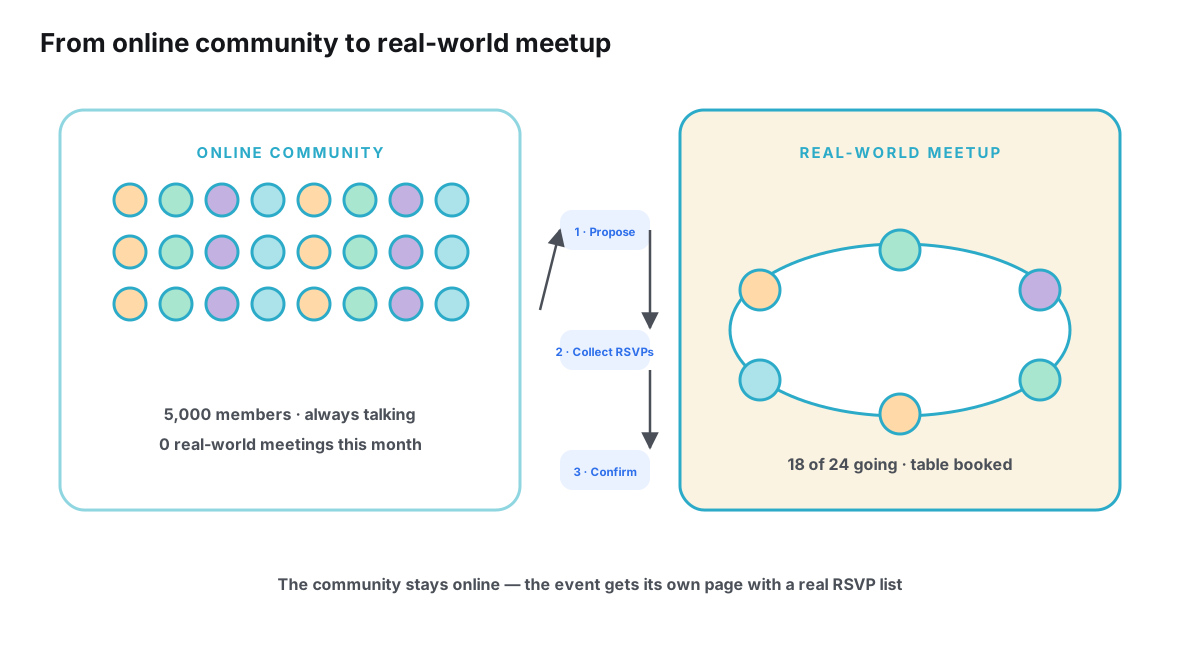
A small illustration shows the workable sequence. Maya runs a monthly boardgame evening in her city’s Telegram community. Her poll asks only “which Friday?” — one question, visible votes, closed the same week. The winning Friday then gets an event page with a firm cap matching the tables she can actually reserve. Members RSVP going or maybe; the going list is the number she books against; a reminder goes to the committed two days out; and the maybes convert or release as their week resolves. The poll did its real job — choosing the date quickly and fairly — and never once pretended to be a headcount. Tom, who co-hosts, insists on the same rule for his pickup-football group in a different form: the poll picks the pitch, the RSVP list picks the teams.
| Technique | What it addresses | How to apply it |
|---|---|---|
| Poll for options only | Misuse of the tally | Limit polls to genuine preference questions — date, venue, format — and close them early |
| Collect RSVPs separately | No obligation, no identity | After the poll, open going / maybe / not going per person on the event itself |
| Let answers age properly | Vote decay | Keep the RSVP list open and updatable until the event, and say so |
| Remind the committed | Silent drift | Send one reminder near the date to those marked going, not to the whole group |
| Act on current numbers | Both failure modes | Book against the RSVP count close to the date, never against peak enthusiasm |
| Record the real turnout | Next time’s guesswork | Note who came; recurring events then plan from history, not hope |
The distinction underneath: a conversation vs an event
Everything in this article rests on one structural difference, worth naming precisely because it generalizes beyond polls. A poll lives inside the conversation — it is, technically and socially, a message with a tally attached, and it inherits all the properties of chat: it scrolls, it belongs to a moment, it competes for attention and loses to whatever follows. An attendance list belongs to the event as an object — a thing with identity, fields and state that exists independently of any thread. The fuller anatomy of that difference is drawn in the difference between a conversation and an event object, and the Telegram-specific mapping of which information belongs in which container is laid out in chat vs structured event information in Telegram groups.
Two neighboring pieces complete the picture. For communities that feel this gap most sharply — large groups whose members want to meet in person — the playbook for moving a Telegram community from discussion to real-world events shows where RSVPs fit in the wider transition. And for the question of why even a well-tooled community platform leaves this layer missing, the missing layer between Telegram communities and offline events examines the structural reasons. Instruments like Ontaym exist precisely for the narrow middle: polls for the options, RSVPs for the commitment, one page holding both until the event ends — while the Telegram group carries the conversation it was always meant for.
Frequently asked questions
Are Telegram polls useless for event planning?
No — they are excellent at their actual job: choosing between options quickly, fairly and with low friction. The failure is using the tally as a headcount. Poll the preference, then collect commitments separately, and the poll becomes what it should be — the fastest decision tool in the group.
Do visible votes solve the attendance problem?
Partially. Visible votes let you follow up with individuals, which repairs the anonymity problem. But a named vote is still one tap with no obligation and no update path, and it still ages into the tally silently. Use them for short-window decisions where the vote and the event are days apart at most.
How much smaller than the poll should I plan for?
Don’t scale the poll at all — replace it. Plan against an explicit RSVP list close to the date, with going and maybe statuses members can update. The right number differs for every community and format, which is exactly why acting on current commitments beats applying a discount to a mood.
Should I re-post the poll closer to the date?
Re-posting re-measures the mood but recreates the same problem — another tally of obligations that bind no one. If you want fresh signal near the date, ask for an RSVP update instead: one reminder to the committed, with an easy way to switch to maybe or not going.
Why do people vote yes and then not come?
Almost never dishonesty. Voting happens in a second, against an imagined calendar; life then intervenes — work, energy, weather, a forgotten commitment — and the poll, buried in the thread, offers no natural moment to take the yes back. The vote decayed; the tally just never found out.
What does an RSVP give me that a poll doesn’t?
Persistence and consequence. An RSVP is a named, current, updatable commitment attached to a specific event — it can be reminded, changed and counted. A poll is a moment-of opinion aggregated into a number. Events need the first; groups genuinely enjoy both, for different purposes.
Conclusion
Telegram polls are good at what they were built for, and the building shows: one tap, optional anonymity, visible votes, even a quiz mode for fun. None of that machinery makes a promise, and attendance is made of nothing else. Anonymity keeps the tally unaccountable, obligation-free voting keeps it weightless, and time quietly rots it from the inside while the number on screen stands still. A poll answers “what does the group fancy?” with admirable speed; it has never answered “who will be there?”, because it was never asked to.
The practical conclusion is a clean division of labor, not an abandonment of a useful feature. Polls decide — dates, venues, formats — quickly and fairly, and should be closed early. Commitments then get collected where commitments can live: per person, on the event itself, updatable until the day, reminded once, and counted only as they currently stand. Organizers who internalize the split stop being surprised by the door, because they stopped asking a mood meter to do a reservation’s job. The poll picks the Friday; the RSVP list fills the room.
Poll the options. Count the commitments. Do both in one place.
Plan it with Ontaym