
How to Track Who Is Actually Coming From a WhatsApp Conversation
The restaurant wants a number by Thursday. Your WhatsApp thread contains a month of enthusiasm, three poll votes and a thumbs-up — but no number. Attendance is the single most important fact an event produces, and chat is structurally unable to hold it.
Quick answer
You cannot reliably track attendance inside a WhatsApp conversation, because attendance information in a chat is scattered across reactions, replies, poll votes and private messages — none of which aggregate, persist or update. A reaction is a gesture at a moment in time, not a commitment that survives a change of plans. To count guests reliably, move the count out of the thread: keep a single RSVP list with explicit statuses — going, maybe, not going — in one place everyone can see, set a respond-by deadline, chase non-responders privately, and reconfirm the maybes in the final days. The chat stays for conversation; the list becomes the headcount. When statuses live on the event itself, the number composes itself instead of being reconstructed by hand.
The number that carries the event
Every event has one fact that the rest of the plan hangs from: how many people are coming. The restaurant needs it for the table. The host needs it for food. The football game needs eight, or it is not a game. The venue’s capacity, the transport, the cake — all of it is downstream of the headcount. Ask an organizer what they most need to know in the final week and the answer is almost always a number.
And yet the number is precisely what a WhatsApp thread never contains. What the thread contains is conversation about the number: enthusiasm on Monday, a poll on Wednesday, a “should be able to make it!” on Friday, and a quiet reversal the following week that was never posted at all. Somewhere behind the scenes, the organizer maintains the real count — in their head, in a notes app, in a text to the restaurant that says “13, maybe 15” — while the group chats on, unaware that a census is being run off the books.
This article is about that gap: why attendance signals in chat refuse to add up, and how to build a count you can actually trust. It is a narrower question than the general messiness of planning threads — the broader mechanics are covered in why WhatsApp groups become messy when planning events — but it is the corner of the mess with the most immediate consequences, because a buried address annoys one guest while a wrong headcount changes the event for everyone.
Those consequences are worth naming, because they are the reason this problem deserves its own treatment rather than a footnote. Undercount and the event shrinks: the venue seats two tables away from each other, the game cancels for lack of players, the host cooks for ten and fourteen arrive to stand around the kitchen. Overcount and the event pays: deposits for unused seats, food that becomes leftovers at scale, a room booked on optimism. Both errors trace to the same source — a number inferred from social signals at some point in the past, presented with confidence in the present. Precision about headcount is not fussiness; it is the difference between the event that was planned and the one that physically happens.
Where attendance information hides in a chat
Suppose you could freeze a planning thread and audit it for attendance signals. You would find them, in quantity — just not in a form anyone can count. There are five common hiding places, and each fails as a record in its own way.
| Signal | What it tells you | Why it is not an RSVP |
|---|---|---|
| Emoji reaction to the plan | Someone saw that message and reacted warmly | A gesture at one moment; ages silently; indistinguishable from “nice idea” |
| A reply in the thread | Current enthusiasm, phrased socially | “I’ll try!”, “hopefully!” and “in!” look identical in tone and differ completely in meaning |
| A poll vote | An opinion while the poll was open | A snapshot of preference, not a commitment that updates with circumstances |
| A private message to the organizer | A real answer, delivered off the record | Invisible to the group; only the organizer knows; never appears in any count the guests see |
| Silence | Nothing reliable whatsoever | Blends together the confirmed-but-quiet, the absent and the declined-by-omission |
The pattern across the table: each signal carries some attendance information, and none of it is addressable, current or complete. The organizer’s job under this regime is to read all five channels continuously, weigh them by personal knowledge of each friend’s flake quotient, and maintain a private spreadsheet of the result. It works, in the way that doing accounts from memory works — until the night it doesn’t.
Why the count drifts
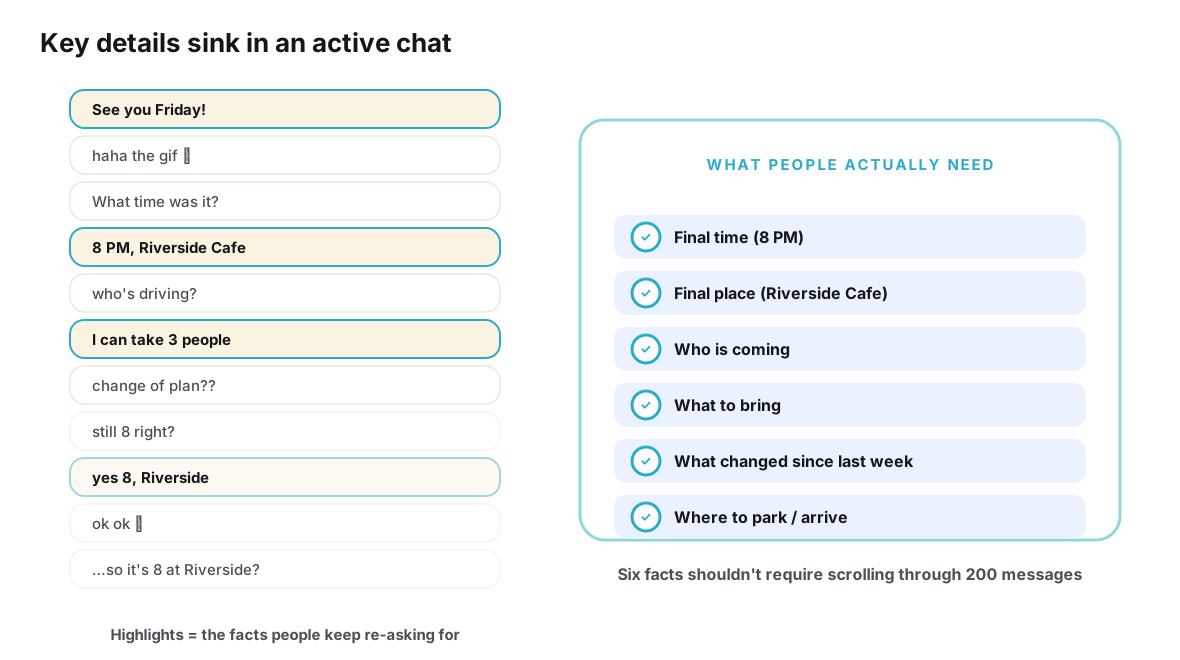
The deepest problem is not that chat signals are weak. It is that attendance is a field that changes over time, and a thread has no way to express change to a previous signal. When Tom’s Wednesday “in!” becomes Friday’s silence, the thread still confidently displays Wednesday. The yes does not expire; it just quietly stops being true, and no one — including sometimes Tom — notices the moment it crosses over.
Drift runs in both directions. People who enthusiastically confirmed drop out without announcing it, because withdrawing publicly in a group of friends feels heavier than simply not appearing. People who said nothing quietly arrange their week around the event and show up. The poll’s losing option acquires secret supporters once the date gets close. Every one of these movements is invisible in the stream, which means the count you assembled two weeks ago is not the count for tonight — and the thread offers no way to ask the second question without starting a new round of messages.
There is also a social layer that pure information analysis misses. A group chat is a stage, and on a stage people perform availability they do not have. “Sounds great!” is often a compliment, not a commitment — the speaker is praising the plan while their calendar quietly disagrees. A decent RSVP system makes the same conversation survivable in private: marking yourself “maybe” on a list is a small administrative act, while typing “I’m a soft maybe” into a stream of enthusiasm is a social act. Chat does not merely fail to record commitment; it actively discourages the honest expression of it.
Polls: a snapshot, not a promise
The poll is the thread’s best attempt at structure, and it deserves a fair hearing. When the question is genuinely a preference — which Friday, pizza or sushi — a poll closes the question cleanly, visibly and in one place. That is a real improvement over prose, and organizers should use it for what it is.
But the boundaries are hard. A poll records votes during the window it was open; it does not track commitment after the window, does not update when circumstances change, and usually cannot distinguish “I prefer Friday” from “I can come Friday.” Scheduling-poll services such as Doodle solved the first problem years ago for the narrow case of choosing a time — but even a mature scheduling poll answers when, not who, and events live or die on the second. The distinction matters enough that the web’s own vocabulary keeps them separate: structured data has an RsvpAction type — a person responding to an invitation — distinct from any poll or rating mechanism. A vote is an opinion about an option; an RSVP is a statement about yourself. Planning needs both, and a thread only has the first.
The pattern generalizes across platforms, which is worth knowing because groups often assume a different app will solve it. Telegram’s own FAQ describes polls that can be anonymous or show each voter’s choice, and even quiz-style variants — genuinely richer tooling than most. But every one of those polls is still a moment-in-time aggregation of opinions; making the vote public changes how accountable it feels, not whether it updates when someone’s babysitter cancels. The gap between a vote and a commitment survives every feature level.
Running a count you can trust
None of this requires abandoning WhatsApp for conversation. It requires moving the count out of the conversation and into a register — a single place where each person’s status lives, visible to the organizer and preferably to the group. The procedure below is the stable core; it works on paper, in a shared list, or, with the least effort, on an event page.
- Declare the statuses. Fix the vocabulary before inviting answers: going, maybe, not going — plus, if the event needs it, a convention for plus-ones. Three or four statuses, no more. Ambiguity in the vocabulary becomes ambiguity in the headcount.
- Put the list somewhere with one address. A page or shared register that every guest can open. The status list and the event details belong together, because details buried in WhatsApp and headcounts lost in WhatsApp are the same failure wearing two hats.
- Invite answers into the list. Ask each guest, once, through whatever channel suits them, to set their status — and make setting it easier than replying in prose. Every answer that arrives as prose is a status you have to transcribe.
- Set a respond-by date. A deadline converts silence from an interpretation problem into an action item. After it passes, the non-responders form a finite, known list.
- Chase privately, not publicly. A group-wide “please confirm!” taxes the already-confirmed to reach the unconfirmed. Four individual messages reach exactly the people who need reaching.
- Reconfirm near the date. In the final days, ask the maybes — and only the maybes — to firm up. This is the step that recovers the drift: the count you present to the restaurant reflects the current week, not the optimistic one from a fortnight ago.
The procedure’s quiet principle is that every step moves information from prose into state. Once the answers live as statuses, counting is arithmetic; while they live as messages, counting is reading comprehension performed by the busiest person involved.
Designing the statuses
Three statuses look trivial, and are in fact the load-bearing design decision of the whole count. Get them wrong — too few, too many, or too vague — and the list inherits the ambiguity it was built to escape.
| Status | What the guest is saying | What the organizer does |
|---|---|---|
| Going | Count me; I have arranged my week around it | Include in the firm headcount; no further action |
| Maybe | Genuinely uncertain; a dependent factor exists | Track individually; reconfirm in the final window |
| Not going | A polite, explicit no | Remove from chasing; thank and close the loop |
| No status set | Unknown — anything from enthusiasm to oblivion | Chase once, privately, after the respond-by date |
Two design notes. First, protect the “not going” option: a guest who can gracefully decline in one click declines early, and an early no is worth three late maybes to a headcount. Second, resist adding more statuses — “probably”, “if before 9”, “coming for dessert only” are all real situations, but they are notes on a person, not categories of the count. The moment the vocabulary tries to encode prose, it becomes prose.
One more note on visibility, because it is the part organizers most often get backwards. The status list helps most when guests can see it, not just the organizer. A visible count lets the friend who marked “maybe” notice that the event is one yes short of viable and convert himself; it lets the couple coordinate their plus-one without asking you; it lets the group self-correct the number in both directions, without you in the loop. A private spreadsheet is still better than memory — but a shared register turns headcount from a service the organizer provides into a fact the group maintains together.
The attendance timeline
Headcount is not a fact you establish once; it is a fact you maintain on a schedule. The rhythm below matches how commitments actually form — early enthusiasm, mid-period drift, last-minute resolution — and puts the organizer’s effort where each phase needs it.
| Phase | What is happening with guests | What you do |
|---|---|---|
| Invitation | Enthusiasm peaks; early answers arrive fast | Collect statuses, not adjectives; capture the early firm yeses before they soften |
| Quiet middle | Life intervenes; early maybes drift unannounced | Leave the list visible; resist polling the group again; note new arrivals |
| Deadline passes | The population splits into answered and silent | Chase the silent list privately, one message each |
| Final 48 hours | Maybes resolve; logistics questions surface | Reconfirm maybes; publish the number to venues and helpers |
| Event day | Last-minute deltas: illness, work, energy | Update the list as changes land; one place, one number |
Notice how much of this timeline is passive. A visible status list does the middle phases on its own — guests check it, adjust it, and see the headcount move without a single group message. The organizer’s active work concentrates into two short windows, the chase and the reconfirmation, both of which are one-to-one by design. Compare that with the thread-native version of the same fortnight, in which the middle phases are silent and the final 48 hours are a burst of “so we’re 12, right? right??” messages.
Two Fridays, counted two ways
Take one hypothetical event — Nadia’s leaving do, twenty invitees, a restaurant that wants a number by Wednesday — and run the attendance problem through both regimes.
The thread version. The plan lives in a group of twenty. On day one, the announcement collects a dozen reactions and six replies ranging from “yesss” to “I might be able to swing by after my thing.” A poll on the date closes 11–6. Over the following week, two people who voted quietly discover conflicts and say nothing; one person who said nothing books a flight to be there; someone messages Nadia privately to ask if their partner counts. By Tuesday the thread contains, in principle, everything needed to compute the headcount — and in practice nobody can compute it. Nadia spends Wednesday evening scrolling, remembers that Dan flaked on the last two, weights Sofia’s “hopefully!” at fifty percent, and texts the restaurant “14, could be 15.” Fourteen and fifteen turn out to both be wrong.
The register version. Same guests, same WhatsApp group for everything social, but the invitation pointed at an event page with three statuses and a respond-by of Monday. The early enthusiasts mark themselves going on day one — the same enthusiasm, captured as data instead of adjectives. Monday night, the register shows 12 going, 4 maybe, 2 no, 2 silent. Tuesday morning, Nadia sends exactly two private chase messages. Wednesday, she asks the four maybes to firm up; two convert, two decline gracefully with a click they would never have typed into the group. The number she gives the restaurant — 14 — comes from arithmetic, not memory, and when her colleague asks to join on Thursday, his “going” updates the total in front of everyone.
The two versions contain the same people behaving the same way. The difference is purely where the answers landed: as messages that must be interpreted and re-interpreted, or as statuses that compose. That is the entire content of this article, demonstrated.
The day-of delta
Attendance tracking does not end when the number is given; it ends when the door closes. The final day brings its own class of changes — the fever announced at noon, the work crisis, the friend who texts “running 40 late” — and each one perturbs a count that has already been communicated to caterers, drivers and venues.
Handle the delta the same way you built the count: in the register, not the thread. A status flipped to “not going” at noon is visible to everyone who needs it, updates any shared headcount, and requires zero repetition. The same news delivered as a group message starts a sympathy cascade of replies that buries the two genuinely logistical questions still open — who is picking up the cake, and does the restaurant know. Event day is precisely when nobody has attention to spend on re-reading a thread; it is also when a single current list pays for itself most visibly.
Late joiners make the count worse
Every event acquires people after the count has settled: the friend who heard about it last night, the partner added as a courtesy, the returning teammate. In a thread, each arrival perturbs the count invisibly — they may say yes to the organizer, appear in no list, and eat a seat the restaurant was not holding.
Worse, late arrivals interact badly with a thread’s already-weak memory. A late joiner who asks “is there still space?” forces the group to reconstruct the current count in public, from memory, usually wrongly. A late joiner who does not ask assumes. Both patterns add noise precisely when the plan can least absorb it — the onboarding side of this problem, including why “scroll up” fails as an introduction, is covered in what happens when someone joins a WhatsApp plan late.
Why the count belongs on the event
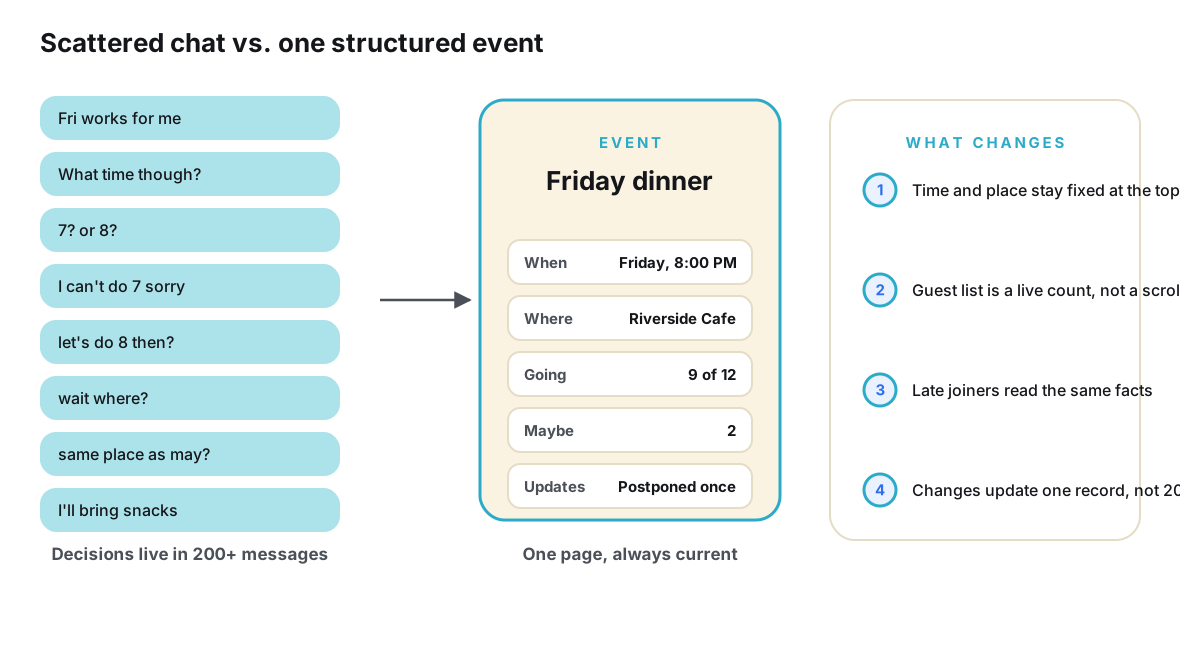
Step back and the conclusion is almost architectural. A headcount is a property of the event — as intrinsic as its time and place — and it behaves like one: it has a current value, a history of changes, and a set of people authorized to change it. Registers with those properties need to be the thing itself, not a message about the thing. That is the argument of why an event needs its own digital space, and attendance is its most convincing exhibit.
This is also where purpose-built tools earn their place alongside the chat. An event page in Ontaym, for instance, carries the RSVP statuses next to the details they attach to: going, maybe and not going compose into a live headcount, maybes are reconfirmable as the date approaches, and each guest’s status is theirs to update when their week changes. The thread, meanwhile, keeps doing what only it can do — the jokes, the anticipation, the logistics banter — with the number safely out of the stream and one tap away.
Frequently asked questions
Can I just run a WhatsApp poll asking who’s coming?
You can, and it beats counting reactions — but treat the result as a snapshot, not a headcount. Poll votes do not update when plans change, cannot express “maybe” nuance, and tend to collect opinions rather than commitments. Use the poll to gauge interest early, then move to statuses for the count that matters.
How do I count the maybes?
You don’t — you convert them. Give every maybe an explicit moment of resolution: a reconfirmation request in the final days, phrased one-to-one. A headcount of “9 going, 5 maybe” is a fact about your uncertainty; “12 going, 2 not” is a fact about your event. The gap between them is two private conversations.
What is the fairest way to chase people who never answered?
Privately, once, with an easy out. “No pressure either way — just need a number for the table” gets answers because it makes declining cheap. A group-wide reminder feels efficient but bills the people who already answered and embarrasses the people it is aimed at, which is why it underperforms.
How do plus-ones fit into the count?
As a convention established up front, not negotiated per guest. Decide whether the invite includes partners, encode it in the status vocabulary — “going (+1)” — and let guests apply it themselves. The alternative is a private ledger of asterisks that only the organizer can interpret on the night.
When should I lock the final number?
Lock what you owe the venue at their deadline, and keep the live list running after that for reality. Restaurants generally forgive a swing of one or two; the number you give them should come from the status list at that moment, not from the poll three weeks earlier. The count is never finally true until the door closes.
Doesn’t this turn a friendly dinner into an admin exercise?
The admin exists either way — the choice is only whether it is visible or hidden. In a thread, the organizer silently performs census work for two weeks and presents a number of uncertain provenance. With statuses, the work collapses into a list guests maintain themselves, and the visible artifact is just a number everyone can trust. Less administration, not more.
Conclusion
Attendance is where chat-based planning fails most expensively, because the question it fails at — who, exactly, will be there — is the question the physical world then bills you for. Reactions age, replies are compliments, polls are snapshots, and silence is uninterpretable; the honest thread-native headcount is a private ledger maintained by the most overstretched person in the group, correct only at the moment of its final update.
The fix is to treat the count as what it is: a field on the event, with a vocabulary, a deadline and a maintenance rhythm. Three statuses, one address, a private chase for the silent, a reconfirmation window for the maybes. Guests gain a way to commit and decline that costs nothing socially; the organizer gains a number that composes itself; the restaurant gains the truth. The chat loses nothing except a job it never asked for — and keeps everything it is actually for.
Stop counting reactions. Start reading a number.
Track RSVPs with Ontaym