
Why WeChat Group Chats Become Difficult for Event Coordination
WeChat group chats are magnificent rooms: full of people, money, history and warmth. This is the long version of why those same rooms get difficult the moment they are asked to coordinate an event — not because anything is broken, but because a conversation and a plan are different shapes of thing.
Quick answer
A WeChat group chat is an append-only stream of messages, and event coordination needs a current state: one final time, one final place, one reliable headcount, one visible list of changes. As a group gets larger and a plan gets more consequential, four pressures compound. Message volume buries decisions minutes after they are made. Reactions and casual replies never resolve into a headcount the organizer can hand to a venue. Corrections arrive as new messages, so outdated facts stay behind, and people who read different slices of the thread hold different plans. And every update must be re-sent to reach those who missed it, which makes the chat noisier and pushes members to mute it, which widens the gap further. The fixes that work — pinning, re-posting, sub-groups — are labor simulating structure. What actually resolves the pressure is giving the event its own addressable record and letting the chat remain what it is good at: the conversation.
A scale nobody designed the conversation for
Start with the room itself. WeChat is a super app — messaging, payments, mini-programs and official accounts in one package, as outlined on WeChat’s product site — and for hundreds of millions of people it is the primary interface of their social lives. A single group chat can hold up to 500 members. That ceiling is a design statement: the group chat is expected to hold entire communities, not just the five people deciding where to eat.
That expectation is exactly what makes the coordination problem interesting. A conversation among five people can carry a plan inside it, because everyone reads everything and social memory patches the gaps. A conversation among 150 cannot. Past a certain size, the majority of members are lurkers most of the time; they dip into the thread when something catches their attention and rely on the group not to change state without notifying them. The chat’s actual mechanism for notifying people — being the newest message — is also its mechanism for burying everything else. Scale turns that tension into the organizing problem itself.
It is worth saying plainly: this is not a defect of WeChat, and the analysis that follows applies, with local variations, to every large group chat on every platform. WhatsApp groups over a thousand members, Telegram supergroups and Discord servers all exhibit versions of the same physics, and each platform has grown its own structures in response. The question this article answers is narrower and more practical: which parts of event coordination does a big WeChat group handle gracefully, which parts does it handle only through organizer labor, and what is the cheapest durable fix.
The anatomy of a busy planning thread
To see the difficulty clearly, imagine a realistic week in a mid-sized group — an alumni chapter, say, planning its annual dinner. On Monday someone proposes a date. Within an hour there are forty messages: twelve enthusiastic confirmations, six jokes, two people asking which city, someone changing the subject to a photo from last year, and one crucial message — “the 14th doesn’t work for the Zhangs, what about the 21st” — sitting between a meme and a sticker.
By Thursday the thread contains three dates under discussion, two venues, a side debate about whether partners are invited, and a booking that one member made unilaterally on Wednesday. Every fact needed to run the event exists in the thread. No fact is findable as a fact: each one is a sentence, positioned in time, surrounded by other sentences that may confirm, contradict or supersede it. The thread is a complete historical record and a terrible current-state record, simultaneously.
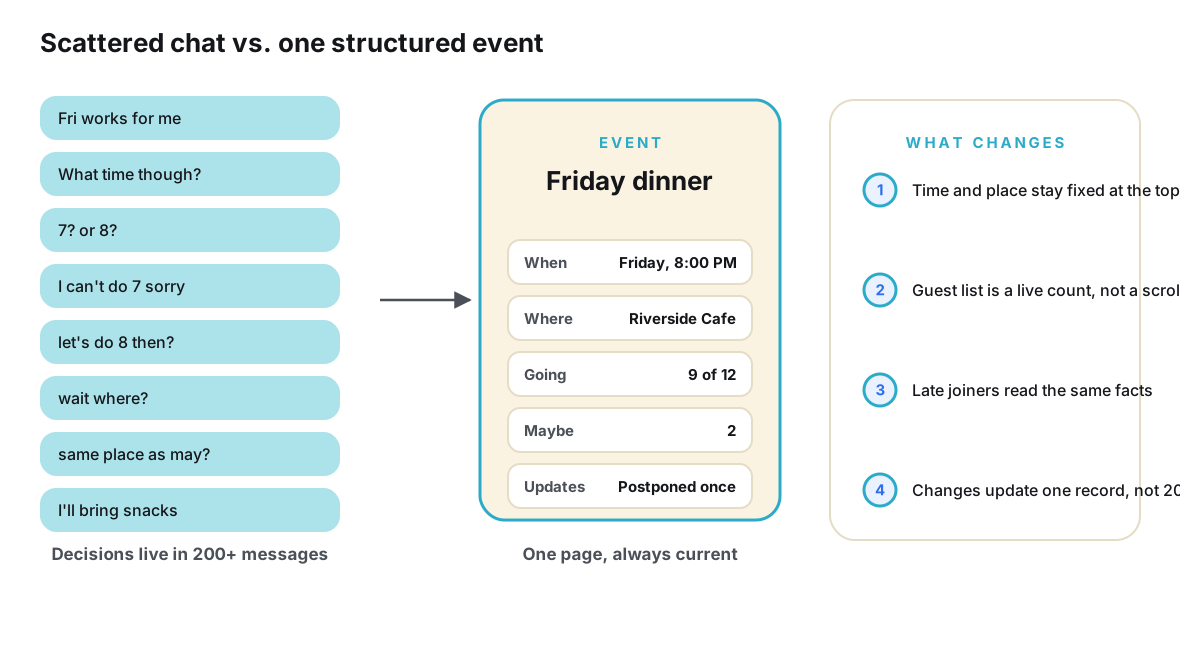
Notice what a member has to do to answer the simplest question — “when is the dinner?” They must reconstruct the answer by reading: find the most recent date-related message, check whether anyone objected after it, infer whether the venue booking applies to that date, and hope they did not miss a correction from the two hours they were offline. Different members performing this reconstruction on the same thread arrive at different answers with reasonable confidence. Nobody has misread anything; the medium simply never stated the answer once, in one place, as a value rather than as a moment.
Six pressures that compound with size
The general failure above has specific shapes. Six pressures account for most of the difficulty large groups meet when coordinating events, and they reinforce one another rather than merely adding.
| Pressure | What it looks like in the thread | Why the medium amplifies it |
|---|---|---|
| Message volume | Decisions scroll out of view within hours of being made | Every message is equal and chronological; importance is not a property the stream carries |
| Interleaved conversations | Logistics threads tangled with banter, side topics and cross-talk | A chat has one stream; it cannot separate parallel discussions the way channels can |
| Attendance ambiguity | “I’ll try”, emoji and silence where a headcount should be | Reactions signal mood on one message; they are not a per-person commitment that updates |
| Decision churn | Dates, venues and times revised as new constraints appear | A correction is a new message; the older fact remains in place, still asserting itself |
| Late joiners | New members inherit every superseded message with no markers | History is the only entry point; the current state is not separately addressable |
| Day-of volatility | Time-critical pins and arrival messages racing the scroll | The busiest hours of the event are the busiest hours of the chat |
The compounding matters more than any single row. Volume makes churn worse, because corrections struggle to outrun the stream. Churn makes late joiners worse, because the backlog now contains multiple versions of the plan. Ambiguous attendance makes churn worse again, because the organizer re-opens settled questions to chase a firmer number. Each pressure is survivable alone; together they convert the organizer into the group’s search engine.
The headcount that never resolves
Of all the fields an event needs, the guest list degrades fastest in chat, and it deserves its own examination because it is the field venues actually price. A restaurant wants a number. A badminton session needs eight to twelve players per court. A bus charter has seats. In the thread, that number is assembled from three materials of unequal reliability: explicit statements (“count me in”), emoji reactions on some earlier message, and silence.
Each material fails differently. Explicit statements age — the person who confirmed on Monday has a conflict by Friday, and in a large thread their quiet retraction may consist entirely of not mentioning it again. Reactions are pinned to the wrong object: a thumbs-up on “great, the 21st then!” is a vote for a date, not a promise to attend, but the organizer counts it anyway because it is the closest thing to an RSVP the medium offers. And silence is uninterpretable — among 300 members, the 280 who said nothing include both the people who never saw the message and the people who saw it and declined to reply, and no one can distinguish the two populations afterwards.
The organizational consequence is a familiar ritual: in the final days, the organizer switches from broadcasting to direct messages, chasing members one by one to convert vibes into numbers. It works, in the sense that the venue eventually gets told a number. But it is the organizer personally performing what a structured RSVP list does automatically — and it is invisible labor that scales linearly with guest count while the social reward stays flat.
Superseded messages and the silent fork
The second structural difficulty is subtler and more expensive: in a chat, an update never replaces what it updates. When the venue changes from the Sichuan place to the hotpot chain two streets over, the group receives a new message; the old message with the old address does not vanish. It stays, fully legible, one search away, asserting the Sichuan place with all the authority of the moment it was sent.
Most of the time, social gravity handles this — people read the newer message and adjust. The failure mode is timing. Anyone who read the thread during the window between the original plan and the correction, and has not read it since, holds the old plan in good faith. Anyone who searches the thread for the address later may surface the old one first. The result is a silent fork: two sub-populations of the same group, each correctly informed according to their slice of the history, converging on two different restaurants. The fork surfaces at 7 p.m. on the night, in the form of a confused voice message from a parking lot.
Large groups are structurally prone to forks for a blunt reason: the probability that at least one member missed any given message approaches certainty as membership grows. A correction read by 95 percent of a 40-person group leaves two people misinformed; read by 95 percent of a 400-person group, it leaves twenty. Pinning helps — but a pin requires a human to remember to update it, and a stale pin is worse than none, because it lends outdated facts a badge of authority.
The update fan-out tax
Because updates decay with the scroll, reaching everyone requires repetition. The organizer posts the change; by evening it is buried; a day later someone asks a question the change already answered; the organizer re-posts it; the re-post triggers new discussion, which buries both earlier versions further. Each round of repetition is individually rational and collectively noisy — and noise has a cost curve of its own, because members respond to a loud thread by muting it.
Muting is the quiet multiplier in this whole dynamic. A muted group is a group in which updates reach nobody without repetition, which pushes the organizer to repeat more, which pushes more members to mute. Eventually the chat splits into two communication regimes: the engaged minority who read everything, and everyone else, who are effectively reachable only by direct message. At that point the group chat has become a broadcast channel with an audience of ten and a roster of four hundred — and the event’s real coordination has moved into the organizer’s private one-to-one conversations, where it is invisible to everyone else who needs it.
The economics deserve emphasis because they explain organizer burnout better than any personality-based story. In a chat-mediated plan, the cost of every change, every reminder and every re-answer is paid by one person, in attention, forever. In a record-mediated plan, the same change is paid once — edit the page — and everyone who looks afterwards sees the new state. The difference is not diligence. It is architecture.
Groups within groups
Large communities rarely stay in one chat. A 400-member alumni association spawns a committee group, a volunteers group, a per-city group and a per-event group; a hiking club keeps a general chat plus smaller chats per difficulty level. Sub-grouping is a genuine and often effective response — it reduces volume per thread and gives each audience a room sized to its purpose. WeChat’s own 500-member ceiling sometimes forces the same move on communities that outgrow one chat, a dynamic covered in detail in what happens when a WeChat group becomes too large.
But sub-groups trade a volume problem for a boundary problem. Each new group is another place where a version of the plan can live, and another audience whose members must be told when something changes. The parent-group announcement, the committee decision and the sub-group chatter can drift apart silently, exactly the way individual readers drift apart inside one thread — except now the fork is institutional rather than personal. Communities that sub-group heavily tend to discover they need something the groups can point at: one address that every group agrees is the plan.
Why the super-app conveniences don’t close the gap
A fair question at this point: WeChat is a super app — payments, mini-programs, official accounts. Surely the ecosystem can absorb event coordination? The honest answer is that the ecosystem absorbs the adjacent jobs brilliantly, while the central job remains.
Payments close the money loop: fees collected, dinners split, deposits reimbursed, all without leaving the app. Mini-programs close the point-task loop: a vote on the date, a sign-up sheet, a booking flow — each arrives as a card in the conversation, does one job, and leaves. Official accounts close the broadcast loop, letting a club announce to followers who never joined the chat. What none of them provide is the persistent, current, single record of this specific event: the place where the final time is final, the headcount lives and updatable, and every member — including the lurkers, the late joiners and the muted — can look up the state without asking a human.
The distinction is worth naming precisely because the super-app structure makes it look solvable in place. A poll mini-program is not an RSVP list; it snapshots preferences at one moment and does not track commitment as it evolves. A sign-up card is not a living guest list; it is another message that scrolls. These tools are conveniences layered on the stream, and they behave like the stream: useful at the moment of use, gone afterwards. For a deeper examination of that pattern across platforms, see why messaging apps were never designed to be event databases.
| Coordination need | How a large chat behaves | Where the cost lands |
|---|---|---|
| A final time and place | Lives as the newest relevant messages, unmarked as final | Every reader reconstructs it; some reconstruct differently |
| A firm headcount | Assembled from replies, reactions and silence | Organizer chases individuals by direct message in the final days |
| Visible changes | Corrections arrive as new messages; old facts persist | Silent forks surface on the night, at the wrong venue |
| Late joiners getting current | Backlog reading with no supersession markers | Organizer writes private summaries, per person, repeatedly |
| Reaching the disengaged | Repetition against scroll and muting | Organizer pays an attention tax on every update, forever |
| A record for next time | History exists but state does not | The next organizer re-plans from archaeology |
How other platforms meet the same pressures
It is instructive — and only fair — to note that every platform facing these pressures has grown structures in response, and that all of them stop short of the same place. Telegram formally separates channels, a one-to-many broadcast surface, from groups, a many-to-many conversation, which is precisely a response to the interleaving pressure; its polls can be anonymous or public-vote, and quiz-styled, per the Telegram FAQ. Discord builds communities as servers with channels, roles, threads and scheduled server events — a heavy structural answer to volume and interleaving, described on discord.com.
Yet in each case the event’s state still lives inside a platform-scoped structure, and the boundary problems persist in new clothing: the Telegram channel reaches Telegram users; the Discord event reaches server members, and an “interested” marker is an expression of interest rather than a commitment. The lesson is not that other apps solved what WeChat failed to solve. It is that the industry converges on the same insight from different directions — conversation and event state want to be separate objects — and that no amount of in-chat structure fully substitutes for the event having its own address.
The organizer becomes the infrastructure
Step back and the pattern is recognizable as one person absorbing every structural gap described above. They re-answer the same question because the thread cannot answer it. They chase headcounts because reactions cannot hold them. They repeat updates because the scroll buries them. They summarize for late joiners because history cannot. The community experiences a smoothly run event; the organizer experiences a second job with good food.
This has a social consequence worth naming in a coordination analysis: the role deters its own volunteers. Groups that run every gathering this way concentrate the organizing knowledge in whoever last survived it, and the obvious successors — the members who would happily host if hosting meant two hours of venue logistics rather than two weeks of human API duty — decline the honor. The medium’s gaps, unpaid and invisible, quietly centralize a community’s event life on its most patient member.
What changes when the plan gets an address
The workable pattern rarely involves leaving WeChat, and that is the point: the chat keeps every job it is genuinely excellent at. What changes is that the event acquires a record with a stable address — a page that always shows the current state: final time, final place, the living guest list, the sequence of changes. Conversation continues in the group; decisions land on the page; every “what’s the plan?” is answered with the same link. The conceptual foundation for this split is examined in the difference between a conversation and an event object, and the platform-specific trade-offs of adopting it are laid out in WeChat groups vs dedicated event pages.
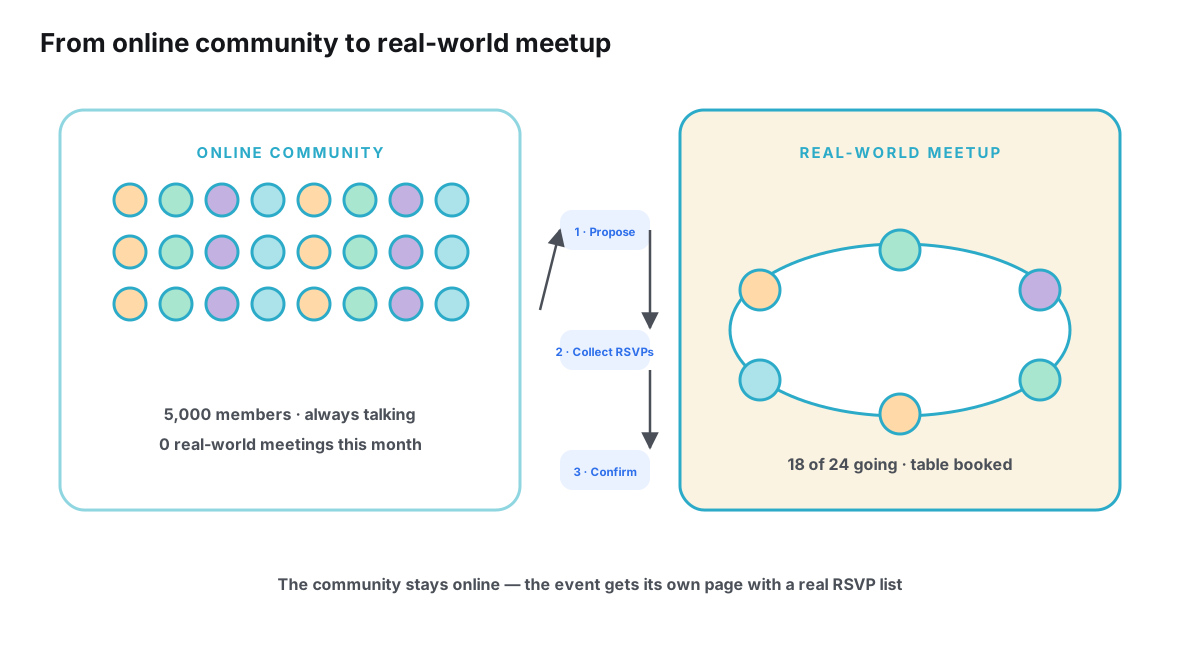
Under that pattern, every pressure in the table above changes shape. Volume stops mattering, because the plan is not stored in the messages. Churn becomes an edit rather than a race. Late joiners become trivial — they receive the link and are current in seconds. The headcount becomes a list with named statuses instead of an atmosphere. The organizer’s private labor becomes a public object. Tools exist for exactly this pattern — Ontaym, for one, builds event pages with RSVP statuses, option voting and updates — but the pattern matters more than any particular tool, and it works with any system that gives an event a current-state address.
Signs a group has crossed the threshold
Because the drift into difficulty is gradual, most communities do not decide to change their workflow — they suffer it one small repetition at a time. The warning signs below tend to appear roughly in order as an event or a group grows. None is damning alone; together they are a system announcing that it has no system.
- The re-ask rate climbs. “What time?” “Where again?” “Is it definitely the 21st?” — asked by different people in the same week, each an independent rediscovery that the thread has no readable current state.
- Screenshots start circulating. Members answer each other by screenshotting older messages, which is history being copied and re-injected into the stream because the stream cannot surface it.
- The pin goes stale between events. The pinned details belong to the last gathering, and updating them is a chore everyone postpones.
- The organizer’s direct messages double as the plan. Real coordination has migrated to one-to-one conversations; the group is theater.
- Forks surface on the night. People arrive at the wrong venue, or the right venue on the wrong day, holding screenshots that were correct when taken.
- Nobody wants to organize next time. The strongest sign: the community has learned that hosting means becoming the infrastructure.
Frequently asked questions
Is this an argument against using WeChat groups for events?
No — it is an argument about roles. The WeChat group remains the best place for the conversation around an event: proposals, debate, banter, day-of chatter and settlement afterwards. The difficulty is confined to the record-keeping functions — final details, headcounts, changes — which the group can only approximate through organizer labor. Splitting those functions out is an upgrade to the group’s workflow, not a departure from it.
At what group size does coordination in chat break down?
There is no magic number, because the drivers are message volume, churn and how many people need firm answers — not membership alone. A quiet 300-member announcement group coordinates more easily than a chaotic 30-member friend group. As a rule of thumb: when a plan has a venue capacity, a fee or a deadline, and the guest list extends beyond the people who reliably read every message, the structural problems arrive regardless of headcount.
Don’t pinned messages solve the buried-details problem?
They mitigate it. A pin holds one message at the top of the thread, which works while the plan is static and someone remembers to refresh it. It fails when details change faster than the pin is updated — a stale pin is actively harmful, because members treat it as authoritative — and it cannot hold a live headcount or a change history. It is a snapshot of one message, not a current state.
Why can’t mini-programs handle RSVPs inside WeChat?
They handle point tasks well: a one-time vote, a sign-up form, a booking. What they do not provide is the persistent event record — the place where the final details are final, statuses update over time, and anyone can check the current state without asking. A sign-up card behaves like the stream it lives in: useful at the moment of use, scrolled away afterwards.
What about splitting the community into sub-groups?
Sub-grouping genuinely reduces volume per thread and is often the right move for a 400-member community with distinct audiences. The trade is a boundary problem: each group becomes another place a version of the plan can live, and announcements must be synchronized across them. Sub-groups plus one shared event address work well; sub-groups alone tend to relocate the fork rather than remove it.
How do we move an event that’s already buried in the chat?
Extract the current facts — final time, place, likely attendees, open questions — onto a fresh event page, then post the link once with one sentence: from here on, the plan lives here. Keep the thread for conversation. Communities moving from ad-hoc chat events to a full program can take the fuller route described in how to organize offline activities from a WeChat community.
Conclusion
Large WeChat group chats struggle with event coordination for reasons that are architectural, not social: a conversation is an append-only, chronological, equal-weight stream, and an event is a small set of current values that must stay authoritative while the stream keeps flowing. Volume buries decisions, reactions never resolve into headcounts, corrections never replace what they correct, and repetition — the only outreach the medium offers — teaches members to mute. Every workaround groups invent is real organizer labor standing in for missing structure, and the bill for that labor arrives as burnout and as events nobody wants to host next season.
The fix preserves everything worth preserving. Keep the group chat as the community’s living room: the debate, the warmth, the payments, the day-of chatter. Give each event that needs one a stable address where its state lives — final details, a named guest list, a visible history of changes — and make the link the answer to every question about the plan. Communities that adopt this split do not talk less; they simply stop paying one person to be the database.
Let the chat be the conversation — not the database.
Give your event one link with Ontaym