
How to Separate Conversation From Event Information in WeChat
Your WeChat group is excellent at talking and hopeless at standing still. This is a concrete workflow for letting it do the first job while your event details live somewhere that doesn’t scroll.
Quick answer
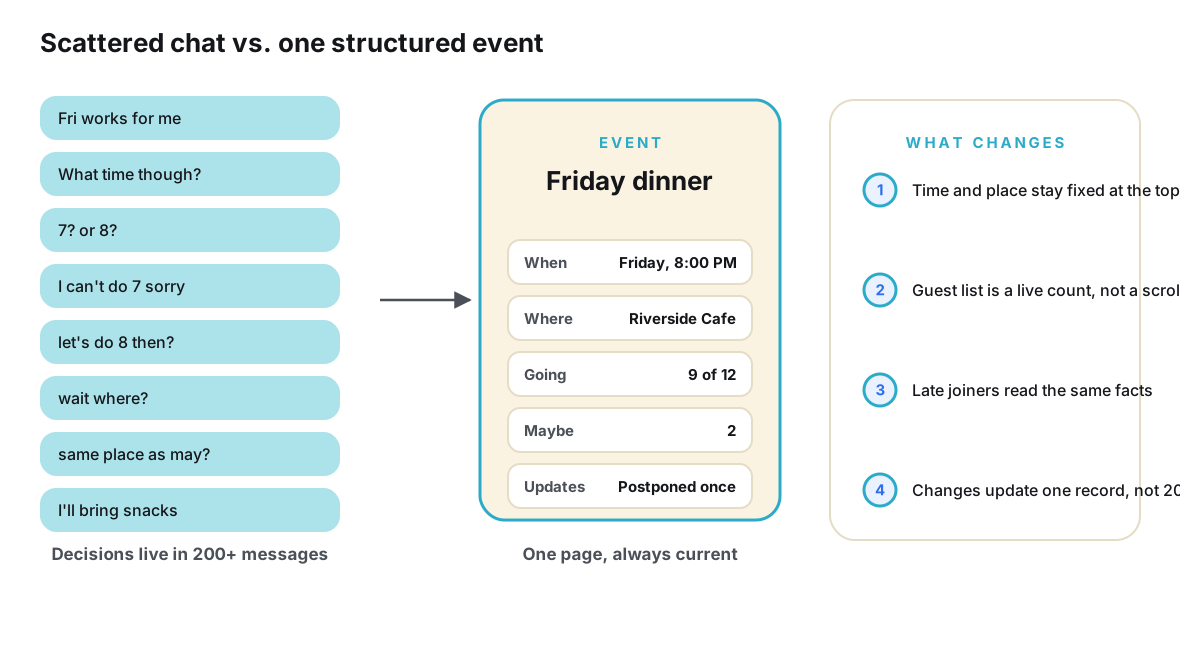
Separate the two by giving each a different home. The group chat keeps everything social: ideas, jokes, negotiation, day-of chatter, photographs afterward. Every event gets its own page — one address holding the current facts: time, place, cost, what to bring, and a real RSVP list. Post that link into the group once and make it the standing answer to every detail question. When facts change, edit the page and announce only the change, never a restatement of the whole plan. Take attendance on the page — going, maybe, not going — not from reactions or “+1” messages. Late joiners receive the link and are instantly current, with no backlog to read. The group stays warm; the event stays true. The whole method is six steps, and the first two do most of the work.
What mixing costs you before you notice
Start with the failure pattern this workflow exists to end, because it usually doesn’t look like failure while it’s happening. A plan is proposed in the group — dinner, the twelfth, somewhere new. The thread does what threads do: enthusiasm, options, a menu debate, a time change, a correction to the time change. Every fact the event needs gets stated, correctly, at least once. The problem is not missing information; it is that the information has been dissolved into a medium that keeps moving. By the eve of the dinner, the final time exists as the third-most-recent related message, the address is a reply to a question nobody remembers asking, and the headcount is a feeling.
The costs arrive on schedule. The organizer re-answers the same questions privately because the thread cannot answer them. Two subgroups arrive at the restaurant with different bookings. The friend added late is told to “scroll up” through an ocean of banter and recovers only a rough idea of what she is walking into. And the day-of logistics — the gate number, the table under the name — compete for attention with forty concurrent conversations. These are the standard mechanics of WeChat group chats becoming difficult for event coordination, and no amount of group discipline fixes them, because the medium is not malfunctioning. It is being a conversation.
That last point is the article’s foundation, so it deserves to be said plainly. Nothing here asks your group to be less chatty, less spontaneous or less fun — those are its best qualities. The workflow only moves one category of content, the event’s current facts, to a container that holds still. Chat stays for everything else, which turns out to be almost everything.
The principle: conversation flows, information stands still
Think of the two media as having opposite physical properties. A conversation is a river: it is alive precisely because it moves, and anything dropped into it drifts out of reach. Event information is a signpost: valuable precisely because it stays where it was put, so that anyone, at any time, from any direction, gets the same answer. Planning breaks when a group tries to use a river as a signpost — and every folk remedy groups invent, from pinned messages to all-caps “FINAL PLAN” posts, is an attempt to nail something to the water.
It is reassuring that the open web reached the same conclusion. When engineers needed to describe events in a way machines could read, they defined them as structured records — schema.org’s Event type, with labeled fields for the start time and the location — rather than as transcripts. The page your workflow gives each event is the same idea at human scale: a small set of labeled, current facts at a stable address, standing next to a conversation that never has to stop.
The separation principle follows directly: whatever the group would want a newcomer to know in ten seconds belongs on the signpost; everything else belongs in the river. Time and place, obviously. But also cost, what to bring, the RSVP roster, the cancellation status, and the answer to “has anything changed?” What stays in the river is equally clear: the debate about which restaurant, the jokes about last time, the friend asking whether the blue trail is muddy, the photographs after, the warmth that makes a group worth belonging to at all.
Notice that this division is not a compromise between structure and social life. It gives each its best case. The conversation becomes more relaxed, not less, once it is no longer responsible for remembering anything; the plan becomes more reliable, not more bureaucratic, once it has somewhere to stand. Groups that adopt the split usually report that the chat got better — lighter, funnier, freer — because the weight came off.
The workflow, step by step
Here is the whole method. Steps one and two do most of the work; the rest is how the habit holds up under pressure.
- Create the event’s home before the discussion starts. As soon as an idea has a date attached to it, give it a page — before the thread heats up, not after it becomes unmanageable. Record what is known, even if half the fields read “to be decided”: the date, the rough plan, the organizer. The page can start nearly empty; what matters is that it exists and has an address before anyone starts repeating themselves in chat.
- Post the address, not the details. Drop the link into the group with one line — “dinner on the twelfth, details live here.” Do not also paste the details into the message; a copy in the thread is a second version that will go stale. The link is the plan; the message is just the invitation to it.
- Answer detail questions with the link. When someone asks what time, where, or who’s coming — and at first, people always do — reply with the address, warmly and briefly. Every link-answer trains the group a little; every full re-answer trains it the other way. Within two or three events, most members check the page first and ask the thread only for things that are genuinely conversational.
- Update the record, announce only the change. When a fact moves — new time, new venue, weather call — edit the page first, then post one line in the group: “venue changed, link updated.” The announcement carries the news; the page carries the state. Never restate the whole plan in the announcement, because restatements become the stale copies you are trying to eliminate.
- Move attendance out of the thread. Ask for RSVPs on the page — going, maybe, not going — rather than collecting “+1”s and reactions. Reactions are moods attached to messages; an RSVP list is a named, current roster attached to the event. The restaurant, the carpool and the organizer all need the second kind of thing.
- Onboard late joiners in one step. Anyone added to the group mid-plan, or invited directly, receives the link and nothing else. They are instantly as current as the founding member — no scrolling, no archaeology, no private retelling of the saga. This step is where the workflow pays its biggest dividends, because late joiners are otherwise the most expensive people in any plan.
Run honestly, the six steps converge on a single rule of thumb that fits in a sentence: the chat is where the event is discussed, and the page is where the event is. Every judgment call the workflow ever asks you to make resolves against that sentence.
The first event, run end to end
A concrete pass makes the rhythm visible. On Monday, Priya floats the idea in the group — hotpot, sometime next month — and a dozen reactions say yes before lunch. That evening, once a date has roughly settled, she creates the event page with what little is known: the date, “hotpot, venue TBD,” her name as organizer. She posts one line with the link. The thread keeps flowing around it — restaurant suggestions, spice-level diplomacy, a fond memory of the last dinner — and none of that needs capturing, because it is conversation doing its job.
On Wednesday the group argues cheerfully between two restaurants. Priya puts both on the event as a poll; by Thursday the votes settle it, and she records the venue on the page. On Friday the restaurant asks for a headcount by the following week; she posts one line — “please RSVP on the page by Thursday” — and watches the going and maybe list fill at its own pace, generating no messages for the sixty people who are not coming. The following Tuesday, a work conflict moves the time by an hour: she edits the page, posts “time shifted, link updated,” and that is the entire cost of the change. On the day, Tom — added to the group only that morning — gets the link and arrives knowing precisely where the table is. Afterward, the photographs go where photographs belong: the group chat, warmer than ever, and mercifully free of logistics.
Count what the organizer actually did: created one page, posted three one-line messages, made two edits. Count what she did not do: re-answer the time twelve times, maintain a private headcount, mediate between members holding different venues, or brief a late joiner. That asymmetry — a handful of small actions replacing an unbounded number of large ones — is the entire business case for the split.
What belongs where
The fastest way to internalize the split is a sorting exercise. Nearly everything a planning group produces falls cleanly on one side or the other, and the borderline cases are fewer than people fear:
| Content | WeChat group | Event page |
|---|---|---|
| Ideas, options, “shall we?” | Yes — this is the negotiation’s natural home | Open options can appear as a poll; decisions get recorded as they settle |
| Final time and place | No — it will scroll and fork | Yes — labeled fields with one current value |
| Who is coming | Reactions and “+1”s only as social energy | The RSVP roster, per person, updatable |
| Changes and cancellations | One-line announcements of the change | The edit itself; the page is always current |
| Costs, what to bring, logistics | Discussion of preferences | The settled facts, stated once |
| Day-of chatter and running updates | Yes — live color belongs in the river | Only the durable anchors: gate number, table name, final meeting point |
| Photographs and aftermath | Yes — this is the community’s life | Optionally a short note of what actually happened |
Two rows deserve comment because they are where groups hesitate. The options row: gathering opinions in chat is fine — chat is superb at it — but the settling should be recorded on the page the moment it happens, which is why pairing the negotiation with a poll on the event keeps opinion and outcome from blurring. And the day-of row: live color (“we found parking!”, “the queue is huge”) belongs in the group; the page carries only the facts someone might need at any moment — where the gate is, under what name the table stands. If a fact would still be correct tomorrow morning, it belongs on the page. If it will be irrelevant in an hour, it belongs in the river.
Situations, and the right move for each
The workflow meets reality in specific moments. These are the common ones, with the move that keeps the split intact:
| Situation | The move | Why it works |
|---|---|---|
| Someone asks “what time?” | Send the link, warmly | Answers the question and every future one at once |
| The venue changes on short notice | Edit the page, then one line in the group | News travels by message; state lives on the page |
| A new member is added the day before | Send them the link and nothing else | Onboarding becomes one step instead of archaeology |
| Someone replies “+1” in the thread | Thank them, point to the RSVP on the page | Converts a mood into a countable commitment |
| The restaurant needs a final headcount | Read the RSVP list, not the thread | A number instead of a feeling; maybes handled by cutoff |
| The event cancels entirely | Change the page’s status first, announce once | One authoritative place says cancelled; the thread cannot argue |
| Someone forwards the plan to a friend | Encourage forwarding the link itself | The link updates; a forwarded copy never will |
Notice the last row, because forwarding is the workflow’s hidden adversary inside WeChat specifically. The app’s sharing culture is one of its strengths — plans travel person to person, group to group. But a forwarded plan is a snapshot: whatever was true at forwarding time is frozen in the copy, and when the venue changes, the copy lies quietly forever. The link is the anti-forward. It can be forwarded everywhere a plan would be, and it never stops updating — which makes “send the link” not a rule to impose on the group but a favor to everyone who would otherwise hold stale facts in good faith.
WeChat-specific notes
A few features and habits of the platform deserve honest placement in this workflow. Group announcements and pinned content, where a group uses them, are best employed as pointers — a durable note whose entire content is “the plan lives at this address” — rather than as containers for the plan itself, for the usual reason: an announcement holding details is a snapshot that someone must remember to refresh. The group description plays the same role nicely for a standing community: it is a fine home for the sentence “our events always live at…” and nothing longer.
Mini-programs — the embeddable services that live inside WeChat, per the platform’s description of itself — can cover particular slices of an event, such as bookings or payments, and for those slices they work well inside a super app where messaging and payments already sit together. The question to ask of any in-app tool is the same one this article keeps asking: does it give the event a durable, shareable current state, or does it add another container of snapshots? That question, and where the whole super-app model is heading for event organizers, is taken up at length in the future of offline event coordination inside super apps.
Screenshot culture deserves its own word, because it is the folk remedy most likely to feel like a solution. A screenshot of the settled plan, posted back into the thread, solves exactly one person’s problem for exactly one afternoon. It is a copy of history reinserted into the stream — a photograph of a signpost nailed to the river. Every subsequent change makes it not merely stale but actively misleading, and unlike the thread it came from, it carries no timestamps, no context and no way to be corrected where people saw it. When you feel the urge to screenshot, that is the workflow telling you the fact wanted a page. The one legitimate use is nostalgia: screenshot the final plan after the event, frame it, and let it say what it is — a memory, not a source.
It is also worth saying what this workflow does not require: it does not require anyone to leave WeChat, to install anything as a condition of friendship, or to abandon the group where the community actually lives. The event page is reached by a link; it is open to the muted, the late, the quiet and the brand-new on equal terms. That openness is the technical side of a social fact — the way WeChat groups are used for real-world gatherings always runs on goodwill, and goodwill is best spent on warmth, not on re-answering the time. Building one source of truth for a group event is, in the end, a courtesy the organizer pays to the whole group, including themselves.
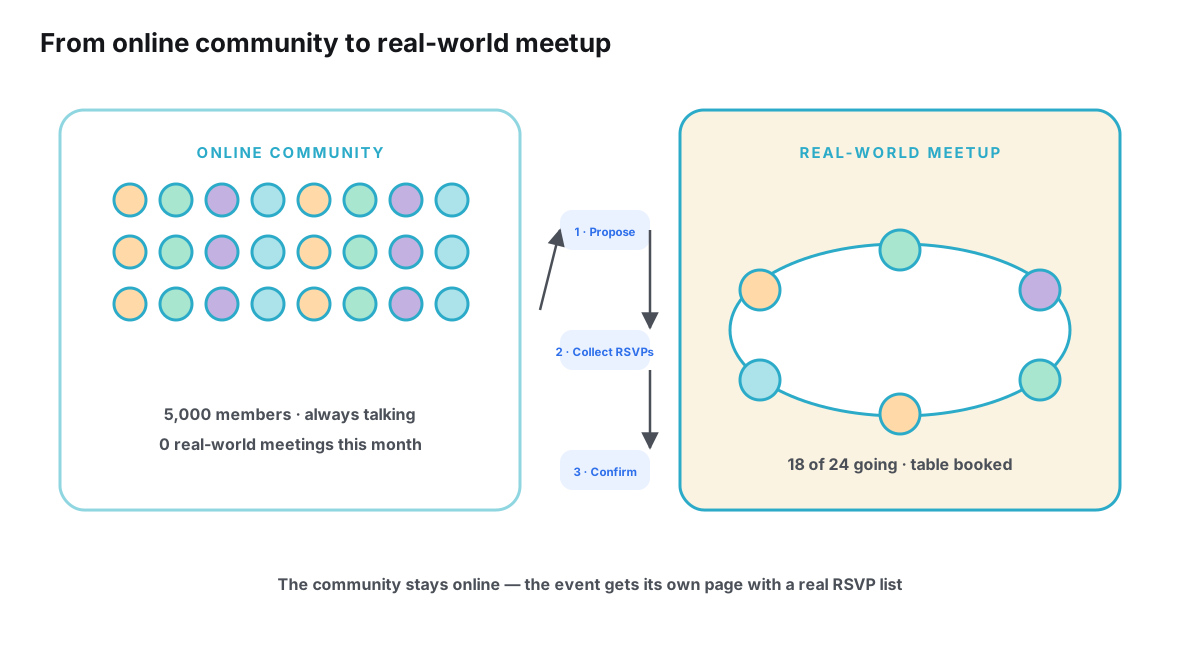
On the day itself, the split proves its worth one final time. The morning of, the group chat does what it wants to do: chatter, anticipation, photographs from the road. Meanwhile the page quietly holds the two or three facts that matter at the last moment — the final meeting point, the table’s name, the note that the start slipped fifteen minutes — edited in place, visible to everyone including the person who joined at noon and the one who never unmutes. Nobody scrolls; nobody screenshots; nobody relays. The river does what rivers do, and the signpost stands still.
Making the habit stick
Every workflow survives on consistency, and this one has exactly one pressure point: the first two events. Those are when the group’s habits are forming — when each re-answer in the thread re-teaches the old behavior and each link-answer teaches the new one. The organizer who holds the line gently through two plans will find the third largely runs itself, because the members have learned where the plan lives and, more importantly, have learned that it is less effort to check a page than to ask a person.
Expect relapses and treat them casually. Someone will post “so it’s 7, right?” in the thread the night before; answer with the link and no lecture, because the lecture costs more goodwill than the question did. Someone will forward a screenshot of last week’s details into a new side group; send them the link and thank them for spreading the word. The workflow is not a rule the organizer enforces — it is a convenience the group adopts, and conveniences win by being easier, which this one is.
For events that repeat — the weekly hike, the monthly dinner — the same six steps apply with one addition: give every occurrence its own page and keep the rhythm fixed, so each cycle is one link and one line rather than a fresh negotiation. That recurring version of this workflow, with its cadence and its rules, is laid out in companion pieces across this cluster.
Frequently asked questions
Where should the final time and place live in a WeChat workflow?
On the event’s page, as labeled fields with one current value — never in the thread. The chat can discuss and even announce changes, but the moment a time or place is settled, it is recorded on the page, and every later question is answered with the link. The test: anyone should get the same answer in two taps, whether they ask today or the morning of.
What about the group announcement feature — isn’t that the right home for the plan?
It is the right home for a pointer, not for the plan. An announcement holding details is a snapshot: correct when posted, quietly wrong after the first change, and refreshed only if someone remembers. Use announcements for the durable sentence “our events live at this address,” and let the page carry everything that changes.
How do I stop people from replying “+1” in the thread?
You don’t stop them — you redirect them, warmly and repeatedly. Thank the “+1” and point at the RSVP on the page. Over two or three events the group learns the pattern, because it is genuinely less effort for them too. The goal is not silence in the thread; it is that the countable commitment lives where it can be counted.
My event is already buried in the chat. How do I migrate?
Excavate once: read back through the thread, extract the current facts — final time, place, likely attendees, open questions — and put them on a fresh page. Then post one message: “From here on, the plan lives here,” with the link. The thread remains as history. Expect one or two stragglers still reading the old facts; the link answers them too.
Does this require my friends to leave WeChat or install something?
No. The group chat stays exactly where it is, and nobody changes apps to keep talking. The event page is reached through a link — openable by the muted, the late joiners and the merely curious alike. The only behavior that changes is that material questions get answered with a link instead of a re-telling.
Conclusion
The workflow compresses to a picture you can hold in your head: a river and a signpost, side by side, each doing what it is shaped for. The WeChat group flows — proposals, jokes, negotiation, live color, the whole social life of a plan. The event page stands still — the current time, the current place, the named roster, the change history, one address that means the same thing to everyone who opens it. Between them travels a single link, posted once per event and reused for every question thereafter.
The six steps are deliberately small: create the home early, post the address, answer with the link, edit rather than restate, count RSVPs on the page, onboard with one tap. None of them asks the group to be more disciplined — they ask the organizer to stop paying the costs of mixed media: the re-answers, the stale copies, the headcount assembled from mood. Groups that make the split keep everything they liked about planning in chat and lose the parts nobody liked. The conversation gets warmer, the plan gets truer, and the evening arrives with the right number of people knowing exactly where to go.
Keep the chat for chatting — give the plan an address of its own.
Plan it with Ontaym