
How WeChat Groups Are Used for Real-World Gatherings
From weekly dinners to alumni reunions, an enormous share of the world’s real-world gatherings starts life inside a WeChat group. This is a field guide to how that actually works — the lifecycle of a plan, the advantages of a super app, and the seams that show once the plan grows teeth.
Quick answer
WeChat groups are the default venue for real-world gatherings because the app combines what a gathering needs in one place: messaging everyone already uses, built-in payments for splitting costs, mini-programs for tasks like voting or booking, and official accounts for clubs that publicize activities. Group chats hold up to 500 members, so one group can serve a class, a club or an extended family. In practice a gathering moves through a recognizable arc — the group forms, a plan is debated, details firm up, the chat becomes a live channel on the day itself, and photos and payments settle everything afterwards. The friction appears on the informational side: final details live inside a scrolling conversation, so organizers lean on pinning, re-posting and, increasingly, a linkable page for the event itself.
The place where plans already live
For hundreds of millions of people, WeChat is not one app among several — it is the connective tissue of their social lives. Conversations with family, payments to the noodle shop downstairs, mini-programs for booking badminton courts, official accounts followed for news and club announcements: all of it happens behind the same green icon, as described on WeChat’s own product site. That completeness matters for gatherings, because the hardest step in organizing anything is usually getting everyone into the same room, digital or otherwise. With WeChat, that step is already done. The room exists, everyone is in it, and nobody has to install anything.
The group chat itself is sized for communities rather than small friend circles. A WeChat group can hold up to 500 members, which comfortably covers a graduating class, a residential compound’s hobby club, a department at work or an extended family across three cities. Different platforms draw this line in different places — WhatsApp, for instance, supports just over a thousand participants per group, per the WhatsApp Help Center — but the shared insight is the same: a group chat is designed to hold a whole community, not just the handful of people who happened to be free on Friday.
Joining is frictionless in a way that shapes everything downstream. A new member scans a QR code passed across a dinner table, or is added by someone already inside, and instantly inherits the full history of the conversation. Between gatherings the group persists as an ambient room: the reunion committee from two years ago is still there, photos and all, waiting to be reactivated. This persistence is quietly powerful. It means a community’s memory lives where its conversation lives, and the next event begins not from a blank page but from a room that already knows everyone’s name.
A gallery of gatherings
The pattern is easiest to see in the wild. A graduating class keeps one group that idles between reunions and comes alive every few years: a committee forms inside it, a banquet venue gets debated, deposits are collected through the app, and city-based sub-chapters organize their own dinners in parallel. The parent group’s pinned notice points the way, and after the banquet the group returns to photographs and nostalgia until the next anniversary stirs it.
A hobby club — hikers, badminton players, photographers — runs a tighter loop on a weekly or monthly rhythm. The recurring question is not “shall we gather?” but “this Saturday’s route and headcount,” which makes the group a standing operations room: a trail proposal, a headcount for the bus, a rendezvous pin on the morning, and a shared album by evening. Between sessions the same room trades gear advice and photos, which keeps the community warm enough to survive a rained-out month.
A residential compound’s neighbor group coordinates everything from block parties to shared bulk orders of fruit from a nearby farm — one neighbor announces, neighbors reply with quantities, payment lands in the app, and distribution happens at the compound gate on an agreed evening. And a family group, often spanning three generations and several cities, arranges holiday trips with a patience all its own: the itinerary is negotiated for weeks, the elders’ preferences are weighed by the middle generation, and the younger members are drafted into booking duties. The workplace team, the church or temple fellowship, the new-mothers’ circle — the specifics vary, but the shape holds: a persistent room, a recurring plan, money that moves inside the app, and a scroll that remembers everything.
The life cycle of a typical gathering
Watch enough WeChat groups organize real-world meetings and a pattern emerges. Nearly every gathering, from a hotpot dinner to a 200-person alumni reunion, passes through the same five stages — and each stage asks something different of the group.
- Formation. A group is created for the occasion, or an existing group is repurposed for it. Someone passes around a QR code; membership grows by word of mouth within the community. The group’s name and notice board get set to state its purpose.
- Proposal. Someone floats an idea — a date range, a restaurant, a hike — and the room reacts. Options surface, allies emerge, and the plan acquires a rough shape through conversation rather than through any formal proposal.
- Refinement. The open questions get settled one by one: which Saturday, which venue, what budget, who is responsible for the booking. Discussion does most of the work, sometimes assisted by a vote or a shared sign-up card from a mini-program.
- The day itself. The group turns into a live operations channel. Location pins get dropped, people announce that they’ve arrived or are parking, stragglers ask which exit of the station to use, and the organizer fields a steady stream of small questions.
- Afterwards. Photos land in the group, thanks are exchanged, costs are settled through the app’s payment features, and the group either goes quiet until next time or dissolves having served its purpose.
The interesting part is how differently the group behaves at each stage. Formation and the day itself play to a chat’s strengths — presence, immediacy, everyone reachable at once. Refinement is where the medium starts to work harder than it was designed to: it is the stage that produces final answers, and final answers are an awkward thing to store in a flowing conversation. The afterwards stage is, in many ways, where WeChat groups outshine every alternative, because settlement and memory are built into the same place the conversation happened.
What the super-app layer adds to a meetup
The single biggest structural advantage is that money is inside the app. Splitting a dinner, collecting activity fees from forty hikers, reimbursing the friend who put the venue deposit on their card — these are native actions, not an export to a separate payment service. Red packets add a social register to the same rails: money that arrives wrapped in ceremony, used for everything from settling a small debt to seeding a prize for the evening’s game. The treasurer problem that haunts groups coordinating on other platforms is, for WeChat groups, largely solved by design.
Mini-programs supply the rest. These lightweight apps run inside WeChat itself, which means a group’s tooling can arrive as cards in the conversation: a voting mini-program for choosing a date, a sign-up sheet for a trip, a booking flow for the venue, a shared album for the photos afterwards. Nobody leaves the app to use them, and nobody creates an account — the group’s shared context is the login. For a club that runs on official accounts, announcements can reach followers who have never joined the chat at all, pulling new faces into the community’s orbit.
Location sharing deserves its own mention because of when it matters. On the day of a gathering, the group’s most valuable message is often not words at all: it is a live location, a dropped pin on a map, a photo of the restaurant entrance taken from across the street. The chat absorbs all of these natively, and the group becomes a genuine operations channel for the two hours when the event is actually happening — a role it plays remarkably well.
| Stage | What the group does well | Where it starts to strain |
|---|---|---|
| Formation | QR-code joining, instant reach of the whole community, persistent room between events | Membership and attendance get conflated — being in the group says nothing about coming |
| Proposal | Ideas surface naturally in conversation; enthusiasm is visible and contagious | Enthusiasm is not commitment; loud early interest can outweigh quieter certainty |
| Refinement | Everyone hears the debate; decisions feel shared rather than imposed | Final answers live as messages among messages; later readers must reconstruct them |
| The day itself | Live location pins, arrival updates, instant answers to small questions | Time-critical messages compete with a busy thread and can scroll out of view |
| Afterwards | Photo sharing, thanks, and in-app settlement of costs in the same room | Nothing rolls up into a record the next organizer of the next event can read |
Why the social side works so well
It is worth being explicit about the strengths, because they explain why the pattern is so durable. The first is simple reach: the person you want at the dinner is already reachable, with no question of which app they prefer. Cross-platform friction — the quiet tax that afflicts friend groups split between two or three messengers — mostly does not exist inside a WeChat-centric social circle. The gathering inherits the network instead of rebuilding it every time.
The second strength is continuity of identity. Group members are people from your actual friend graph, with real names and history attached, not usernames created last week. That continuity changes the texture of coordination: commitments carry social weight, no-shows are visible to peers, and the organizer is often organizing friends-of-friends rather than strangers. Trust, which is the real currency of any shared plan, comes bundled with the membership.
The third is ambience. Between events, the group keeps breathing — jokes, articles, someone’s photo of the sunset from last week’s hike. By the time the next gathering is proposed, the community is already warm. This is something an event-specific tool cannot easily replicate: the chat is not merely the logistics layer for the gathering, it is the gathering’s off-season home.
A fourth strength is subtler: the group makes hosting feel like a shared activity rather than a service being rendered. In a thread, the person who researches venues gets immediate feedback, the person who knows a good restaurant contributes it, and someone else volunteers to arrive early — the plan is genuinely crowd-made even when one person holds the pen. Gatherings organized this way arrive with their social work already done, which is one reason groups that plan together tend to show up together.
The informational seams
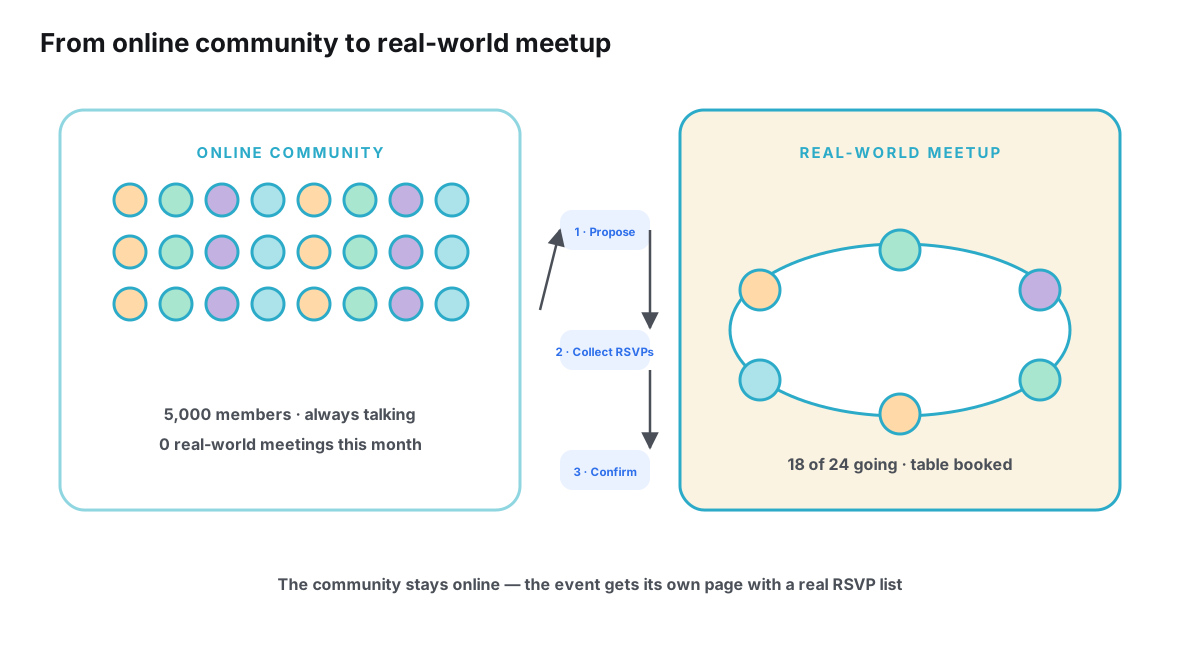
None of the above is contradicted by the difficulties — they coexist, and honest organizing practice holds both in view. The seams appear when the gathering needs answers rather than conversation: one final time, one final place, one reliable headcount. A chat thread holds all of those things as words inside messages, distributed across the scroll, and every reader assembles them by reading. People assemble them slightly differently, which is how a group can contain two contradictory beliefs about Saturday without anyone misreading anything.
The headcount is the classic pressure point. “I’ll try to make it,” a thumbs-up on someone else’s message, and plain silence are all the thread has to offer — and each is ambiguous in a different way. The organizer who needs to tell the restaurant twelve versus twenty is left counting signals of wildly different reliability. This is not a flaw in the app so much as a property of the medium: a conversation records what people said, not what the event’s state is. For a much deeper treatment of these mechanics, read why WeChat group chats become difficult for event coordination — it dissects the structural reasons large chats strain under planning work.
Changes and late arrivals press on the same seam. When the venue moves, the correction is a new message that supersedes older ones only for whoever reads it; the person who joins the group three days in inherits every outdated message alongside the current ones, with no marker distinguishing the two. Groups develop a whole workaround culture in response — pinning the final details, re-posting the plan the morning of, answering “check the pinned message” — and it says something kind about the medium that these workarounds usually succeed. But they are labor standing in for structure. If you are weighing whether your gathering needs that structure at all, our comparison of WeChat groups and dedicated event pages walks through the trade-offs without assuming one size fits all.
| Task | How the group typically handles it | Common workaround |
|---|---|---|
| Final time and place | Discussed until consensus; the last relevant message is implicitly current | Pinning the settled details; re-posting them on the morning of the event |
| Headcount for the venue | Replies, emoji reactions and silence, counted by the organizer by hand | A sign-up mini-program, or direct messages to the noncommittal |
| Changes to the plan | A new message announcing the change | Repeating the announcement for those who missed it; updating the pin |
| Bringing someone in late | They join the group and read backwards | A private summary message from the organizer |
| Collecting and splitting money | In-app payments and red packets, often on the spot | Rarely needed — this is the group’s strongest suit |
| Day-of coordination | Location pins, arrival messages, live questions | A short re-post of the address for people arriving in waves |
After the plates are cleared
The aftermath of a gathering is where WeChat groups are at their most distinctive, because three separate jobs — settlement, memory and momentum — all land back in the same room. Settlement comes first: within a day or two, shared costs are evened up through transfers, the member who fronted the deposit is made whole, and small debts dissolve into red packets that feel more like gifts than invoices. Money handled this promptly rarely becomes the quiet resentment that lingers after otherwise successful events elsewhere.
Memory arrives next, as a flood. Photos taken by a dozen phones trickle into the group over the following week, alongside jokes about the evening, compliments to whoever chose the venue and follow-ups on conversations started at the table. The group becomes a shared album that everyone already knows how to browse. Months later, a member scrolling upward through an evening’s worth of photographs is performing a kind of community maintenance that no one had to schedule.
Momentum is the quiet third act. A gathering that went well leaves behind a warm room, a proven venue and a demonstrated format — the raw materials of the next event. What it does not automatically leave behind is a record: the final headcount, the actual costs, the lessons about capacity and timing all remain embedded in the scroll, retrievable only by whoever is patient enough to dig. Communities that grow into programs learn to extract those facts while they are fresh — a short note beside the photos — so that the next organizer inherits knowledge instead of re-deriving it. The event ends; the group, ideally, gets slightly better at existing.
Habits that keep group gatherings pleasant
Because the medium is conversation, the groups that organize best are the ones that adopt a small set of habits — a lightweight protocol layered on top of the chat. None of these require new tools; they are conventions, and they compound when everyone in the group knows them.
- Pin the final plan, and refresh the pin when it changes. A pin that goes stale is worse than no pin, because people trust it. Treat the pinned message as the group’s front door and keep it current.
- Re-post the essentials on the morning of the event. Time, place, one map pin, one sentence. The scroll will have buried everything else by then, and the people arriving in waves will thank you.
- Name a coordinator out loud. Groups run smoother when it is explicit who holds the booking, who counts heads and who answers questions on the day. Ambiguity about ownership is how details fall between chairs.
- Collect money while enthusiasm is high. Payment inside the app takes seconds; the same task two weeks later takes reminders. Settle deposits and shared costs as soon as the plan firms up.
- Split truly large events into sub-groups by table or activity. A 300-person reunion coordinates better as a parent group for announcements and smaller groups per class year or activity than as one roaring firehose.
- Give the gathering a linkable record when it deserves one. For anything with a venue capacity, a fee or a firm deadline, a single page holding the current details turns every “what’s the plan?” into one link. The thinking behind this pattern is explained in how to create one source of truth for a group event.
Communities that run recurring activities tend to formalize these habits over time, because they learn the same lessons every season. If that describes your group — a club with a monthly cadence rather than a one-off dinner — the step-by-step version of this playbook lives in how to organize offline activities from a WeChat community.
Frequently asked questions
How many people can a WeChat group hold?
Up to 500 members. That is generous — enough for a graduating class, a large club or a workplace department — and it means most real-world gatherings never hit the ceiling. What large groups hit instead is an attention ceiling long before the member ceiling, which is a different constraint with different remedies.
Does every event need its own group?
No, and creating one is often the worse instinct. A standing group that hosts many gatherings builds continuity; an event-specific group fragments the community and makes everyone join yet another chat. A reasonable rule of thumb: recurring community events share a home, one-off events with many outside guests may justify a temporary group, and small dinners need no new group at all.
How do WeChat groups handle splitting costs?
Better than almost any alternative, because payment is native to the app. Members transfer money to the organizer directly, red packets handle small amounts with a social flourish, and settlement often happens at the table while the bill is still warm. The friction that remains is informational rather than financial — tracking who has paid still falls to the organizer.
What if some guests don’t use WeChat?
It happens at the edges of any community — overseas relatives, colleagues on other platforms, guests without the app. The usual adaptations are a relay person who forwards details, or moving the event’s factual record somewhere neutral that everyone can open. A single link answers this better than asking anyone to adopt a new messenger for one dinner.
Is it better to plan in the group or on a dedicated event page?
For most small gatherings, the group alone is genuinely fine — the thread is short, everyone reads it, and social memory covers the gaps. A dedicated page earns its place when the event has a capacity limit, a fee, changing details or a guest list wider than the group. The two also work well together: the chat stays the conversation, the page holds the plan.
Conclusion
WeChat groups occupy a genuinely enviable position in the anatomy of a gathering. They already contain the community, they move the money, they carry the day-of operations, and they keep the memory afterwards — four jobs that most organizing tools would love to do half as well. Any description of group-chat coordination that pretends otherwise is selling something.
What the group is not, and was never shaped to be, is the system of record for the plan itself. Final details, firm headcounts and clean updates live awkwardly inside a scrolling conversation, and the workaround culture — pins, re-posts, patient private summaries — is real labor compensating for absent structure. The strongest pattern, practiced by experienced organizers, is a division of labor: let the WeChat group be the living room of the community, and when a gathering grows beyond a dozen-or-so heads or acquires a venue and a deadline, give the event itself a small addressable page that always shows the current state. Keep the warmth; add the structure only where the plan demands it.
Keep the conversation in WeChat — and give the plan itself one link.
Coordinate your next gathering with Ontaym