
WeChat Groups vs Dedicated Event Pages
Every WeChat community planning a real gathering eventually faces the same fork: keep everything in the group chat, or give the event a page of its own. This is a neutral, side-by-side look at what each option is actually good at — including the ways each one loses.
Quick answer
A WeChat group chat and a dedicated event page solve different halves of the same gathering. The group chat is conversation-first: it is where the community already lives, where proposals get debated, where payments settle and where day-of chatter happens — and it is unbeatable at all of that. An event page is record-first: it holds the current plan — final time and place, a named guest list with RSVP statuses, visible changes — at a stable link anyone can open. Chat weakens exactly where the page is strong: details bury, headcounts blur, updates decay with the scroll. The page weakens exactly where chat is strong: it has no ambience, no banter, and it only works if people remember it exists. For small, simple gatherings the chat alone is usually enough. For events with capacity limits, fees, changing details or guests beyond the group, the page earns its keep — and the strongest setup for a community is both, linked together.
Two tools shaped for different jobs
Start by being precise about what each thing is, because most bad advice about this choice comes from blurring them. A WeChat group chat is a many-to-many conversation with up to 500 members, embedded in a super app that adds payments, mini-programs and official accounts to the same place — the package described on WeChat’s product site. Its native unit is the message: chronological, equal-weight, readable by all, and gone from view as newer messages arrive.
A dedicated event page is a small record with an address. Its native unit is the field: a final time, a final place, a guest list with per-person statuses, a description, a history of changes. The page is not a conversation — though some support comments — and it does not decay: opening it next Tuesday shows the same current state as opening it today, whatever changed in between. The idea has formal weight elsewhere in the ecosystem: schema.org defines Event as a structured data type with exactly these kinds of properties, because “an event with a stable address and labeled attributes” is a genuinely different object from “a lot of messages about an event.”
Neither description contains a value judgment. A conversation and a record are both essential to human coordination; they simply fail differently when asked to do each other’s job. The rest of this article is about those failures, honestly, in both directions.
It helps to frame the choice as a workload question rather than an ideological one. Neither option is “modern” or “traditional”; they distribute the work of a gathering differently. The group chat distributes work across time — many small acts of reading, repeated by everyone, forever — while the page concentrates it into structure that is built once and consulted cheaply. Which distribution is cheaper depends on how much repetition the gathering generates, and the sections that follow give that abstract trade a concrete shape.
What the WeChat group does better
Everyone is already there. This is the advantage so large it is easy to overlook. The group contains the community: members joined once, via a QR code or an invitation, and they remain reachable without any further consent being collected. An event page starts from zero on this axis — every participant must be brought to it, usually by a link shared into the very chat it is meant to relieve. For communities whose members check WeChat daily, the chat is not one channel among many; it is the channel.
Proposals live in conversation. Deciding between two restaurants, three dates or a hike versus a barbecue is a social process, and chat is native to it. Ideas surface, allies pile on, objections get negotiated in real time, and the outcome feels shared rather than imposed. A page can display the result of that negotiation, but it cannot host it — and groups that move deliberation into formal tools often lose the spontaneity that made their events feel alive in the first place.
Money is built in. Splitting the bill, collecting fees, reimbursing the deposit-payer, sending a red packet as thanks: all of these happen inside the app, at the table, seconds after the need arises. Event pages, whatever else they do well, generally sit outside the payment rails that WeChat groups enjoy natively.
Day-of operations belong to chat. On the day itself the group becomes a live channel — location pins, “parking now”, someone asking which exit, a photo of the meeting point. This is high-frequency, short-lived, conversational traffic, exactly what a messaging app is optimized for. Routing it through an event page would be slower and stranger for everyone involved.
The community persists between events. The group keeps breathing in the off-season: jokes, photos, someone’s news. By the time the next gathering is proposed, the room is already warm and the proposal lands on fertile ground. A page created per event is, by design, dormant between events — it serves the plan, not the relationships around the plan.
What a dedicated event page does better
The plan has one current version. On a page, the final time is a field, not the newest relevant message. When it changes, the field is edited and every subsequent reader sees the new value — there is no superseded message left behind asserting the old one, because there are no messages at all. This single property eliminates the quiet failure where two members of the same group hold different plans in good faith — the mechanism dissected in why WeChat group chats become difficult for event coordination.
The headcount is a list, not an atmosphere. An event page typically carries per-person RSVP statuses — going, maybe, not going — set by the participants themselves and updatable as their plans change. The organizer reads a number instead of counting reactions. Venues, deposits and shared costs all hang off this number, which is why it is the single most consequential fact a mid-size gathering produces.
Late joiners onboard in seconds. Whoever arrives late — added to the community after the planning, invited by a friend, returning after a busy month — opens the link and is immediately current. No backlog reading, no archaeology, no private summary message from a patient organizer. The more successful a community is at growing, the more this property matters.
The page travels across app boundaries. A link is a neutral object: it opens for the colleague on another messenger, the relative abroad, the guest who uses WeChat reluctantly or not at all. Group chat membership cannot cross that boundary — and even platform-adjacent structures, like the related communities-and-announcements features other messengers offer (see the WhatsApp Help Center for one platform’s version), remain scoped to that platform’s membership. For gatherings whose guest list extends past one app’s user base, this is not a nicety; it is the difference between inviting people and merely informing them.
Updates reach everyone exactly once. Changing the venue on a page is one edit; the next person to open the link sees it, and so does the person who opens it the day before the event. Nothing needs re-posting, because nothing scrolls. Reminders can still be sent — most pages support them — but they supplement the record rather than substituting for it.
| Dimension | WeChat group chat | Dedicated event page |
|---|---|---|
| Core unit | The message — chronological, equal-weight, scrolling | The field — labeled, current, stable |
| Where the community lives | Yes — persistent room, ambience, shared history | No — per-event record, dormant between events |
| Deliberation and debate | Native — proposals, negotiation, social energy | Limited — shows outcomes, not the argument |
| Final details | Newest relevant message, unmarked as final | One current version, always |
| Headcount | Replies, reactions and silence, counted by hand | Named RSVP statuses, self-updating |
| Changes | New message; old facts persist and can fork silently | Edit; every later reader sees the new value |
| Late joiners | Read the backlog, or ask the organizer privately | Open the link, current in seconds |
| Payments and splitting | Built into the app | Generally outside the page’s scope |
| Day-of chatter | Excellent — pins, live locations, arrival messages | Wrong tool — high-frequency chat traffic |
| People outside the app | Cannot meaningfully participate | A link opens for anyone |
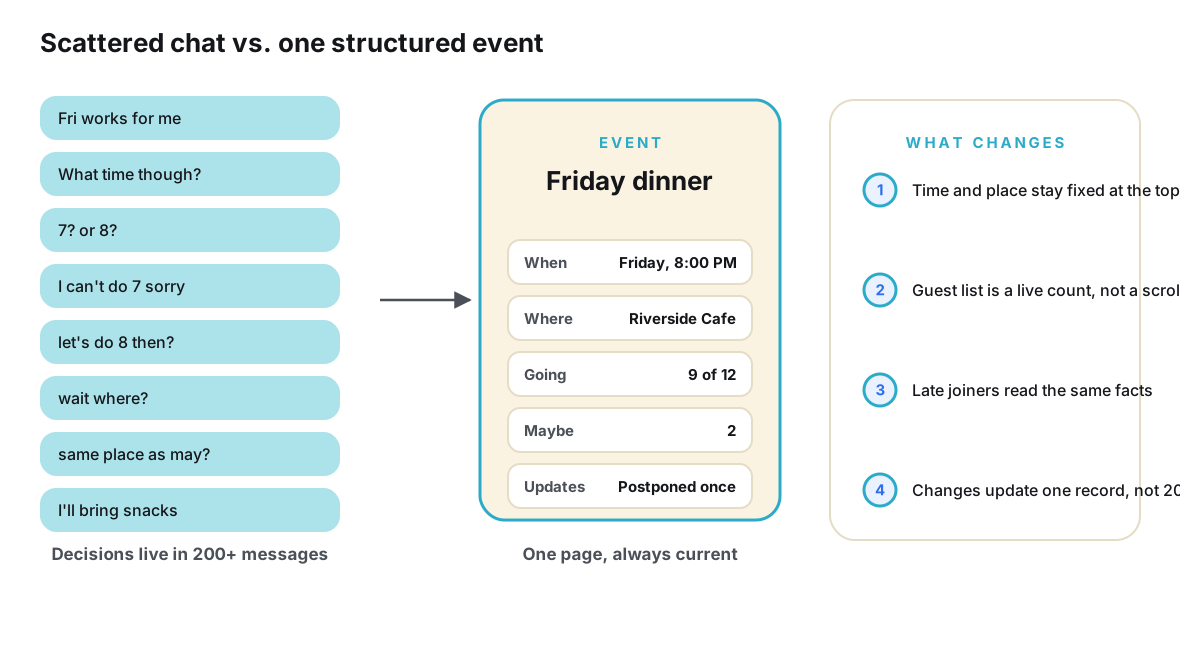
The same dinner, planned both ways
The comparison becomes concrete when the same event runs through both worlds. Picture an alumni chapter dinner for thirty: same city, same community, same restaurant — organized twice, once in each style.
Chat-first. On Monday, an organizer posts the idea and three candidate dates. By Wednesday the thread has 180 messages; a date has emerged, though two members are still arguing for the alternative. On Thursday the restaurant is booked — provisionally for thirty, because that is roughly the number of people who said something enthusiastic. Over the following week, the menu choice, the deposit and the question of partners all get settled in the thread, each in a separate flurry. The organizer re-posts the consolidated details twice as they change. On the day, a location pin goes out at noon; three people ask about parking; one member arrives at the wrong branch of the restaurant chain, guided by a screenshot from ten days earlier that named the original branch. Afterwards, the bill is split beautifully in the app, photos flood the thread, and the final “who actually came” count exists nowhere at all — except in the reservation that had to be corrected at the door from thirty to twenty-three.
Page-first. On Monday, the same organizer creates an event page with the three candidate dates and shares the link into the group with one line: “Dinner being planned — details and sign-ups live here.” The debate still happens in the thread, warm and argumentative as ever, but when a date wins, the page is edited to show it as the final value. Members set their own statuses as their plans firm up; partners get counted by marking a plus-one rather than by parsing replies. The deposit decision is made against the page’s list, not against enthusiasm. When the branch changes, one edit updates the address for everyone who opens the link afterwards. On the day, the same location pin goes out at noon — because the chat remains the day-of channel — and the member who would have gone to the wrong branch instead glances at the page. Afterwards, the same photos, the same in-app bill splitting, and one additional artifact: a record of the evening’s final facts, which next season’s organizer reads in ninety seconds instead of reassembling from a hundred-message scroll.
Neither run is a caricature; both happen constantly, and both dinners can be wonderful evenings. The difference is entirely in what each organizer paid, in attention and repetition, and in what each community was left holding when the night ended.
Where each option loses
Honesty requires the reverse column. The event page has real weaknesses, and communities that adopt one without acknowledging them tend to abandon it after a season. The first is dependency on a habit: a page only works if people remember to open it, which means the community must train itself to answer “check the link” instead of “scroll up.” Until that habit forms, the organizer still repeats things — now in two places. The second is no ambient presence: the page does not buzz with life between events, so it contributes nothing to the relationships that make gatherings worth attending. The third is one more thing: for a casual dinner, creating a page is overhead with no payoff, ceremony where none was needed.
There is also an honest transition cost between the two worlds. A group that adopts pages spends its first event or two answering questions in two places — the thread and the link — until the habit forms, and a community whose organizer is the only believer in the new pattern will relapse the moment that person takes a season off. The failure mode is not that pages do not work; it is that they are adopted as a gadget rather than as a rule, and rules survive gadgets. Announcing the rule explicitly — “the plan lives at this link; the chat is for talking” — does more for adoption than any feature comparison.
The group chat’s losses have already filled most of this article’s neighbors, so they can be stated briefly: details bury, headcounts blur, corrections linger as competing facts, late joiners dig, and the organizer pays for every gap in personal attention. Which set of losses you can live with depends entirely on the shape of the gathering — which is what the next section makes concrete.
| If your gathering is… | Lean toward | Why |
|---|---|---|
| A small dinner among regulars | The group chat alone | Short thread, everyone reads, social memory covers the gaps |
| Spontaneous and same-week | The group chat alone | Speed matters more than records; ceremony would slow it down |
| A venue reservation with a headcount | Chat plus a page | The number needs named statuses the thread cannot hold |
| A paid activity with a fee and deadline | Chat plus a page | Fees and deadlines need one authoritative version and reminders |
| A large community event, hundreds invited | Chat plus a page | Scroll volume, muting and late joiners make chat-only costly |
| Guests from outside WeChat | Page-forward | A link crosses app boundaries; chat membership cannot |
| A recurring club program | Standing group plus per-event pages | The chat is the home; each event gets its own current record |
Questions worth asking before choosing
The decision guide above compresses into a short conversation with yourself. Before committing a gathering to one approach or the other, run through these questions — the answers usually point the same way:
- Does any venue depend on the headcount? A reservation, a room, a table — if a number must be promised to a third party, the page’s named RSVP list earns its place immediately.
- Will the details change after announcing? Volatile plans punish the chat’s scroll and reward the page’s edit; stable plans forgive either.
- Is anyone invited who is not in the group? Guests beyond the chat’s membership can receive a link; they cannot receive membership.
- Is money collected in advance? Fees and deadlines want one authoritative version of the plan, because two versions of “pay by Friday” collect differently.
- Will people join after the plan is formed? If the answer is yes — and for any healthy community it usually is — weigh the late joiner’s experience heavily: backlog reading versus opening a link.
- Who organizes the next edition? If the role is meant to rotate, favor the setup that leaves behind a readable record rather than an archive that only its author can navigate.
A gathering that answers “no” to all of these belongs in the chat, full stop — and adding a page to it would be process for its own sake. Two or more “yes” answers, and the page has already started paying for itself.
The pattern that uses both
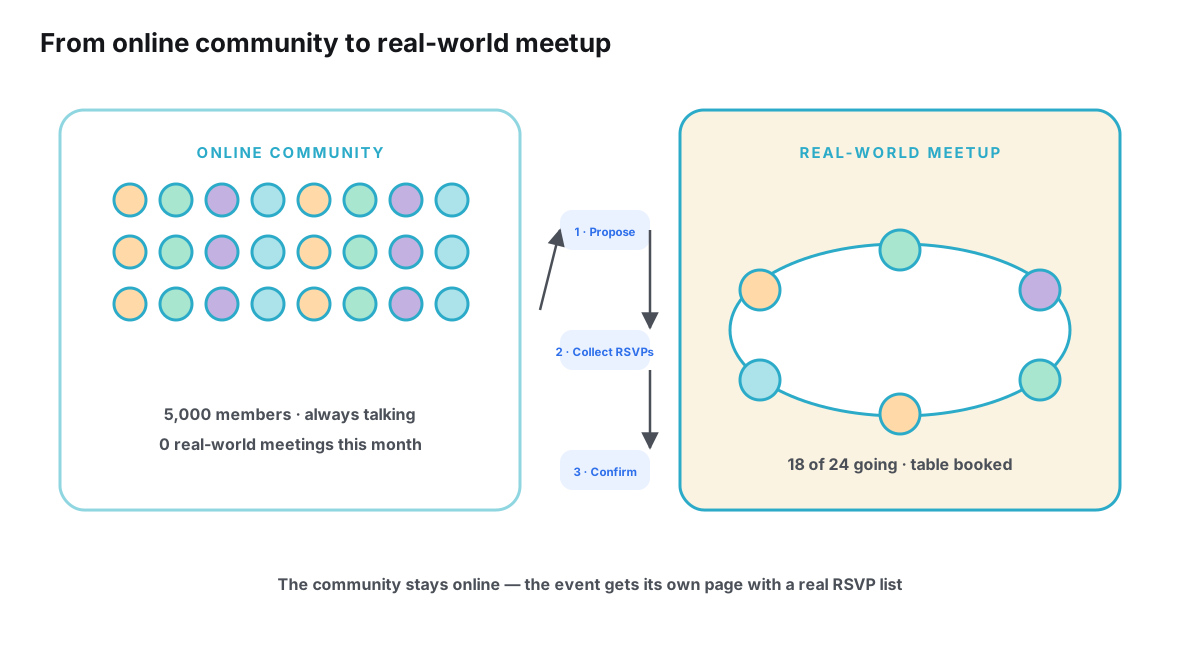
In practice, the fork in this article’s title is mostly false, because the strongest communities run both tools as a pair. The group chat remains the home — proposals are debated there, the day is coordinated there, money settles there. Each event that needs one gets a page holding its current facts, and the page’s link is posted into the group, pinned, and reused as the standing answer to every “what’s the plan?” The reasoning behind this division — one conversational home, one authoritative record — is developed further in why an event needs its own digital space.
The hybrid keeps the chat’s strengths exactly where they help. Deliberation stays conversational; the page simply records what deliberation concluded. When the community votes on a date or a venue — a decision process with its own trade-offs, examined in how WeChat polls work for group decisions — the result lands on the page as the final value, and the debate that produced it stays in the thread as history. Tools like Ontaym are built for this pairing: an event page with RSVP statuses, voting on options and updates, living alongside whichever chat the community already uses.
Communities with a full calendar — monthly hikes, weekly games, seasonal reunions — get the most out of the pattern, because the per-event pages accumulate into a program while the chat stays a single, sane room. If that is your situation, the operational playbook is in how to organize offline activities from a WeChat community.
Money and etiquette sit comfortably in the hybrid too. Fees and bill-splitting stay in the chat’s native payments, where they are frictionless; what moves to the page is only the factual side — the cost, the deadline, who has confirmed. Etiquette-wise, the strongest habit a hybrid community can adopt is announcement discipline: one pinned post holding the link, questions answered with the link, changes announced in one line that points at the edited page rather than restating the whole plan. Communities that keep that discipline find that the chat actually gets quieter — not less social, but less repetitive — which was the point all along.
Frequently asked questions
Does using an event page mean abandoning the WeChat group?
No, and it usually should not. The healthiest pattern keeps the group as the community’s home — debate, payments, day-of chatter — while each significant event gets a page for its current facts. The two answer different questions: the chat answers “what are we saying?” and the page answers “what have we decided?”
How do I get group members to actually check the page?
By making the link the standing answer. Post it once when the event is created, pin it, and answer every planning question in the thread with the same link rather than repeating the facts. Habits form when the link reliably works — people who scroll up twice and find outdated facts will switch to opening the page the third time on their own.
Isn’t a pinned message in the group just as good as a page?
For static, simple facts, close — and for a casual dinner it is genuinely enough. A pin falls short once the plan has a headcount, changes over time or guests beyond the group: it is one frozen message, it goes stale silently, and it cannot show per-person RSVP statuses or a history of updates.
What about events where everyone is already in the group?
If the guest list is exactly the group membership, the page’s cross-boundary advantage is irrelevant — but the record-keeping advantages are not. A forty-person group dinner with a restaurant reservation still benefits from a live headcount and edit-based changes, even though nobody outside the chat is invited.
Are dedicated event pages overkill for small plans?
Frequently, yes. A coffee for four plans perfectly well in a quiet thread, and adding a page would be ceremony for ceremony’s sake. The threshold is not headcount alone but consequence: a venue booking, a fee, a deadline, a change-prone plan or guests beyond the group are the signals that a record will start earning its keep.
Which is better for recurring activities?
Both, in their roles. A standing group gives the community continuity between gatherings; per-event pages give each activity a clean current record instead of an ever-deepening backlog. The pairing avoids the two classic failure modes of recurring programs: the chat that drowns in history, and the tool that replaces the community.
Conclusion
The comparison resolves less into a winner than into a division of labor. WeChat groups are unbeatable at the social layer of a gathering — presence, deliberation, payment, day-of energy, continuity — and no event page should try to replace any of that. Event pages are unbeatable at the record layer — one current plan, named RSVPs, clean updates, a link that works for anyone — and no group chat, however disciplined its pinners, can fully emulate it, because the chat’s commitment to chronological messages is the very thing that makes it a good conversation.
Practical guidance, then: default to the group chat, and treat the page as a promotion an event earns. The moment a gathering acquires a reservation, a fee, a deadline, a volatile plan or a single guest outside the app, give it a page and make the link the group’s standing answer. Communities that internalize this rule stop choosing between warmth and reliability — the room keeps the first, the record keeps the second, and the organizer stops being both.
Give your gathering a page — and let the chat stay a chat.
Create an event page with Ontaym