
How WeChat Polls Work for Group Decisions
Every group that meets in the real world has to decide things: which Saturday, which restaurant, which trail, whose turn to pick. This is a close look at how those decisions actually get made inside WeChat groups — from typed +1s to poll cards — and at the line where a vote stops being the right instrument.
Quick answer
Group decisions in WeChat happen across a spectrum of formality. At the informal end, members vote by typing “+1” under an option, stacking emoji reactions or simply weighing in with words — fast, social, and ambiguous about who has actually committed to anything. At the structured end, polls arrive as cards in the conversation, typically through mini-programs or external polling services shared into the group, and produce a clean tally at a moment in time; scheduling polls such as Doodle specialize that idea for dates. What every poll captures is a snapshot of preference. What a group’s real decisions also need — persistence, per-person identity, updates as plans change, and a bridge to attendance — a poll does not hold. So polls are excellent for narrowing options and genuinely poor as RSVP lists. The reliable pattern: poll to decide, then record the decided plan and the actual commitments somewhere with one current version — and let the vote be the beginning of the event, not its record.
The decisions a group actually has to make
Strip a gathering’s planning down to its decision points and the list is short. There is the date — usually the first and most consequential choice, because it gates everything else. There is the venue or activity — hotpot versus Thai, hike versus museum, karaoke versus quiet bar. There is the budget band — settled implicitly in most friend groups, negotiated explicitly in clubs and alumni associations where fees are collected. And then there is a long tail of small calls: start time, whether partners are invited, who books, who collects the money.
These decisions differ in a way that matters for tooling. Some are preference aggregations — many people’s tastes rolled into one choice, where a vote is exactly the right instrument. Others are commitment registrations — each person stating what they personally will do, where a vote is the wrong instrument no matter how convenient it looks. Which Saturday works best is a preference question. Who will actually be there on the chosen Saturday is a commitment question. Groups that use one mechanism for both discover the difference on the night, when the poll’s twenty votes become twelve diners — a distinction developed further in why group chat isn’t the same as an event.
WeChat groups, holding up to 500 members inside a super app of messaging, payments, mini-programs and official accounts, have evolved a layered set of ways to make these calls — and the layers are worth understanding individually, because each one carries a different kind of accuracy.
Informal voting: the +1 economy
The most common group decision mechanism on the platform — and on every messenger — has no button at all. Someone posts an option: “Hotpot on the 14th?” The group responds in its native currency: a cascade of “+1”, “count me in”, a thumbs-up on the message, a smiling emoji, or a counter-proposal in the next breath. The thread’s mood thickens around an option, and within an hour everyone involved understands what has been decided — or believes they do.
The strengths of the +1 economy are real and shouldn’t be dismissed by anyone who has watched it work. It is instant, requiring no setup. It is social — enthusiasm is visible, contagious, and the back-and-forth itself is part of the fun of planning. It is adaptive, folding new constraints (“the 14th is a school night”) into the decision in real time rather than forcing a restart. For small groups whose members all read the thread, it is a genuinely good decision system.
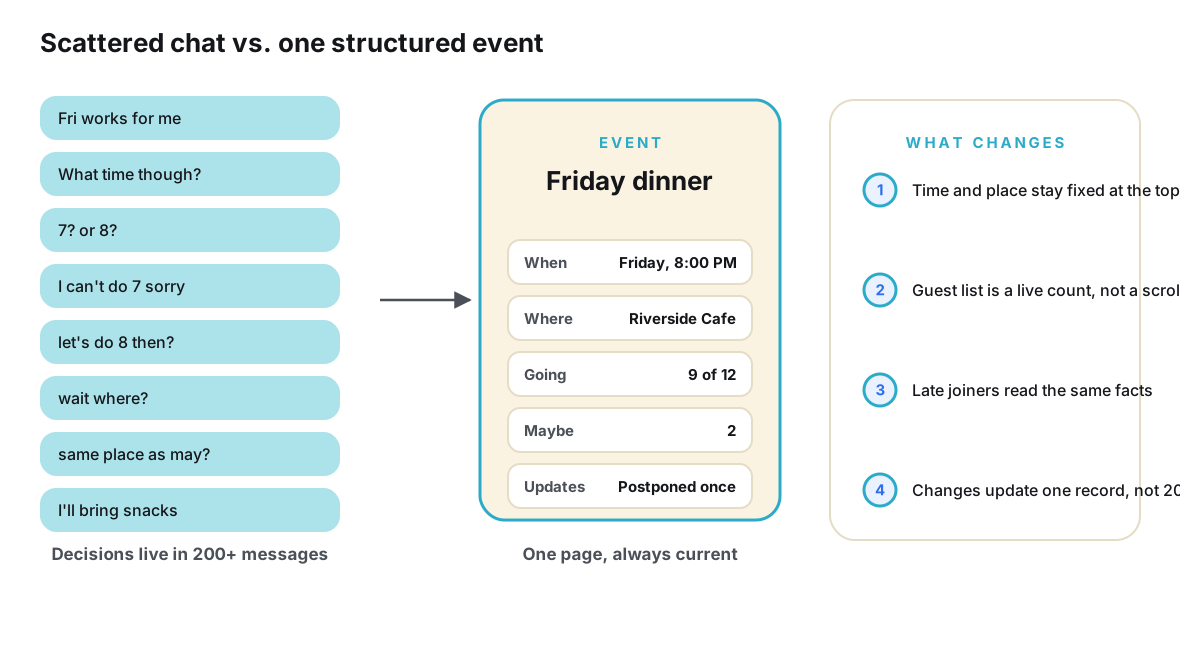
Its ambiguities are just as structural. A “+1” on the 14th is a vote for a date, not a promise to appear; but the organizer, needing numbers, counts it anyway. Emoji stacked on a message carry at least three possible readings — enthusiasm for the plan, acknowledgment of the message, solidarity with its author — and the thread does not record which. Silence is unreadable: among a large membership, the quiet majority contains both the unreachable and the uninterested. And the whole tally is ephemeral: it lives in the reactions and replies of specific messages, which scroll away and get re-counted differently by whoever looks later. None of this is carelessness by the group; it is a preference signal being asked to stand in for a commitment record, a substitution examined at length in why WeChat group chats become difficult for event coordination.
Structured polls arrive as cards
When a decision is consequential enough, groups reach for something more formal — and in WeChat’s super-app model, that something arrives in the conversation rather than beside it. Voting typically comes in as a card: a mini-program — the lightweight apps that run inside WeChat itself — shared into the group by whoever needs the answer. Members tap in, choose an option, and the card accumulates a tally anyone can open. For the specific problem of finding a date, dedicated scheduling polls do the same job with a calendar grid; Doodle is the long-standing example of the genre. The overall shape of the ecosystem — messaging, payments, mini-programs, official accounts in one package — is sketched on WeChat’s product site.
A structured poll fixes several of the +1 economy’s ambiguities at once. The options are fixed and visible, so the group is answering one crisp question instead of drifting between adjacent ones. The tally is arithmetic rather than atmospheric — seven against four, readable by anyone, not estimated from the temperature of the thread. And because voting happens inside the card rather than in replies, the poll stays coherent even in a busy group: the conversation can rage around it without scattering the count.
What the card inherits from the stream, though, is its position. A poll is a message like any other: it can be pinned for a while, but it competes for attention, it decays with the scroll, and its moment is finite. Groups routinely watch a poll close, act on the result — and then lose the ability to consult it, because three days of chatter have buried it. The poll answered its question beautifully and then became archaeology, which is fine for a settled question and expensive for an evolving plan.
| Decision | Informal chat vote | Structured poll | RSVP / commitment list |
|---|---|---|---|
| Choosing a date window | Works for small groups | Excellent — fixed options, clean tally | Only needed after the date is set |
| Choosing venue or activity | Works, slowly | Excellent — especially with photos in options | Not applicable |
| Setting a budget band | Normal and fine | Useful when feelings are delicate | Not applicable |
| Who is attending | Misleading — +1s are not promises | Also misleading — votes are not promises | The right tool — named, updatable statuses |
| Headcount for the venue | Unreliable | Unreliable — a tally, not a list | The right tool — this is its whole job |
| Covering a shared cost | Unworkable at size | Wrong shape — money needs a ledger | Pair statuses with the app’s payments |
Anatomy of a good poll question
Most poll problems are authored, not suffered. A poll is a small instrument, and like any instrument it performs according to how it is built. The habits below are not etiquette — they are the difference between a tally that decides something and a tally that starts an argument.
Ask one question. “The 14th or the 21st, and hotpot or Thai?” forces respondents to bundle two preferences into one answer, and the result is uninterpretable — a win for a date under an assumed venue. Run two small polls instead; sequencing them also lets the second question absorb the first answer. Offer concrete, comparable options. “Saturday afternoon” and “Saturday evening” compete cleanly; “whenever” and “I’m flexible” are not options but abstentions wearing costumes, and they pollute the tally. Three to five options is the useful band: fewer feels like coercion, more produces a scattered vote nobody treats as decisive.
Phrase options neutrally. The author’s enthusiasm leaks easily — “the usual place” versus “somewhere new for once” nudges before anyone votes — and a poll that steers gets quietly discounted by the people who notice. Declare the deadline and the tie-break in advance. A poll without a closing time never closes; it just fades. Say when it ends and what happens on a tie — organizer’s call, coin flip, the option with fewer strong objections — before voting starts, so the loser accepts the result instead of relitigating it. And state what the poll is for: “this decides the date” or “this is just to gauge appetite before we book anything.” The most damaging misunderstanding in group voting is a member who believed they were committing when they were only being counted, or the reverse.
What a poll records vs. what a decision needs
It is worth being precise about the gap, because “we already voted on this” is one of the most common sentences in group planning, and it papers over four differences between a completed poll and a working decision.
A poll is a snapshot; a decision is a state. The vote records what people preferred when the poll was open. Plans live for weeks, and preferences decay — the date that won three Sundays ago now collides with an exam, a business trip, a family visit. A decision that cannot absorb those changes without a re-vote is less a decision than a strong suggestion with a timestamp.
A tally is anonymous to its consequences. A result of “the 21st, twelve votes” tells the organizer the group’s mood, but not which twelve, and therefore not who to notify when the venue changes or who to gently chase when the reservation needs confirming. Votes aggregate people away; attendance is irreducibly per-person.
A poll ends; a plan continues. Closing a poll feels like finishing the decision, but it is really the midpoint: the result must now become a time on a calendar, a booking, a fee, a meeting point — each of which can change, and each change of which needs to reach the people who voted, wherever they are in the thread by then. The poll has no mechanism for any of that; it answered and retired.
A vote has no cost; attendance does. Tapping an option costs a second and nothing else. Getting to the venue on a rainy Saturday costs an evening. Instruments that measure the first will systematically overestimate the second — not because people are dishonest, but because the two acts are priced differently. Every experienced organizer knows the arithmetic of the enthusiasm gap; knowing it is precisely what keeps a poll from being mistaken for a guest list.
How other platforms draw the same lines
The same instrument lands differently on other platforms, and the comparison clarifies what is essential. Telegram implements polls natively in its groups, with a design that makes voter identity a first-class choice: a poll can be anonymous or public, with visible per-person votes, and can even be styled as a quiz — capabilities documented in the Telegram FAQ. Discord equips its servers with polls alongside roles, threads and community structure. WeChat’s approach reflects the super-app philosophy: rather than one deep polling layer, the platform lets specialized services arrive in the conversation as cards, each poll suited to its purpose.
What is striking is that the differences stop mattering at exactly the point this article cares about. Anonymous or public, native or card, single-choice or quiz — every poll on every platform is still a snapshot of preference. None of them is a persistent commitment record, and every platform’s organizers eventually confront the same sequence: vote, decide, and then somehow hold the decided plan where it stays current and the promised people where they stay counted. The instrument varies; the gap it leaves is universal.
| Situation | Use a poll when… | Skip the poll when… |
|---|---|---|
| Picking a date | There are three or more realistic windows across many calendars | The group is small enough to converge in a few replies |
| Picking a venue | Taste genuinely varies and options are comparable | One person owns the choice this time — rotation beats voting |
| Gauging appetite for an idea | You want honest, low-pressure signal before investing effort | The event is happening regardless; a poll only creates doubt |
| Counting attendees | Never the whole job — at most a first approximation | Always, when the venue needs a number — use statuses instead |
| Settling a dispute | Both options are genuinely fine and the group is split | Some members care far more than others — weigh voices, not votes |
| Choosing a time slot same-day | A quick card beats a flurry of replies | Delay itself is the cost — just decide and adjust live |
Reading a poll honestly
Even a well-built poll is read through distortions that every organizer should know by heart. The first is sample bias: a group chat poll samples the people who open the app that day, not the membership. The quiet member who works night shifts and the parent who mutes the group during school weeks are structurally undercounted, and their constraints — “any Saturday but that one” — surface only after the date is locked. A tally of the visible is a fact about the visible.
The second is intensity blindness. Votes are weighted equally, but preferences are not: the member who deeply cares that the reunion not clash with a family tradition is recorded identically to the member who voted with a shrug between meetings. Small groups handle this in conversation, where passion is legible; a poll flattens it by design. When a result is close and the people on the losing side care visibly more than the winners, a wise organizer treats the poll as the opening of a negotiation rather than its close.
The third is moment bias: the poll measures the week it ran. A Tuesday-evening poll during exam season is a different instrument from the same poll after grades post. None of these distortions makes polls useless — they make polls partial, and the organizer’s judgment is the other half of the instrument. The healthiest reading habit treats the tally as one input among several: the vote, the maybes hovering around it, the private messages that always follow a close result, and the organizer’s knowledge of who actually shows up to things.
From vote to commitment
The healthiest pattern treats the poll as the first half of a two-step move. Step one: vote to decide — date, venue, variant — using whatever instrument suits the group. Step two: record the outcome and the commitments somewhere built to hold them: the decided facts as one current version of the plan, attendance as named, updatable statuses. The moment the vote closes, its result should migrate into that record and the poll itself can rest. This is the same division of labor described in how to create one source of truth for a group event — debate and vote in the conversation; store the outcome as an object.
Tools built for event coordination collapse the two steps into one flow. Ontaym, for example, lets a group vote on options — dates, venues — and then carries the winning option into the event page, where RSVP statuses track the people who actually committed. The vote still happens; it simply stops being the plan’s final resting place. Groups that keep everything in WeChat can approximate the same discipline: close the poll, post the decided facts in one clearly marked message — or better, a linked page — and treat that record, not the tally, as the answer to every later question.
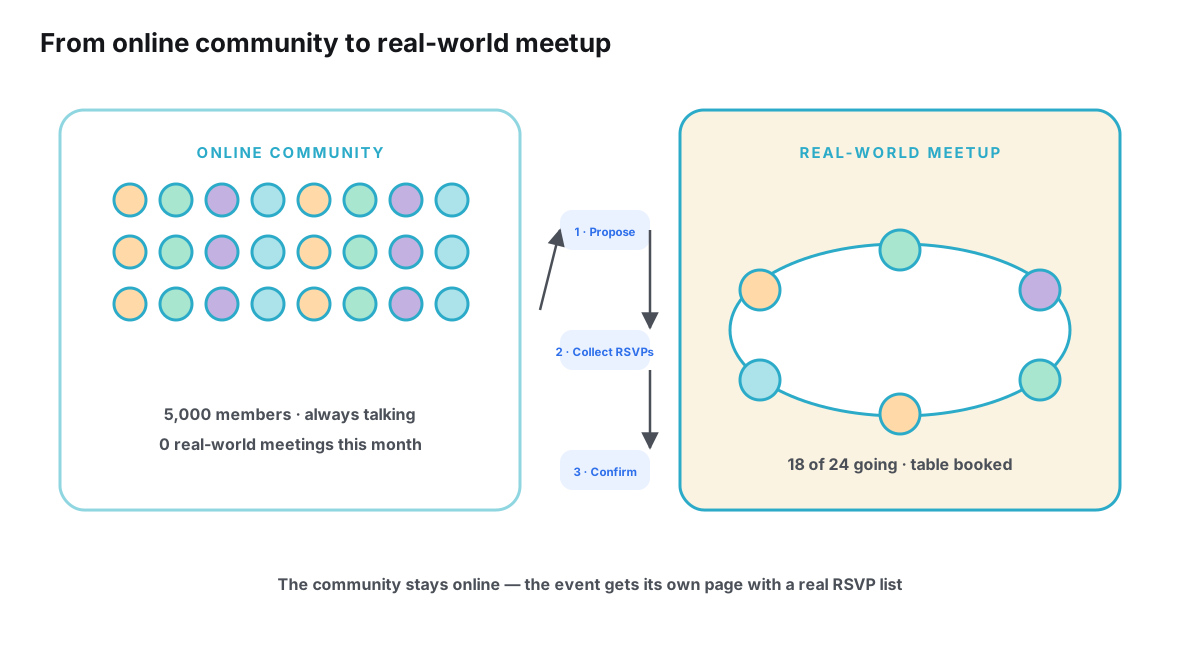
The handoff has a ritual quality worth honoring: when the poll closes, announce the result once, clearly, and immediately state where the decided facts now live. “The 21st won — final details and sign-ups are here” is a complete sentence that retires the poll and christens the record in one breath. Skip the ritual and the group keeps relitigating the question in fragments for days, because to a member who missed the poll’s closing, the question still looks open. A decision that no one announces is a decision the group has not finished making.
Scale changes the stakes of this discipline rather than its shape. In a group of thirty, a mishandled poll costs an organizer an evening of re-counting; in a community pressing against the 500-member ceiling or already split into sub-groups, the same gap forks the plan across rooms and surfaces as people at the wrong venue. The scale dynamics — and why structure becomes economical exactly when repetition becomes unaffordable — are laid out in what happens when a WeChat group becomes too large.
Frequently asked questions
Does WeChat have built-in polls in group chats?
Group voting in WeChat typically runs through the super-app layer rather than a single deep feature: poll cards arrive in the conversation via mini-programs or external polling services, and scheduling polls specialize the idea for dates. The practical consequence is that a poll is one card among the group’s messages — excellent at its moment, and subject to the stream’s decay afterwards.
Why did forty people vote but only fifteen showed up?
Because a vote and an attendance commitment are different acts at different prices. Tapping an option costs a second and nothing more; attending costs an evening. Polls measure preference at a moment, which systematically overestimates eventual turnout. Treat the tally as interest, and collect commitments separately through named, updatable RSVP statuses.
When is an informal +1 thread good enough?
When the group is small, everyone reads the thread, the stakes are low and the plan is stable — a regular dinner among friends, for instance. The informal vote is fast, warm and self-correcting at that scale. It starts to mislead when membership grows past the everyone-reads-everything threshold or when the decision gates money, bookings or travel.
Should poll votes be anonymous?
It depends what the vote is for. Anonymous suits preference questions where social pressure could distort answers — budget bands, divisive venues. Named votes suit anything connected to follow-through, because the organizer will eventually need to know who is on which side of the decision. On platforms with native polls, like Telegram, that choice is explicit; in WeChat it depends on the polling service used.
How do I keep a poll’s result from getting lost?
Close the loop explicitly. When the poll ends, post the outcome in one clearly marked place — ideally a page holding the event’s current facts — and make that the standing answer to questions about the plan. The poll answered the question; the record keeps the answer findable for everyone who arrives late or checks back.
Can a poll replace an RSVP list if I just ask “who’s coming?”
Not reliably. Even phrased as attendance, a poll records each answer once, at one moment, usually without the ability to flip cleanly as plans change — and often without telling you who changed. An RSVP list is built exactly for that: per-person, updatable over time, and rolled up into the headcount the venue needs.
Conclusion
WeChat groups decide things across a spectrum that runs from typed “+1” cascades to structured poll cards, and every point on that spectrum is a genuinely good instrument for the job it actually does: aggregating preference. The “+1” economy is fast and warm; a poll card is crisp and countable; a scheduling poll tames the specific chaos of shared calendars. Groups should use all of them without apology.
The discipline is in the handoff. A poll is a snapshot with no memory, no per-person persistence and no bridge to attendance — so the moment it closes, its result needs to become something else: a current, addressable record of the decided plan, and a named list of the people actually committed to it. Groups that build that habit — vote to decide, then record the decision and the commitments — keep everything fun about deciding in chat while sparing themselves the classic surprise of a tally that confidently predicted a crowd that never assembled. Let the poll do the voting; give the plan somewhere to live afterwards.
Vote on options, then let the winning plan live at one link.
Try polls and RSVPs on Ontaym