
Why WhatsApp Is Great for Chatting but Bad for Structured Event Planning
WhatsApp does conversation as well as any software ever shipped — instant, warm, always in your pocket. The same qualities that make it a superb place to talk are what make it an unreliable place to keep a plan.
Quick answer
WhatsApp is optimized for conversation: messages arrive instantly, the newest one is always the most visible, and the thread simply grows. Planning an event needs almost the opposite: a fixed set of labeled facts — one final time, one final place, a definite list of who is coming — that stays current and checkable no matter how much chatter surrounds it. These are not bugs in WhatsApp; the features that make chatting feel effortless, like recency ordering and append-only streams, are precisely what prevent the thread from holding stable state. Polls, pins, and group descriptions patch individual symptoms without introducing structure. The working arrangement is a division of labor: keep the conversation in WhatsApp, and give the event itself a small, addressable record that always shows its current state.
Two jobs that wear the same uniform
In a small group, chatting and planning look like the same activity. You talk about Friday, you agree on Friday, you go out on Friday. The conversation was the planning; the planning was the conversation. Every group starts here, and for truly simple plans, this is a complete and healthy system — no tool is going to improve upon five friends deciding to meet at the usual place.
The two jobs separate the moment a plan acquires structure. Structure means specifics that must survive: a reservation for a particular number, a start time that a venue is holding, a train that leaves whether or not the thread has reached consensus. A conversation can produce those facts, but it cannot store them, because storing facts was never a conversation’s job. Talking is a process; a plan is a state. Processes and states have fundamentally different storage requirements, and only one of them is shaped like a message stream.
The confusion persists because the chat feels like it contains the plan. And it does contain the plan — as prose, distributed across dozens of messages, interleaved with jokes, superseded in place but never erased. What it doesn’t contain is anything a person can consult. The difference between containing information and providing information is the entire subject of this article, and it is the reason groups can spend a week energetically messaging each other and still not agree on what time dinner starts.
What WhatsApp is actually optimized for
It is worth saying clearly: WhatsApp is excellent at its job. Message delivery is essentially instantaneous across almost every phone on earth. Typing indicators and delivery ticks give conversation a shared pulse. Groups form in seconds, photos compress beautifully, voice notes carry tone that text cannot, and the whole thing sits one tap away in the muscle memory of three billion pockets. As an environment for human talk, it is a triumph, and nothing in this article should be read as a complaint about it.
The app’s own framing supports this. WhatsApp presents itself as a simple, private messenger, and every major feature — replies, reactions, statuses, voice notes — serves the exchange of words between people in real time. None of that design effort went into representing objects, because messengers were never asked to. A group chat is a place where talk happens, the way a café is a place where talk happens. Nobody expects the café to remember what you decided over coffee.
That is the honest framing to keep: not “WhatsApp is bad at events,” but “WhatsApp was built for a different job, and events borrowed it because it was in everyone’s pocket.” The borrowing works right up until the plan needs to be consulted rather than discussed — and then the medium’s deepest assumptions start working against you.
Five design choices that serve talking, not planning
Underneath the interface are a handful of quiet design decisions, each unimpeachable for conversation and each quietly hostile to structured plans:
- Recency rules the screen. The newest message is always the most prominent. For conversation this is perfect — the latest remark is the live one. For a plan it is backwards: the most important facts are stable and old, and they lose their position to every joke that follows them.
- The stream only grows. Nothing is edited, nothing is superseded, nothing is reordered. A conversation should indeed be an immutable record of what was said. A plan should be a mutable record of what is true; every update in chat adds a competing truth instead of replacing one.
- The message is the unit. There are no fields, no records, no types. A time, a place, a yes and a joke are all the same shape: a bubble of prose. Chat cannot treat a time differently from a joke because it has no idea which is which.
- Membership is the phone number. Groups in WhatsApp are built on members’ phone numbers, which is what lets the experience feel so frictionless. It also means participating in the plan means joining the conversation — you cannot have the facts without the chat, or the chat without sharing your number.
- Attention is the delivery mechanism. Information reaches you by interrupting you. For conversation, interruption is the point — someone is talking to you. For a plan, it means facts are delivered as demands for attention, and people who rationally reduce notifications rationally lose the plan.
Read as a list of conversation features, all five are correct decisions. Read as infrastructure for an event, all five are defects. This is what a design trade-off actually looks like: not a missing feature that a roadmap could add, but a shape that serves one purpose by excluding another.
What a structured plan actually requires
Turn the problem around and ask what an event needs from its container, ignoring apps entirely. A restaurant wants a headcount. A venue wants a start time. A guest wants to know where to stand at seven o’clock. An organizer wants to see, at a glance, who has committed and who has gone quiet. These are requirements about state, not about talk:
| Requirement | Conversation is served by | A plan is served by |
|---|---|---|
| Ordering | Newest first — the live remark leads | Current state first — the settled facts lead |
| Unit of information | The message, free-form prose | Labeled fields with one value each |
| Change | A new message adding to the history | An edit that replaces the old value |
| Membership | Whoever is talking, open-ended | A definite guest list with per-person status |
| Commitment | Reactions and enthusiasm | Named RSVPs that persist and update |
| Recall | Scrolling and searching words | Opening one address and reading the state |
| Attention model | Push — messages interrupt | Pull — check when you need to, get the same answer |
The two columns are not merely different; in three rows they are opposites. That is the structural reason event planning in chat degrades as it grows — the group is running its state through a medium built for process, and the mismatch compounds with every message. A fuller account of how that mess accumulates day by day is in why WhatsApp groups become messy when planning events; here the interest is in why it cannot be otherwise.
One row deserves special emphasis because it is where groups feel the most pain on the night: commitment. A conversation collects expressions of enthusiasm, and enthusiasm is real information — but it is not a headcount. A restaurant asked for twelve; the thread contains twelve enthusiastic replies, and on the night eight people arrive, three of whom never once spoke in the group. The plan needed a per-person status that each guest could set and later revise; the thread needed the same thing and had no place to put it, so the organizer guessed. Guessing is precisely what structured planning exists to eliminate.
The split point in every plan’s life
Every plan has a moment where chat stops being the right home, and it comes earlier than most groups expect. In the beginning, a plan is pure conversation: options are floated, enthusiasm is measured, weekends are compared. This stage is genuinely, properly served by WhatsApp — the medium’s informality lowers the cost of proposing ideas, and half-formed thoughts belong in a medium that doesn’t require them to be structured yet.
The split arrives with the first decision. The moment “maybe Saturday or Sunday” becomes “Saturday, 8 pm, the place on the corner,” the group has produced a fact — and facts have different storage requirements from proposals. From that instant, two things exist simultaneously: a continuing conversation (still welcome, still chat-shaped) and a growing set of settled facts (not chat-shaped at all). Groups that keep both in the thread pay for it every time a new message buries a settled fact, every time someone asks “sorry, which place was final?”, every time the group re-litigates a decision that was already made.
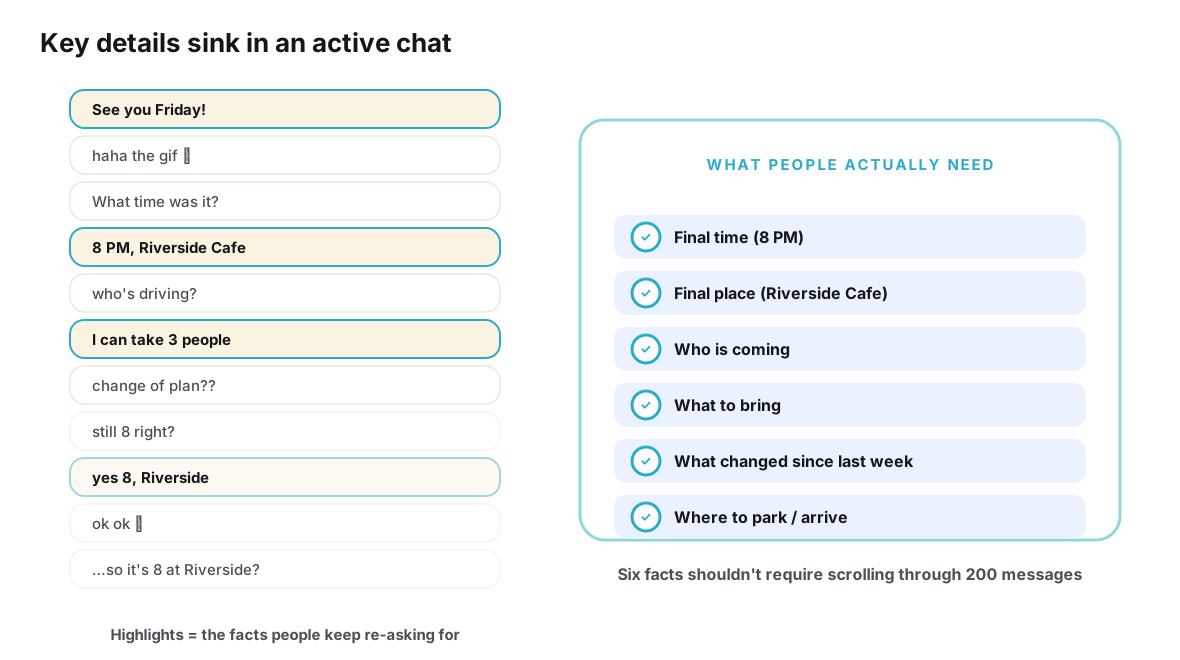
Recognizing the split point is a genuine organizing skill. Before it, structure is bureaucracy — nobody should build an event page to ask “drinks soon?” After it, the absence of structure is debt, and the interest is paid in repeated questions, forking details, and a headcount the organizer has to guess. Experienced organizers describe the same instinct: the second time they retype the plan for someone, they wish the plan had an address.
Why the built-in features don’t close the gap
A reasonable objection: WhatsApp has noticed all of this and shipped features for it. Groups have polls; messages can be pinned; descriptions can carry a line of text. These are real conveniences, and used well they make chat-based planning meaningfully more survivable. But each one is best understood as a snapshot or a tally laid on top of the stream — none of them turns the stream into state.
| Feature | Genuinely good at | Cannot represent |
|---|---|---|
| Group poll | Aggregating preferences at one moment with a clean tally | Commitment over time, per-person updates, or what anyone actually does on the night |
| Pinned message | Keeping one message visible above the flow | Anything after the plan changes; two facts that change at different times |
| Group description | A short, persistent note about the group’s purpose | Per-event detail, changing fields, or per-guest status — it is a label, not a record |
| Reply threading | Keeping a question attached to its answer | Whether the answer was accepted, superseded, or read by anyone else |
| Reactions | Fast, low-effort signals on one specific message | A named, current attendance record that survives the next hundred messages |
The pattern across the table is consistent: every feature is either frozen at a moment or scoped to a single message, while a plan is a living object spanning weeks. A poll is a photograph of opinions; a pin is a photograph of a plan. Neither can be the thing itself. The WhatsApp Help Center documents each of these features doing exactly what they were designed to do — and their design briefs were conversation conveniences, not state management.
The habit loop that keeps groups in the thread
If the mismatch is this structural, why do groups keep planning in chat for years, disaster after disaster? Partly because the pain is diffuse. No single failure ever gets blamed on the medium — it gets blamed on Marco, who never reads the group, or on the organizer, who buried the new time under a photo of a dog. The system’s costs are always paid by individuals, so the system never gets revised.
Partly, too, because chat’s strengths are front-loaded while its weaknesses are back-loaded. The first hour of planning in a thread is genuinely the easiest planning experience that exists: no setup, no invitations to send, everyone already present, replies arriving within seconds. The costs arrive weeks later, in the form of forks, repetitions and archaeology — too late to connect them to the choice that caused them. Groups remember how easy the start felt and never audit what the end cost.
And partly because the alternative is imagined as heavy. The word “structured” conjures software, accounts, forms — bureaucracy for a birthday dinner. The mental image is wrong, as the division of labor below shows: the record is a small object with an address, not a project management system. But the image does its work, and the thread keeps its throne.
The membership question nobody chose
There is a second, quieter mismatch: the boundary. A WhatsApp group’s boundary is its member list, and its member list is phone numbers. For a family or a close friend circle, that boundary is invisible — everyone is already inside it. For almost any other event, it is load-bearing and awkward. The friend who doesn’t use WhatsApp. The colleague you’d happily invite to dinner but not to your contacts. The friend-of-a-friend who is coming but shouldn’t need the group’s entire history to do so.
Chat-boundary planning forces a decision a plan never asked for: is this person in the conversation or out? There is no middle state, so organizers invent them — adding people to chats they didn’t ask to join, forwarding screenshots to outsiders, relaying questions by word of mouth. Every workaround is another copy of the plan outside the place where the plan lives.
An event, considered on its own, has a different and softer boundary: people are either coming or not. Participating in an event does not require belonging to a conversation about it, and a plan’s container should be able to reflect that. This is a big part of the argument for giving an event its own digital space rather than borrowing the chat’s walls: the event’s boundary becomes “who has the link and wants to come,” which is exactly the boundary the event actually has in real life.
A division of labor that keeps both
None of this argues for abandoning WhatsApp, which would be both unpopular and pointless — the conversation genuinely belongs there. What works is an explicit division of labor, and it is less work than it sounds:
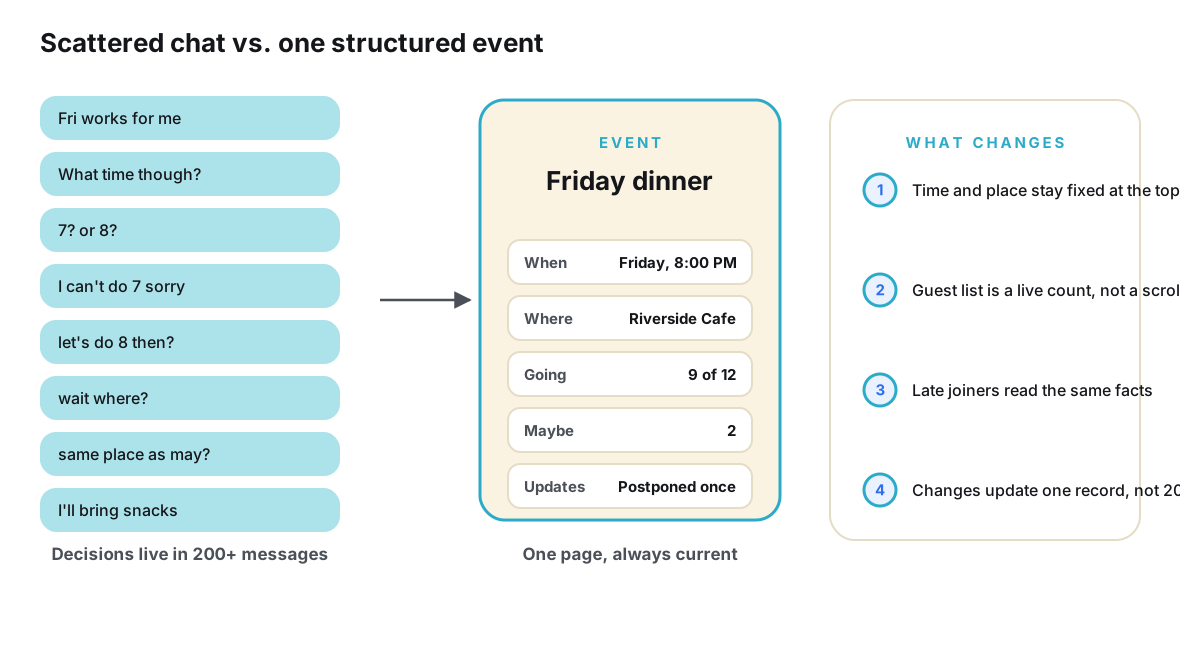
Let the chat own everything process-shaped: proposing options, arguing about them, telling jokes, sharing anticipation, coordinating the social texture that makes a group feel like a group. Give the record everything state-shaped: the final time and place, the guest list with statuses, the changes as they happen, the details a newcomer needs. The connection between the two is a single link, posted in the thread whenever it is useful. When someone asks what the plan is, the complete answer is the link — a sentence of conversation pointing at the state.
Practiced this way, each medium stops subsidizing the other’s weaknesses. The thread stops accreting logistics and becomes pleasant to read again; the record stops being an empty form and becomes the one place anyone checks. A tool like Ontaym is built around exactly this split — one link per event, options that can be voted on, going and maybe statuses that update, and reminders that come from the record — but the principle matters more than the product: conversation in the chat, state at an address.
The tell that the division is working is what the thread sounds like. A chat that has lost its logistics traffic reads like a group of friends rather than a scheduling department: jokes, anticipation, photos from last time, a debate about whether the new place does a good dessert. The record, meanwhile, quietly answers every logistical question the thread no longer needs to ask. Organizers are often surprised by how much they enjoy their own group again once the plan stopped living in it.
Why scale makes the trade-off visible
For a dinner among six people who all read everything, chat-based planning fails gracefully — social memory patches the gaps, and the cost of the mismatch is a repeated question or two. The mismatch becomes visible at scale, because the things that break — burial, repetition, boundary friction, headcount ambiguity — all grow with the group while chat’s capacities stay fixed. A planning conversation involving dozens of people, or a plan that changes several times, multiplies exactly the failure modes described above.
Scale does not merely enlarge the earlier problems; it adds new ones. Questions repeat because they go unanswered during the hour it takes the thread to move on. Sub-groups form around logistics, and the plan splinters across them. The silent majority grows, and the gap between who is talking and who is coming widens until the two lists barely overlap. None of these phenomena exist at dinner-table scale, which is why small groups can plan in chat for years and conclude, reasonably, that it works.
This is why the largest groups are always the first to abandon pure chat planning, usually after one memorable disaster. If you have watched a group of hundreds try to organize a single picnic through a thread, you have seen every row of the earlier table operating at once. The dynamics of that specific situation — what happens to event information when a WhatsApp group is enormous — are covered in the companion piece on huge WhatsApp groups.
Frequently asked questions
Why does planning in chat feel fine until it suddenly isn’t?
Because the early stage of planning really is conversation, and chat serves it well. Problems begin at the first settled decision, when facts that must persist and stay consultable start living in a medium that buries, duplicates, and never supersedes them. The failure is gradual, then abrupt — usually when the first detail changes or the first latecomer asks to catch up.
Aren’t WhatsApp polls enough for choosing a date?
A poll is an excellent way to take a snapshot of preferences and a poor way to hold a commitment. Votes are cast once, early, and drift as schedules change; a vote for Saturday three weeks ago tells you little about Saturday morning. Choose the date with a poll if it helps, then move the decision into a record where per-person status can update until the event happens.
What’s the actual harm — anyone can scroll up, right?
Scrolling works when the thread is short and the plan is final. It fails when the plan has changed, because the scroll returns every version of the truth with no indication of which one won; it fails for latecomers, who must reconstruct weeks of context; and it fails when the group is active, because the effort of finding one fact grows with every message. “Scroll up” is archaeology, and archaeology is a costly default for information people need in five seconds.
Does this apply to other messaging apps too?
Yes, because the architecture is shared. Telegram, Signal, Messenger, and iMessage groups all order by recency, append rather than edit, and treat the message as the unit — Telegram’s FAQ, for instance, describes its groups in exactly these conversational terms. WhatsApp is the clearest example only because it is the most common place the borrowing happens.
When is chat alone genuinely enough?
When the plan is small, stable, and single-app: a handful of people, one decision, no changes after it is made, everyone already in the thread. Under those conditions the conversation and the plan never diverge enough to matter. The moment any of those conditions breaks — a change, a latecomer, a headcount the venue needs — the split described here begins.
What does structured planning look like in practice?
An addressable event page holding labeled facts: the final time and place, options still open with votes, a guest list with going and maybe statuses, and updates applied as edits. The chat stays open for everything else, and a link connects the two. The step-by-step version of moving a live conversation onto that footing is in how to turn a WhatsApp conversation into an organized event.
Conclusion
WhatsApp earned its place in every pocket by being a superb conversation tool, and the qualities that make it superb — recency, streams, informality, phone-number intimacy — are the exact qualities a plan cannot be stored in. Expecting a thread to hold a structured event is not a failure of effort by the group; it is a category error made by software that was never asked to be a database.
The practical conclusion is a split, not a switch. Let WhatsApp carry the conversation it is brilliant at: proposals, debate, jokes, anticipation. Give the event a small record at a stable address that holds one current value for every fact, updates by edit, and lets anyone check the plan without reading a word of chat. The group that makes this split stops choosing between talking and planning — it gets to do both, each in the place built for it.
Keep the chat for chatting. Give the plan an address.
Plan it with Ontaym