
How to Turn a WhatsApp Conversation Into an Organized Event
Your event already exists — buried in a thread, scattered across three weeks of messages. This is the process for lifting it out intact: one sitting of work, one announcement message, and a plan that stops depending on scrolling.
Quick answer
To turn a WhatsApp conversation into an organized event, freeze the discussion briefly and extract the current facts from the thread: final time, final place, cost, the guest list as it actually stands, and the questions still open. Create an event record — a page with its own link — and populate it with those facts, marking anything undecided as an open option people can vote on. Collect RSVPs on the record rather than in replies. Then post one message to the group explaining that the plan now lives at the link. From that moment, changes are edits to the record, questions are answered with the link, and the thread returns to being what it is good at: conversation. The migration takes one focused sitting plus a short transition week, and nothing is lost — the thread stays as history.
Knowing when it’s time
Not every conversation needs rescuing. A two-message plan for coffee is already organized. Migration earns its effort when the thread starts showing the classic strain signals: the same question returning every few days, screenshots of older messages being posted as answers, details that changed and nobody is sure which version won, or a newcomer asking to be brought up to date and receiving a “haha, scroll up” in reply.
The strongest signal is emotional rather than technical: the organizer is tired. When the person who wanted the event to happen starts dreading the group notification, the conversation has quietly become a system the group is maintaining by hand. That is the moment to move — before the fatigue curdles into cancellation. The mechanics of how threads reach this state are covered in why WhatsApp groups become messy when planning events; what follows is the way back.
A rough frequency heuristic works well: if questions about the plan surface more often than genuine news about the plan, the thread has inverted from a place where things get decided into a place where decisions get re-requested. The ratio matters more than the group’s size — a four-person trip planned over two months can generate more retrieval traffic than a fifteen-person dinner organized in a week. When you catch yourself composing the same answer for the third time, the conversation has already volunteered to become an organized event; the only question is whether you accept.
Step zero: call a brief freeze
Before extracting anything, post one short message: “Big cleanup tonight — anything decided before I post the new plan sticks; hold new decisions for a few hours.” The freeze matters because a thread is a moving target. If the venue is being renegotiated while you are extracting the venue, your record is stale the moment it is created, and the group’s first experience of the new system is a correction — the worst possible start.
Keep the freeze short and explicit. A few hours, or one evening, is enough for most friend groups. The goal is not to stop discussion; it is to stop decisions from landing mid-extraction. Anyone who proposes something during the freeze gets a simple answer: “great, it can be an option on the page.”
The migration, step by step
- Extract the current facts from the thread. Scroll the whole conversation once, top to bottom, and write down what is actually settled: the time, the place, any cost or contribution, the transport or meeting point, and what people committed to. Resist reconstructing what “should” be true — record what the thread says, including contradictions, and note which facts are certain versus disputed.
- Separate the settled from the open. Sort your notes into two lists: facts the group has genuinely decided, and questions still live. The Friday-versus-Saturday debate that never concluded is not a fact; it is an open option. This two-list discipline is what keeps the record honest and stops the page from asserting things the group never agreed to.
- Create the event record and seed it with what you know. Set up a page or link for the event, fill in every settled fact, and create an explicit “to be decided” entry for each open question. A record that says “time: TBD — voting open” is trustworthy; a record that silently omits the time invites the group to assume it hasn’t changed from the thread.
- Turn the open questions into votable options. For each undecided item, list the candidate answers as options people can vote on — dates, venues, cuisine, anything genuinely open. Voting replaces the thread’s endless proposal-counterproposal loops with a visible tally that converges on its own, and people who would never type a reply will happily tap an option.
- Collect RSVPs on the record, not in replies. Add a going / maybe status for each guest, set your own first, and let everyone update their own. This single change retires the most repeated question in the history of group chats — “who’s in?” — because the answer is now a list that maintains itself instead of a thread of enthusiasm that maintains nothing.
- Announce the move with one message containing the link. Post a short, warm message to the group: what changed, where the plan now lives, what the thread is still for. Pin it. This is the only broadcast you need — everything after this is pointing, not repeating. The anatomy of a good handover message is below.
- Run the transition week by answering with the link. For the next week or two, whenever someone asks a planning question in the thread, reply with the link — pleasantly, every time, without scolding. Every link reply trains one more person that the record is the source, and the thread’s logistical traffic drops as the reflex spreads.
- Run the event from the record: edits, reminders, headcount. When facts change, edit the page; when the day approaches, send the reminder from the record so it points at current state. On the day, the answer to every “where/when” is still the link. The event ends with the record as its complete, accurate archive.
Notice what is absent from the process: no demand that anyone adopt a new way of talking, no rule against jokes, no lectures about message hygiene. The migration moves the plan, not the people. The group keeps its culture; the plan gets a home.
| Fact | Where it hides in the conversation | What to put in the record |
|---|---|---|
| Final time | A proposal, a reply, a counter-proposal, and a much later “confirmed?” | The one time that won — and “TBD, voting open” if none did |
| Venue | Options debated in prose; the winner implied by the last related message | The venue that was actually booked or agreed, with its address |
| Cost or contribution | A single message in week one that nobody revisited | The amount and what it covers, so nobody reconstructs it from memory |
| Who is actually coming | Emoji reactions, one-word replies, enthusiasm, and silence | A per-person going / maybe list that guests keep updated themselves |
| Plus-one and children rules | A side exchange between two people the others never saw | An explicit line — ambiguity here is how headcounts break |
| Meeting point and transport | A “let’s meet at the station first” that scrolled away in minutes | A field of its own, with the time attached |
| What to bring | Buried in a joke thread about someone bringing a guitar | A short list, assigned where it matters |
| Open questions | Debates that trailed off without a verdict | Named options, votable, with a decision deadline |
Three extraction traps to avoid
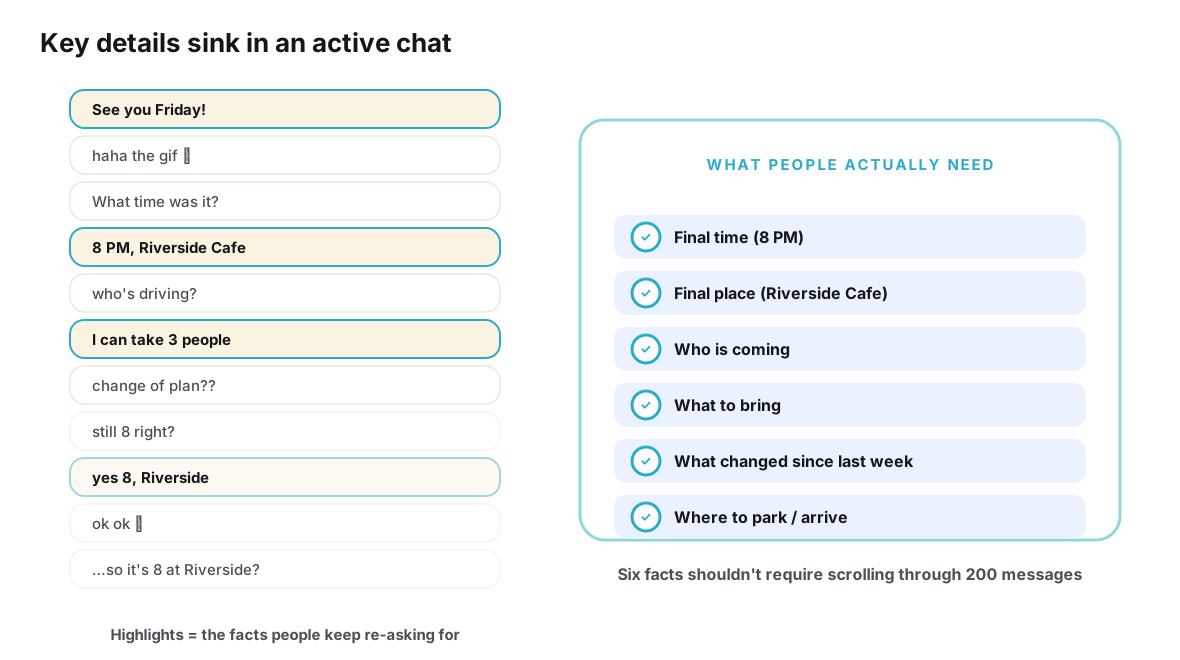
The extraction pass itself is simple, but three traps catch almost everyone on a first migration. The first is trusting the loudest message over the latest one. A confident “Saturday it is!” from three people can sit in the thread next to a quiet later message reading “sorry, Saturday’s out for me” — and the debate may have continued in private messages you cannot see. When two statements conflict, the honest record says the question is open again, and the question becomes an option with a vote. Extraction is no place for wishful interpretation.
The second trap is importing the thread’s ambiguity into the record. “Soon-ish”, “the usual place”, and “let’s say 8 unless…” are perfectly fine in conversation and poisonous in fields, because a field’s entire value is being definite. Convert or flag: either the fact becomes concrete on the page, or it goes to the open list. A record with vague values is just a shorter thread wearing a suit.
The third trap is over-extraction — copying the history instead of the state. The record needs the current plan, not the saga of how it formed. Nobody consulting the page needs to know that the venue changed twice; they need the venue. Leave the history in the thread, where it belongs, and let the record be ruthlessly present-tense.
Writing the one message that moves the group
The announcement is the hinge of the whole migration, and it deserves five minutes of care. Its job is not to explain information — the record does that. Its job is to explain the change of venue for the plan, in a tone that makes the group feel looked after rather than managed. A workable shape looks like this:
“Friends — three weeks of genius planning later, here’s everything in one place: [link]. Time, place, who’s coming, and the two things we still get to vote on are all there, and I’ll keep it updated instead of burying it in here. The group stays exactly as chatty as ever; the facts just live at the link now. Set your going/maybe when you get a sec — it’s how I count for the table.”
Three things are doing the work in that message. It gives the link a reason to exist (everything in one place). It explicitly reassures the group about the chat (stays exactly as chatty as ever) — this matters more than organizers expect, because the first objection to any migration is the fear that the fun is being policed. And it ends with exactly one concrete ask (set your status), small enough to do from a lock screen, which gets everyone into the record once — and one visit is usually all it takes for the format to click.
What moves to the record and what stays in the chat
Migration confuses people when the boundary is left implicit, so make it explicit — ideally in the announcement itself. The division is consistent across every group that has done this well:
| Item | Where it lives now | Why |
|---|---|---|
| Negotiating options | Both — argue in chat, vote on the record | Persuasion is conversation; the tally is state |
| Final time and place | The record, always | One current value, consultable by anyone in seconds |
| Who is coming | The record’s status list | Self-maintaining headcount instead of a recurring thread |
| Changes and updates | Edits to the record, with a heads-up in chat if major | An edit reaches everyone who looks; a message reaches whoever saw it |
| Reminders | Sent from the record | The nudge and the facts arrive together instead of as two things to reconcile |
| Jokes, banter, anticipation | The chat, forever | This was always the chat’s job, and it is now free to do only this |
| Post-event photos and debrief | Wherever the group enjoys them | The record’s job ended when the event did — it stands as the archive |
If you want the boundary in one sentence for the group: “If it’s still true next week, it goes on the page; if it’s only funny today, it goes here.” Groups tend to internalize the rule within days, after which the organizer’s job collapses to occasional edits.
Winning over the thread-loyal
Every group has one or two members who keep planning in the thread out of habit or mild principle, and how the organizer responds in the first two weeks decides whether they become adopters or martyrs. The rule that works is: never fight the thread, and never duplicate it either. If someone proposes a new venue in chat, reply with a sentence of genuine engagement plus the link — “ooh, good call — added it as an option on the page, everyone vote.” The proposal gets honored, the record gets the decision, and nobody is corrected in public.
The failure mode to avoid at all costs is maintaining both systems in parallel “to be safe.” The moment the organizer keeps updating the thread and the record, the two drift, the record loses its authority, and the group rationally concludes that the thread is still where truth lives. One source, pointed to often, beats two sources updated in parallel — this is the core of the argument for creating one source of truth for a group event, and migration is where it is proven or lost.
Give the skeptics a specific grace: nobody must change how they talk. The thread-loyal member who never opens the record still benefits from it — their questions get link answers that take four seconds, and on the night they arrive at the right place. Adoption of the tool is optional; the accuracy of the plan is not.
Running the event after the move
Migrated life is quieter than thread life, and organizers sometimes miss the noise. What replaces it is a short weekly rhythm: glance at the votes, close what has converged, edit what changed, and otherwise let the record sit. When a genuinely major change lands — new venue, new day — announce it in the chat in one line with the link, because the point of the group is still to reach people, and a nudge plus a source beats a source alone.
If you are not the only organizer, settle ownership explicitly on day one: who edits the record, and how changes get communicated between you. More than one person can edit, but the group should still experience the record as a single voice — one current state, whoever typed it. The failure pattern to avoid is co-organizers making contradictory edits and announcing them separately, which politely rebuilds the fork problem with better tooling.
In the final days, send the reminder from the record rather than composing the traditional “FINAL DETAILS (for real this time)” message. The reminder’s job is done when it gets people to one address that is guaranteed current — which is also why day-of corrections are so much calmer after migration: edit the page, post “update — link,” and even the person who reads it three hours late lands on the truth. For groups that keep planning many events, the same pattern scales down beautifully: a single activity planned in a handful of messages is the exact workflow described in how to plan a group activity without 200 WhatsApp messages.
Do you need a tool, or just a document?
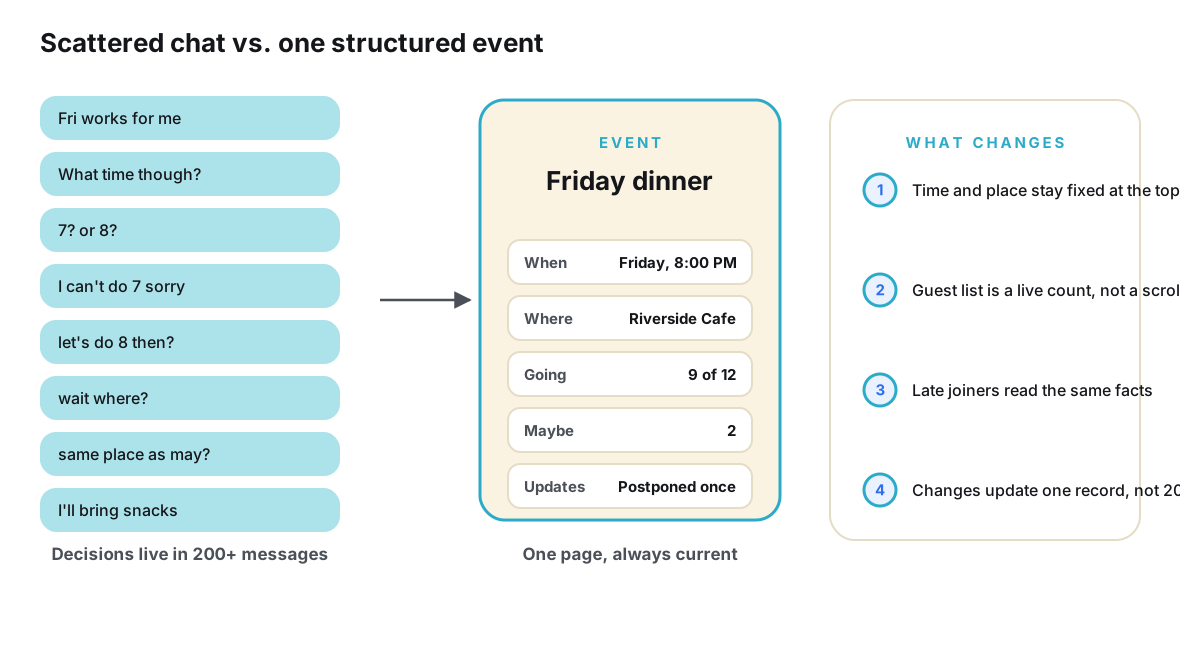
For one small event, a disciplined document or note can play the role of the record: one address (a shared link), labeled fields, statuses kept by hand, edits instead of new versions. The approach fails predictably as any of three things grow — guests who must update their own status rather than pinging you, options that need real voting, and changes that need to reach people without you relaying them. That is where a purpose-built record starts paying for itself: an event page with voting on options, going and maybe statuses each guest controls, one link per event, and reminders sent from the facts — the way Ontaym approaches it.
It is also worth knowing that structure is not just a convenience for humans. Search engines and assistants increasingly expect events as structured data — the schema.org Event type is the standard way a page declares itself to be an event with a time, a place, and an attendance action — and a well-formed event record can carry that meaning in a way a chat thread never can. Your dinner will not need rich results, but it is a nice reminder that “event with fields” is a real, formal concept, not a productivity affectation.
If your hesitation is scheduling-specific — the group’s real problem is just finding a date — a dedicated scheduling poll may be all that is needed, and services like Doodle have done that one job for a long time. But date selection is one field of an event; the migration described here is for groups whose plans have outgrown any single question. And for the mechanics of what WhatsApp itself can hold together — polls, pins, group descriptions — the WhatsApp Help Center is the honest source on the ceiling of each.
When the event is over
The migration’s last dividend arrives after everyone has gone home. The record is the event’s archive: what was planned, what changed, who came, what it cost. Thread-based events have no such object — their history is a scroll of versions where the final plan must be inferred. A week later, “what was that place we loved?” is a lookup instead of an excavation, and the next event starts from a template instead of from zero.
Recurring groups feel this most. The fifth dinner organized from a copy of the fourth’s record takes minutes to set up, while the fifth dinner organized from a fresh chat starts the whole mess again. There is a deeper reason for that difference, and it is the same reason this whole migration works: a conversation and an event object are different kinds of things, as argued in why messaging apps were never designed to be event databases. Migration is simply the act of letting each of them be what it is.
Frequently asked questions
Do I have to delete or abandon the WhatsApp group?
No — the group is the migration’s biggest beneficiary. It keeps the jokes, the anticipation, and the conversation, and sheds only the logistical traffic that was making it noisy. Most groups find the chat becomes more enjoyable after the plan moves out, because the thread returns to being purely social.
What if some guests don’t want another app or link?
The record asks far less than a group chat does: no membership, no phone number shared with strangers, no notification stream — open a link, read a page, tap a status. Guests who refuse even that still receive the facts the old way, through the thread’s link answers and the reminder. The bar is low on purpose; the plan must reach everyone, not convert everyone.
How long does the migration actually take?
One focused sitting covers steps one through six: the extraction pass, building the record, and writing the announcement. For a typical group the extraction is the slow part, and it shrinks sharply with practice. After that comes the transition week, which costs seconds at a time — answering questions with the link instead of with summaries.
What if decisions are still being made after I create the record?
That is the record doing its job, not failing at it. Anything undecided enters as an open option with a vote; when the group converges, you close the option and the field fills in. The record is designed to hold “TBD” honestly, which is exactly what a thread cannot do without generating another round of messages.
What about people who keep planning in the thread anyway?
Engage with their idea, then move the decision: a sentence of real response plus “added it as an option — link.” Never scold, and never maintain a parallel copy of the plan in the thread to accommodate them — parallel copies drift, and drift destroys the record’s authority. Habitual thread-planners usually convert within a couple of weeks of seeing their ideas honored on the page.
Can I do this without any dedicated tool?
For one small event, yes: a shared document with labeled fields, kept ruthlessly current, covers the extraction and the single-address principle. It weakens as soon as guests need to update their own status, vote on options, or get reminders without you relaying everything — which is where a purpose-built event record earns its place.
Conclusion
The migration is deliberately unglamorous: freeze briefly, extract honestly, build the record with facts and open options, announce once with warmth, then answer everything with the link. None of the steps is technically hard; the discipline is emotional — resisting the urge to keep updating the thread, and trusting one address to hold the truth.
Do it once and the group learns the pattern permanently. The second event takes minutes to set up, the third organizes itself, and the phrase “scroll up” quietly retires from the group’s vocabulary. The conversation gets better, the plan gets sturdier, and the organizer — the person this was all really for — gets to spend the week before their own event looking forward to it instead of relaying it.
Lift your plan out of the thread — in one sitting.
Plan it with Ontaym