
WhatsApp Event Planning: What Happens When Someone Joins Late?
The plan took two weeks and four hundred messages to settle — and then Dan joined on Tuesday. In a WhatsApp thread, every late arrival restarts the conversation the group thought it had finished, and the finishing has to be done again, by hand.
Quick answer
When someone joins a WhatsApp event plan late, they inherit a scroll-back archive rather than a plan: superseded decisions sit beside current ones with nothing marking the difference, so the newcomer reconstructs the event by archaeology and often reconstructs it wrongly. Their questions then re-open settled matters, generating repeat answers that bury themselves again — the mess compounds with every arrival. Recap messages and pinned summaries help briefly but decay with each change. The durable fix is to stop treating the thread as the onboarding document: keep current facts at one address that always shows the latest state, give late joiners that link plus a two-sentence orientation, and let them set their RSVP on arrival. Onboarding becomes a lookup instead of a research project.
Everyone joins late eventually
Planning conversations pretend to be synchronous. They are not. The thread runs for two weeks, but each member participates in a personal slice of it — the evenings they were free, the commute when they scrolled, the day they were off sick. The person who “joins late” is only the extreme case of a condition everyone has: nobody has read everything.
This is why late joining is a design problem rather than an edge case. Someone hears about the dinner after the date was fought over and won. A colleague is added once the plan becomes serious. A partner is brought in at the “so what exactly is this?” stage. The friend who was traveling returns to a group that has quietly moved continents. Every one of these people needs the same thing — the current plan, quickly — and the thread offers them the same thing it offers everyone: raw history, undifferentiated, in reverse order.
The moment is more delicate than it looks, because it is a social occasion wearing an information-problem’s clothes. The late joiner wants to be enthusiastic and low-maintenance; the group wants to welcome them; nobody wants to redo the negotiation. And yet the thread’s structure converts a simple need — “catch me up” — into one of the most expensive interactions the group performs. The mechanics of that conversion are the subject of the rest of this article. The broader decay they feed into is covered in why WhatsApp groups become messy when planning events; here the focus stays on the newcomer’s side of the wall.
A field guide to late joiners
Not all late joiners arrive the same way, and the differences matter, because each type stresses the thread differently. The five below cover most real cases.
| Late joiner | What they missed | What the thread offers them |
|---|---|---|
| The added member | The whole decision phase; arrives to hundreds of messages | “Scroll up” — full archaeology, oldest errors first |
| The verbally invited | Everything; heard about the event outside the group entirely | Secondhand summaries of varying accuracy |
| The returning member | A dense burst of changes since they last looked | A diff they must compute against their own memory |
| The plus-one | Context and norms: dress code, in-jokes, who is who | Membership in a group of strangers, uninvited history included |
| The promoted organizer | The reasoning behind every settled decision | Rationale scattered across weeks of interleaved debate |
One type deserves special mention because it is invisible in the membership list: the muted member. They are technically present from day one and functionally a late joiner throughout — dropping in every few days to a wall of undifferentiated messages, missing changes announced while they were away, asking questions the active members answered long ago. In groups with default-muted members, late-joiner dynamics are not an occasional event; they are the permanent operating condition.
The muted member also explains a puzzle organizers report: the same person asks the same question repeatedly, despite having been answered twice, without any apparent carelessness. They are not failing to remember — they are optimizing. Re-asking costs them five seconds; scrolling four hundred messages to verify costs them their evening. Under that arithmetic, asking again is the rational choice, and the thread has quietly priced its own contents out of reach. Any group that scolds members for not reading back is arguing with a price, not a person.
The archaeology of “scroll up”
The standard onboarding instruction — “scroll up, it’s all there” — contains a truth and a trap. The truth: the information is all there. The trap: it is there as history, not as a plan, and history is the hardest possible format from which to extract a current state.
The archaeologist works in the worst direction: backwards, encountering the group’s oldest errors first. They meet the Friday plan before the Saturday correction, the first venue before the switch, the enthusiastic “I’m in!” from the friend who later dropped out without saying so. Nothing marks a superseded fact, because the thread has no concept of supersession — only of position. Reconstructing the present therefore requires reading the past, remembering the corrections, and correctly inferring which statements were decisions, which were jokes, and which were opening bids that never closed. It is an interpretive exercise requiring exactly the context a newcomer lacks. That is why two late joiners, both diligent, both scrolling the whole thread, routinely arrive at different events.
The errors that result have a signature shape. The late joiner believes the event is bigger than it is, because visible enthusiasm is easier to count than invisible attrition. They believe it is earlier than it is, or on the wrong day, if they stopped scrolling one correction short. They ask before the group’s social history whether they can bring a partner, a question the thread answered weeks ago in a message now buried under a hundred others. And because they did the reading honestly, they hold these beliefs with conviction — the archaeology felt like research, and research confers confidence.
The repeat-question cycle
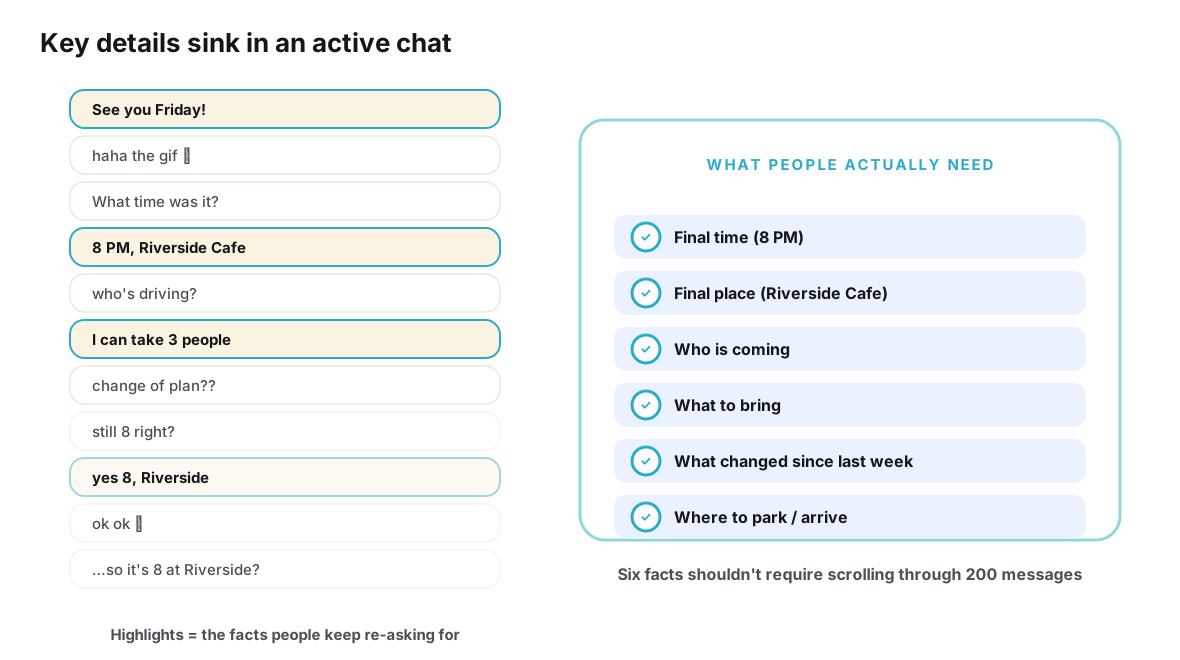
Archaeology is expensive, so most late joiners outsource it: they ask. This is individually rational and collectively corrosive, because every question re-opens a matter the group considers settled — and the answer, once given, begins to sink like every message before it.
Watch the cycle run. Dan joins Tuesday and asks what time. Three people answer, slightly differently, because each remembers the thread differently. Someone reposts the address “so it’s in one place” — creating a new copy that will diverge from the pin if either changes. A quiet member, seeing the question, realizes they too were unsure, and asks a second. The organizer answers privately to reduce noise, which removes the answer from the group’s view entirely. Two days later, another joiner asks what time, and the cycle runs again — but from a higher baseline, because the thread is now longer, and the answering population is more tired.
The structural cruelty is that the cycle is self-worsening. Every late joiner increases the message count; more messages make archaeology less attractive; less archaeology means more asking; more asking means more messages. The thread’s usefulness as an onboarding document declines at precisely the rate it is used as one. And the organizer, who holds the actual state in their head, becomes a replay service — a human endpoint that answers the same query with the same response, forever, one arrival at a time.
The recap message: a snapshot that decays
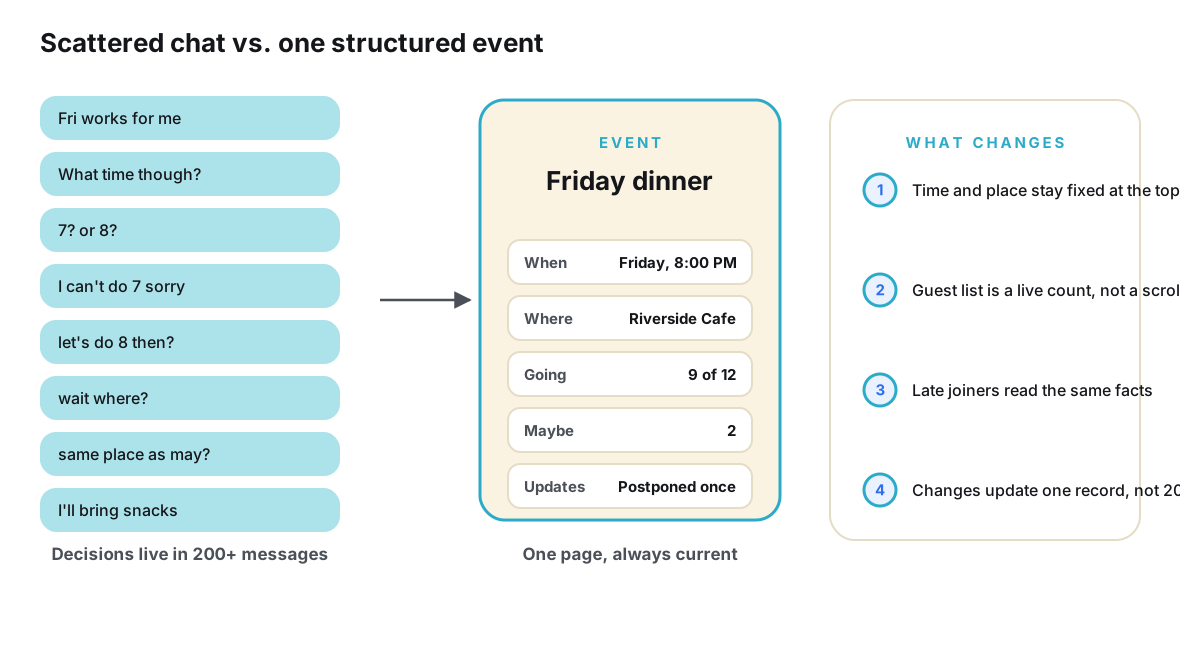
Experienced organizers invent the same tool around the second event: the recap. A single, well-formatted message — “PLAN SO FAR: Saturday 14th, 8pm, Casa Verde, 12 coming, bring something to drink” — posted into the thread and often pinned. It works, immediately and visibly. Questions drop. Newcomers orient. The organizer feels the relief of having written something down.
Then time does what it does. The venue changes; the recap says Casa Verde with the confidence of bold text. The headcount moves; the recap’s “12” becomes fiction one quiet dropout at a time. A second recap is posted to supersede the first, and now the thread contains two recaps, and a late joiner scrolling backwards meets them in the wrong order — the exact failure the recap was invented to prevent, rebuilt one level up. The pin, meanwhile, can hold only so many messages before it becomes its own archive.
The recap’s failure mode is precise: it is a snapshot pretending to be a state. Snapshots are static copies of a moving fact, and every copy ages. The group’s instinct — post it again, pin it harder, add “(UPDATED)” to the title — treats the symptom while deepening the cause, because each new snapshot is one more thing that can be wrong at the same time as the others. What the recap is reaching for is a place that shows the current plan and updates when the plan does. That place is not a message, in the same way a photograph of a clock is not a clock.
What adding someone to the group actually does
When the late joiner is brought in via group membership — the default move — the platform performs a small bundle of actions at once, and it is worth unpacking the bundle, because only part of it is the onboarding you wanted.
The new member receives the full history, unfiltered: not just the plan, but the negotiation, the abandoned options, the side jokes, and quite possibly messages about people they have never met. They become visible to the group as a contact — WhatsApp group membership rests on phone numbers, so joining means appearing in the membership list of every other member, per the way the WhatsApp Help Center describes group and Communities membership. They inherit the notification stream at full volume, which for an active planning group is an intimidating welcome. And they acquire write access on day one, before they know what is settled — which is how the re-litigation begins.
For large or ongoing memberships, WhatsApp’s Communities — described at whatsapp.com as a way to link related groups and share announcements with all their members — soften one edge: announcements can reach everyone without the reply-all storm. But an announcement is still a message; it ages, it cannot be queried, and a late joiner still needs the latest one rather than the ones before. The broadcast problem is solved; the state problem is untouched. Other platforms make the same trade in their own accent — Telegram’s own FAQ describes channels as one-to-many broadcast separate from groups, a cleaner separation, but a channel feed is still a feed, newest-first, unqueryable as a current state.
Onboarding methods, compared
Set the options side by side and the pattern is hard to miss: every thread-native method is either labor that recurs or a snapshot that decays.
| Method | Effort per joiner | Stays current afterwards? |
|---|---|---|
| “Scroll up” | Theirs: high | No — and the reconstruction is often wrong |
| Private chat briefing | Yours: high, every time | No — the answer lives in one private thread |
| Pinned recap message | Yours: one-time, then maintenance | Until the first change, then actively misleading |
| Group description | Yours: low | Too small for a plan; edits are silent |
| Announcement channel blast | Yours: low | No — a feed of updates, newest-buried like any feed |
| One event link with current state | Yours: none after setup | Yes — the link shows the latest plan by construction |
The last row is doing something categorically different, and the difference is worth stating plainly. Every other row delivers a copy of the plan at a moment in time, produced per joiner or per change. The link delivers the plan itself, which is why it cannot go stale: there is no copy to diverge. The work of onboarding collapses from an act of communication into an act of pointing.
One weekend, three late joiners
To see the whole article compressed into a single weekend, take a hypothetical cabin trip planned by eight friends in a WhatsApp group across two weeks — and then joined, serially, by three people.
Joiner one: Elif, added on day nine. She is added to the group, greeted with twelve welcome messages she must scroll past, and told “everything’s in the chat.” She spends an evening reading backwards. She encounters the original plan — leaving Saturday at 9 — before the correction to 11, and the original cabin before the switch to the second one, and she emerges with a hybrid: the second cabin, at 9. Her question about the time re-opens a mild debate about whether 11 was really final. The organizer, cooking dinner, answers three messages to settle a matter settled a week ago.
Joiner two: Marco, invited verbally, day twelve. Marco never joins the group; a friend relays the plan to him in a private chat, accurately, minus the detail about bringing bedding, which the friend forgot was decided. Marco arrives with a sleeping bag and no towel. Nobody is at fault — the relay did its best — but the thread’s knowledge existed nowhere a relay could check it.
Joiner three: Priya, returning member, day thirteen. Priya was present at the start, offline for ten days, and comes back to four hundred messages. She does what a sensible person does: she reads the last thirty, infers wrongly that departure is 9, and books nothing, plans nothing, and discovers her error in the car park. Her fix attempt — “wait, we’re leaving at 11??” — generates a fresh round of confirmations that will themselves be buried by morning.
Now rerun the weekend with the plan held at one address. Elif gets the link and a two-sentence hello; she is current in thirty seconds and her status joins the list. Marco’s relay is the link itself, sent to his private chat — checkable, complete, current. Priya opens the page she bookmarked on day one, sees departure at 11 in a labeled field, and adjusts her morning. The group’s message count for the entire weekend of arrivals is roughly zero. The difference is not that the friends became better organized; it is that the plan stopped being something you have to have been present for.
Building an event that onboards itself
The practical version is a small discipline, applied once at the start of planning and inherited by every arrival afterwards.
- Hold the plan at one address from day one. Before the discussion heats up, give the event a page or link with its known facts and its open questions. The earlier the address exists, the less history any late joiner ever needs — the thread never becomes the only source.
- Point, don’t summarize. When someone joins, send the link with two sentences of orientation: what the event is, what you need from them. Resist the urge to also summarize the plan in the message; every summary is a copy, and copies diverge.
- Let them RSVP on arrival. Their first act is a status — going, maybe, not going — not a message. The headcount updates itself, and the group learns they have joined from the list, not from an interruption.
- Make changes as edits at the address. When the plan moves, the page moves with it, and every past and future joiner sees the new state without anyone re-announcing it to them. Handling updates this way is its own discipline, unpacked in how to manage event changes when everyone has different WhatsApp messages.
- Keep the group for the group. The chat remains what it is best at — banter, anticipation, the social texture. The difference between chatting and planning is exactly the difference between a thread and a state, and it is worth keeping the two consciously separate; why WhatsApp is great for chatting but bad for structured planning draws that line in full.
Notice that the procedure makes no distinction between the first guest and the fifteenth. That indifference is the feature. An event that onboards through a current-state address treats arrival order as irrelevant, which is the correct treatment for something that happens asynchronously — and it is the same invariant described from the organizer’s side in how to create one source of truth for a group event.
The RSVP that arrives after the count
One late-joiner consequence deserves its own paragraph, because it is the one with a bill attached: the headcount. A late yes perturbs a number that has often already been communicated — to a restaurant, a coach booking, a cake order — and in a thread-native plan that perturbation happens invisibly. The joiner tells the organizer, the organizer updates the venue by phone, and the group’s shared understanding of “how many of us are there” quietly forks from reality.
The address-based pattern absorbs this by construction: the late joiner’s status lands on the same list as everyone else’s, the visible count moves in front of the whole group, and whoever needs the number reads it from the source rather than from the last thing they remember being told. The late arrival becomes a one-line event in a ledger instead of a private transaction that the organizer must remember to redistribute.
There is a subtler benefit too, on the social side of the ledger. A late joiner who must ask for permission to exist — “is it too late to come?” — absorbs a small amount of friction on top of their enthusiasm, and some fraction of marginal guests simply evaporate at that step. A joiner who finds a list they can add themselves to experiences the opposite: the event is visibly still open, the mechanism is visibly ready for them, and joining costs one tap. Events that are easy to join late are, in the most literal sense, easier to join.
Frequently asked questions
Should I add a late joiner to the group at all?
Ask what the membership is for. If the point is for them to participate in the ongoing social life of the group, add them — that is what groups are for. If the point is only to get them the plan, a link does that without the notification dump, the history exposure, or the write-access-before-context problem. Many events need the second and never needed the first.
What should I send a late joiner first?
Two sentences and the link: what the event is, in plain words, and what you need from them — usually an RSVP by a certain date. Not a summary of the plan, not a history, not an apology. The summary ages, the history overwhelms, and the link does neither.
How do I stop late joiners from re-opening settled decisions?
By making settlement visible. A decision recorded on a page as a final fact reads as closed; the same decision buried at message 140 reads as an opinion someone once held. If a late joiner still re-opens it, answer by pointing at the field — and if their point is genuinely new, reopen it deliberately, in the open, rather than letting the thread re-litigate by accident.
What if the late joiner disagrees with a decision already made?
Treat it as a fork in the road, consciously chosen. Either the point is not material — say so kindly and move on — or it is, in which case the decision process restarts for everyone, at cost. What you want to avoid is the middle path the thread enables by default: a quiet re-litigation in which the plan changes for some participants and not others.
Don’t Communities and announcement channels solve this?
They solve distribution, not state. Announcements reach every member without a reply-all storm, which is a real improvement for large memberships. But the late joiner still needs the newest announcement rather than the old ones, and announcements still age like any message. The gap remains between telling everyone about the plan and holding the plan somewhere current.
Isn’t some of this just… hosting?
Yes, and the social labor of welcoming people is genuinely part of organizing — nothing here automates warmth. What it removes is the clerical labor mistaken for hosting: repeating facts, re-sending addresses, computing headcount deltas by hand. The welcome that remains is the part guests actually remember; the replay service is the part that burned you out.
Conclusion
Late joiners are not a problem to be prevented — they are the natural shape of any plan that outlives a single conversation. The problem is what awaits them: a thread that offers history where they need state, an onboarding of archaeology and inference, and a welcome that consists of several hundred backlogged messages and the instruction to read them. Everything the group does to compensate — recaps, pins, re-answers, private briefings — is a snapshot or a repetition, aging on the same schedule as the messages it was meant to rescue.
The alternative is to hold the plan where arrival order does not matter: one address with the current facts, the open questions, and each person’s status, ready to be opened in thirty seconds by whoever shows up, whenever they show up. Send the link with two warm sentences. Let the chat do the welcoming. A plan that can be joined at any time is not a nicer plan — it is the same plan, finally stored in a format that matches how people actually arrive: late, in a hurry, and ready to say yes if someone tells them where.
Make your next event joinable at any time — with one link.
Welcome late joiners with Ontaym