
Why WhatsApp Groups Become Messy When Planning Events
Every group that has ever planned an event in a WhatsApp thread has watched it decay in the same order, at roughly the same speed. That regularity is the tell: the mess is not bad luck or bad participants. It is structure.
Quick answer
WhatsApp groups become messy for event planning because a chat thread is an append-only, newest-first record of a conversation, while an event plan is a small set of current facts that must stay findable and authoritative. Six mechanisms follow from that mismatch: history accumulates instead of state, recency outranks importance, every topic shares one lane, replies are ambiguous signals, every update costs the whole group’s attention, and scale multiplies all of it. Pins, polls and re-posted recaps soften individual symptoms without introducing the missing thing — a current state. The durable fix is to separate conversation from record: let the chat talk, and hold the plan at a single address the chat points to.
The mess has a shape
Ask around and you will hear the same story with different names attached. The group starts with a burst of enthusiasm. A date gets proposed, then debated. Someone asks a question that was answered on day one. Someone else mutes the group and reappears a week later, confused. The organizer posts a “final details” message that is superseded by a quieter correction two days later. By event day, at least two people hold a wrong time, and the person who did the most work is the tiredest.
What makes this pattern interesting is how little it varies. Different groups, different countries, different kinds of events — the decay curve is recognizably the same. When a failure is this consistent, the cause is rarely the people. The cause is the medium. A WhatsApp group is a superb instrument for one job — sustained, many-to-many conversation — and planning an event quietly asks it to do a different job: maintain a small database that everyone can read at any time.
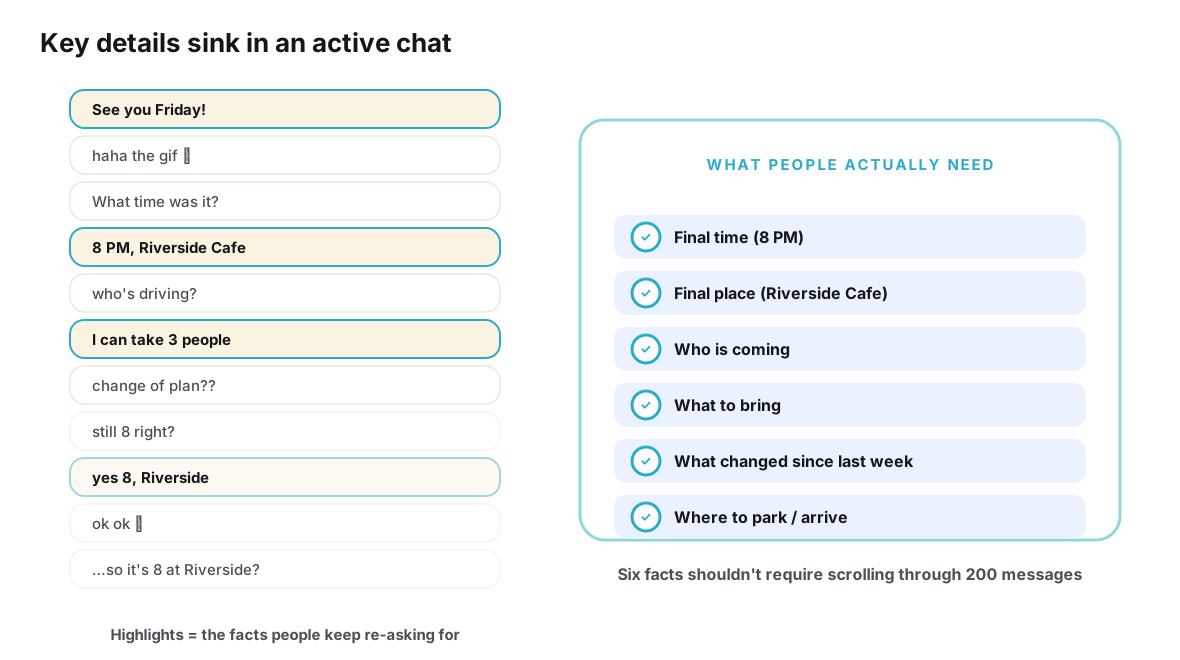
A thought experiment sets the scale of that second job. Take any group chat that has planned a real event and try to reconstruct, from the thread alone, the six facts every guest needed on the night: final date, final time, final place with its address, the going list, what to bring, and what changed along the way. Even in a modest thread this takes minutes, produces at least one moment of genuine doubt, and ends with a reconstruction rather than a lookup. Now repeat the exercise for every guest, on the night, from a phone, in a hurry. The mess is what that arithmetic feels like from the inside.
This article is a mechanism-by-mechanism account of why threads degrade, written without blame. WhatsApp is not malfunctioning in any of what follows; it is working exactly as designed, for a purpose that events bend it away from. If you want the constructive counterpart — the workflow that avoids creating a group in the first place — that is covered separately. Here, the goal is diagnosis: understanding precisely why the mess forms, because every real fix has to target one of these mechanisms or work around all six.
Mechanism one: the thread records history, not state
The deepest difference between a chat and a plan is what they store. A chat stores everything that was said, in order, forever. A plan is a set of current values: one final time, one final place, one definitive list of who is coming. These are not the same thing stored differently — they are different things.
When the plan changes from 8 PM to 9 PM, the thread does not update. It appends. The group now contains “8 PM” and “actually, 9 PM” as two equally real messages, and the truth lives only in their ordering. Every reader becomes a little archaeologist, reconstructing the present from a stratigraphy of statements, each true when it was sent. Nothing in the interface distinguishes a superseded fact from a current one, because the interface has no concept of supersession — only of sequence.
This is why two careful people can read the same thread and reach different conclusions about the same event. Neither misread anything. The thread never contained a single authoritative record; it contained a series of utterances whose current validity must be inferred. Inference is work, work is skipped, and skipped work becomes a wrong time on a Thursday night.
Mechanism two: recency is the only ranking
Every messaging interface shares one silent assumption: the newest message is the most relevant one. For conversation, that assumption is exactly right — it is what makes chat feel alive. For an event, it is inverted. The most important information is a small, stable set of facts — when, where, who, what changed — and its importance does not decay no matter how many messages pile on top of it.
A chat cannot reorder by importance, because importance is not a property messages carry. A message reading “moved to Saturday!” is rendered identically to a message reading “lol”: same bubble, same font, same slide into history. The interface gives the organizer no way to say this is the plan and everything else is commentary. And so the address, the final headcount and the dress code sink beneath the day-to-day social life of the group, exactly as if they were worth no more than that day’s jokes.
The burial problem has its own anatomy — scroll depth, the limits of in-chat search, the half-life of a pinned message — and it is serious enough to deserve its own treatment in how to stop important event details from getting buried in WhatsApp. For this article, the point is smaller and stranger: the mess is not caused by too much information, but by the absence of any ranking other than time.
Mechanism three: every topic shares one lane
A planning conversation is not one conversation. It is at least four, interleaved: the date negotiation, the venue debate, the logistics thread (parking, lifts, plus-ones), and the ordinary social chatter that is the reason the group exists at all. A WhatsApp group gives all of them a single shared lane.
Interleaving is what makes a planning thread genuinely hard to read, beyond mere length. A message saying “that place is too pricey” is unintelligible without knowing which venue message it answered, which may be forty messages up. A date settled at lunch gets reopened at midnight by someone just arriving. The same question is answered three times because the answers do not stay adjacent to the question. None of this is anyone’s fault — it is what happens when parallel conversations are forced through a single chronological channel.
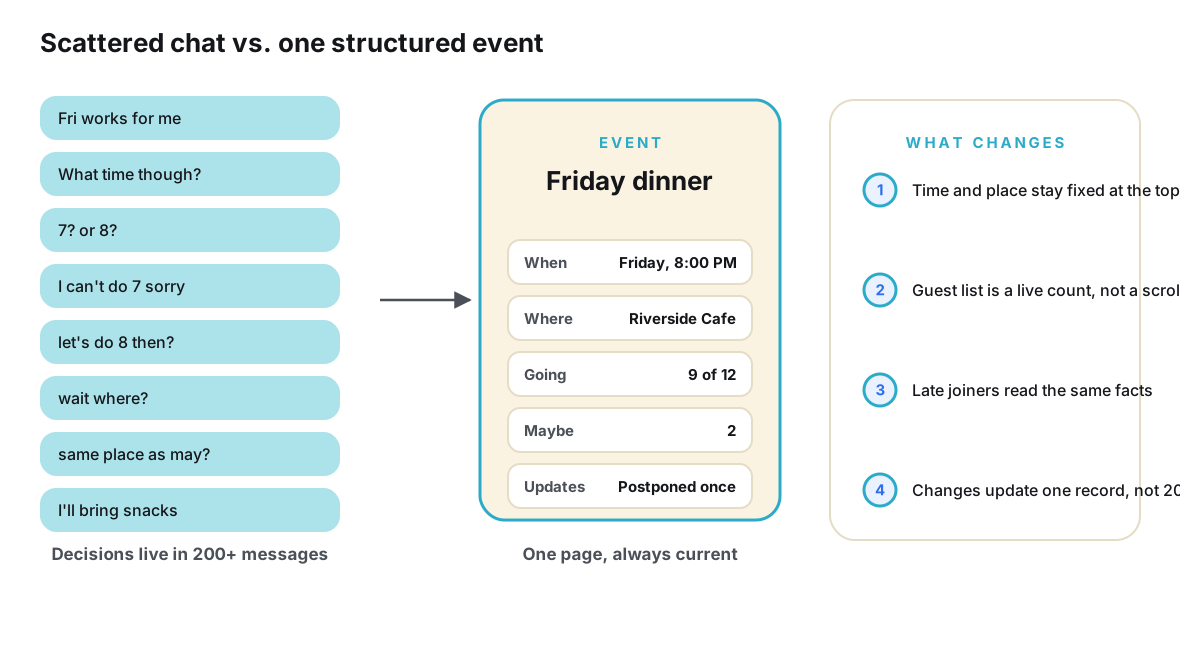
The practical casualty of interleaving is resolution. In a well-run planning process, a question gets raised, discussed and closed, and its closure becomes a fact. In a shared lane, closure is invisible. Was “let’s do the 14th” a decision, or an opening bid? Did the silence after the venue suggestion mean agreement, or that everyone was busy arguing about the date? The group has no register of settled matters, so settled matters get re-litigated — and the re-litigation produces new messages that bury the original settlement deeper.
Interleaving has accomplices. Photos of menus, screenshots of maps, voice notes negotiating a lift, a forwarded message from the restaurant — all of it enters the same lane with the same weight, and none of it is addressable later. You cannot link to “the second photo,” you cannot search the contents of a voice note, and a screenshot of a map is a picture of information rather than the information itself. Six weeks on, the thread is not so much a record of the plan as a sediment of everything the group ever exchanged, with the plan dissolved somewhere inside it.
Mechanism four: replies are ambiguous signals
Ask a chat “who’s in?” and observe what comes back. A thumbs-up on the message itself. A “👍” as a standalone reply. A “I’ll try to make it!” that could mean enthusiasm or apology. A poll vote. A private message to the organizer saying “don’t put me down yet.” And — the largest category — silence, from people who are in, people who are out, and people who have not opened the app since Tuesday.
Every one of these signals is genuine social communication and every one of them is useless as a record. A reaction is a gesture at a moment in time, not a commitment that persists. A warm reply precedes a quiet dropout as often as it precedes an arrival. A poll vote records an opinion while the poll was open, not a promise for the date itself. And silence is the most ambiguous signal of all, because the thread cannot distinguish “no” from “not yet” from “never saw it.”
The organizer experiences this mechanism as counting work. Somewhere in their head — or in a notes app the group never sees — they maintain the real list: definitely coming, probably, said yes but historically flakes, plus-ones, the two who need chasing. The thread holds the raw material; the organizer holds the state. This is the specific mechanism behind headcount chaos, and it has its own deep dive in how to track who is actually coming from a WhatsApp conversation.
Mechanism five: every update is charged to everyone
In a record, a change costs one edit. In a chat, a change costs one message — read by every member as a new interruption. That seems like a small price until you multiply it out: a plan that changes five times charges twenty-five people a hundred interruptions, most of which are irrelevant to the reader at that moment.
Organizers are social creatures, and they respond to this pricing rationally: they start economizing on updates. Changes get batched, softened and delayed — “probably still 8, will confirm tomorrow” — because stating them crisply feels like spamming friends. Ambiguity enters the record not because information was missing but because the medium made stating it clearly feel expensive. Then, because announcements decay with scroll, the same update must be repeated for everyone who missed it, and the repetition is itself what makes the channel noisy. The medium taxes exactly the behavior an evolving plan needs most.
There is a second-order effect worth naming: the organizer becomes the group’s memory as a defensive adaptation. Rather than post a fourth clarification, they start answering questions privately, one-to-one — quiet, invisible work that keeps the thread calm and concentrates all the load on one person. Burnout among organizers of chat-planned events is not a personality issue. It is the equilibrium this pricing produces.
Mechanism six: size multiplies everything
WhatsApp groups support up to 1,024 participants, per the WhatsApp Help Center — a figure that testifies to how well the platform scales conversation. But the mechanisms above all scale with the square of participation in practice: more people means more messages per hour, more parallel topics, more late arrivals, more updates, more chances for any given reader to have missed any given message. A thread that was merely untidy at eight members becomes unmaintainable at forty, with no change in anyone’s behavior.
Scale also changes the social physics. In a small group, politeness and memory do real work: everyone reads everything, and the organizer can hold the state in their head. Past some threshold, reading everything stops being feasible, social memory saturates, and the gap between what was said and what anyone currently knows grows on its own. This is why the mess feels sudden — the mechanisms were running from message one, but their costs stayed invisible until the group crossed the size where social goodwill stopped absorbing them.
WhatsApp’s Communities feature, described at whatsapp.com, acknowledges a version of this by letting organizers link related groups and push announcements to all of them. It is a genuine improvement for broadcasting to a large membership — but announcements are still messages, and messages still age. Scale was never the root problem; the missing state was.
| Mechanism | What the group experiences | What it costs |
|---|---|---|
| History, not state | Old facts remain beside new ones; the present must be inferred | Contradictory beliefs about the same plan |
| Recency as the only ranking | Key facts sink under later chatter | Scrolling, re-asking, screenshots of old messages |
| One shared lane | Parallel topics interleave; closure is invisible | Re-litigated decisions and unreadable context |
| Ambiguous signals | Reactions and replies stand in for commitments | Unreliable headcounts; the organizer counts privately |
| Updates charged to all | Changes get softened, batched, repeated | Ambiguity priced in; organizer burnout |
| Size multiplies all | Same behavior, worse outcomes as membership grows | The mess arrives suddenly at scale |
The lifecycle of a messy planning thread
Run the mechanisms forward in time and you get the lifecycle every organizer recognizes. It is worth spelling out stage by stage, because each stage has a natural intervention point — and because seeing the pattern in advance changes where groups spend their effort.
| Stage | What happens | What would actually help |
|---|---|---|
| 1. The spark | An idea lands in an existing chat or a new group forms; enthusiasm floods in | Write the essentials down as a brief before inviting discussion |
| 2. The decision burst | Dates, venues and options get proposed in parallel; nothing closes cleanly | Convert each settled question into a recorded fact the moment it settles |
| 3. The quiet drift | Chat volume falls; plans age silently; minds change without announcements | A scheduled reconfirmation tied to a deadline |
| 4. Re-litigation | Returning members reopen settled questions; “what time?” appears again | A single current-state destination to point every question at |
| 5. Recap attempts | Pins, “FINAL details” posts and description edits multiply and contradict | One authoritative address instead of several stale snapshots |
Most groups first reach for remedies at stage four, when the mess is already load-bearing, and reach for the remedies the platform puts nearest: pins, re-posts, stern group descriptions. By then the underlying statelessness has been compounding for days. The lifecycle also explains why the same group repeats the pattern on every event — nothing in stage five’s cleanup changes how stage two begins.
What groups try, and why it half-works
The workarounds deserve respect, because they are rational responses to real symptoms — and understanding why each decays sharpens the diagnosis.
The pinned message freezes one message at the top of the thread, which works until the plan changes; then the pin is either stale or manually replaced, and members who saw the first pin but missed the replacement hold the old facts with confidence. The group description is a natural home for “every Thursday, 7 PM” — until it is asked to carry event-level detail it was never sized for, and members who never open it assume it says what it said last month. The re-posted recap — the beloved “FINAL PLAN (updated)” message — is a snapshot that starts aging the moment it is sent; post it twice and the thread now contains two finals. The dedicated announcement group or broadcast list separates one-to-many updates from the chatter, which genuinely reduces noise, but announcements are still messages, still unqueryable, still subject to the same decay. And polls close one question cleanly at one moment — then the result drifts as reality does, and the poll cannot drift with it.
Look across the remedies and a pattern appears: every one is either a frozen snapshot, a moment-in-time aggregation, or a louder repetition. Each fights a symptom of statelessness with more messages. None of them introduce the thing whose absence started the mess — a single, current, queryable state that any member can read at any time without generating work for anyone else.
Stabilizing a thread that is already messy
Sometimes the mess is already installed and the event is too close for philosophy. A field-expedient stabilization exists, and it works by simulating the missing state as cheaply as possible:
- Stop the bleeding. Declare a freeze on re-litigation in one friendly message: settled questions are settled, and open ones get listed explicitly. Name the open ones so the freeze is verifiable.
- Reconstruct the state yourself. Privately, write down the current facts — final time, place, going list, outstanding unknowns — by reading the thread once, end to end. This is the archaeology pass; do it once so no one else has to.
- Publish one canonical message. Post the reconstructed state as a single, clearly formatted message and pin it. Mark it as the reference. Resist the urge to also pin three other things; one pin, one truth.
- Route every question to the pin. When someone asks what time, answer with a pointer, not a restatement. This is discipline, not curtness — every restatement creates a new fact that can drift from the pin.
- Update the pin, never append to it. When something changes, edit or re-post the canonical message and unpin the old one. The moment two pins coexist, you have rebuilt the original problem one level up.
This procedure works, which is exactly its danger: it is manual labor simulating a record. The organizer has become the database — reading, writing and versioning state by hand. For one event, in one crisis, that is a fair trade. As a standing workflow, it is the most expensive possible way to hold six facts.
Why none of this is WhatsApp’s fault
It is worth pausing on the fairness question, because the mess can read like an indictment of the platform. It is not. WhatsApp optimized, superbly, for conversation: instant delivery, read receipts, threading by group, presence, media. Every one of those choices is correct for talking — and every one is orthogonal to maintaining structured state. The comparison that makes this clearest is within the same category: Telegram, whose own FAQ describes supergroups of up to 200,000 members, polls with visible or anonymous votes, and a strict separation between channels and groups. Different platform, different features, larger numbers — and the same planning mess, because the underlying shape, conversation-as-stream, is shared. The failure mode is not a platform defect. It is a category boundary.
The boundary has a clean formulation: a conversation is a sequence of utterances; an event is an object with fields. The utterances can contain all the field values as words, but containing is not holding. This distinction — and what changes when a plan is finally treated as an object rather than a very long sentence — is unpacked in the difference between a conversation and an event object.
Frequently asked questions
Is the mess avoidable with better group etiquette?
Partially, and only for small groups. Etiquette — answering clearly, not re-opening settled questions, using polls for votes — slows the decay but cannot reverse it, because the mechanisms are structural: history still accumulates instead of state, and recency still outranks importance. Etiquette raises the ceiling; structure removes it.
Do WhatsApp polls fix the decision problem?
They fix one slice: a poll closes a single question at a single moment, cleanly and visibly. But a poll result is a snapshot. Attendance shifts after the poll closes, options change, and the vote cannot track any of that. Use polls for preferences; use a record for commitments.
At what group size does planning in chat break down?
There is no magic number, but the threshold is lower than people expect. Around a dozen active participants, reading everything stops being automatic; past that, the mechanisms compound faster than social memory can absorb them. A very quiet group can survive far larger numbers — activity, not membership alone, drives the decay.
What about making a second, announcements-only group?
It genuinely reduces noise, and for large memberships it is a reasonable stopgap. But announcements are still messages: they age, they cannot be queried, and each one must be repeated for those who missed it. You have split the stream in two, not added the state.
If the chat is the problem, why not just move everything to email?
Email has the same deep shape — an append-only stream of statements — plus quoting and threading that help slightly at the cost of fragmentation. The mess mechanisms survive the platform swap, which is the strongest evidence that the cause is structural rather than a defect of any one app.
What is the actual fix, in one sentence?
Give the event one address that always shows its current state, let the chat keep doing conversation, and make “check the link” the standing answer to every question about the plan.
Conclusion
Group chats do not become messy because people are careless. They become messy because planning asks a conversation tool to maintain state, and six specific mechanisms — history without state, recency without ranking, one lane for many topics, signals without commitment, updates priced in everyone’s attention, and scale multiplying it all — do their work steadily from the first message. The workarounds groups reach for are snapshots and repetitions, which is precisely why the mess returns on schedule for every event.
The structural insight is small and liberating: stop asking the thread to be the plan. Let conversation be conversation, somewhere it is good at it, and hold the plan itself — final facts, statuses, changes — at one address that any member can read in seconds at any moment. Groups that make that split report the same discovery: the chat did not get less social. It got less clerical. And the event, freed from being reconstructed daily, simply has details.
Let the chat be a chat — give your plan one address instead.
Plan it with Ontaym