
How to Plan an Event When Half Your Friends Use WhatsApp and Half Use iMessage
The mixed group is the most common planning problem there is: the iPhone contingent lives in iMessage, everyone else lives on WhatsApp, and the event belongs to both halves equally. Here is how to plan across the divide without losing updates, headcounts or your patience.
Quick answer
When a friend group is split between WhatsApp and iMessage, the plan usually splits too: each app grows its own thread, an update posted in one is missed by the other, and one person ends up relaying details by hand. Four strategies work in practice. You can standardize on a single app that everyone is technically able to join, run parallel groups with strict mirroring, appoint a bridge person to relay between chats, or — most robustly — give the event a neutral, link-shareable page that both apps point to, so each conversation links to one current record instead of carrying its own diverging copy. The right choice depends on your group's size, how often details change, and how much notification fatigue everyone already carries.
The split group is the default, not the edge case
There is a persistent fantasy that groups converge on one messenger. They do not. People choose their apps for reasons that have nothing to do with your dinner reservation: the phone they happened to buy, the family plan they sit on, the country where they grew up, whether their colleagues reached them somewhere else first, and how they feel about handing a given company their phone number. By the time your event enters the picture, those choices are years old and not up for renegotiation. The organizer inherits the split; the organizer does not get to cure it.
The technical boundary underneath the split is real, and it is not anyone's fault. iMessage groups are tied to Apple devices, which means friends on Android cannot take part in them at all. WhatsApp runs happily on iPhones and Android phones alike — its groups support up to 1,024 participants, so capacity is never the issue for a friend group — but membership is built on phone numbers, so joining means sharing yours with the group's creator and effectively with everyone in it. The two apps simply made different bets about identity: one ties you to hardware, the other to a number. Neither bet was made with your Saturday night in mind.
If you want to check those boundaries yourself rather than take my word for it, WhatsApp's Help Center documents how groups and their membership work, and Apple's support pages cover what iMessage groups depend on. Reading them as an organizer is a useful exercise: what you find are two perfectly reasonable messaging systems, each with an edge ending exactly where the other begins.
Your event, meanwhile, is indifferent to all of this. It needs precisely one final time, one final place and one dependable headcount, regardless of how many apps its guests prefer. The entire problem of mixed-group planning lives in the gap between "one event" and "two conversation islands" — and every strategy below is a different way of closing that gap.
What breaks first when the plan lives in two apps
Mixed groups rarely fail loudly. They fail quietly, in a handful of predictable ways, and it helps to name them before choosing a fix.
The first failure is information asymmetry. Decisions happen wherever the most talkative subset happens to be. If the iMessage half is chattier, the venue gets chosen there — and the WhatsApp half discovers it after the fact, sometimes with opinions that no longer matter because the booking is made. Nobody excluded anyone on purpose; the group simply forgot that half of itself was somewhere else.
The second is the relay tax. Every update must now exist twice. The organizer posts the new time in WhatsApp, remembers the iMessage thread, posts it there too, then answers the same follow-up question in both places. Multiply by every change the plan undergoes and the organizer's role quietly mutates from host to switchboard operator.
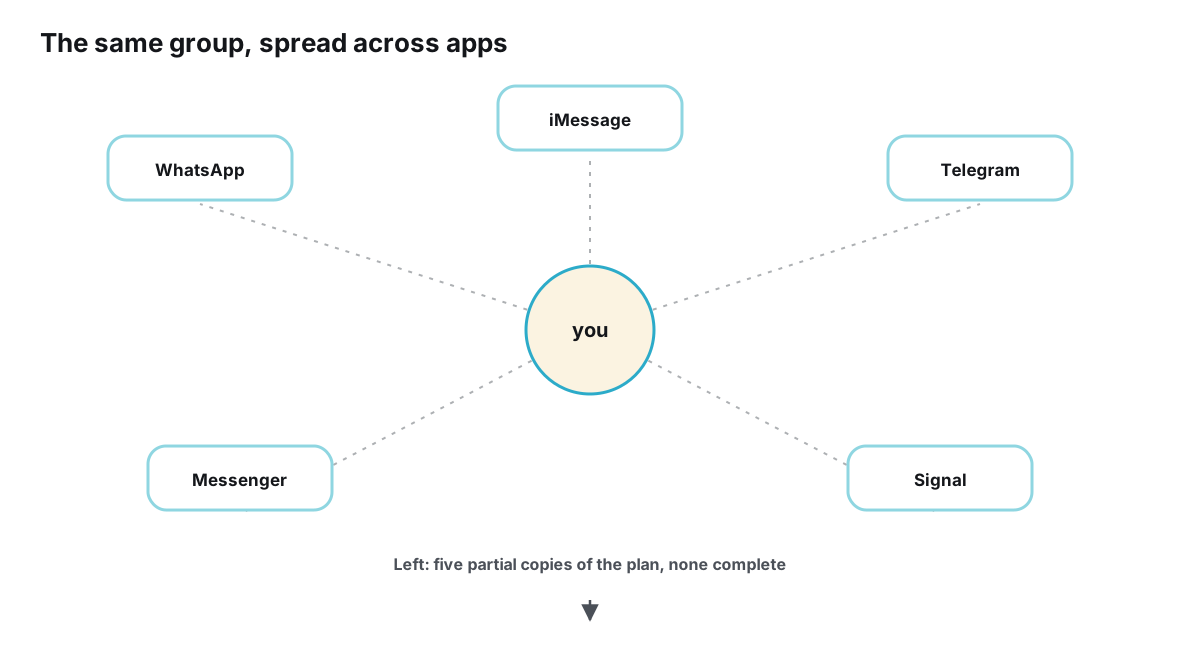
The third is fragmented responses. A poll launched in one app structurally cannot hear from people who are not in it. Six thumbs-up here and three "I think I can make it" messages there do not add up to a headcount; they add up to an estimation problem the organizer solves by privately messaging six people. If you want the full anatomy of this pattern, what happens when event information ends up spread across multiple apps breaks down version drift and the multiplication cost of every change.
The fourth is missing context. The reasoning behind a decision — why the early seating was chosen, why one friend needs the later slot — lives in whichever thread discussed it. The other half receives conclusions without rationale, which makes them feel like passengers rather than guests.
The fifth and most expensive is day-of divergence. When the venue swaps or the meeting point moves at short notice, the update reaches whichever chat the organizer thinks of first. The other group arrives at the wrong door, and the evening starts with an apology tour. This is the failure mode every strategy below is ultimately judged against.
Strategy one: standardize on a single app
The most obvious fix is to get everyone into one group. In a WhatsApp–iMessage split, the realistic direction is WhatsApp, because it runs on both platforms: your iPhone friends keep their phones and add one app, while your Android friends change nothing. iMessage cannot play the universal role, because it cannot reach Android devices at all — a group tied to Apple hardware has a hard floor under its membership.
The cost is social, not technical. Someone must install an app, register a phone number, accept a second stream of notifications and join a group that may outlive the event. For friends who already use three messengers, the request is genuinely annoying; for friends who avoid sharing their number, it can be a real objection rather than a grumble. The strategy also concentrates power in one app's notification settings: a member who mutes the group is unreachable in every sense.
Standardizing works best when the group is small, the event is informal and only one or two people must adapt. The moment you are asking four or five friends to install something for you, you are spending social capital the event may not return. WhatsApp's own product site makes the onboarding look trivial — and for most people it is — but the people who resist are rarely resisting the technology.
Strategy two: parallel groups, strictly mirrored
If nobody will switch, the classic fallback is two groups with one organizer keeping them synchronized. The WhatsApp group and the iMessage thread both exist; both discuss; and every settled fact is posted to both by the same person. What must be identical everywhere is short: the final time, the final place, changes, deadlines and the RSVP question. What may differ is everything else — jokes, side conversations, photos — because banter does not need to be synchronized, only facts do.
The discipline this demands is easy to underestimate. Every update is a manual double action, performed precisely at the moments when things are most hectic. The pattern decays predictably: the organizer posts the time change to WhatsApp at 5:40 pm while walking to the train, fully intending to mirror it in iMessage, and mirrors it at 9 pm after two people have already arranged childcare around the old time. The failure is not carelessness; it is that a human being is acting as a synchronization protocol, and humans have latency.
Two rules extend the strategy's life. First, adopt a fixed announcement format — same emoji, same first line, every time — so members can spot an official update instantly in either app. Second, declare that a decision only exists when it appears in both threads. That converts the mirroring duty from a courtesy into the group's constitution, which makes skipping it visible rather than silent. Even so, mirrored groups suit plans that change rarely; frequent changes turn the organizer into a full-time broadcaster.
Strategy three: the bridge person
Sometimes the group contains exactly one bilingual member — the person who is in both chats anyway, likes being useful and offers to keep the halves informed. As a strategy this is the oldest one in human history: it is a translator, a herald, a gossip with good intentions. For a small, slow-moving plan it works charmingly, and it costs the organizer nothing.
Its weaknesses are structural. The bridge is a single point of failure who synchronizes at human speed: when the venue changes at 6 pm, the bridge may be at the gym. The role is also socially expensive in ways that only show over time — the bridge answers the same questions from both sides, absorbs the friction of every inconsistency and gradually becomes the group's human directory. And because the bridge relays by paraphrase, errors enter the chain silently: "I think she said 8:30" is how a 7:30 dinner becomes legend.
Treat bridging as a volunteer role with a term limit, not an institution. It bridges gaps; it should not be the plan's load-bearing wall.
Strategy four: one event, two conversations
The fourth strategy inverts the others. Instead of forcing the people together, or duplicating the plan until it frays, you move the plan itself somewhere both apps can reach. The event gets its own page — one address holding the current time, place and guest list — and each conversation links to it. The chats keep doing what they are good at: talking. The page does what chats cannot: staying current.
The mechanics matter. A link is app-neutral: it opens from WhatsApp on an Android phone and from iMessage on an iPhone with equal indifference, and it renders a preview in both. When the time changes, the organizer edits the page once, and every future visit — from either app, from anyone, at any hour — shows the new time. Nothing needs to be posted twice, because nothing was duplicated in the first place. The conversations become transports for a pointer rather than containers for a copy.
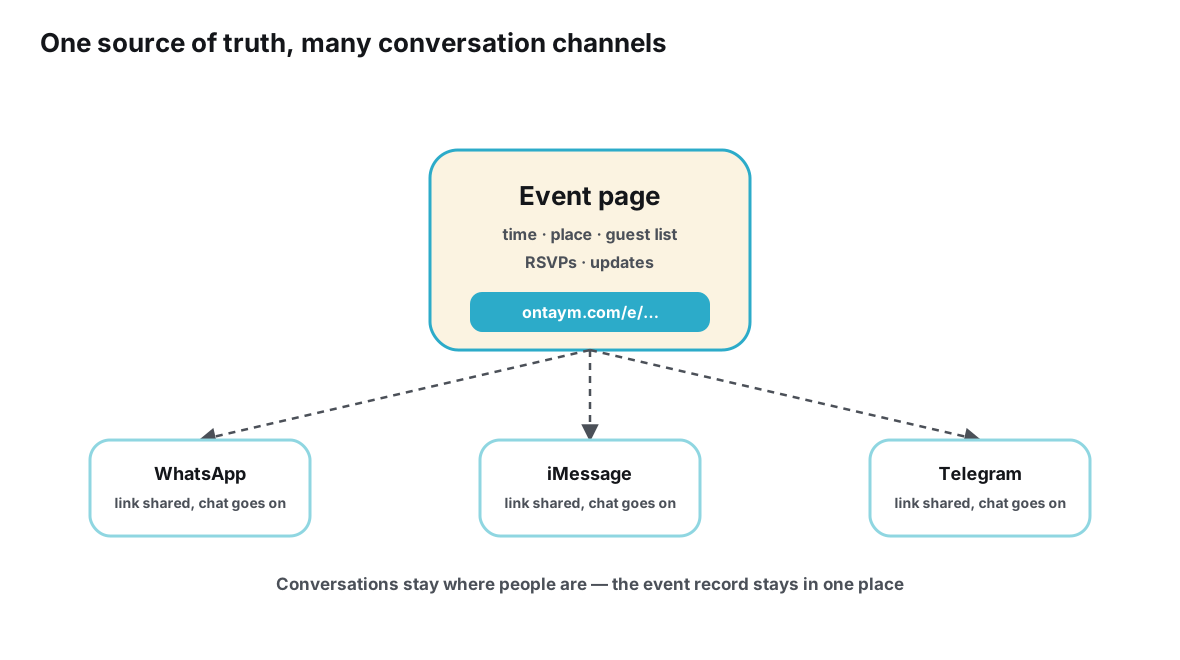
Responses can live on the page too. Instead of counting reactions in two apps, the organizer watches one RSVP list where each guest's going or maybe status is attached to their name, updates itself when they change their mind and rolls up into the headcount the restaurant actually needs. Tools like Ontaym are built around exactly this pattern — one event page with one link, polls to settle options before they harden, and going/maybe statuses that replace tallying by hand — though any system giving your event a stable, current-state address achieves the same effect.
What makes this strategy robust is that it survives contact with reality: late joiners open the link and are instantly current, day-of edits reach whoever checks, and the organizer stops being a switchboard. If you want the full mechanics of setting such a record up, how to create one source of truth for a group event is the step-by-step companion to this article.
Choosing between the four strategies
No strategy dominates; each buys something and charges something. The table below summarizes the trade you are making.
| Strategy | How it works | Where it strains | Best fit |
|---|---|---|---|
| Single-app group | Everyone joins one group, usually WhatsApp since it runs on iPhones and Android alike | Requires holdouts to install an app and accept its identity model; some friends never will | Small groups where only one or two people must adapt |
| Mirrored parallel groups | Both chats discuss, and the organizer posts every settled fact in both threads | Every update is a manual double post; one missed post forks the plan silently | Groups that resist new tools and rarely change details |
| Bridge person | One member belongs to both chats and relays questions and decisions | Synchronizes at human speed; one person absorbs all the friction and can burn out | Short-lived plans with few changes and a willing volunteer |
| Shared event record | Both chats link to one event page that always shows the current plan | Needs a group willing to open a link instead of scrolling a thread | Anything with changes, RSVPs, late joiners or a headcount to manage |
A useful shortcut for choosing: ask what the plan will be like in its final week. If the answer is "settled and quiet," almost anything works. If it is "still moving," every strategy built on copying — mirroring, bridging, forwarding — charges you per change, and only the shared record keeps a constant price.
How each strategy survives a real week
Strategies are easy to compare in the abstract and easier to compare under stress. Four moments break mixed-group plans more reliably than any others: the night-before time change, the late joiner, the headcount deadline and the day-of venue swap.
| Moment | Single app | Mirrored groups | Bridge person | Shared record |
|---|---|---|---|---|
| The time changes the night before | One announcement reaches everyone in that app | Two announcements; a missed one leaves half the group on the old time | Relayed by hand; timing depends on one person being awake | One edit; every later visit shows the new time |
| Someone joins the plan late | They scroll the back-log of one app | They catch up on one thread but miss the other half's context | The bridge briefs them personally | They open the link and are current in seconds |
| A headcount is due for the booking | One poll, but only members of that app can answer | Two polls whose results must be merged by hand | The bridge tallies replies from both sides | Going and maybe statuses accumulate in one list |
| The venue swaps on the day | A blast message, effective only if notifications are on | Two blasts, double the chance of a miss | Relayed twice, with a delay | One edit plus an optional one-line ping in each chat |
Read down the last column and a pattern appears: the shared record is not winning because it is fancier, but because it is the only strategy where nothing depends on a message being seen at the right moment. The other three all work — until the precise evening they are needed most.
Getting the headcount right across both halves
The headcount deserves special attention because it is where mixed groups hurt organizers most. A restaurant wants a number, not a vibe. Yet in a split group the signals arrive in incompatible forms: reactions in one app, words in another, silence in both. Silence is the killer — the friend who never replies might be a yes who is busy or a no who is conflict-avoidant, and the organizer cannot tell the difference from a thread.
The repair is to give responses a single home with an explicit vocabulary. A going/maybe/not-going status per person, attached to the event itself, converts scattered signals into a list. It also lets people change their answer without ceremony — flipping from maybe to going is a two-second action, whereas announcing a change of heart in a lively group chat feels like interrupting a room. Headcounts gathered this way are not just easier to read; they are more honest, because the interface prices honesty cheaply.
There is a second, quieter benefit. When responses live on the event, the two conversations stop being the official record of who is coming — which means they can be as messy, tangential and alive as friend groups actually are. If the deeper argument for why facts and conversation belong in different places interests you, why an event needs its own digital space makes the case in full.
Anti-patterns that make the split worse
Some responses to the mixed-group problem are understandable and counterproductive. Worth naming so you recognize them before committing.
The group of groups is the most seductive: create a third chat containing only the most active planners from both sides, and coordinate there. It feels efficient for a day. Then the third chat becomes another place the plan exists, two more people to add to every update, and a layer of insiders who know things the outer halves do not. You solved a split with a deeper split.
Screenshot forwarding feels harmless and is quietly poison. A screenshot of the other chat's decision is a copy of a copy, frozen at the moment of capture, unreadable to screen readers, unsearchable and stale the instant anything changes. Each forwarded screenshot is a small bet that nothing will change — a bet plans love to lose.
Asking the group to vote on an app turns logistics into identity politics. Everyone defends the messenger they already use, the vote produces a 5–5 tie, and now there is a mild grievance attached to your birthday dinner. The choice of strategy is the organizer's; the group's vote should be about date and venue, not about anyone's phone.
Planning in DMs to avoid the mess simply relocates the mess into channels with no group memory at all. The split you were avoiding becomes a fog of private conversations that not even the organizer can reconstruct.
A worked example: Maya's birthday dinner
Consider how this plays out concretely. Maya is organizing a birthday dinner for eleven friends. Six are in a years-old iMessage thread; five, colleagues from a previous job, live in a WhatsApp group. The dinner is Maya's problem; the apps are not going to negotiate.
She starts where most organizers start: she mentions the dinner in the iMessage thread, because that is where her thumb was. A date gets debated, half-settled, then set. Two days later she remembers the WhatsApp five and posts a summary there — already a copy, already aging. The WhatsApp half replies with a conflict on the chosen Friday; the iMessage half has already arranged around it. One round of cross-posting later, the date moves, and Maya must now be certain the correction lands in both chats, in front of people who saw the old date.
Instead of continuing the relay, she creates one event page with the new date, two remaining venue options as a poll, and an RSVP list, then drops the link into both conversations with one line each: the plan lives here, chat away as usual. The venue question settles in a day. One friend flips from going to maybe when his shift changes, and the list updates itself. On the day, the restaurant moves them to the back room; Maya edits the note field once, and both halves standing outside different doors is a disaster that simply does not occur.
Notice what did not happen: nobody installed anything, nobody switched sides, and both chats kept their character — the iPhone thread still jokes, the WhatsApp group still argues about football. The only thing that changed is where the facts live. That is the entire ambition of good mixed-group planning: change the home of the facts, not the habits of the people.
Frequently asked questions
Can Android users join an iMessage group?
Not in any meaningful sense. iMessage groups are tied to Apple devices, so a friend on Android cannot be a real member of one; at best they can be reached as an ordinary text conversation that sits apart from the group experience. The practical consequence is fixed: iMessage cannot be the shared home for a group that contains Android users, no matter how the group votes.
Isn't it rude to ask my iPhone friends to install WhatsApp?
It is a request with real costs, so it deserves honest framing rather than a shrug. Installing an app is easy for most people and genuinely unwanted for some — an extra notification stream, a phone-number registration, one more thing to mute. If the ask is small and the group is close, it lands fine; if it is your fifth such request this year, rotate the burden or remove it entirely by putting the event on a neutral page nobody has to join.
What if someone refuses to open links?
Keep them on the channel they prefer and relay to them alone. This shrinks the bridge problem from the whole group to one person: instead of synchronizing two apps, you are synchronizing one friend, which is what organizers have always done. What you avoid is rebuilding the entire plan around the most link-averse member of the group.
Do both chats still need to stay active afterward?
For conversation, whatever the group enjoys. For facts, neither chat is needed once the record exists — the link answers questions that scrolls used to. In practice the chats usually stay alive for banter and go quiet on logistics, which is the healthy division of labor: talk where you like, check the plan where it lives.
How do we stop the two chats from deciding different things?
Adopt one rule and keep it: a decision exists only when it is on the shared record. Debate anywhere, in either app, as loudly as you like — but the moment something settles, it gets written to the event page, and anything not written there is officially a rumor. The rule works because it is enforceable by anyone with the link, not just the organizer.
Conclusion
A mixed WhatsApp–iMessage group is not a temporary condition you can wait out; it is the permanent shape of the group, and the plan has to be built for it. The four strategies — standardizing, mirroring, bridging and sharing a record — are ranked here roughly by how gracefully they age. The first three all work by copying information into more places, which means their cost grows with every change, every late joiner and every headcount question. The fourth works by removing the need to copy at all.
If you take one instruction from this article, take this: stop trying to unify the conversations and start unifying the facts. Give the event one address that both apps can open, answer every "what's the plan?" with that link, and let each chat keep its accent. Your friends will not remember which strategy you used. They will remember that nobody ended up at the wrong restaurant — which is the only metric an organizer is ever judged on.
One event, two apps, zero relay work.
Plan it with Ontaym