
WhatsApp Polls vs Event Polls: What's the Difference?
Both start the same way: a question, a handful of options, a row of growing tally marks. One lives inside a conversation; the other belongs to an event — and nearly everything that matters afterward flows from that single distinction.
Quick answer
A WhatsApp poll is a message: it lives in the chat timeline, collects preferences from whoever is in that group at that moment, and its result is a tally sitting in the thread. An event poll is a question attached to an event record: it has a lifecycle tied to the event, its outcome is meant to change the event's details, and the people answering it are being tracked as potential participants. The practical differences come down to timing (a snapshot of opinion versus a stage in a plan), obligation (a vote commits to nothing; an event answer feeds commitments and headcounts), and follow-up (a tally that ends in the chat versus a decision that flows into the event, the guest list, and reminders). Chat polls excel at quick preferences; event polls exist for decisions with consequences.
Two polls, one dinner
Picture Maya organizing a birthday dinner for her friend Priya. In the family WhatsApp group she posts a poll: “Dinner on Friday or Saturday?” Within an hour the tally reads six for Friday, four for Saturday, and two people have replied underneath with complications — Tom can do Friday only after nine, someone's partner works Saturdays. The poll does its job: it surfaces the group's leaning faster than forty free-text messages would have.
Now picture the same dinner organized on an event page. Maya creates the event, marks the date as undecided, and attaches a poll with the same two options. The difference is invisible while voting happens — same question, same options, same tap to answer. It becomes visible the moment voting ends. On the event, the winning option becomes the event's date; everyone who voted is a named potential guest; the next question (venue, this time) attaches to the same object; and when the date is settled, the poll gives way to a different kind of answer — going, maybe, not going — that determines how many seats Maya needs to reserve.
Neither experience is better in the abstract. They are different tools wearing similar clothes. The rest of this article is about what those clothes conceal: where each poll lives, what each vote means, and what happens after the tally appears.
Where the poll lives decides what the poll is
The deepest difference between the two kinds of poll is their address. A poll in WhatsApp is an artifact of a conversation. It was created by a member, it sits at a particular point in the group's timeline, and its audience is exactly the membership of that group — WhatsApp group chats can include up to 1,024 participants, and the poll's reach stops at that boundary. Nothing about the poll knows that an event exists. If Maya's dinner is also discussed in a second group, or on a call with Priya's college friends, the poll has no way to know those people were ever asked.
An event poll, by contrast, belongs to an event object — a record with its own identity, its own page, and its own list of potential participants. The poll isn't a message positioned in time; it's a property of a thing. That changes its behavior in quiet but consequential ways. The poll can outlive any individual message because it doesn't live in a message stream at all. It can be seen by anyone who can see the event, including people added weeks later. And when the poll resolves, its result has somewhere to go: into the event's date field, where it becomes the plan rather than a remark about the plan.
This is the same structural divide that separates a conversation from an event object generally — the chat is an append-only stream of statements, while the event is a mutable record with current state. A poll inherits the properties of whatever it is attached to. Attached to a stream, it is a moment; attached to a record, it is a stage.
| Dimension | Poll inside a WhatsApp group | Poll attached to an event |
|---|---|---|
| What it is | A message in the chat timeline | A question bound to an event record |
| Who can answer | Current members of that one group | Anyone invited to the event, however they were invited |
| What an answer means | A preference, expressed once, committing to nothing | An input to a decision that will shape the event's details |
| Relationship to time | A snapshot of the group's mood when it was live | A stage in the event's life, with stages before and after it |
| When it ends | Whenever chatter moves on; the tally simply stops moving | When the decision is made and recorded on the event |
| After the tally | The organizer must carry the result forward manually | The result updates the event and the next stage begins |
| Late joiners | Find an old poll they may not be able to usefully answer | See the current state, including decisions already made |
| Downstream effects | None — nothing is connected to the result | Headcounts, reminders and updates all build on it |
Timing: a snapshot of mood versus a stage of a plan
A chat poll has no real schedule. It goes up, it collects taps for a while, and then it stops — not because anything closed it, but because the conversation moved on. The tally that remains is a snapshot of the group's opinion during a particular window. People who were busy that week, who joined the group afterward, or who changed their minds three days later are all outside the snapshot. The poll can't distinguish between “nine people prefer Friday” and “nine people preferred Friday when asked,” and only the second statement is true in a way an organizer can safely act on.
An event poll is timed by the event itself. It exists because there is a decision to make before the event can proceed — a date, a venue, a cuisine — and it ends when that decision is made. That gives it a position in a sequence: proposal, decision, commitment, reminder, attendance. Its purpose isn't to sample opinion; it's to unblock the next stage. When the venue question is settled, the RSVP question opens. When the RSVP list stabilizes, reminders take over. A poll that is part of this sequence is read differently by everyone involved: not as “how does the group feel?” but as “we are deciding, and your answer counts.”
The timing difference shows up most clearly with deadlines. A restaurant reservation made for Friday forces the Friday-or-Saturday question to close by Wednesday. A chat poll has no mechanism for that closure — the organizer has to announce it in a separate message and hope everyone who might vote sees it. An event poll can be closed by the act of deciding: the event's date field changes, the poll freezes as history, and anyone opening the event later sees the outcome, not the deliberation.
Obligation: voting costs nothing, and everything reads on that
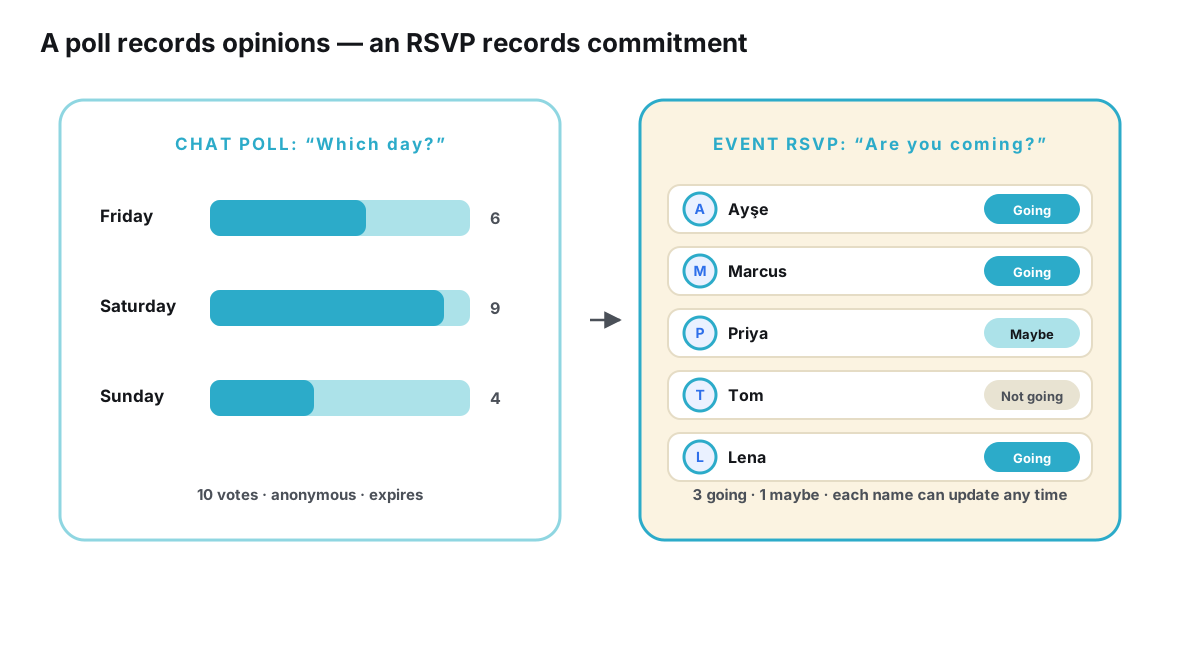
When Tom taps “Friday” in a WhatsApp poll, what has he committed to? Nothing, and everyone knows it. He has expressed a preference — a genuine and useful one, but a preference all the same. He might be free on Friday in principle and unavailable on the Friday that actually gets chosen. He might vote Friday, forget the dinner existed, and be unreachable on the night. The poll tally says six people lean Friday; it does not say six people are coming Friday, or even that six people would come Friday. Mixing those two readings is the single most common way organizers misjudge their own events.
An event poll sits closer to obligation, and in well-designed event systems the obligations are made explicit as a separate step. First the group votes on options; then, once the details are fixed, each person gives an actual answer — going, maybe, not going — that is bound to their name and meant to hold until they change it. The vote is advisory; the RSVP is operative. Keeping the two apart protects both: preferences stay cheap and honest because they don't cost anything, and commitments stay meaningful because they are given deliberately rather than inferred from a tap on an option.
This distinction — the difference between answering a poll and saying you're going — is deep enough that we've treated it in its own article, why “going” is different from answering a poll. The short version: a vote is information about your taste; an attendance answer is information about your calendar. Events need the second, and polls only ever collect the first.
Follow-up: the night the tally has to become a plan
Every poll eventually faces the same moment of truth: the tally exists, and now something has to happen. In a chat, that something is manual. The organizer reads the result, decides Friday wins, types a message announcing Friday, maybe pins it, and then begins the second, harder job of finding out who is actually coming. Each of these steps is a new message in the stream. Each can be missed. And the poll itself — now resolved — remains in the thread one scroll away from a dozen other messages, still visually suggesting that the question is open.
The work I just described has a name in software terms: it's a hand-off between systems that weren't connected. The chat system produced a result (six to four for Friday) and the event — which exists only in Maya's head and her notebook — needs that result as input. A human bridges the gap by re-typing, re-announcing and re-tracking. This is manageable for one dinner. It becomes genuinely expensive when the group runs an event every week, or when three sub-decisions (date, venue, start time) each produce their own poll, their own announcement and their own corrections.
When the poll is part of the event, the hand-off disappears because there is no gap. The result updates the event; the event notifies the participants; the RSVP stage opens on the same page. Follow-up stops being a matter of vigilance — did everyone see the announcement? — and becomes a property of the system. The organizer's attention shifts from relaying information to making decisions, which is the part only a human can do.
And follow-up has a long tail. Between the decision and the event, people drop out, join late, and shift from going to maybe. A chat poll not only can't track any of that; its very existence encourages everyone to treat the original tally as the answer. The funnel from “invited” to “actually attended” always narrows, and the tools around an event are built to observe the narrowing rather than deny it.

When a chat poll is exactly the right tool
None of this is a case against WhatsApp polls. For what they are built for, they are superb, and pretending otherwise would be poor advice. A chat poll is the right tool when the question is small, the audience is already assembled, and nothing permanent needs to happen afterward.
Consider the genuinely good uses. A group of colleagues deciding between two lunch spots an hour before leaving. A family choosing which film to watch tonight. A sports team expressing whether they'd prefer the earlier kickoff. In each case the group already exists, everyone who could vote is present, the stakes are low, and the result will be consumed immediately and then forgotten without loss. The poll's properties — snapshot timing, zero obligation, no follow-up — match the job precisely. WhatsApp groups also scale far beyond most friend groups' needs, supporting up to 1,024 participants, and WhatsApp Communities let organizers link related groups and push announcements across them, which is a real coordination convenience for clubs and larger organizations, as documented in the WhatsApp Help Center.
The same logic extends across chat platforms. Telegram's polls can be anonymous or public with visible votes, and can even be quiz-style, as its own FAQ explains — a flexible toolkit for community questions, and one whose visible-vote mode can suit friendly groups that enjoy the transparency. Doodle has spent years as a dedicated service for one specific kind of poll — choosing a date and time — and does that narrow job very well, as you can see at doodle.com. None of these tools is broken. The question is only ever whether the decision at hand needs to become an event, and whether follow-up matters.
When the poll needs to belong to the event
Flip the conditions and the right answer flips with them. A poll belongs to the event when any of the following are true, and the more of them that hold, the stronger the case:
- The decision changes the event's details. A date or venue choice that will govern everyone's plans shouldn't evaporate into the timeline; it should land somewhere addressable.
- A headcount will eventually matter. Reservations, tables, tickets, car seats, portions — anything counted needs the poll stage to hand off to a commitment stage, which a chat cannot host.
- The guest list isn't identical to the group membership. The moment someone outside the group is invited, a group-scoped poll has the wrong audience, and its tally quietly stops representing the event.
- People will join late. Newcomers need the outcome of past decisions, not the chance to vote on settled questions.
- Decisions come in sequence. Date, then venue, then start time is a pipeline, and pipelines are only manageable when each stage's result feeds the next.
- The result must survive. “Which Friday did we decide?” asked two weeks later should have a one-tap answer, not a search through the thread.
Notice that these conditions are about the event's needs, not the group's sophistication. A brilliant, highly organized group of eight friends still loses poll results inside an active chat, because the failure is architectural rather than personal. When the decision deserves to outlive the conversation that produced it, the poll should live where decisions live — attached to the event, on the same page where the guest list and the updates will later grow. That broader architecture, one address holding the event's current state while conversation happens anywhere, is what we cover in how to create one source of truth for a group event.
| Your situation | Better fit | Why |
|---|---|---|
| Quick preference among members of one existing group | Chat poll | The audience is assembled, stakes are low, nothing must persist |
| Choosing a date that will anchor everyone's calendars | Event poll | The result must become the event's state, visible to all including late joiners |
| Voting between venue options before booking | Event poll | The choice feeds a commitment stage (RSVPs) and possibly a reservation |
| Picking a film or a restaurant for tonight | Chat poll | Consumed immediately, forgotten without cost |
| Guest list spans multiple apps or includes non-group members | Event poll | A group-scoped poll has the wrong audience; the event includes everyone invited |
| A recurring club deciding its weekly slot, once and for all | Event poll | The decision must survive months of subsequent chatter |
| Gauging interest in an idea nobody has committed to yet | Chat poll | Early exploration is exactly preference-sampling; commitment can wait |
Running the two together
The mature pattern isn't replacing chat polls; it's sequencing them. Conversation remains the right place to float ideas, argue for the izakaya over the trattoria, and feel out the group's energy. A chat poll is a fine instrument for exactly that phase. But when the discussion converges and a real event starts to exist, the question deserves to be re-asked — or transplanted — onto the event itself, where its answer can do work: fix the date on the page, open the going/maybe list, feed the reminder that goes out the day before.
In practice the hand-off is one motion: create the event with its known facts, put the open question on the event as a poll, and drop the link into the chat where the debate was happening. The debate continues where it was comfortable; the decision lands where it will be needed; and the two stop stepping on each other. Ontaym was designed around exactly this division — event pages carry polls and voting on options alongside RSVP statuses and updates, with one link per event that can be shared into any conversation — but the pattern works with any tool that gives an event an address.
One warning from experience: don't run both polls at once for the same question. A WhatsApp poll and an event poll asking “Friday or Saturday?” in parallel will produce two tallies, and the discrepancy between them will become its own discussion. Ask each question exactly once, in the place where its answer will live.
Frequently asked questions
Is a WhatsApp poll the same as an RSVP?
No. A WhatsApp poll collects preferences from group members; an RSVP records a personal commitment to attend a specific event at a specific time. A poll can tell you which date people prefer, but it can't tell you who intends to come, and the two questions have different answers surprisingly often. If you need a headcount, you need an RSVP mechanism, not a tally — and if you're currently using reactions as that mechanism, the comparison in event RSVP vs group chat reaction covers why that fails.
Can I use a WhatsApp poll to figure out attendance?
You can approximate it, and many organizers do — “Who's in? Tap Friday if you're coming.” The approach degrades quickly. Votes are preferences, not commitments; people who join the group later never see the poll as a live question; and when someone's plans change, the tally has no way to change with them. It works tolerably for small, same-day plans among people who all read the group. For anything with a reservation attached, it undercounts and overcounts at the same time.
If someone changes their mind after a poll, what happens?
In a chat, a changed mind produces a new message — “actually can't do Friday anymore” — while the old tally stands unchanged next to it. The record and the reality drift apart, and reconciling them is left to whoever is organizing. On an event, a changed mind is an update: the person's answer changes, the headcount changes with it, and the event reflects the new state. This is a core reason event-bound answers age better than poll taps, and it's examined in detail in our RSVP versus reaction comparison.
Do event polls show who voted for what?
Dedicated event tools generally attach answers to named participants, because the whole point of the poll is to inform the organizer's next decision — and an anonymous tally can't be followed up. Chat platforms differ by design: some polls are anonymous, others show votes, as with Telegram's anonymous and public poll modes. The visibility question is worth deciding deliberately: anonymous voting suits sensitive or contested choices; named voting suits anything the organizer may need to act on person by person.
What about scheduling polls like Doodle?
Scheduling-poll services solve the hardest single sub-problem — finding a time many calendars can tolerate — and they solve it well. What they don't provide is everything that surrounds the time: the event page, the guest list, the RSVPs, the changes, the reminders. A scheduling poll is an excellent front end for one decision; treat it as a stage, not as the event itself, and plan for where its result lands afterward.
Conclusion
A poll in a WhatsApp group and a poll on an event page share a skin and nothing else beneath it. The chat poll is a message: it samples the preferences of a group's membership during a window of time, costs its answerers nothing, and leaves every consequence of the result to be carried forward by hand. The event poll is a stage in a plan: it's bound to a record, timed by a decision, answered by actual potential guests, and connected to what comes next — commitments, headcounts, reminders and updates.
Neither tool should be used for the other's job. Preference-sampling on an event page adds ceremony to questions that deserved a quick tally; deciding real event details in a chat poll guarantees that the decision will live as a message that scrolls. Ask each question where its answer will live, sequence chat debate before event decisions rather than in parallel with them, and reserve commitments for a mechanism that was built to hold them. Groups that make this split stop losing decisions into their timelines — and start ending the week with the headcount they actually needed.
Decide where your group can see it — then let the RSVPs roll in.
Plan it with Ontaym