
Why Not Everyone Wants to Join Another Group Chat
The invite looks like a favor: you’re included! But for many people, another group chat is another standing subscription on their attention, reputation and contact details. Understanding that reluctance is the key to invitations people actually accept.
Quick answer
People avoid group chats because joining costs more than it appears to. Every group is a standing claim on attention — messages arrive for weeks or years, not just for the event. It creates social obligation: to read, to reply, to be seen participating, and to leave loudly if it becomes too much. And it exposes the joiner: their number and identity become visible to strangers, and their words sit in a thread whose audience they cannot fully see. None of this means people dislike the event itself. They dislike the packaging. Invitations that carry the plan without demanding membership — a link to check, a status to set — remove most of the resistance, because the cost of participation stops being permanent.
The invitation that arrives already heavy
Most organizers experience the group chat invite as pure generosity. You are making a space, including someone, saving them from missing out. What arrives on the other end is subtly different: a notification, an unfamiliar roster of names, a wall of back-scroll to understand why the group exists, and an implicit contract that nobody read before signing.
The gap between those two experiences is where most planning friction hides. The organizer sees a tool; the guest sees a set of commitments. And because declining a group invite from a friend, a colleague or a relative carries a social cost, the guest’s real choice is not “join or don’t join” but “join now, or join later after an awkward conversation.” Faced with that menu, many people take a third option: they join, mute immediately, and never truly arrive — which quietly starves the organizer of the responses they created the group to collect.
This is worth dwelling on, because it is the pattern most misdiagnosed. When a group goes silent, hosts tend to blame apathy. More often the silence is a rational response to a structure that asked for too much, too permanently, from people whose only actual question was “what time should I be there?”
Attention is what’s actually being requested
A group chat is not a one-time request. It is a subscription. From the moment of joining until the group’s natural death — which, for most groups, is never — every message from every member arrives on the guest’s phone, and each arrival makes a small withdrawal from the same limited account: attention.
Attention behaves like a budget rather than a warehouse. Each active group is a recurring charge against it, and most people already run a deficit of family threads, work chats, school groups and neighborhood boards before your dinner party asks for its share. The marginal cost of one more group is not one more app icon; it is one more stream of interruptions that competes, every single day, with everything else the person already manages. That is why the phrase “it’s just one group” lands so poorly — it is never just one, and the person being invited knows exactly how their home screen looks.
The structure of chat compounds the budget problem. In a conversation, relevance is assumed to be newest-first, so a group member must at least skim everything to be confident they missed nothing. A group of thirty moderately chatty people can generate hundreds of messages about a single evening out, of which perhaps five contain information anyone needs. The ratio is the problem: the noise is not a malfunction of the group, it is what a conversation looks like when it is asked to be a bulletin board.
Contrast that with a plan that has its own address. A guest who holds an event link pays attention exactly once — when they choose to check it — and receives the current state in seconds. No subscription, no skim tax, no fear of having missed the one message that mattered. The information reaches them with the noise surgically removed, which is why the same person who ignored a 200-message thread will happily open a link twice on the day.
Attention also has a timing problem that chats amplify: they spend it when it is cheapest to waste and hardest to spare. The busiest moments around an event — the run-up, the day itself — are exactly when message volume peaks, so the demand lands on the guest when they have the least slack. A quiet guest who checks a plan once on Thursday evening and once on Saturday morning has all the information they need; the same guest inside a chat spends Thursday evening deleting notifications instead. Organizers rarely see this asymmetry because for them the messages are productive — they are the ones coordinating. For everyone else, the same traffic is pure overhead arriving at the worst possible time.
Obligation, reciprocity and the cost of silence
Attention is the visible cost; obligation is the one people feel more deeply. Group chats are social spaces, and social spaces have rules older than any app: if everyone is discussing, silence is noticeable; if someone asks a question, leaving it unanswered is rude; if you were included, staying visibly engaged is the polite return on being wanted.
For many members this turns a messaging thread into a low-grade performance. There is the pressure to react to jokes they didn’t find funny, to weigh in on options they have no opinion about, to send the cheerful acknowledgment that keeps their presence warm. The effort is individually tiny and collectively exhausting, and it falls hardest on the people who care most about being seen as cooperative — which is to say, exactly the people organizers most want to keep.
Exit is the other half of the trap. Leaving a group is rarely quiet; in most messengers the departure is announced to everyone who remains, framed as the social statement it never intended to be. Declining membership in a family group reads as a family statement. Muting is the compromise position, but muting has its own failure mode: the muted member resurfaces days later, discovers the plan changed without them, and faces a choice between rejoining the noise or being the person who “never reads the chat.” The whole architecture leaves no graceful middle path between full participation and social friction.
None of this is the apps’ fault in some moral sense — these are conversation tools, and conversation does carry reciprocity. The problem arises when a conversation is used as the container for an event, because an event’s obligations are temporary while a chat’s are open-ended. People sense that mismatch even when they can’t name it, and their hesitation is the sense taking verbal form.
Social exposure: the audience you can’t see
The third cost is the least discussed and often the decisive one: joining a group means becoming visible to people you did not choose, and staying visible indefinitely.
Consider what membership actually discloses. In messengers built on phone numbers — WhatsApp being the most familiar case — every member can see every other member’s number, name and photo in the group info screen. For a group of close friends this is harmless. For the mixed audiences that events tend to gather — coworkers plus partners, school parents plus teachers, neighbors plus that one friend-of-a-friend — it means your reachable identity is handed to near-strangers in a single tap. The mechanics of that exposure at scale are covered in detail in the privacy problem with large WhatsApp groups, and they matter here because they transform a social decision into a data decision.
Then there is the audience problem. A group chat has no perimeter that matches its purpose. The joke that fits the two people who were in on it lands in front of thirty. The offhand opinion about a restaurant is read by the person who suggested it. Sociologists have a name for this flattening — context collapse — and everyone has felt it: the moment you realize your words are being consumed simultaneously by circles that have never met each other and never would have, if not for this thread. Writing for an unknown merged audience is work, and people who feel they have to perform rather than talk simply talk less.
Finally, the thread remembers. Messages sent in the first flush of enthusiasm — the teasing, the venting, the plan-that-changed-three-times — remain scrollable months later, long past the point where anyone remembers the context that made them sensible. A record of a fun evening that never ends being consultable is not obviously a gift. Many people manage this the only way the medium allows: by saying less than they think, or by not joining at all.
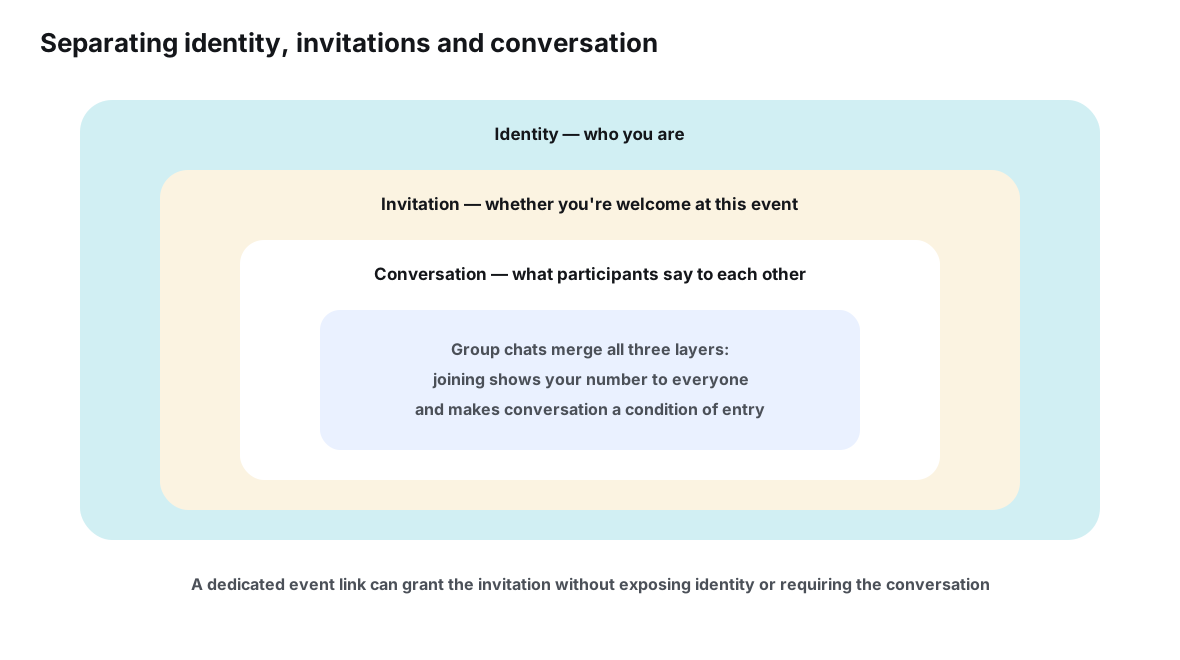
The layered picture above explains a lot of mutual misunderstanding. The host believes they sent an invitation — the middle layer. What the cautious guest receives is the full stack: an identity transaction, a permanent membership and an open-ended conversation, all accepted with a single tap. One party is describing a doorbell; the other is describing a lease. Both are describing the same button.
The permanence problem: groups don’t end
Events end; groups don’t. This single asymmetry quietly degrades social life, and it deserves its own examination because it drives behaviors that look like flakiness but are actually boundary maintenance.
A dinner party has a natural lifecycle: a plan, an evening, a memory. The chat built to organize it has no such lifecycle. After the event it lingers — maybe repurposed for the next dinner, maybe dormant but alive, still holding every member’s contact details, still capable of buzzing back to life at any moment. Multiply by every birthday, trip, committee and class in a typical year, and a person’s messaging apps fill with semi-dormant groups that each represent a small ongoing claim: we can reach you, we know your number, you are still on the list.
Some people prune these groups ruthlessly, accepting the visible-exit cost each time. Most simply accumulate, and their wariness toward new invitations grows in proportion. It is not cynicism; it is pattern recognition. Every previous group started the same way — with warmth, a clear purpose, and a promise, implicit and false, that it was temporary.
The archive itself does quiet damage after the event. A dormant group still gets opened, sometimes months later, by someone scrolling for an address or a photo — and what they find is a time capsule of a version of the group that no longer exists: the friend who came to everything and now can’t, the couple who has since split, the plan that fell through. Conversations that ended gracefully in real life remain frozen mid-sentence in the thread. People who sense this learn to write nothing worth archiving, which is its own small loss.
Hosts can short-circuit the whole cycle by matching the container’s lifespan to the occasion’s. An invitation whose context expires when the event does — the page closes, the list dissolves, nothing hums in the background — asks for nothing permanent, and guests respond to that lightness more readily than organizers expect. The design question worth asking before any group is created: will this still make sense in six weeks? If not, build something that is allowed to end.
The asymmetry between hosts and guests
Underlying all of these costs is a structural imbalance: the person who creates the group captures most of the benefits, while the costs are distributed across everyone else. Seeing the two sides laid out together explains why hosts are so often surprised by the reluctance — from where they sit, the ledger looks entirely positive.
| Dimension | What the host gains | What each guest pays |
|---|---|---|
| Convenience | One place to broadcast every update | A new stream to monitor indefinitely |
| Coordination | Headcount and responses arrive in one thread | Obligation to reply visibly and promptly |
| Information | Sees who is engaged at a glance | Must skim everything to find what matters |
| Privacy | Access to every member’s contact details | Their number and identity shown to all members |
| Social standing | Visible role as the organizer | Visibility to circles they didn’t choose |
| Exit | Can archive or delete the group at will | Departure is announced to everyone |
The table is not an argument that hosts are selfish — most are doing unpaid, thankless coordination work, usually at real personal cost. It is an argument that the tool concentrates benefits and disperses costs, and that a well-mannered host compensates consciously. Sometimes that compensation is small: keeping the group tight, stating that it will be deleted after the event, letting people reply in direct messages. Sometimes it is structural: not creating the group at all.
The quiet decline, decoded
Because refusing outright is socially expensive, people decline in code. Hosts who learn to read the code can fix the underlying problem instead of taking the signal personally. The table below pairs the common signals with the mechanism underneath and the adjustment that actually addresses it.
| What people say | What typically lies beneath | What actually helps |
|---|---|---|
| “I’m not really on my phone” | Attention budget is full; another stream is unaffordable | A link they can check once, on their own schedule |
| “Just tell me when and where” | They want the output of planning, not the process | Send final details and a way to RSVP without membership |
| “I’ll ask Tom what’s happening” | They’ll ride a member’s summary rather than join | A single address that is the plan, so no intermediary is needed |
| “Add me if you need numbers” | Willing to be counted, unwilling to be chatty | Collect their status directly; let them skip the thread |
| Silence after the invite | The cost of joining exceeded the cost of ignoring | Lower the ask: one link, one tap, no membership |
Read down the middle column and a pattern emerges: none of the underlying reasons are about the event. People are not declining the dinner, the trip or the reunion — they are declining a permanent structure wrapped around a temporary occasion. Strip the wrapper and the underlying enthusiasm, which was usually there all along, has room to express itself.
App fatigue and the fifth messenger
There is one more tax that rarely appears in any single invitation but shapes all of them: every new group potentially means a new app. The family is on one messenger, the football team on another, the committee on a third, and now a friend suggests the group trip run somewhere new because “it has better polls.” For the guest, that is not one more group — it is one more account, one more notification profile to configure, one more identity to maintain, and one more app holding a copy of their contact details.
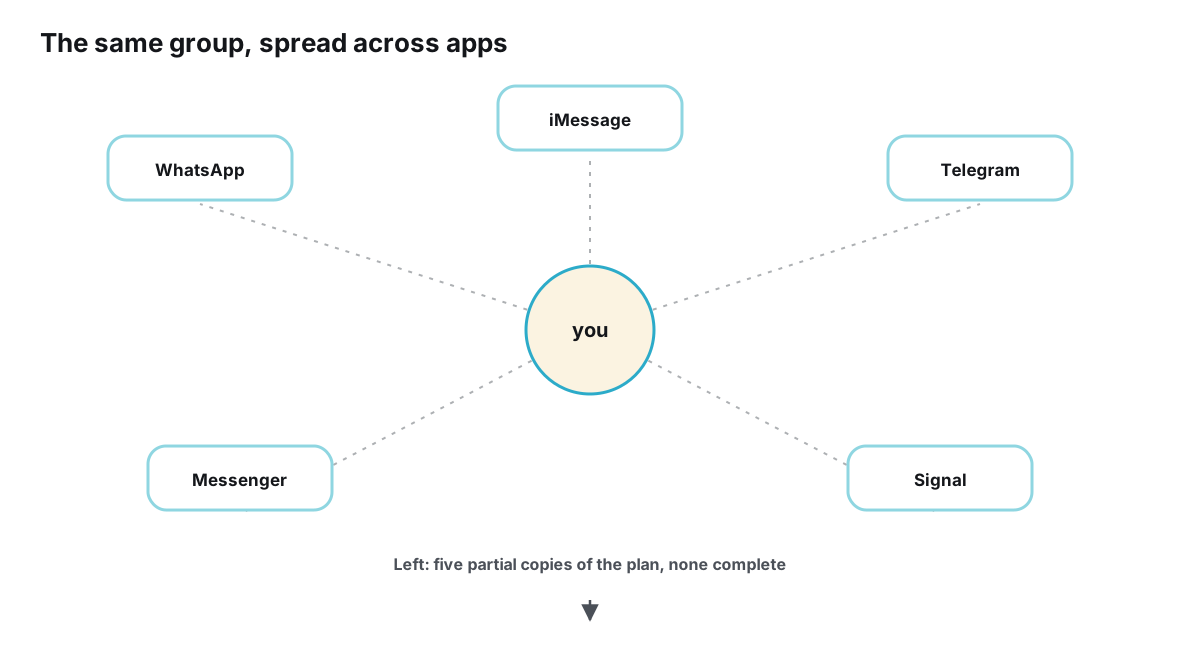
The diagram is deliberately drawn from the guest’s point of view, because that is whose home screen it describes. Every dashed line was drawn by somebody else’s convenience — an organizer picking the app their circle preferred. The guest’s preference, which is to hold one link that works in any browser and requires no membership anywhere, is rarely consulted. When it is consulted, the answer is remarkably consistent: a web page over an app, a link over a login, a status over a subscription.
This is also, incidentally, why the habit of asking “which app is everyone on?” before planning produces such reliably poor answers. The honest answer for most real groups is “all of them, partially,” and the correct response is a plan that lives above all of them — the argument made at length in why messaging apps were never designed to be event databases.
What a lower-cost invitation looks like
None of the foregoing means groups are bad. For a standing circle — the weekly five-a-side team, the family, the friends who talk every day — a persistent chat is exactly right, because the group itself is the point. The analysis only bites when the group is a means to an end: one event among people who don’t otherwise share a thread. In that case, the invitation can be redesigned to cost almost nothing.
The redesigned invitation has a recognizable shape. It leads with a link rather than a membership: one address that opens the plan, whatever app or browser the guest prefers. It asks for a decision, not participation: an RSVP of going, maybe or not going, set in one tap. It keeps conversation where it already lives — the pairs and cliques who want to banter have threads for that. It updates in place, so the guest’s second visit shows the current plan without anyone re-broadcasting it. And it ends, taking with it every obligation it created.
Guests recognize the difference immediately, even if they describe it in plain words: “oh, I don’t have to join anything.” That sentence — I don’t have to join anything — is the entire reluctance problem dissolving. The privacy dimension of this design is treated at length in how event invitations can protect participant privacy, which covers the identity and data-exposure mechanics; the present article’s claim is the social one. When the cost of being included stops being permanent, inclusion stops being something people need to defend themselves against.
It bears repeating that privacy here is not a separate concern bolted onto a social one. The UK’s Information Commissioner’s Office, whose guidance on everyday data protection is written for normal people rather than lawyers, frames personal details as something to share deliberately and minimally — and a phone number shown to a hundred acquaintances is the opposite of both. The same principle underlies the EU’s GDPR, which treats contact details as personal data to be handled with purpose and proportion. A guest’s wariness about exposure and their wariness about obligation are the same instinct expressed through two different costs. An invitation that minimizes one almost always minimizes the other. For groups that do need to exist, the same principle generalizes: share the minimum, make leaving quiet, and let purpose define lifespan.
Frequently asked questions
Isn’t declining a group chat just antisocial?
Not usually. Most reluctance is about the container, not the company — people decline the permanent stream while still wanting the evening itself. Offering a link instead of membership gives them a way to say yes to the event without signing up for something open-ended, and most take it gladly.
Why do people join a group and then never speak?
Because joining once is cheap and speaking is not. Lurking lets them stay informed without accepting the performance obligations of an audience they can’t fully see, and without their words sitting permanently in front of mixed circles. It’s a boundary strategy, not a lack of interest — though it does leave the host without the responses they need, which is a sign the container is wrong.
What if my group really does need to discuss things together?
Then a chat is the right tool — for the discussion. The pattern that works is separation: debate in the thread, decide onto the record, and share the plan’s address so the quiet members can follow without wading through the conversation. Discussion-heavy groups benefit most from keeping the event itself somewhere quieter.
Is a poll a gentler way to include people?
A poll lowers the cost of one specific act — expressing a preference — but it still usually requires joining the group to vote, and it captures opinions rather than commitments. It’s gentler, not gentle. An RSVP that lives outside any membership is closer to what reluctant guests actually want: one tap, no thread, done.
How do I invite people who all use different apps?
Skip the app question entirely and send a link. A link is neutral ground: it opens in any browser, requires no account, and lets each guest respond once. The alternative — picking one app and forcing everyone onto it — is precisely the accumulated friction that makes people hesitate at the next invitation.
Does any of this apply to work groups?
The dynamics are stronger, not weaker: obligation to appear engaged, visibility to hierarchy, and no real option to leave make people even more cautious. The same redesign helps — decisions on a record everyone can read, chat for the actual discussion — and colleagues generally notice the drop in mandatory-thread-reading immediately.
Conclusion
The wariness people feel toward another group chat is not rudeness, and it is not nostalgia for phone calls. It is an accurate accounting of what membership asks: permanent attention, unbounded obligation, exposure to an unauditable audience, and a presence that outlives the occasion that justified it. Hosts who read that accounting as personal rejection are reading the wrong ledger.
The practical response is not to plead with people to join, nor to run ever-more-elaborate threads, but to lower the ask. Match the container to the occasion: persistent conversations for persistent groups, and something light, addressable and temporary for one-off events. When being invited stops costing anything permanent, the people who went quiet come back — not because they changed, but because the structure finally stopped charging them for their own inclusion.
Invite people to the plan — not to another group chat.
Try Ontaym for your next event