
How Event Invitations Can Protect Participant Privacy
An invitation decides who learns what about whom. Designed well, it delivers the plan to every guest while collecting almost nothing in return — no shared contact list, no permanent roster, no membership that outlives the occasion. This is the complete guide to that design.
Quick answer
A privacy-protecting invitation does one thing differently from a group chat: it shares the event instead of the attendees. Concretely, it uses a single link as the invitation, so guests never join a shared roster and never see each other’s phone numbers; it asks each guest only for a display name and an RSVP; it keeps responses in one place the organizer controls, where statuses like going and maybe roll up into a headcount without exposing anyone’s contact details; and it ends with the event, so nothing persists that needs cleaning up. The principles behind this shape — minimal data, scoped identity, controlled visibility, revocability and expiry — are the same ones data-protection frameworks use, and any organizer can apply them without any legal expertise.
Every invitation is a privacy decision
Most organizers do not think of themselves as handling anyone’s data. They think they are throwing a party. But look at what a traditional group-chat invitation actually does: it assembles a list of identifiable people, publishes their contact details to each other, records their responses and conversation indefinitely, and preserves the whole artifact long after the event it existed for. Any institution doing the same — collecting names, numbers and associations into a shared, permanent, screenshot-able register — would recognize itself as processing personal data. The difference is only that the institution has policies and the dinner host has a group chat.
This is not an accusation, and it is not a reason to stop inviting people to things. It is a reframe that turns an invisible side effect into a design choice. Once you see the invitation as the moment your guests’ details start flowing, you can ask the only question that matters: what is the smallest amount of information that will make this event work? For almost every event, the honest answer is startlingly small. Guests need the plan. The host needs a headcount. Nobody needs everyone else’s phone number.
The reframe has a social payoff as well as a technical one. Guests can feel the difference between being included and being catalogued, even if they never articulate it. An invitation that asks for almost nothing is easier to accept, easier to forward to a tentative friend, and easier to decline gracefully — which, in a world where people are increasingly cautious about joining things, is a genuine advantage for the host. Privacy, done well, is hospitality.
The three layers a good invitation keeps apart
Every invitation implicitly deals in three different things, and most privacy accidents happen because they get fused into a single act. Separating them is the foundation of everything else in this article.
- Identity — who the guest is: their name, their number, their profile, everything that makes them reachable or recognizable beyond this occasion.
- Invitation — the fact that they were asked: a link, a date, a way to respond, with no obligation to disclose anything else.
- Conversation — what participants say to each other, which is optional, contextual, and belongs to whoever chooses to take part.
A group chat merges all three: accepting the invitation discloses your identity to every other participant and enrolls you in the conversation simultaneously, in one irreversible tap. Each layer then borrows the properties of the others — your identity persists because the conversation does, and the conversation is permanent because your membership is. A well-designed invitation touches only the middle layer. It confirms that you were asked and records your answer; your identity stays yours, and conversation happens wherever the people who want it already talk.
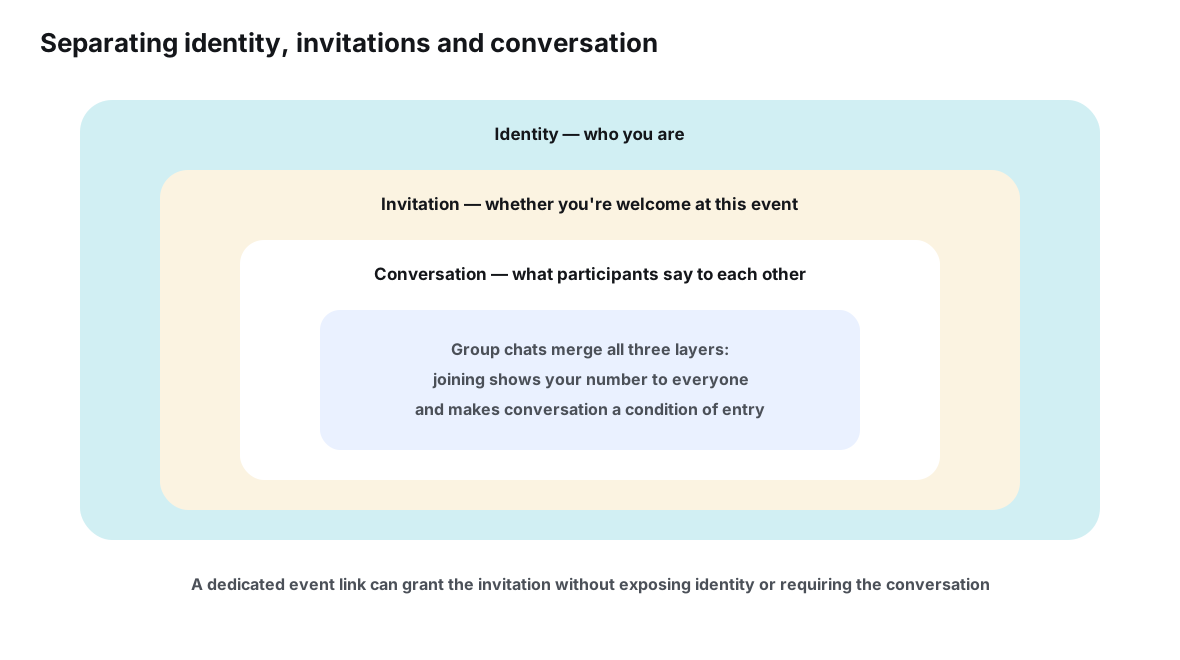
Keeping the layers separate also clarifies what each guest is consenting to. In the fused model, one tap agrees to everything at once, which is why cautious people hesitate at the invite itself. In the separated model, consent is granular: receiving the link commits you to nothing, responding discloses only a name and a status, and joining a conversation is a further, deliberate choice. Guests who can see the steps can take the first one lightly — and light first steps are what high response rates are made of.
Seven principles of privacy-protecting invitations
With the layers in view, the design principles follow naturally. None of them are technical; all of them are decisions an organizer makes in the first ten minutes of planning, usually without realizing it.
Collect the minimum. Write down what the event genuinely needs — typically a name to put on a list, a going/maybe answer, perhaps a dietary note. Everything else is habit, not requirement. A number is only needed if the plan depends on calling someone; an email is only needed if updates cannot live at the event’s address. Every field you don’t ask for is a liability you never acquire.
Scope identity to the event. A guest at your dinner is “Priya, going” — not a phone number, not a social profile. Scoped identity means the person exists for your purposes as exactly what the event needs and nothing more. When the evening ends, the scope closes with it.
Make visibility deliberate. The default question should be “who needs to see this?” rather than “who can we show this to?” Guest lists, statuses and comments each deserve their own answer. A headcount can be public while the list of names stays with the host; attendance can be visible while contact details are visible to no one.
Keep the invitation revocable. People’s plans change, and invitations should change with them. An invitation design that lets the host withdraw access — turning off a link, removing a guest, closing the page — treats guest data as something held in trust rather than something given away. The alternative is a screenshot-permanent commitment made on day one.
Let it expire. The invitation’s authority should end when the event does. This is the single most underrated principle: an invitation that cannot end becomes a directory, and directories outlive their purpose, quietly holding details for years. Expiry is not deletion for its own sake; it is the recognition that consent given for Friday does not extend to forever.
Separate the plan from the chatter. Facts live at the event’s address; conversation lives in whatever corner each clique already uses. This is both a privacy and a clarity measure — it prevents the event record from accumulating everything anyone said, and it prevents casual remarks from becoming part of the official artifact. The deeper argument for treating the plan as its own object rather than a conversation is made in the difference between a conversation and an event object.
Be transparent about what guests are sharing. The invitation itself should answer, in a glance, the questions a careful guest would ask: who runs this, who can see my response, what happens to my details afterwards. Transparency costs one sentence and removes the ambient uncertainty that makes people hesitate.
Anatomy of an invitation: four designs compared
Principles become concrete in the choice of invitation mechanism. Four designs cover nearly everything organizers actually do, and they differ enormously in what they expose.
| Design | What each guest must hand over | What guests see about each other | Revocable after sending? | Expires with the event? |
|---|---|---|---|---|
| Add everyone to one group chat | Phone number, name, photo — automatically and permanently | Full roster of contact details | No — leaving is loud, screenshots are forever | No — the group typically persists |
| Message each guest individually | Nothing new | Nothing | Partially — each message is its own copy | Yes, practically — but updates must be repeated by hand |
| Group invite link | Identity and number upon joining | Full roster after joining | The link can be revoked; membership persists | No |
| Event link with RSVPs | A display name and a status | Names and going / maybe statuses, at most | Yes — link and guest access can be turned off | Yes — the page can close with the occasion |
The bottom row is not magic; it is simply the only design in which the invitation’s data model matches the event’s actual needs. Note that the top row — the default for most social planning — is the only one that makes every guest’s contact details visible to every other guest as a condition of participating. The trade-off comparison between the last two designs, including when a real community genuinely should use a group, is drawn in detail in private event links versus group chats.
The second row deserves a kind word. Individual messages are the original privacy-preserving invitation — nothing is shared, nothing persists, nothing is joined. Hosts of sensitive gatherings have used exactly this method forever. Its weakness is purely logistical: every change means re-sending every message, every response arrives in a different thread, and the host becomes a human switchboard. The event link is best understood as the individual message’s semantics — minimal, personal, non-binding — with the logistics fixed: one address to update, responses collected in one view, no roster created in the process.
Scoped identity: a name for the evening, not a key to your life
The deepest problem with phone-number identity is not visibility alone; it is scope. A phone number is the same key to every door in a person’s life — the same identifier that confirms their presence at your barbecue also fronts their banking, their work chats, their family thread and their account recovery. Handing it over for one purpose grants a credential that works everywhere. The full argument for why that makes numbers a poor foundation for events — over-privileged, non-revocable, context-linking — is the subject of why phone numbers aren’t good event identity systems; for the organizer, the practical consequence is simpler: the less your invitation leans on numbers, the less it can leak.
Scoped identity is the alternative, and it is not exotic — it is how offline invitations always worked. A guest list for a wedding knows guests as “Ms. Okafor, party of two, chicken.” Nobody’s home address is on the seating chart. The digital translation: a guest appears at the event as a display name and a status. The host sees a headcount; fellow guests see who is coming; nobody sees a route to anyone’s pocket. If two guests want to exchange numbers at the event, that is their conversation — the important word being their.
Scope also has a time dimension. “Priya, going” should be a fact about Saturday, not a permanent record. Identity that is scoped in both audience and duration — visible to this event’s guests, meaningful until this event ends — gives the organizer everything the plan needs while giving away nothing that needs protecting. It is the difference between wearing a name badge at a conference and having it tattooed on.
RSVPs that inform without exposing
The RSVP is where invitation design earns its keep, because it is the moment personal data actually changes hands: a real person makes a real commitment about their real evening. Handled carelessly, that moment broadcasts; handled well, it informs precisely.
Consider what the host needs from responses: a headcount that stays current, a sense of who is firmly in, and enough per-person resolution to notice when a key guest hasn’t answered. Consider what the guests, collectively, need from each other’s responses: enough social signal to know the evening will be lively and who to look forward to. Neither of those lists requires contact details, and neither requires the full social graph of who was invited. A well-shaped RSVP system shows names and statuses — going, maybe, not going — to the people for whom that is useful, and shows nothing else to anyone.
There is even a formal vocabulary for this in the structured-data world: schema.org, the vocabulary search engines use to understand pages, models an RSVP as an RsvpAction — an action attached to an event, with a status and a participant — rather than a record about a person. The modeling choice is telling even for non-developers: the interesting fact is the response, not the respondent’s identity. An RSVP is an event that happened, not a person you now possess. Good invitation designs treat it exactly that way.
Statuses also protect guests socially, not just technically. “Maybe” exists because plans are uncertain and people are honest; a visible maybe lets a guest hold a genuine option without a private back-channel to the host. And because statuses can be updated, the record tracks commitment as it evolves — unlike a chat poll, which captures opinions at one moment and quietly expires into wrongness. The host watching a headcount that updates itself is experiencing what data minimization feels like from the inside: less information, better information.
Revocation, expiry and the right to be forgotten by the group
Two capabilities separate a trustworthy invitation from a one-way disclosure: the ability to revoke, and the ability to end. They are the organizer’s half of the privacy contract, and most group-chat invitations quietly lack both.
Revocation means the host can change what the invitation grants. A link that leaked too far can be turned off; a guest whose plans soured can be removed from the list; access to a venue address can wait until the day before. None of this is about excluding people — it is about the invitation remaining under the host’s authority for as long as it exists. Contrast the group chat, where the moment of sending is the moment of surrender: the roster is out, the members have the numbers, and the only remedial action available is asking everyone nicely to forget.
Expiry means the invitation’s authority has a stop date. The cleanest invitations are one-per-occasion: when the event is over, the page closes, the list dissolves, and there is nothing left to leak, manage, or apologize for. This is also the direction data-protection thinking has pushed organizations for years — keep data only as long as it serves the purpose for which it was collected — and it translates to social life without any machinery at all. A birthday group that still has forty members in March was a February event that nobody archived.
Guests benefit from a mirror-image set of abilities: to decline without a visible exit, to change an answer without explanation, and to leave the plan entirely with one tap. The invitation that grants these quietly — no announced departures, no awkward “left the group” moments — removes the social tax that stops people from managing their own boundaries. Over time, that is what makes an organizer’s invitations trusted: people learn that saying yes is reversible, so saying yes becomes cheap.
What data-protection law expects, in plain terms
Nothing in this article is legal advice, and no organizer of a dinner party needs a compliance program. But the legal frameworks are worth knowing about at the level of their shared intuition, because that intuition validates everything above.
The EU’s General Data Protection Regulation — the GDPR text is public — is built around principles such as data minimization (collect only what you need), purpose limitation (use it only for what you said), storage limitation (keep it only as long as needed) and integrity (protect it while you hold it). California’s consumer privacy law covers similar ground from the consumer-rights side; the CCPA overview from the state attorney general is the standard reference. Both regimes treat phone numbers unambiguously as personal data.
Read as design guidance rather than law, these principles map one-to-one onto invitation design: minimization is asking only for a name and status; purpose limitation is using the guest list for the event, not for next year’s mailing; storage limitation is the invitation that expires; integrity is keeping responses at the event’s address instead of scattering them across threads. The organizer who follows the seven principles above will find, on inspection, that they were doing privacy engineering all along. For everyday questions about handling personal information, the UK regulator’s plain-language materials at ico.org.uk are a genuinely readable starting point.
One caveat belongs here: obligations differ by jurisdiction, role and scale, and an organization planning events — a club, a company, a community group — carries responsibilities a birthday host does not. The point of this section is not compliance; it is that the direction of travel, from law and from etiquette alike, points the same way. Less data, held for less time, with the guest’s knowledge. The law formalized what considerate hosts always did.
Updates without re-exposure
Plans change, and every change is a fresh chance to either protect or spread guest data. The mechanism the host chooses for updates decides which happens.
Update-by-rebroadcast — posting a new message to every group and thread where the plan was mentioned — multiplies copies. Each copy carries the plan, the guest context around it, and often the roster itself; each new chat that receives it becomes another place the details live. Update-by-edit inverts the math: the host changes the fact at the event’s address, and everyone who looks sees the current state. Nothing is re-sent, because nothing needs to be. The link was shared once, and it keeps working precisely because it never moved.
The edit model is also kinder to guests’ attention, which is a privacy-adjacent virtue. A plan they can check on demand makes no demands of them; a stream of correction messages requires them to read, now, in every app the event touched. Guests experience the difference as calm, and organizers experience it as not fielding forty “which time is final?” messages. Reminders complete the picture: scheduled at the host’s choosing, they reach everyone with the link without anyone having to maintain a notification list by hand.
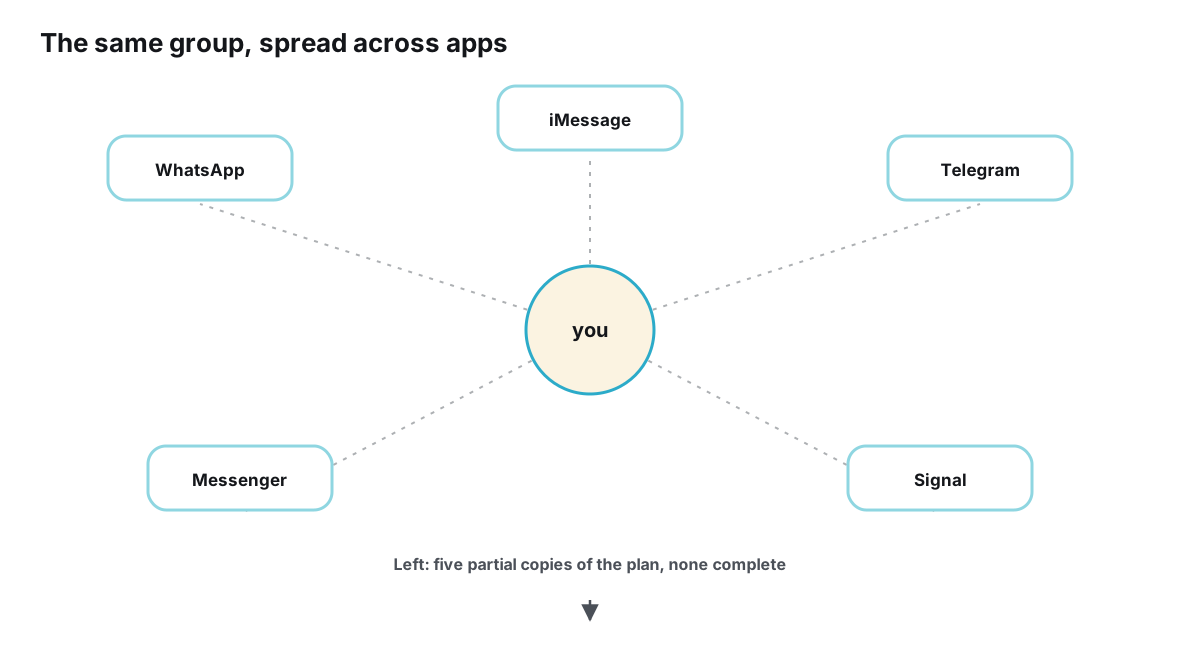
The diagram is worth showing to any group that argues about which app to use for the plan. The honest answer for real gatherings is that several apps will be involved no matter what, because people talk where they already talk. The privacy-preserving response is not to consolidate the conversations — that fight is unwinnable — but to de-consolidate the data: one event address above all of them, linked from each, so the plan exists exactly once and the guest details exist approximately never.
The organizer’s pre-flight checklist
Everything above compresses into a short set of questions worth asking before any invitation goes out. Thirty seconds with this list prevents the vast majority of the exposures this article has described.
| Question | Why it matters | The safer default |
|---|---|---|
| What does each guest actually have to give me for this to work? | Every requested field is data held on trust; most fields are habit | A display name and an RSVP status |
| What will guests see about each other? | Merged audiences expose people to circles they never chose | Names and going / maybe statuses — no contact details |
| Can I withdraw this if circumstances change? | Irrevocable sharing turns every mistake into a permanent one | A link or list the host can turn off or edit |
| When does this invitation stop being valid? | Invitations that cannot end become long-lived directories | The plan closes with the event |
| Where do the facts live when something changes? | Rebroadcasting updates multiplies copies of guest data | One address that is edited, not re-sent |
The checklist scales in both directions. For a coffee with two friends, answering it takes a moment and mostly confirms that nothing special is needed. For a 200-guest fundraiser where guests include public figures, survivors of something difficult, or simply people who did not choose to be publicly associated with each other, the same five questions are the difference between an occasion and an incident. The questions never change; only the stakes do.
Frequently asked questions
Do I need an app to protect my guests’ privacy?
No — the principles matter more than the tools. Messaging guests individually, keeping the list in one private place, and deleting group chats after events gets you most of the way with nothing but good habits. Dedicated tools simply make the privacy-preserving path the easy path: the link does what the discipline would otherwise have to do by hand.
Isn’t a group invite link already privacy-friendly?
It is friendlier than adding people directly, but only until someone joins. A link that opens a group still places each joiner into a shared roster, with the usual visibility of numbers and profiles. A link that opens an event page never creates membership, so there is no roster to join. The destination of the link, not the link itself, determines the privacy.
What if guests genuinely need each other’s contacts — for carpooling, for example?
Then make it a deliberate, mutual exchange rather than a default. Guests who want to coordinate can share their details with each other directly, or the host can announce “everyone driving, message me and I’ll connect you.” The principle is consent per purpose: contact details flow to the people who need them, for the reason they need them, rather than to everyone forever.
Does this mean I should never make a group chat for an event?
It means group chats should be a considered choice, not a reflex. For a standing circle that talks anyway, adding one event to the existing thread is natural and fine. For one-off occasions among mixed circles — the case for most events — the group chat is the option that costs guests the most privacy for the least necessity, which is exactly backwards.
What should I do with the guest list after the event?
Whatever the guests agreed to, and no more. If the invitation said “for the dinner on the 14th,” the list’s job ends there; keeping names and responses indefinitely serves the host’s convenience, not the guests’ consent. The tidiest invitations make this automatic — when the event page closes, the list goes with it.
As a guest, how can I tell if an invitation respects my privacy?
Look at what it asks for. If joining reveals nothing but a plan and a set of RSVP buttons, your details are staying with the host. If it requires installing an app, joining a group, or creating an account before you can even see what time dinner starts, the event is also collecting you. A respectful invitation answers your questions before it asks for your identity.
Conclusion
Invitations are the oldest privacy technology in social life. Hosts have always known, without any regulation to tell them, that a guest list is a sensitive document: shared with the venue, not with the town; current for the evening, not for the decade; generous with warmth and stingy with details. Group chats broke that tradition by accident, bundling identity, invitation and conversation into a single permanent membership and calling it convenience.
The repair is to design invitations the way good hosts always ran them. Share an address, not a roster. Ask for a name and an answer, and nothing else. Let guests see who is coming without being able to reach into anyone’s pocket. Keep the invitation revocable, let it expire with the occasion, and update the plan where it lives instead of everywhere it was mentioned. These are not technical constraints — they are manners, formalized. The organizers who adopt them are finding that what reads as privacy from one side reads as effortlessness from the other: invitations people accept in one tap, headcounts that assemble themselves, and nothing left over to manage once the last guest has gone home.
Send one link. Collect RSVPs, not contact details.
Create your event with Ontaym