
When Should a Group Stop Using WhatsApp for Event Planning?
Most groups don’t decide to stop planning in WhatsApp — they suffer their way to the question. Here are the signals that actually predict trouble, the situations where staying in the chat is the right call, and a five-minute test to tell which one your group is in.
Quick answer
Stop using WhatsApp for planning when the pain becomes structural rather than incidental: the same questions recur because the thread has no readable current state, decisions get re-opened, nobody can state the headcount, changes generate more messages than the original plan, and late joiners need personal briefings. Any one of these is a nuisance; three or more, recurring across events, is a system without a system. Keep planning in the group when the event is small, one-off, stable and universally on WhatsApp — chat genuinely suffices there. And “stopping” rarely means leaving the app: it means letting the chat keep the conversation while the plan moves to a structured, linkable event record that always shows its current state.
The question is fit, not fault
It helps to be precise about what is being asked. WhatsApp is a superb messaging app — fast, universal in much of the world, and genuinely good at what it was built for. Its group chats can hold over a thousand participants, and its Communities feature exists specifically to help organizers link related groups and broadcast announcements to all of them, as documented in the WhatsApp Help Center. If raw capacity were the constraint, almost no friend group or club on earth would have a problem.
The constraint sits somewhere else entirely: in the shape of the information. A plan is state — one current time, one current place, one definitive list of who is coming — while a chat is a stream: an append-only sequence of statements, each true when it was sent. A group chat can contain every fact about your event and still not be able to answer the only question anyone has at nine in the evening two days before it: what is the current plan? To answer that from a thread, every reader has to reconstruct it, and different readers reconstruct it differently.
This is why the question “should we stop using WhatsApp for planning?” is misphrased. WhatsApp isn’t failing at messaging; the group is asking a stream to behave like a record. The honest version of the question is: has our planning outgrown what a message stream can represent? The difference matters because it points at observable signals — things your group actually does — rather than at opinions about apps. The distinction between a conversation and a structured record is explored at length in the difference between a conversation and an event object; the rest of this article stays practical.
Seven signals it is time to move
These signals tend to appear in a rough order as a group or an event grows, and they have a useful property: each one is visible in the thread itself, so you can audit your own group against this list in a few minutes of scrolling.
The same question keeps returning. “What time are we meeting?” asked by three different people in one week is not three careless people; it is three people independently discovering that the thread has no readable current state. In a functioning system, a question is asked once and answered by a place. In a chat-based one, every member carries the full cost of staying current, and most quietly decline to.
Decisions get re-litigated. A venue was agreed on Tuesday, and by Friday someone proposes an alternative — not out of malice, but because the Tuesday agreement is now four hundred messages up and carries no more visual weight than the joke beneath it. When settled facts and open questions look identical in the interface, the group cannot tell what is decided, so everything stays perpetually half-open.
The headcount is unknowable. The organizer cannot say how many people are coming without a forensic pass over reactions, one-line replies and silence. This one is expensive because it propagates outward: the restaurant reservation, the table size, the food order, the deposit. A thumbs-up from four days ago is not an attendance record, but in a chat-based plan it is the closest thing that exists.
Changes cost more than the original plan. One moved time generates a chain: the announcement, the people who missed it, the people who saw the old version and the new one, the follow-up clarifications, and the organizer’s repeated re-answering. In a record-based system a change is one edit. In a stream-based one it is a small communication campaign, and organizers start softening or delaying changes to avoid the noise — which is the medium quietly taxing accuracy.
Late joiners need a personal briefing. Someone is added to the group after the plan formed, and their onboarding is either “scroll up” — an archaeology assignment — or a private chat with the organizer summarizing what matters. Both are workarounds for a missing onboarding surface. If your group has a roving correspondent whose job is explaining the plan to newcomers, that is the signal in its purest form.
A second app appears. Someone’s partner is on Signal, a colleague only uses Telegram, and suddenly the WhatsApp group has a satellite conversation running elsewhere — with facts pasted across the gap by hand. This is the signal with the sharpest edge, because it silently ends the chat’s tenure as the single source of truth: from the moment two apps hold parts of the plan, neither one is authoritative, and no amount of diligent copy-pasting restores what the group lost.
The organizer is tired in a specific way. Not tired of hosting — tired of being the interface. Privately answering where/when/who questions, maintaining a mental headcount, re-posting details for people who missed them. When the person who volunteers to organize starts volunteering less because the coordination overhead has eaten the hosting, the group is losing its most valuable member to a structural problem it could fix in an evening.
| Signal | What it costs right now | What it predicts if nothing changes |
|---|---|---|
| Recurring questions | The organizer answers the same things repeatedly | Members stop asking and start guessing |
| Re-litigated decisions | Energy spent re-arguing settled points | Plans fork silently; two subgroups hold different versions |
| Unknowable headcount | Reservations made on instinct | Empty seats, overcrowding, deposits at risk |
| Expensive changes | Updates get softened or delayed | Ambiguity becomes the group’s default style |
| Late joiner briefings | The organizer becomes a private help desk | Newcomers feel like a burden and disengage |
| A second app appears | Facts get pasted across apps by hand | Multiple partial copies, none authoritative |
| Organizer fatigue | The best organizer slows down | Nobody volunteers to organize the next event |
One pattern worth noticing: none of these signals mentions member count. A five-person trip spanning two weekends with shifting logistics can hit every signal on the list, while a standing twenty-person drinks night with a fixed venue hits none. Size correlates with trouble, but the causes are volatility — changes, late joiners, multiple apps — not headcount itself.
The counter-signals: when WhatsApp is the right home
An honest decision framework has to be able to say “stay,” and there are real situations where the group chat is not just tolerable but correct. The clearest case is the small, stable, one-off plan: a dinner with four friends at the usual place on the usual night. The thread will be short, everyone will read all of it, and social memory — the original coordination technology — covers whatever the thread misses. Introducing a structured record there is not harmful so much as pointless; the structure has nothing to organize.
Stay is also right when the group is genuinely universal: every single participant is on WhatsApp daily, nobody needs to be added or removed across the event’s life, and the plan has no audience beyond the group. The moment that condition breaks — one key guest on a different app, one plus-one who shouldn’t see the banter, one person who would rather not hand over their number — the chat stops being a sufficient container.
And stay is right when the conversation is the event. A standing banter group that occasionally materializes into a pub has no planning problem to solve; its chattiness is its purpose, and its plans are deliberately loose. Structure would not make that group more effective. It would make it less itself.
| Your situation | Verdict | Why |
|---|---|---|
| Dinner for five, tomorrow, usual place | Stay in chat | Short thread, everyone reads everything, nothing to structure |
| Weekend trip, a dozen people, logistics in flux | Move the plan | Volatility is high; a record absorbs changes a stream cannot |
| Monthly club with a headcount the venue depends on | Move the plan | Attendance is a recurring, load-bearing fact |
| Standing banter group with occasional casual meetups | Stay in chat | Looseness is the feature, not the bug |
| Group spanning WhatsApp plus one other app | Move the plan | No single chat can be authoritative across apps; a link can |
| One-off celebration with a guest list beyond the chat | Move the plan | Invitations need to reach people who will never join the group |
The gray zone
Plenty of groups read both lists and land in between: two signals present, not five; one painful event behind them, one smooth one. The gray zone is best handled with a cheap experiment rather than a verdict. Pick the lightest intervention available — rigorous message pinning, a one-line plan summary posted after every decision, a dedicated thread for plan facts only — and run it consciously for one full event cycle.
Then observe what the experiment costs. If maintaining the pin or the summary takes the organizer real effort each week, and the questions still slip through, you have learned that the group’s discipline is being spent simulating a record — labor doing a database’s job. That is the classic gray-zone outcome, and it resolves the decision: migrate. If, on the other hand, the light intervention holds with near-zero effort and the group’s pain was really about one unusual event, stay. The experiment is diagnostic precisely because success and failure both point somewhere clear.
What the gray-zone experiment should never become is a permanent compromise. Groups can spend years in a state where the organizer’s summary posts are the de facto system of record — maintained by hand, always slightly stale, and dependent on one person’s continued willingness. That arrangement works until the organizer travels for work, and then it fails in a single evening. If your workaround has a single point of failure and that point is a human, the workaround is the argument for migrating.
A five-minute test
If you want something faster than a signal hunt, run this test against your group’s current or most recent event. It works best answered by two or three members independently, without conferring, because the disagreements are themselves diagnostic.
| Question | If yes | If no |
|---|---|---|
| Could a member who joined today state the final time and place without asking anyone? | The thread is still short enough to serve as its own record | Onboarding is broken; the plan has no readable surface |
| Can the organizer name the current headcount without scrolling? | Attendance is informal but stable | Headcount is folklore, not data |
| Has any detail changed more than once since planning began? | Only if the change flowed cleanly to everyone | Each change strands someone on an old version |
| Do any two members currently hold different versions of the plan? | Unlikely, and it would surface immediately if so | You will find out on the night, at the venue |
| Did the organizer re-post or re-explain anything this week? | It was a genuine one-off | Repetition is a habit, which means the record is missing |
Score it honestly. Mostly “yes” column answers and you can shelve the question until your next event. Two or more “no” column answers and the migration question is already answered; what remains is choosing the destination and the moment — and for that, the general playbook for moving from chat-based to structured planning covers the mechanics end to end.
A worked example
Consider a hiking group that organizes a day walk every month. For years it ran entirely inside one WhatsApp group: the route was usually familiar, the meeting point was a train station everyone knew, and whoever felt like organizing that month simply posted a date and counted the replies. By the framework above, that group had every reason to stay — and for a long time it did, happily.
Then the group’s character drifted, the way groups do. New members joined who didn’t know the default stations. Routes became more ambitious and started requiring car-sharing, which meant knowing who was driving and how many seats existed. Weather forced changes on the eve of walks. And the most experienced organizer — the one who actually knew the trails — started answering route questions in private messages rather than the group, because explaining things for the tenth time in a scrolling thread had stopped being fun.
Run the checklist against that description and the verdict is unambiguous: recurring questions, an unknowable car-seat headcount, expensive eve-of-event changes, private briefings for newcomers, and a quietly tiring organizer — five of the seven signals, recurring monthly. Nothing about the group had failed socially; the plan had simply acquired volatility, audience and logistics that a message stream cannot represent. The month this group moved its walks onto a structured event page — route details and meeting point as fields, seat counts and attendance as statuses each hiker set themselves, weather changes applied as single edits — the recurring questions largely evaporated. The chat went back to photographs and trail banter, which is what it had always been best at.
The example generalizes. The trigger for migration is rarely a dramatic collapse; it is a slow accumulation of exactly the patterns in the list above, arriving one at a time until the organizer notices the month feels like work.
Choosing the moment
If the decision is to move, timing still matters. The worst moment is mid-crisis on the eve of an event, when tempers are short and the thread is loudest — even though that is exactly when most groups finally snap and do it. The best moment is between events, when nothing is in flight: the previous event is done, the next one is a blank page, and the group can adopt the new pattern as the way the next plan starts rather than as an emergency transplant onto a live one.
The second-best moment is early in a plan’s life, before decisions accumulate — the migration is cheapest when there is the least to carry over. And if you find yourself reading this with an event already drowning in the thread, even the worst moment works: the operation is small, the steps are mechanical, and it is laid out in full in how to move an event from WhatsApp to a dedicated event page.
One timing note cuts the other way: don’t migrate in the final hours of an organizer’s patience. A migration done resentfully tends to be announced resentfully, and groups read the tone more carefully than the content. Pick a calm week, frame the move as an experiment for the next event rather than a verdict on the past ones, and let the results argue.
What stopping actually means
The word “stop” misleads here, because almost no group that stops planning in WhatsApp stops using WhatsApp. What changes is the app’s role. The chat keeps the parts it is brilliant at — the negotiation before decisions, the jokes after them, the low-stakes chatter that keeps a group feeling like a group. The plan itself — the current values, the guest list with real statuses, the change history — moves to a structured record with its own address: an event page that anyone can open from any app, no membership required.
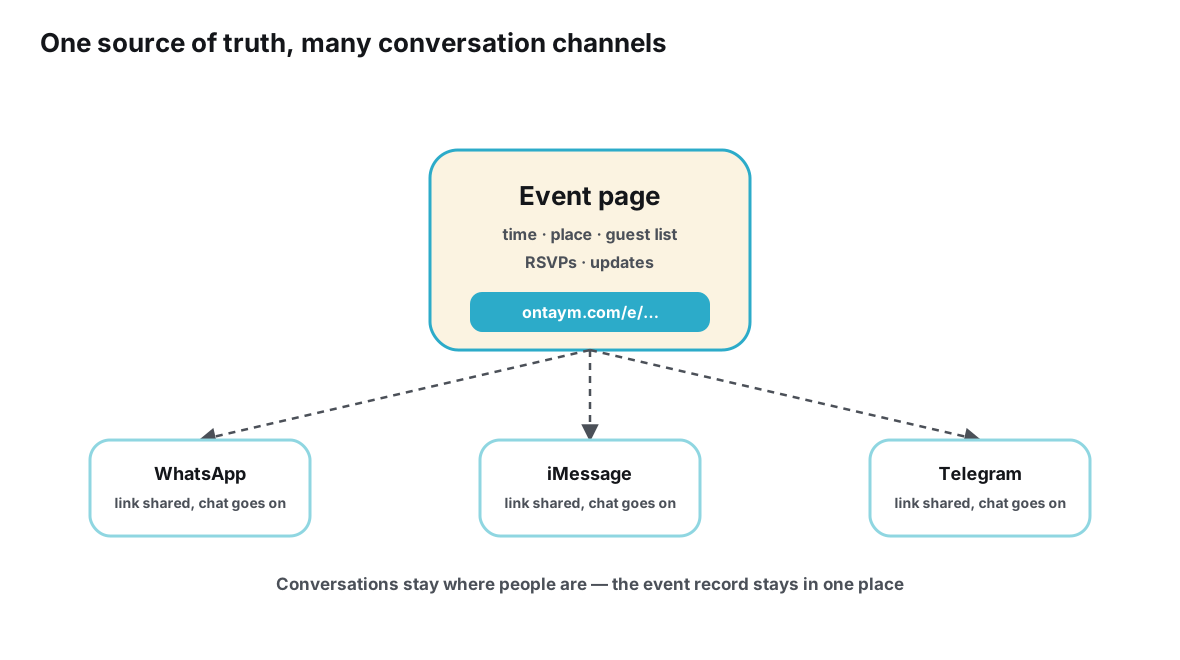
This division of labor is what tools like Ontaym are built around — one link per event, RSVP statuses guests set themselves, updates that reach everyone who holds the link — but the pattern predates and outlives any particular product. The organizer’s rule of thumb is simple: the chat is where the plan is discussed; the page is where the plan is. Groups that internalize that sentence stop having the argument entirely.
The cost of waiting
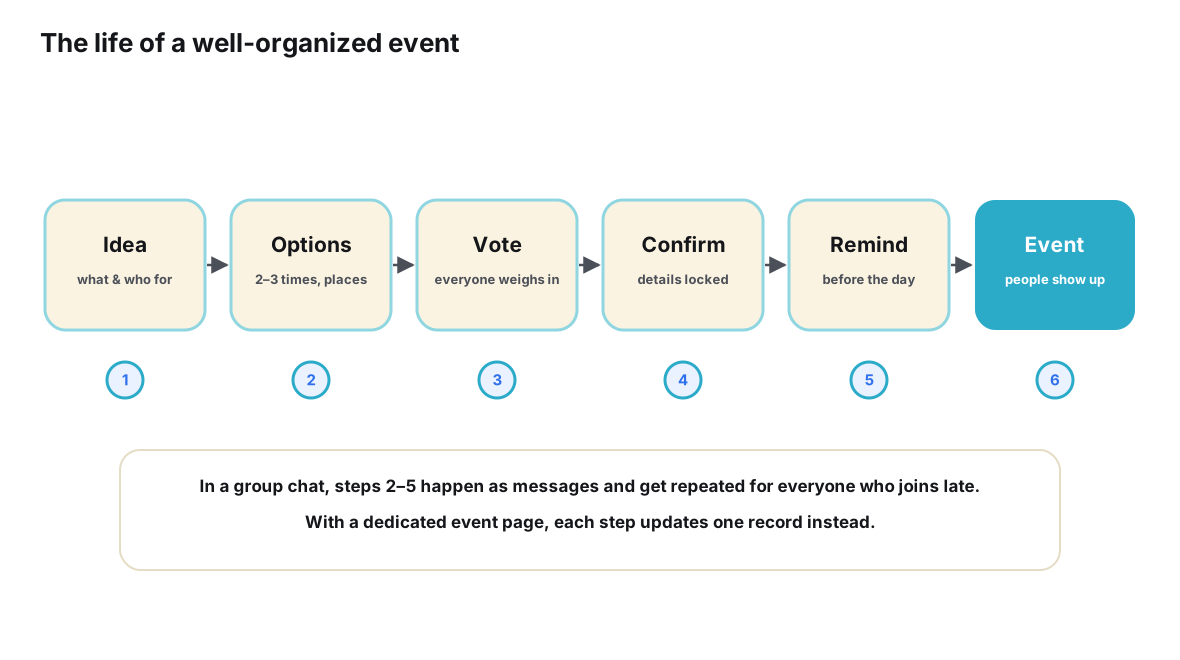
Signals like these do not stay constant; they compound along the life of an event. In the early days, the thread is short and everything is easy — which is precisely why groups drift into chat planning without deciding to. By the middle, the changes start and the questions begin. By the final days, when the headcount matters most and the details are most volatile, the thread is at its longest and least readable. The pain curve and the stakes curve rise together.
Waiting also has a social cost that is harder to see. Every event planned painfully in the thread teaches the group that organizing is exhausting, and the people best positioned to organize conclude they would rather not. The decision to restructure is usually framed as being about software. It is more honestly about keeping the volunteer organizer — the scarce resource in any friend group, club or community — willing to raise their hand again next time.
And if your group’s home is Telegram rather than WhatsApp, the framework transfers almost unchanged: the signals, the counter-signals and the role split all apply, with the platform-specific details — channels, supergroups, poll mechanics — covered in turning an existing Telegram community into an event community.
Frequently asked questions
Is WhatsApp bad for planning events?
No. WhatsApp is excellent at what it was designed for: real-time conversation among people who have each other’s numbers. The problems described here appear when a group asks a message stream to also serve as the system of record for a plan — a job that requires current state, not history, and labeled fields, not sentences. It is a mismatch of tools to jobs, not a defect.
Is there a group size where chat planning breaks down?
Not a fixed one. Groups can hold far more members than any friend group needs, and trouble shows up in small groups with volatile plans while large groups with fixed routines coast. The predictors are volatility and audience — changes, late joiners, guests beyond the chat — not the member count on the screen.
Does stopping mean leaving WhatsApp?
Almost never. The chat keeps conversation, banter and day-of coordination. What moves is the plan itself: current details, the guest list and the change history relocate to a structured event page with its own link. Most groups end up using WhatsApp more enjoyably, because the thread stops being clogged with logistics.
Aren’t pinned messages and polls enough?
They buy time, and in the gray zone they can even settle the question. But a pin is a frozen snapshot that goes stale the moment the plan changes, and a poll is a preference tally at one moment, not a commitment that updates. If they are holding without organizer effort, stay. If maintaining them has become a chore, that chore is the argument for a real record.
What if only part of the group wants to change how we plan?
Treat it as an organizer’s decision, not a vote. The structured record does not require universal enthusiasm to function — it requires a link that works for everyone, including the skeptics, from whatever app they already use. Post the plan’s address once, answer questions with it consistently, and let convenience do the persuading.
Conclusion
The decision to stop planning in WhatsApp is worth making deliberately, because the alternative is making it accidentally — event by painful event, with the group’s best organizer slowly concluding that hosting isn’t worth the coordination tax. The signals are legible if you look: recurring questions, re-litigated decisions, an unknowable headcount, expensive changes, briefed late joiners, a second app, a tiring organizer. Three or more, recurring, means the group has outgrown the stream.
Just as important is the courage of the other verdict. Small, stable, one-off plans among people who all live in the same chat are not a failure mode — they are chat doing its job well, and adding structure there is ceremony. The skill is telling the two situations apart, and the five-minute test above usually settles it. Whichever way your group lands, the goal is the same: conversation where conversation belongs, and a plan with one address that is always, boringly, current.
When the signals line up, give your plan a better home than the scrollback.
Plan your next event with Ontaym