
Why “Going” Is Different From Answering a Poll
In a chat app, choosing a poll option and promising to attend cost the same single tap. The similarity ends at the interface: one answer describes your taste, the other describes your future — and only one of them can safely be counted by the person organizing.
Quick answer
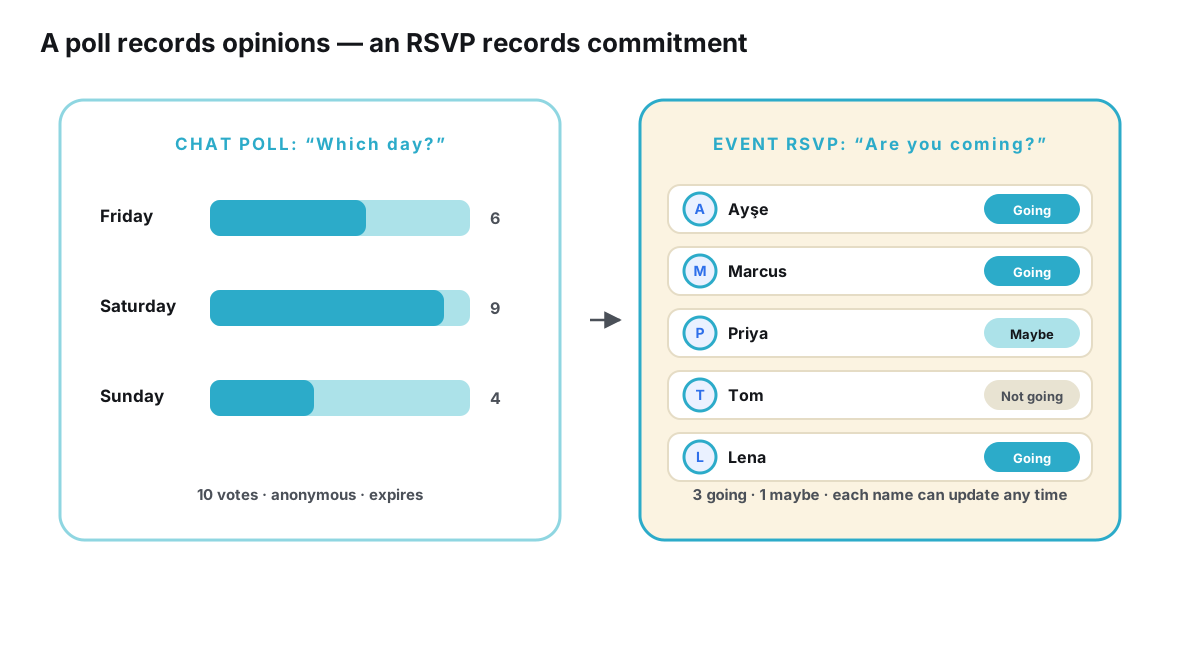
Answering a poll records a preference: how you feel about a question at the moment you answer, with no obligation attached. Saying you're going records a commitment: a statement about your attendance at a specific event, bound to your identity, expected to persist until the event, and updatable when your plans change. Preferences aggregate into a tally; commitments aggregate into a guest list and a headcount. When organizers treat poll answers as commitments, they overcount — because voting is cheap, social, and revocable by silence. When systems treat commitments properly — one current answer per person, changeable, timestamped — headcounts get honest. The rule of thumb: poll people while you're still deciding, collect commitments once the event exists, and never let one mechanic do the other's job.
One tap, two meanings
The interface is the reason this distinction gets lost. Somewhere along the way, every coordination question in a group chat became answerable with a tap: a poll option here, a thumbs-up reaction there. The tap is frictionless, and frictionless answers feel interchangeable. Tom taps “Saturday” on the date poll; two days later he taps the heart on the “see you all there!” message; from where he sits, both are the same gesture — a small social nod, half-acknowledgment and half-agreement.
From where the organizer sits, they could not be more different. The first tap is Tom's opinion about a question that hasn't been decided. The second is, arguably, Tom's promise to be somewhere on a date that has. Between those two taps, the event crossed a line — it stopped being an idea under discussion and became a plan with a time, a place and consequences. The interface never announced the crossing. There was no moment where the question changed from “what do you prefer?” to “will you be there?”, because the chat presents both in the same costume.
This is worth slowing down on, because nearly every headcount disaster in group planning traces back to it: an organizer counted answers to the first kind of question as if they were answers to the second. The fix starts with being able to say precisely what each kind of answer is — and what it is not.
What a preference is for
Preferences are genuine data, and collecting them well matters. Before an event exists, there are legitimately open questions. Which weekend suits more people? Is the group more in the mood for hiking or for brunch? Should the trip be one day or two? These questions have no wrong answers, no obligations, and no consequences beyond steering the discussion. Polls were invented for exactly this territory, and chat-platform polls serve it well — WhatsApp groups can run polls among as many as 1,024 members, Telegram polls can be anonymous, public with visible votes, or quiz-style, as described in the Telegram FAQ, and Doodle built an entire long-standing service around date-and-time preference polls, as shown at doodle.com.
The defining property of a preference is that it costs nothing to give and nothing to withdraw. If Tom says Saturday and the group settles on Sunday, nobody thinks Tom broke a promise — he stated a lean, the decision went another way, life goes on. Preferences are also freely revocable without ceremony: changing your mind about which restaurant you fancy is not a social event. This cheapness is not a flaw. It is what makes preferences honest. People will tell you what they actually think precisely because saying it commits them to nothing.
But the same cheapness makes preferences useless as attendance data. A tally of “Saturday looks better” tells an organizer about the group's mood, and nothing at all about how many humans will occupy seats. The gap between the two is not small and not constant — it widens with the size of the group, the distance to the date, and the looseness of the invitation, which is why the problem always seems to appear as the event grows.
What a commitment is for
A commitment is a different category of statement. When Priya says she's going to Maya's dinner, she is making a claim about her future: on that evening, in that place, she intends to be present — and other people's decisions may legitimately rearrange around her claim. Maya books a table for ten partly because Priya and nine others said going. Someone offering a lift plans around who's coming. The venue, the budget, the quantities, the vibe — a surprising amount of an event's material reality is a function of the commitments collected.
Because commitments carry weight, they behave differently from preferences in every dimension that matters to a planner:
- They're bound to a person. “Eight people are going” is only useful if the system knows which eight, because names drive follow-ups, seating, payments and outreach.
- They're bound to an event. A commitment answers a question about a specific occasion — not about a general enthusiasm for the concept of dinners.
- They persist. A going answer given on Tuesday is expected to still be true on Friday, and if it stops being true, that itself is information the system needs to capture.
- They're exclusive. One person, one current answer. You can prefer Saturday and Sunday simultaneously; you cannot be going and not going at once.
- They're updatable — visibly. Changing a commitment must change the headcount, not just add a contradictory remark nearby.
None of these properties exist in a poll mechanism. A poll tally aggregates anonymous-feeling taps into bars; it has no per-person current answer to update, no memory of changes, and no notion that its result should steer reservations. That's not a limitation of any particular polling implementation — it's the definition of what a poll is.
| Property | Poll answer (preference) | Going answer (commitment) |
|---|---|---|
| Question it answers | “Which option do you favor?” | “Will you attend this specific event?” |
| What it describes | Your taste or lean, right now | Your intended presence, until changed |
| Cost to give | Nothing — socially free | A small social promise with an audience |
| Bound to your identity | Optionally; often invisible in the tally | Essentially — the name is the point |
| Lifecycle | Ends when the poll fades from view | Runs until the event concludes |
| Can be exclusive | No — several options can appeal at once | Yes — one current status per person |
| Update path | Re-vote at best; old tallies linger | Status change that replaces the old answer |
| Rolls up into | A tally of opinion | A headcount and a named guest list |
| Safe to book a table on | No | Yes, with the usual human slack |
The funnel explains the gap
Every event passes through an attrition funnel, whether or not anyone is measuring it. People hear about the idea. A subset expresses interest. Fewer say they'll come. Some of those quietly drift. Fewer still walk through the door. The funnel isn't a moral failing of your friends — it's the natural geometry of plans meeting real life: shifts get scheduled, children get fevers, energy runs out.
A poll answer lives at the wide end of the funnel, where enthusiasm is cheap and the future is abstract. Tapping “count me in” on a poll about a picnic next month is a way of participating in the fun of the plan. A commitment lives further down the funnel, closer to the narrow end, where the answer has a date attached and a name on it. The distance between those two points — between the wide end and the door — is precisely the gap between poll answers and attendance. Pretending the tap at the top predicts the count at the bottom is the error; the funnel narrows for everyone, always.

The practical consequence for organizers is a sequencing rule: use preference mechanics while you're shaping the event, and switch to commitment mechanics once the event's shape is fixed. Poll the two possible Saturdays; then, with the Saturday chosen, ask for going answers against the actual event. The two questions sound similar — “which day works?” and “are you coming on the 14th?” — but they summon different mental computations from the people answering, and only the second one deserves to be counted.
Why conflating them corrupts headcounts
When a poll answer gets counted as a going answer, the error runs in a consistent direction: upward. People vote yes for pleasant-sounding options with the vague intention of figuring out logistics later. Their vote is sincere as a preference and meaningless as a forecast. The organizer reads twelve taps, books for twelve, and watches a third of them evaporate — a pattern familiar to anyone who has ever organized anything through a chat thread.
The corruption has a second, subtler layer: it poisons the signal for the guests too. Once the group has seen that “the poll said everyone's coming,” the individuals who genuinely intended to come calibrate their own commitment to the fiction. Commitment inflation is contagious; nobody wants to be the first to say the emperor's headcount has no clothes. By the time real attendance materializes, everyone privately knew the number was soft, and nobody had a mechanism for saying so without social cost.
There's also an undercounting failure mode, less common but just as damaging. Some people won't answer a poll at all — because they're unsure, because they dislike public declarations, because the poll question (“which day?”) wasn't the question they could answer (“can I come at all?”). Their silence gets recorded as absence of interest, when it may be anything but. A commitment mechanism with a “maybe” status exists precisely to catch these people; a poll has nowhere for them to stand.
Who pays for a wrong count
The preference-commitment confusion sounds abstract until you total up who absorbs it. The organizer pays first and most visibly. They are the one who converts the tally into a booking, and the gap between the booked number and the real one lands on them as an awkward conversation with a restaurant holding an oversized table, a deposit on seats nobody sat in, or a room booked for a crowd that never condensed. Every organizer who has stood in a venue apologizing for the empty chairs has paid this bill.
The guests pay too, in smaller and stranger currencies. The ones who came subsidize the absence of the ones who didn't, when the bill is split per head on the night. The ones who declined honestly — who said no when saying yes was cheaper — watch their reliability get quietly discounted, because in a poll-driven culture a no looks like indifference while a vanished yes looks like bad luck. And the ones who were genuinely uncertain never got a legitimate way to stay in the count, so the event lost the chance to win them over with better timing or a smaller ask.
There is even a cost paid forward. Groups remember bad data. The organizer who booked for fourteen and hosted nine doesn't just lose one dinner's margin; they lose faith in the group's signals, and respond rationally — by over-asking, re-confirming obsessively, or quietly scaling plans down to what needs no counting at all. The group's coordination capacity shrinks to the size of its most reliable signal. Fixing the signal, by separating votes from commitments, is what buys the capacity back: the organizer learns which numbers are soft, guests learn that maybe is welcome, and the next plan starts from data everyone trusts.
How platforms draw — or blur — the line
It's instructive to notice how different platforms handle the boundary between preference and commitment, because the industry itself keeps rediscovering that the line matters.
Chat platforms mostly stay on the preference side, honestly. WhatsApp polls are a feature of group conversation — a structured way to ask the group a question, embedded in the timeline where talk happens. Telegram offers anonymous and public polls for much the same purpose. GroupMe offers basic polls and likes in the same spirit. None of these pretends to be a commitment ledger, and used as preference tools they're all perfectly good.
Community platforms have learned the line the hard way and marked it explicitly. Discord's server events let members mark themselves as interested in a scheduled event — and Discord itself frames those markers as expressions of interest rather than RSVPs, a distinction its support documentation maintains. That's an unusually honest piece of naming: it tells organizers that the signal sits at the wide end of the funnel, and attendance planning needs something more.
Dedicated event systems occupy the other side of the line. An RSVP isn't a UI flourish; it's a data type — literally so, in that schema.org, the vocabulary major search engines read, defines an RsvpAction as a distinct structured type alongside Event, as documented at schema.org/RsvpAction. The formalization exists because the answer's properties — a person, an event, a response status — are exactly the things a poll tally doesn't contain. Ontaym sits in this category: event pages collect RSVP statuses — going, maybe, not going — bound to each invited person, updatable as plans shift, rolled into the headcount the organizer actually sees.
| Signal | What it reliably tells you | What it can't tell you |
|---|---|---|
| Reaction on a message (“👍 see you there”) | The message was seen and received warmly | Any attendance intent that survives contact with the calendar |
| Vote in a chat poll | Which option the voter leans toward | Whether the voter intends to show up for the winning option |
| Reply “I'm in!” | Genuine enthusiasm at that moment | Anything after the next hundred messages change the context |
| “Interested” marker on a community event | The event is on someone's radar | Presence — it is interest, not attendance, by design |
| RSVP status on an event record | A person's current answer for a specific event | Perfect prophecy — humans still drift, but changes get captured |
The psychology: commitment needs a moment
Underneath the mechanics there is a human truth worth respecting: people treat commitments differently when the act of committing is marked as such. A tap on a poll option is so light that it doesn't engage the part of a person that checks their calendar, consults their energy, and remembers what they promised their partner. A deliberate going answer — given on an event page, with the date visible, with the person's name attached — engages a different register. It's still low-friction, but it isn't nothing, and that slight weight is what makes it meaningful.
This has a design implication that cuts against everything chat interfaces optimize for. Friction, in coordination, is not uniformly bad. The right amount of ceremony around a commitment is what lets people be honest: it gives the moment enough substance that saying “going” means something, and it gives changing your mind a legitimate, shame-free path — you update your status, the headcount adjusts, no dramatic announcement required. Systems that make commitment too cheap get inflated yeses; systems that make changing your mind too expensive get silent no-shows. The art is pricing both correctly, and a preference tap is priced wrong for both.
Organizers can apply this even inside chat-only workflows. When you need real answers, ask a question that names the stakes — “final numbers for the booking Wednesday night; reply with going / maybe / out” — and accept that the thread's mechanics still won't track the answers over time. The words do half the work; the mechanism has to do the other half, which is remembering, per person, what the current answer is. That remembering is precisely what distinguishes an event object from a conversation, a distinction unpacked in the difference between a conversation and an event object.
From votes to commitments: making the transition
Groups that plan regularly tend to converge on a two-phase rhythm, whether or not they've ever articulated it. The transition between phases is where the value is, so it's worth describing deliberately:
Phase one, decide. The event is hypothetical. Ask preference questions anywhere it's convenient — a chat poll, a scheduling poll, a shouted question at practice. Let the answers be cheap, contradictory and revocable. Their job is to shape the plan, not to count the guests.
The crossing. The plan firms up: a date holds, a venue is chosen, a booking deadline exists. This is the moment to stop polling and start collecting — to stand up the event as a thing with an address, and ask each person for a going, maybe or not-going answer against it. The act of switching mechanisms is itself a signal to the group: the fun phase is ending, the counting phase has begun.
Phase two, count. Every answer now lands in a structure that holds one current status per person, accepts changes gracefully, and reports a headcount the organizer can act on. The counting phase ends not when the event starts but when the last seat is confirmed — and the same structure that counted the commitments is what carries updates and reminders home.
Groups that never make the crossing run every phase with phase-one tools. It works until it doesn't, and “doesn't” usually arrives as a table for fourteen with nine present, or a quorum that silently failed to materialize. If you've lived either, you already know the two taps were never the same.
Frequently asked questions
Isn't a “who's coming?” poll basically an RSVP?
The question is similar, but the mechanism answers a different one. A poll records which option each respondent tapped, once, in a tally that lives in the chat. An RSVP records each person's current attendance status against a specific event, holds it over time, and replaces it when they change their mind. The poll tells you who leaned toward coming when asked; the RSVP tells you who is on the list now. For decisions with consequences, that difference is the whole game.
Why do poll counts always overestimate attendance?
Because a vote is free and a commitment is not. Expressing interest in a pleasant idea is socially costless and mildly enjoyable; rearranging a Tuesday evening is neither. People aren't lying when they tap yes — they're answering the easier of the two questions the poll implicitly asks. The tally measures enthusiasm at the wide end of the funnel, and the funnel always narrows between there and the door.
What's the point of a “maybe” status?
Maybe is the pressure valve that keeps commitment data honest. Without it, uncertain people face a binary — inflate the headcount with a yes, or vanish into ambiguous silence. A visible maybe lets them stay counted as uncertain, which tells the organizer something real: how much of the headcount is firm and how much is soft. Groups that shame maybes get fewer honest answers, not firmer guests.
Can we fix this inside the chat, without new tools?
Partly. You can ask sharper questions, request explicit going/maybe/out replies, and pin the final list — human discipline simulating what a record would do. What the chat can't provide is persistence: per-person answers that stay current, update visibly, and roll into a headcount without someone re-tabulating by hand every time something shifts. The conversation-versus-record distinction is covered in our article on conversations versus event objects.
Does this apply to reactions like thumbs-ups too?
Even more strongly. A reaction is lighter than a poll vote: it's attached to a specific message rather than a question, it often means only “seen,” and it has no update path at all. Using reactions as attendance signals stacks the preference-commitment confusion on top of an even more ambiguous gesture. We break down that failure in why emoji reactions don't make good attendance records, and the broader comparison lives in event RSVP vs group chat reaction.
Conclusion
A poll answer and a going answer share a tap and nothing else. The poll answer is preference: free, momentary, aggregate, and blind to the future. The going answer is commitment: named, persistent, exclusive, updatable, and load-bearing — the thing reservations, quorums and carpools are actually built on. Between them lies the whole difference between measuring how a group feels and knowing who will be in the room.
The discipline that fixes group planning isn't stricter friends; it's correctly sequenced questions. Poll while the event is still an idea, because cheap honest preferences are exactly what shaping a plan requires. The moment the plan firms up, switch mechanics: give the event an address and collect current, changeable commitments against it. Groups that internalize the sequence stop booking tables for the number the poll showed and start booking for the number their guests actually mean — and their guests, asked the right question in the right place, turn out to mean exactly what they say.
Ask preferences anywhere — collect commitments where they count.
Plan it with Ontaym