
The Future of Offline Event Coordination Inside Super Apps
Super apps put messaging, payments and mini-programs in one place — which makes them look like the natural home for organizing real-world events. The interesting question is what that integration actually solves, and what it structurally cannot.
Quick answer
A super app combines messaging, payments, mini-programs and official accounts on a single platform — WeChat is the clearest example. For events, that integration is genuinely powerful: money can be collected and split where the conversation happens, services can run as embeddable mini-programs, and the community the event is for already lives there. But event coordination has a part integration doesn’t reach. The event’s state — its final time, place, roster and change history — is a structured record, not a conversation, and merging payments with messaging doesn’t turn one into the other. Super apps also tend to keep activity inside themselves, while events are inherently open: guests, venues and memories live across many services and apps. The durable pattern is complementary rather than replacement: use the super app’s rails for money and community, and give each event a shareable address that holds its current state — open to every guest, whatever app they use.
What a super app actually is
The term gets used loosely, so it helps to be precise. A super app is a platform that hosts many functions under one identity and one interface, so that a person can move between them without leaving. WeChat is the canonical example: as Tencent’s platform describes itself, it combines messaging, payments, mini-programs and official accounts — a person can chat with their hiking club, pay for the trail bus, use an embedded service to book a table, and follow a venue’s account, all inside one app with one wallet.
The architectural point that matters for events is the identity-and-wallet layer. Because every function shares one logged-in person and one payment method, the frictions that normally sit between the steps of an evening — installing an app, creating an account, typing card details — simply do not exist. Integration is not a convenience feature bolted on top; it is the elimination of the seams between activities that used to be separate products.
Why does this matter for offline events specifically? Because an evening out is one of the most multi-functional things ordinary people do. It is conversational (who’s coming?), financial (who owes what?), logistical (where and when?), and social (the photographs, the follow-up). Almost no other consumer activity touches so many functions at once. Events sit precisely at the intersection super apps were built to serve — which is why super-app communities keep generating events, and why the question of how well the platform actually coordinates them is worth taking seriously.
What integration genuinely solves
Start with the honest ledger of wins, because they are real. Money first, because money is the superpower. Collecting for a group dinner, splitting a guide’s fee, chipping in for a deposit — inside a super app these happen where the conversation is already happening, between people who already share a payment rail. The organizer stops being a bank: no collecting cash at the trailhead, no chasing transfers across separate payment apps, no mental ledger of who paid. For any event with a cost, this alone changes the organizer’s job description.
Second, services. Mini-programs — the embeddable apps that run inside the super app — mean that discrete tasks in an event’s life, like booking a venue or ordering for the table, can be performed without the group ever leaving the platform. The significance is not any single service; it is that the platform is extensible, so the set of things “possible without leaving” keeps growing. Where a traditional messaging app ends at talk, a super app’s surface area extends into doing.
Third, reach and discovery. Official accounts give communities and venues a broadcast channel; the group chat gives the event its natural audience. A hiking community of hundreds already exists as a distribution network for its own events — the announcement of Saturday’s hike reaches everyone who matters in one post. And fourth, identity: members are already known, already logged in, already reachable, so an organizer never faces the cold-start problem of collecting contacts or persuading people to install something.
Add it up and super apps have quietly solved the transactions of organizing: the money, the bookings, the broadcast, the identity. What remains unsolved is the thing this article is about — and it is not a transaction. It is the event’s state.
The gap integration doesn’t close
Here is the structural fact: integrating a conversation with a payment system produces a conversation that can move money. It does not produce a record. The event’s core information — the final time, the place, the named roster of who committed, the history of what changed — remains what it always was inside a messaging layer: sentences in a stream, each true when sent, none authoritative now. The mechanics of how that decays — details buried, corrections that supersede only for whoever read them, plans forking quietly between subgroups — are the same inside a super app as anywhere, and are traced in detail in why WeChat group chats become difficult for event coordination.
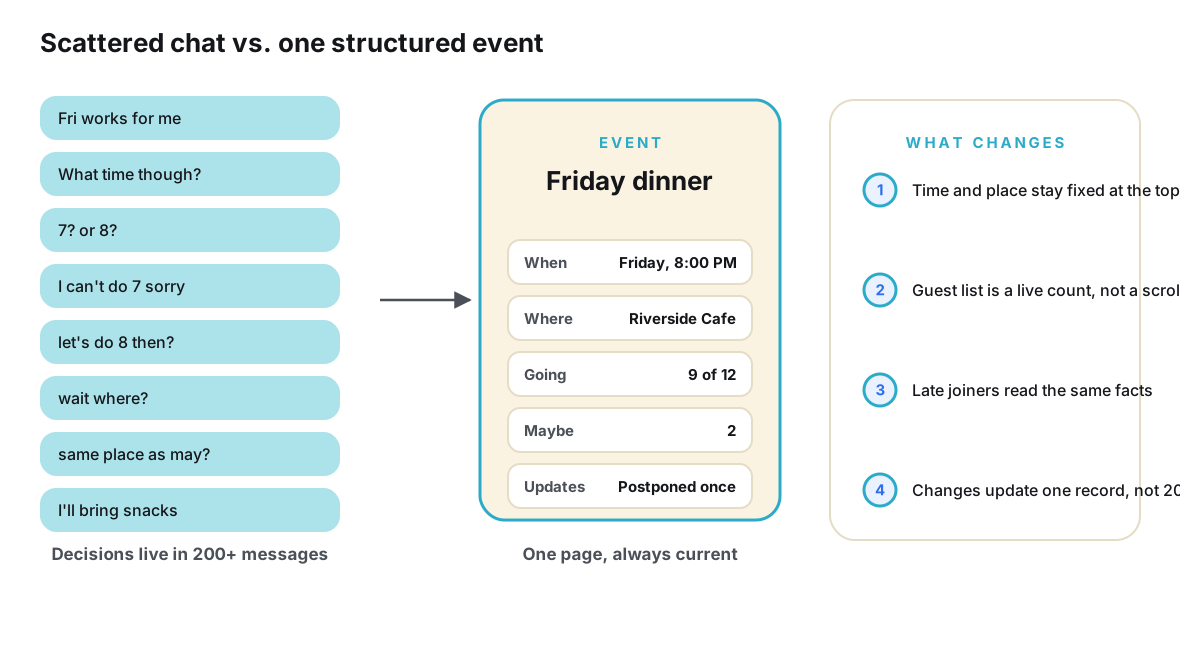
The distinction worth holding onto is the one developed at length in the difference between a conversation and an event object. A conversation is open-ended talk; an event object is a bounded commitment with fields and a current state. Super apps have integrated nearly everything around that distinction while leaving the distinction itself intact. You can pay where you chat; you still cannot store a final headcount where you chat, because a stream has no fields.
A thought experiment isolates the gap. Imagine the most feature-rich super app conceivable: chat, wallet, services, all seamless. Now ask it the organizer’s five questions. What time does the event start? What is the current venue? Who has committed to coming? What has changed since Tuesday? What should the newcomer read first? Every one of these is a question about state, and every one is answered — in any chat-based workflow, however integrated — by reading a thread and hoping. The rails got faster; the record never appeared.
| Stage | Building block that helps | What still goes missing |
|---|---|---|
| Proposing and discussing | Group chat — the negotiation’s natural home | Nothing; this stage genuinely belongs to messaging |
| Converging on details | Polls and mini-program services for specific tasks | A durable place for decisions to land as fields |
| Committing (who’s coming) | Reactions and replies in the thread | Named, current RSVPs — moods are not commitments |
| Paying | The wallet — collection and splitting made trivial | Reconciliation of money against final attendance |
| Day-of logistics | Instant messaging for live coordination | An authoritative final plan visible to all, including late joiners |
| Afterward | Photos, follow-up chat, community warmth | A record of what actually happened, for the next time |
The table’s shape tells the story: the strong cells cluster where the task is a transaction or a conversation, and the missing column fills with exactly one category — state. That pattern is not an accident of any one platform’s roadmap; it follows from what a message stream is. It is also stable over time, which is what makes this analysis durable rather than a snapshot of any product’s current features.
One evening, seen in two layers
A concrete evening makes the two layers visible. A dinner club lives inside a super app: the community group chats daily, the wallet settles every bill, and a mini-program handles the group’s standing reservation at a favorite table. On this particular month, the plan works like this. The idea is proposed in the group — conversation layer, working perfectly. The date is debated, settles, and someone posts it in all caps with three exclamation marks — the thread’s folk attempt at a record. Eleven people react enthusiastically; the organizer, who has done this before, quietly maintains a separate list of who has actually confirmed, because she knows the reactions will overcount. The deposit is collected in the group within minutes — transaction layer, flawless, genuinely a superpower. The venue changes tables on the day; the correction is posted, quoted twice, misunderstood once, and re-posted by the organizer with a plea to read carefully — the record problem, wearing its everyday clothes.
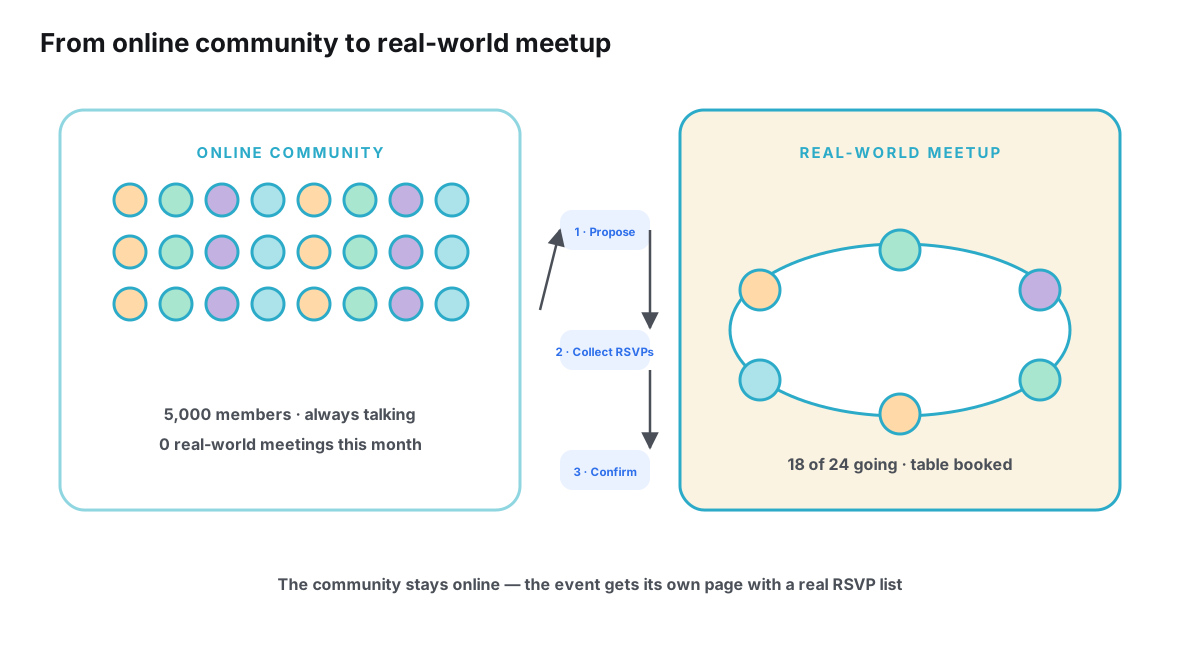
Now run the same evening with the layers properly separated. The chat still proposes, still jokes, still settles the deposit where it always has. But the dinner has an address: a page holding the confirmed date, the venue, the named roster of the going and the maybe. The all-caps message is replaced by one link. The organizer’s private list dissolves into the RSVPs members set themselves. The table change is an edit, announced in one line; the member who misread nothing is the member who opened the page. Nothing about the platform was fought; the transaction layer was used fully, and the record simply got the container it needed. The evening is the same evening — with perhaps two hours of human effort returned to it.
The example generalizes into a rule of thumb for any platform, current or future: if a fact about the event would still be true tomorrow, it wants the record layer; if it is only alive right now — a joke, a payment, a live location — it belongs to conversation or transaction. Super apps will keep expanding what the inner layers can do. The rule about which layer holds which fact does not change with them.
How communities improvise the missing layer
Perhaps the strongest evidence that the commitment layer is a real need rather than an analyst’s abstraction is that super-app communities keep building it by hand. Every large group has its folk institutions: the member who maintains the spreadsheet of who came to the last dozen hikes; the treasurer whom everyone pays because she can be trusted to reconcile in her head; the all-caps FINAL PLAN post; the pinned announcement refreshed by whoever remembers; the organizer’s phone number, passed around as the canonical source of what is happening.
These improvisations deserve respect — they are the community solving, with social effort, a problem its platform never gave it a part for. But notice their common properties: each one is maintained by a person, each one lives outside the conversation it serves, and each one fails when its keeper is tired, busy or on holiday. They are the record layer implemented in human memory and goodwill, which is exactly why they are the first thing to collapse when a community scales or a series runs long enough. The demand for structure is not new; it has been latent in every group chat that ever planned anything serious.
This is also the fair way to read the relationship between super apps and event tools: not as a rivalry, but as a division that the communities themselves discovered before any software acknowledged it. The rails for talking and paying consolidated inside the platform; the record-keeping stayed outside, in spreadsheets and pinned posts and trusted individuals — waiting for a shape of its own.
Payments create a second ledger
The wallet deserves a second, closer look, because it is the integration that changes organizing most — and its second-order effects are under-appreciated. When collecting money is easy, events acquire budgets they never used to have: deposits, prepaid group rates, tickets. The evening gets easier to run and simultaneously harder to account for, because every payment now needs to be reconciled against the thing it was for. Who paid, who owes, and — the sharp one — who paid and then did not come.
A payment is not an RSVP. Money moving confirms intent at the moment it moved, with a precision a fire emoji never had, but attendance is settled at the venue, not the wallet. The prepaid member who falls ill, the person who paid for two and brings one, the refund policy for the cancelled occasion — these are reconciliation problems, and they need a ledger that knows both sides: the payments and the roster. The open web’s shared vocabulary makes the same distinction in its own terms, defining an Event as a structured record and treating one person’s answer to one event as a separate, structured thing — the RsvpAction type — precisely because commitments are objects that systems must count, not sentences that streams must carry.
This is the pattern to watch anywhere payments and events meet: the easier the money gets, the more the bottleneck migrates to the roster. Super apps solved the collection half of group finance; the attendance half — who actually turned up, against what was collected — is a records problem wearing a payments costume.
The boundary problem
There is a second structural limit, quieter than the first. Super apps are, by design and by business logic, systems that reward staying inside. The value of the integrated wallet and identity grows the more of life runs through the platform, so every incentive points inward: keep the chat, the payment, the service, the follow-up all in one place. For most of what a person does, that inward pull is harmless or even pleasant — nobody enjoys app-switching.
Events, though, are outward-facing objects. The dinner includes the friend who lives in another ecosystem. The venue has its own systems, the calendar app has its own users, the photograph ends up in three family groups on three apps. An event’s natural shape is a network with edges crossing platform boundaries, which sits awkwardly with a container optimized for keeping things inside. This is visible in practice in how WeChat groups are used for real-world gatherings: the community works beautifully as long as everyone is inside it, and the moment the guest list crosses the wall, coordination falls back to forwarding, screenshots and retelling — snapshots, again, where links were needed.
The resolution is not to fight the platform’s gravity but to separate the two layers. The community and the money live wherever the group already is — inside the super app, where those rails are excellent. The event’s state lives at an address that travels: one link, open in any browser, showing the current plan to whoever holds it, whatever app they call home. This is the architecture the whole super-app era keeps converging toward from opposite directions — platforms integrating inward, events reaching outward, and the link as the treaty between them.
| Coordination requirement | Relevant block | How well it holds up |
|---|---|---|
| Announce to the community | Group chat and official accounts | Strong — reach is what messaging does best |
| Collect and split money | Payments and the wallet | Strong — the standout integration win |
| Run specific services (bookings, orders) | Mini-programs | Good for discrete tasks within the platform |
| Converge on a time and place | Thread discussion, polls | Partial — opinions gather, decisions don’t land anywhere durable |
| Track who is actually coming | Reactions, replies | Weak — moods and messages, not a named current roster |
| Maintain one current plan | — | The structural gap — a stream cannot hold state |
| Reach guests outside the platform | Sharing and forwarding | Weak — copies travel; the current plan does not |
Read as a whole, the table suggests the shape of the future far more reliably than any product roadmap could: the transaction rows are effectively settled, and will keep getting smoother; the state rows are architectural, and architecture changes slowly if at all. Whatever the next decade of super apps brings, the organizers who thrive will be the ones who stop expecting the strong rows to somehow cover the weak ones.
Principles that survive any platform
Because platform features shift and this article intends to age slowly, it is worth extracting the invariants — the statements that will hold regardless of what any app ships next. There are four, and each one generates practical guidance today.
Commitments need records. Whatever the medium, an intention that other people will act on — a reservation, a headcount, a split cost — must live in something with fields and current values, not in the flow of talk. Practical form: give every event a page with a real RSVP list before asking anyone to commit to anything.
Records need addresses that travel. A plan that can only be seen inside one app is a plan with a fence around it, and events have a habit of outgrowing fences. Practical form: the event’s address should be a link openable anywhere, by the muted, the late and the cross-platform alike.
Money must reconcile with attendance. Easy collection is only half of group finance; the other half is knowing who paid against who came. Practical form: settle against the event’s final roster, not against the thread, and set cutoffs before which payments and commitments stay in sync.
Conversation and record are different layers. Not rivals, not substitutes — layers. The talk is where an event is loved into existence; the record is where it stands still enough to be found. Practical form: post the record’s address into the conversation once per event, and let each layer do its own job forever after.
None of these principles is anti-super-app; the first two in particular are easiest to honor from inside one, where the community and the wallet already live. Tools that embody them exist today — Ontaym, among them, gives each event a page with going and maybe statuses, polls for open options, updates and reminders, and one link designed to be dropped into any chat — but the principles are older and more durable than any tool, which is exactly why they are worth organizing around.
Frequently asked questions
Will super apps eventually replace dedicated event platforms?
For the transactional layer, they have already absorbed a great deal: money, broadcast and services genuinely belong inside a platform where the community lives. What resists absorption is architectural rather than competitive — an event’s current state needs to be a record with an address that travels, and a platform built to keep activity inside is a poor home for objects that must reach outward. Expect convergence and combination more than replacement.
Can I organize events entirely inside a super app today?
Largely, if your whole group lives there and your events stay simple: the chat handles discussion and announcements, the wallet handles money, mini-programs handle specific services. The strain appears at the edges — tracking a reliable headcount, keeping one current plan, including anyone outside the platform, or running events that change. Those are exactly the jobs of the commitment layer, which is usually a tool reached by link rather than a feature inside the chat.
What are mini-programs, in event terms?
Embeddable services that run inside the super app — discrete tasks like booking a venue or ordering for a table, performed without leaving the platform. They extend what can be done where the conversation happens, and they are excellent at transactions. What they do not change is where the event’s current facts live: a service you invoke is not a record that holds your plan.
How do payments change event organizing?
They remove collection as the hard part — and promote reconciliation to take its place. When money is easy, events acquire deposits, group rates and tickets, and every payment needs to be matched against the final roster: who paid, who came, who owes a refund. The wallet solves the moving of money; the attendance record solves the meaning of it.
What is the one thing to get right, regardless of platform?
Give each event its own address — a page holding the current time, place and named RSVPs, reachable by one link from any chat. That single habit works inside a super app, across several apps, or with no platform loyalty at all, because it puts the two layers — conversation and record — in their natural relation to each other.
Conclusion
Super apps are the best thing that has happened to the transactions of organizing: money moves where the talk happens, services run where the people already are, and communities that generate events no longer face any cold-start friction. It is tempting to read that success as the whole problem solved — to assume that a platform this integrated must, any day now, simply swallow event coordination whole.
The structural analysis says otherwise, and says it in a way that will still be true whenever this is read. Conversation is a stream; an event is a record. Payments, bookings and broadcasts orbit the event without becoming it, and a container optimized for keeping life inside will always sit awkwardly around an object whose guests, venues and memories insist on living outside. The future that follows is complementary: super apps as the rails for community and money, and each event standing at its own small address — one link, one current plan, open to everyone it belongs to. Organizers who adopt that split get the best of both layers, and will keep getting it on every platform they ever use.
Use every rail your platform gives you — and give every event its own address.
Plan it with Ontaym