
The Privacy Problem With Large WhatsApp Groups
WhatsApp groups scale to more than a thousand people — and every one of them can see your phone number. This is a factual look at what large groups expose, why the design works the way it does, and what actually helps.
Quick answer
WhatsApp groups are built on phone-number identity, and WhatsApp group chats support up to 1,024 participants. Practically, that means every member of a large group can see every other member’s number, name and profile photo in the group info screen — a shared directory assembled without most members’ explicit consent. Message content is encrypted in transit, but encryption does not control what members do with the roster or with what they read: screenshots, forwards and the group list itself all travel beyond it. Practical mitigations include tightening profile-visibility settings, declining groups that mix unrelated circles, leaving event groups after they serve their purpose, and — for organizers — keeping the plan on an event link instead of inside a large group, so no roster is ever needed.
What every member can already see
Start with the mechanics, because everything else follows from them. WhatsApp identifies accounts by phone number; there are no separate usernames to hide behind. When you join a group — or are added to one — your number becomes part of the group’s shared context. Any member who opens the group info screen can see the full list of participants, and beside each name stands the identifying detail that the whole system runs on.
The default visibility is broader than most people assume. It is worth walking through methodically, because the individual items feel trivial and only the aggregate reveals the shape of what is shared.
| Information | Where it appears | Who sees it | Can settings change it? |
|---|---|---|---|
| Phone number | Group info participant list | Every member, for as long as they remain | No — the number is the identity |
| Display name and profile photo | Messages, tap-to-view contact card | Every member, subject to profile privacy settings | Partially |
| The fact of membership | The roster itself | Every member, plus anyone shown a screenshot | No |
| Everything you post | The thread, permanently scrollable | Every member, including people added later | No — delete-for-everyone has limits |
| Your activity pattern | Typing indicators, replies, reactions | Every member watching the thread | Not meaningfully |
Two columns repay attention. The third and fourth rows cannot be changed by any setting: membership is a fact visible to all, and messages, once sent, belong to the thread. The first row — the number itself — is the keystone, and its visibility is not a configuration choice but an architectural one. Understanding why that architecture was chosen is the fair starting point for judging it.
Why the design is the way it is
It is easy to read the directory effect as carelessness. It is anything but. Phone-number identity is arguably the single most successful onboarding decision in messaging history: no username selection, no password recovery, no “add me, I’m @dragonfan1987.” You have a number; the number is the account; anyone who has you in their contacts can reach you. For a group of twelve friends, this is close to perfect — identity is verified by the phone network itself, impersonation is hard, and everyone you know is reachable through one universal identifier.
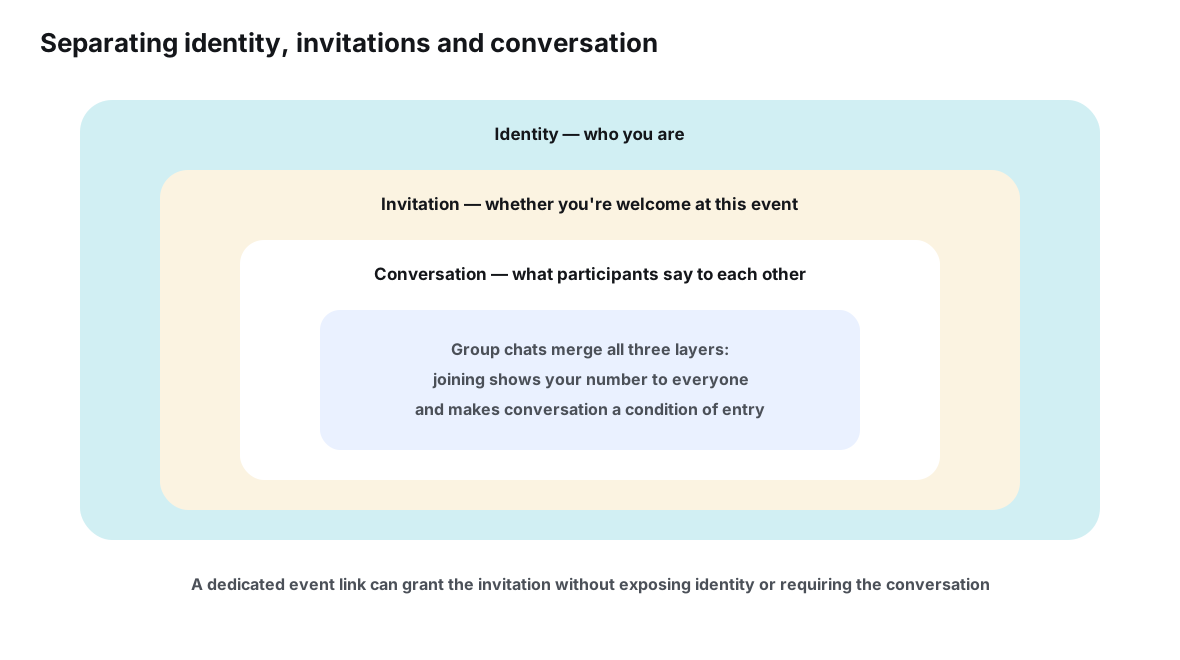
The trade-off only becomes visible when groups grow past the circle where the design assumption holds. Phone-number identity presumes that the people who can see your number are people who plausibly ought to have it — your contacts, your friends, your family. A 1,024-member group breaks that assumption by mixing people who have never met and have no other relationship to each other than co-membership in one chat. The architecture didn’t change; the social context around it did. What functioned as a convenience among intimates functions as a public directory among strangers.
This is the honest framing: WhatsApp is not leaking anything. It is doing exactly what it was designed to do, at a scale its design never anticipated. The privacy problem with large WhatsApp groups is a scale problem wearing a privacy costume — and that distinction matters, because it points to the right remedies. Nothing about the remedies requires believing anything is broken; they require matching the tool to the audience size, the way one chooses between a phone call and a poster.
Scale changes what visibility means
Up to 1,024 participants can share a single WhatsApp group chat. Set aside for a moment whether any actual group reaches the cap — the meaningful point is what the ceiling implies about normal usage. Groups in the hundreds are common and ordinary: neighborhood associations, sports leagues, school cohorts, wedding parties with their extended families, hobby clubs, workplace departments. These are not edge cases; they are the bread and butter of large-group coordination.
Now apply the default-visibility table to those numbers. In a 400-member group, your phone number is displayed to 399 people. Most of them will never open the roster — but “most” is not a control, and the handful who do include exactly the people a privacy model should worry about: the curious, the aggrieved, the commercially motivated, and the person who screenshots the list into another group where it lives forever. Visibility to everyone is, functionally, visibility to anyone, and the difference between the two is decided by strangers.
Scale also erodes the social signals that make small groups self-policing. In a dozen-person chat, a member who misbehaves is known, nameable and accountable to mutual friends. In a several-hundred-member chat, the roster is functionally anonymous — most members cannot say who most other members are, which means the number visible beside each name carries no social context and no accountability. A stranger who obtains your number from the roster knows nothing about you except that you were in this group, and that is precisely the context in which an unsolicited message lands with no shared ground to stand on.
The roster itself is the exposure
Most privacy discussion focuses on messages — what you say, who can read it. For large groups, the more consequential exposure is quieter: the member list itself. A roster states, for every person on it, a fact about their life: that they belong to this group. Belonging to the parents’ association, the recovery meeting, the synagogue outing, the union branch, or the surprise party committee is information most people share selectively — and the roster shares it with hundreds of people simultaneously, in a format built for copying.
Screenshots make the roster portable. Thirty seconds of scrolling and photographing produces a complete, offline, permanent copy of every member’s number and name — a copy that no setting, no departure and no deletion can ever recall. This is the property that separates roster exposure from message exposure: messages you send are at least your own choice, while your presence in the roster was, in most cases, chosen by whoever added you.
Departure has its own asymmetry. Leaving a large group is usually a visible act — the thread typically notes that someone left — so the member who realizes the exposure is too broad faces a choice between continued visibility and a publicly noticed exit. For groups organized around sensitive purposes, that choice is not a small one. It is another example of a general pattern: contact-based chats rarely offer a quiet middle path between full membership and social announcement, and large groups raise the stakes of both options.
Where the directory effect bites hardest
Abstract mechanics become concrete in particular settings, and a few recurring patterns account for most of the real-world discomfort. Neighborhood and building groups are the classic case: members are linked not by friendship but by geography, the roster runs to hundreds of households, and the group typically persists for years with slow membership churn. Every new neighbor who joins — however trustworthy — inherits the full directory, and nobody can say who else has held a copy of it over the group’s lifetime.
School and class groups sharpen the asymmetry in a different direction. The parents in a class of thirty children barely know each other at the school gate; the group hands all of them each other’s numbers in one gesture, and then lives on for the full school career of the children — often repurposed year after year as the class moves up. The same shape recurs in sports clubs, where a weekly fixture group accumulates everyone who ever played a season, and in volunteer organizations, where turnover is a feature of the structure itself: joiners come, leavers linger in the roster, and the directory grows monotonically in one direction.
Workplace groups add a professional edge to the same mechanism. A departmental or project group mixes colleagues at different levels of seniority, sometimes with clients or partners included, and the roster doubles as an informal org chart of who works on what. None of this is catastrophic — most members of most groups never open the roster at all. But the failure mode is not the average member; it is the single motivated one, and the design offers no dial between “visible to all” and “absent.”
Finally, the sensitive-occasion groups: hospital ward updates for a relative, a support circle, a farewell collection, a surprise party. Here the association itself is the confidential fact, and the roster shares it with dozens of people of varying closeness to the center of the story. These groups are created with the best intentions and the least scrutiny, at moments when nobody has spare attention for directory hygiene — which is exactly why they deserve the most deliberate structure.
Communities connect the directories
WhatsApp Communities add a structural layer on top of this picture, and it is worth understanding accurately because it changes the shape of the directory. A Community lets an organizer link related groups together and share announcements with all members across them — the school with one group per class, the club with separate groups for announcements and banter, the neighborhood with subgroups by street or interest.
For coordination, Communities are a genuine improvement: announcements reach everyone at once, and the subgroup structure keeps side conversations from drowning each other. For privacy, they concentrate rather than relieve the underlying mechanism — membership in a Community is based on phone numbers, just as it is for individual groups. Linking groups links their rosters’ logic: the same identifier that placed you in one subgroup now associates you with a broader structure whose boundaries you did not choose. Being a member of the Tuesday running group and being visibly part of the entire athletic club community are different levels of disclosure, and the step from one to the other was almost certainly taken by an organizer, not by you.
None of this makes Communities sinister; it makes them consistent. The design philosophy — the number is the member, the member is the number — simply scales upward from groups to groups-of-groups. The practical conclusion scales with it: the larger and more layered the structure, the more deliberate a member should be about which layers they join, because each one is a statement of association made to everyone else in it.
Forwards, screenshots and the end of context
A large group also changes what happens to content, in ways encryption does not address. WhatsApp encrypts messages end to end, which protects them in transit between devices. It is strong protection against the right threat — interception. But by design, it says nothing about what happens after a message lands: every member can read, copy, screenshot and forward. In a small group, that reach is bounded by trust. In a large group, it is bounded by nothing.
Forwards carry content out of its context. A question asked innocently in the planning thread — an address, a dietary note, a remark about a guest of honor — can be forwarded into another chat where the surrounding conversation that made it harmless is absent. Replies and quotes do the same internally, resurfacing old messages for audiences who never saw their moment. And screenshots dissolve even the pretense of membership-boundary: anything said in a 900-person group should be regarded as sayable in public, not because members are untrustworthy but because the member list is too large for trust to be a property of the group at all.
The workable mental model treats large-group content as publication, not conversation. Before posting in a big group, the sensible question is not “who is in this group?” — nobody can reliably answer that — but “would I mind this being forwarded with my name attached?” Small-group intuition, which relies on knowing the audience, silently fails at scale, and most people calibrate their posting only after an uncomfortable lesson.
Practical mitigations that actually help
Within WhatsApp, the levers are limited but real, and using all of them meaningfully shrinks the surface. Outside WhatsApp, the strongest mitigation is structural: keeping events out of giant groups altogether. The table below separates what a member can control from what only an organizer or a different design can.
| Exposure | What helps inside WhatsApp | What helps structurally |
|---|---|---|
| Number visible in the roster | Nothing — the number is the identity | Declining groups that mix unrelated circles; a separate number for high-exposure roles |
| Photo, about and last seen | Profile privacy settings restricting these to contacts | Fewer large memberships reduces the audience regardless of settings |
| Content forwarded or screenshotted | Nothing after sending; think before posting | Keep plans and addresses on an event page, not in the thread |
| Membership implying association | Leaving when the purpose ends, accepting the visible exit | Join only groups whose full membership you are comfortable being associated with |
| Home address or venue in the thread | Never post it broadly; share individually with confirmed guests | An event page that shows details to invited guests only |
| Group outliving its purpose | Delete the group or leave after the event | Use one-off event links that expire with the occasion |
Notice how many cells in the middle column are empty or resigned. That is the honest picture: inside a contact-based messenger, a member’s control over roster exposure is close to zero, because the exposure is the architecture. The levers that actually bite live in the right-hand column — fewer, smaller, shorter-lived memberships — which is why the next section matters more than any settings checklist.
Organizers carry a separate set of responsibilities, because they control the structure everyone else lives in. A few habits cover most of the ground. Ask before adding people, especially when the group is large or long-lived — it costs one message and converts an imposition into a choice. Keep large groups for their real purpose and move one-off occasions out to an event page. Post venue addresses and personal details sparingly, and share them narrowly when they matter. Announce a closing date when the group’s purpose ends, and actually delete it — a group that no longer hums is still a directory that still leaks. And when the audience is inherently mixed — relatives plus colleagues, parents plus teachers — assume the most private member’s standard, because they are the person the roster endangers most.
For official specifics — current group sizes, how Communities handle membership, and the privacy settings available in the app — the WhatsApp Help Center is the authoritative source, and it is worth consulting directly rather than relying on summaries (including this one) that can drift out of date. The WhatsApp product site describes the same features from the user’s point of view. Nothing in this article is legal guidance, but it is worth knowing that under regulations like the EU’s GDPR, a phone number is personal data — a fact that shapes how organizations, at least, are expected to treat the rosters they assemble.
The event-sized alternative: keep the plan out of the roster
Most large WhatsApp groups exist to organize something: a fixture list, a school fair, a conference, a family reunion. For that purpose — coordinating an event among people who are not otherwise a community — the group is both too much and too little. Too much, because it builds a permanent 1,000-capacity directory around a temporary occasion. Too little, because a message stream is a poor container for a plan: the current details scatter across hundreds of messages, and every late joiner must excavate them.
The alternative shape separates the two problems. The plan lives at its own address — an event page with the time, place, options and RSVPs, reachable by a single link from any app. The large group, if it exists at all, links to the page and returns to being what it is good at: discussion among the people who want to discuss. Guests who only want the facts check the page; nobody joins anything to learn what time dinner starts; no roster grows by a single entry. The design principles behind this separation are laid out in how event invitations can protect participant privacy, and the underlying identity question — why the phone number itself is the wrong key for events — is examined in why phone numbers aren’t good event identity systems.
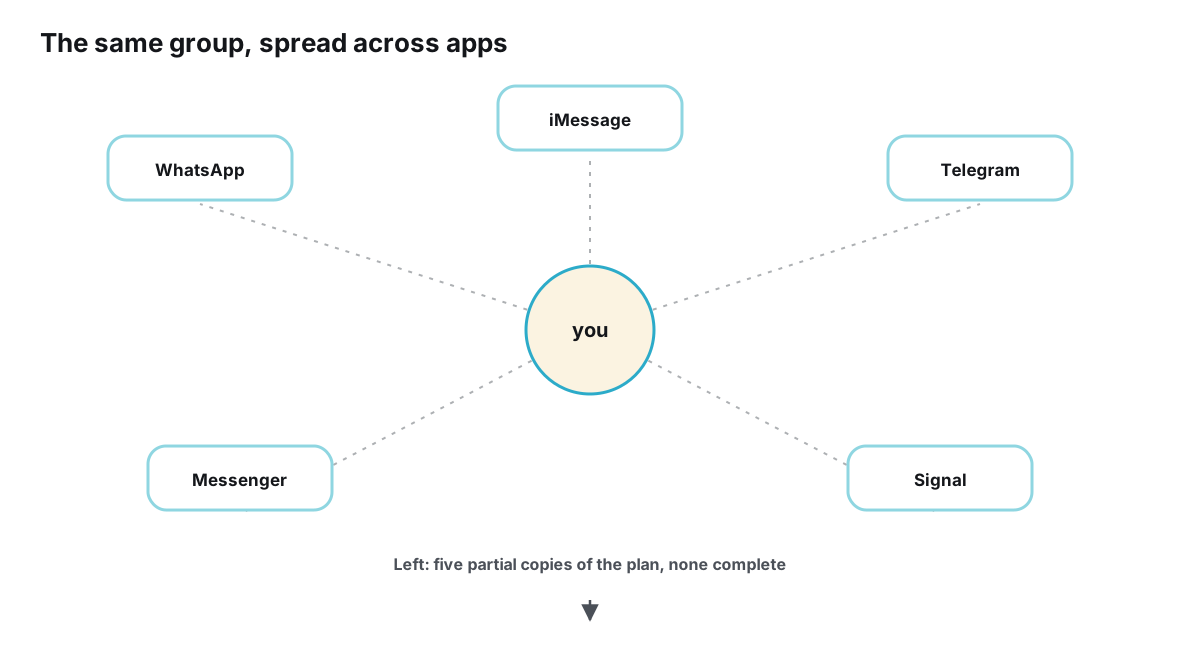
The diagram shows the compounding that organizers should watch for. Real gatherings rarely stay in one place: the family is on WhatsApp, the committee on Telegram, the classmates on something else, and the same event spawns a large group in each. Every additional group is another directory holding the same people’s numbers, another place where the plan lives as an outdated copy, another roster to outlive the occasion. Pulling the plan out to a single shared address — and letting each group link to it rather than restate it — is the pattern described in how to create one source of truth for a group event, and it is as much a privacy measure as an organizational one: one address means one place to retire when the event is over.
Frequently asked questions
Can I hide my phone number from other members of a WhatsApp group?
No — not within the group. WhatsApp accounts are their phone numbers, so the roster displays the number to every member by design. You can restrict what surrounds it, such as your photo, about line and last seen, via privacy settings, but the number itself is the membership card.
Doesn’t end-to-end encryption protect my privacy in groups?
Encryption protects messages in transit — a genuinely strong guarantee against interception. It does not and cannot control what members do once messages arrive: reading, forwarding, screenshotting and the roster itself all sit entirely outside encryption’s reach. In a large group, those human channels are the main privacy exposure, not interception.
Is it rude to leave a large group after an event?
Departure is usually visible, which makes it feel louder than it is. In practice, leaving a purpose-built event group once the event has passed is normal housekeeping, and the more people treat it that way, the quieter the signal becomes. Announcing it is optional; disappearing quietly after a thank-you message is unremarkable.
What about groups where admins must approve new members?
Approval controls the door, not the room. It reduces drive-by joins from leaked invite links, which is useful, but every approved member still sees the full roster of numbers. Admin approval governs who enters; the architecture still decides what everyone sees after they do.
Are Communities better or worse for privacy than plain groups?
They concentrate the same mechanism. A Community links related groups and announces across them, and membership is phone-number-based throughout. That is convenient for coordination and coherent as a design, but it means joining one subgroup associates you with a larger structure. Whether that trade is worthwhile depends on how comfortable you are being visible across the whole community.
What should organizers do differently for large events?
Keep the event out of the mega-group. Put the plan on a page with its own link, post the link in the group once, and let people RSVP there — the group stays for conversation, the page holds the facts, and no permanent roster is created around a temporary occasion. The headcount arrives without the directory.
Conclusion
Large WhatsApp groups are not a privacy scandal; they are a small-group design meeting a large-group world. Phone-number identity, invisible among a dozen friends, becomes a public directory among several hundred acquaintances. Encryption protects the messages and cannot protect the roster. Settings trim the edges and cannot touch the core. Each of these statements is about architecture, not intent — and architecture, unlike intent, responds to scale.
The response that works is proportion. For standing communities that talk daily, a big group is the right room, and members should simply understand what the roster implies. For events — the temporary occasions that generate most of the world’s large groups — the better shape keeps the plan at its own address and keeps the roster out of it entirely: one link, a page of current facts, RSVPs that cost nothing permanent, and an empty cleanup when the day is done. The organizer who adopts that shape gets the headcount they were chasing anyway, and every guest keeps the one thing the old design quietly gave away: the decision of who gets to reach them.
Coordinate the crowd without collecting their numbers.
Host your event on Ontaym