
The Social Awkwardness of Adding Someone to a Group Chat
Being added to a group chat is not the same as being invited to anything — yet it feels rude to notice the difference. A look at why unrequested additions grate, why leaving is harder than joining, and what organizers can do instead.
Quick answer
Adding someone to a group chat without asking feels awkward because it skips consent while creating obligation. The added person is enrolled in a visible roster, exposed to strangers — on contact-based apps, effectively handing everyone their phone number — and given no way to decline privately. Leaving is legible: it can be read as a statement about the group, the host, or the event, so many people mute and endure instead. The fix is to make invitations ask rather than enroll: send a private message first, or share a link to the event that people can open, consider, and answer — going, maybe, or nothing at all — without an audience. Consent restored, awkwardness dissolved, and typically a better headcount too, since people say yes more freely when no is also free.
The ping you didn’t ask for
It starts with a notification. You have been added to “Maya’s birthday wknd.” There are twenty-three participants. You know four of them. The chat is already forty messages deep — an argument about cabins, three polls about Saturday, a photo of a dog — and your arrival is announced to the room before you have decided how you feel about any of it. Your name, your profile photo, and — depending on the app — your phone number are now in front of nineteen people you have never met.
Nobody did anything wrong, exactly. Maya thought she was being generous with the invite. The friend who suggested your name meant it as a compliment. The app, for its part, did exactly what it was designed to do: convert a mental list of people into a room, in a few taps, with no step for asking. The WhatsApp Help Center describes groups of up to 1,024 participants organized around phone numbers — a scale where “everyone in the room has everyone’s number” is not a bug but the basic contract. And yet something has been taken from you that you never agreed to give: the decision about when, and to whom, you become reachable.
If you have never felt this, you are in the fortunate minority. For most people the feeling is familiar — a small flinch, quickly suppressed, because objecting feels disproportionate. It is a birthday weekend. It is just a chat. What is wrong with you that you mind?
Nothing is wrong with you. What you are noticing is a real asymmetry between what the gesture means socially and what it does mechanically. This article takes that flinch seriously — and then takes it apart.
Why being added feels different from being invited
An invitation, in its ordinary social meaning, is a question. It offers something and awaits an answer; it can be accepted warmly, declined politely, or ignored without anyone being assigned a motive. Its essential property is that the invited person retains the decision.
An addition is not a question. It is a completed action in which the added person was the object, not a party. By the time you learn the room exists, you are already in it. The decision has been made on your behalf — and not just the decision to invite you, but several others stacked quietly underneath: that your identity may be shown to the roster, that you accept notifications from strangers, and that you will appear, to everyone watching, as someone who said yes.
That last clause is the one people underestimate. Membership is visible, and visibility converts a private choice into a public performance. Declining an invitation is invisible — the host knows, nobody else does. Declining an addition means either never joining (which the room may notice, depending on how the addition was announced) or leaving after joining (which the room almost certainly notices). The mechanics have quietly replaced “would you like to come?” with “prove in front of everyone that you don’t want to.”
There is also the matter of scale. An addition to a chat of four close friends is barely distinguishable from an invitation; the trust was already there. An addition to a chat of two dozen mixed acquaintances is different in kind: your contact details, your photo, your presence — exposed to people with whom you have no relationship that could justify the exchange. The app treats both gestures identically. Socially, they are not even the same category.
The exit problem: there is no quiet way out
Suppose you decide the room is not for you. What are your actual options? Fewer, and worse, than anyone who has not been in the situation assumes.
| Option | What it feels like to you | What it can look like to the room |
|---|---|---|
| Leave immediately | Honest, but abrupt; often accompanied by guilt | A visible departure that can be read as a judgment on the group or the host |
| Mute and endure | Safe in the short term; the room still holds your identity and resurfaces when you are re-added or mentioned | Invisible — which is exactly why it is the most common choice |
| Ask the host, privately, to remove you | Reasonable, but requires a delicate conversation and shifts emotional labor onto you | A quiet removal, if the host handles it gracefully — the best visible outcome, at the cost of an awkward request |
| Stay and say nothing | Lowest friction tonight; keeps exposing you to the roster for the life of the room | Read as enthusiastic membership |
| Stay and participate | Fine if you genuinely want in — many additions do end happily | Genuine membership; the outcome the host assumed when tapping add |
Notice what is missing from the table: a way to decline that no one sees. Offline life has one — you simply do not attend, and the event passes without recording your decision. Invitations-by-link have one too: you look at the event page privately and answer going, maybe, or not at all. The group chat, by contrast, makes the roster itself the event’s attendance list, so exiting the roster is the refusal, performed on stage.
The platforms differ at the edges — how legibly departures are displayed, how muting works, whether you can even leave certain kinds of rooms — and Apple’s own support pages note that iMessage groups behave differently from cross-platform apps in exactly these areas, since they are tied to Apple devices; see Apple Support for the current specifics. But the deep structure is the same everywhere: joining is one tap and silent, leaving is one tap and loud. When one direction is frictionless and the reverse carries a social charge, most people take the path of least noise. The room fills with muted, enduring members — and the host reads the headcount as enthusiasm.
The host’s side: a gesture with no bad intent
It is worth being generous here, because most additions are acts of warmth executed with the wrong tool. The host wants you at the birthday. The teammate adding you to the football chat is including you. The organizer of the school fundraiser is drowning in logistics and the group chat is the only instrument she has ever been handed for this job. Adding everyone is not carelessness; it is the path of least resistance, offered by every major messaging app as the way to include people.
The awkwardness lives in the gap between the gesture’s intent (come, you are wanted) and its mechanics (you are now enrolled, visible, and reachable). Hosts feel the other side of that gap too. They notice when someone leaves. They sense the flat silence of the muted majority. They privately field the “hey, can you take me off this?” messages and absorb the small sting of each one. Ask organizers what they want from an invitation and almost none will say “a roster of people who couldn’t say no.” They want to know who is coming. The room was simply the only shape of invitation they had.
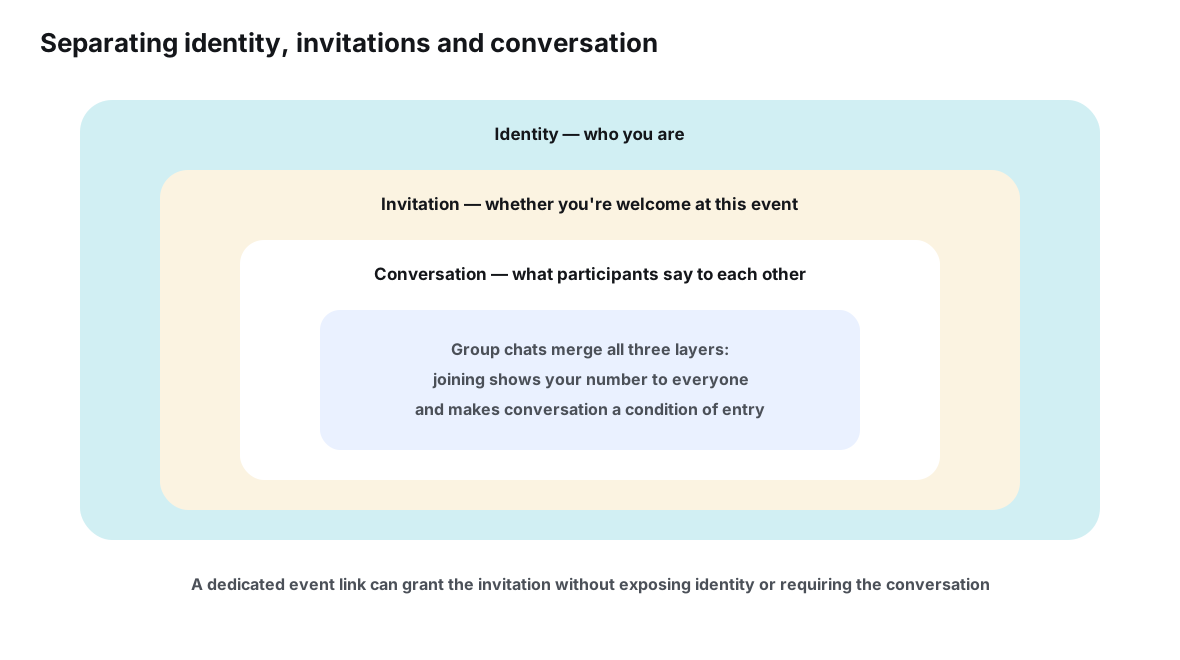
That framing matters, because it points at the solution. The problem is not that people are rude; it is that the tool collapses three separate things — your identity, your invitation, and the conversation — into a single yes. Untangle them, and both sides stop paying the awkwardness tax. We return to that architecture later; first, the practical middle ground.
When the same event pulls you into five rooms
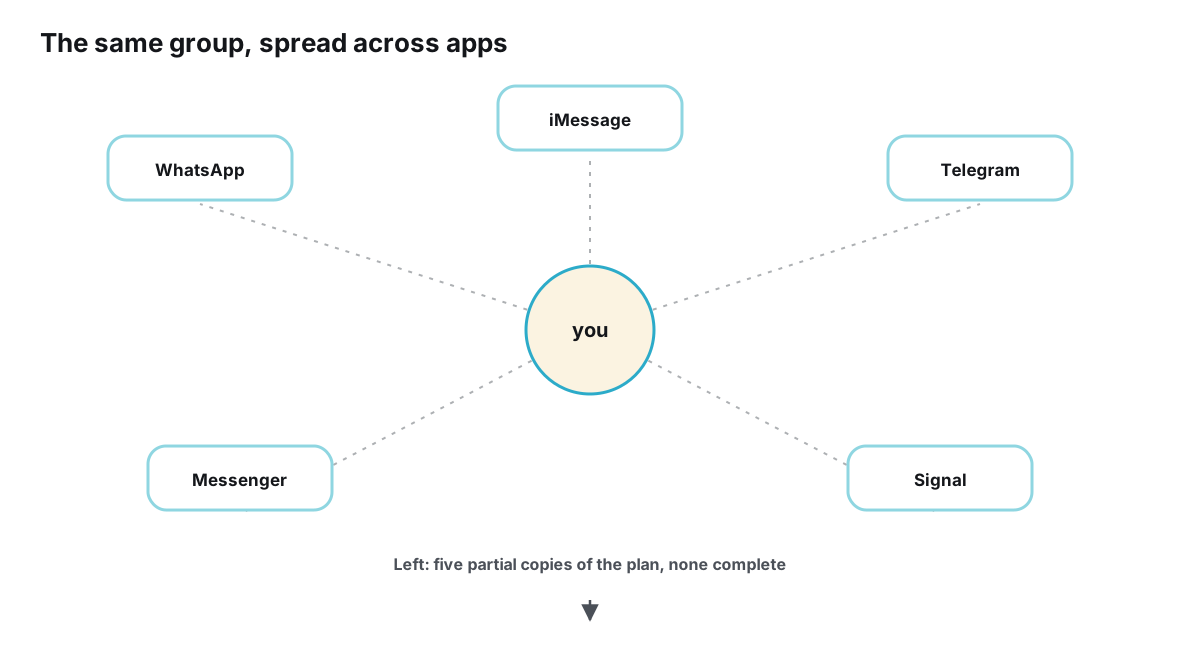
The awkwardness compounds when it is not one chat but several. The hiking club runs on WhatsApp, but the car-share for Saturday’s trail is on Messenger, and two members keep suggesting a Discord “because it has channels.” Each room adds you the same way — without asking — and each holds a partial copy of the plan. Now your identity sits in five rosters, your notifications arrive from three apps, and the actual decision (“what time do we meet?”) is smeared across all of them.
This is the moment when the addition problem reveals itself as a design problem. Five rooms did not appear because anyone wanted five rooms. They appeared because each app’s only unit of inclusion is membership, so every subset of the group with its own app preference spins up its own roster. The guest who quietly endures one chat now quietly endures several, and the host who felt generous four times over is managing four near-empty rooms and one fractured plan.
Why “just leave the group” is bad advice
Every discussion of this topic eventually produces someone who says: it is a chat, just leave. The advice is technically sound and socially tone-deaf, and understanding why is the heart of this article.
Leaving is cheap in clicks and expensive in meaning. In most messaging apps, a departure is a legible event — the room learns or later discovers you are gone, and the interpretation is uncontrolled. Were you annoyed? Offended by the joke in message sixty? Too grand for the group? The truth — you are busy, you did not know nineteen of these people, you did not want your number shared — is rarely the story that gets constructed. A quiet person exiting loudly is a puzzle the room solves with the available evidence, and the available evidence is feelings, not calendars.
So the advice fails because it ignores what the exit communicates. And muting fails differently: it preserves the appearance of consent while accumulating the costs — the roster still holds your identity, the room still boots on your phone, and you will meet these people at the birthday where you are, technically, the muted member who left the group chat two days before. Neither option is declining. Both are performances of something adjacent to declining, chosen for their optics rather than their honesty.
The absence underneath all of this is simple: there is no private no. An invitation architecture that cannot route a quiet refusal will generate awkwardness no matter how considerate its users are, because some invitees always need to say no, and some nos are kinder unsaid.
Lower-friction ways to include someone
Fortunately, the fix requires no confrontation — only slightly different defaults. The principle throughout: let the other person take the step that makes them visible.
| The moment | The usual move | The lower-friction move |
|---|---|---|
| A new colleague could join Friday drinks | Add them to the team chat mid-conversation | Send the event link directly: “we’re at the pub at six if you fancy it” |
| A friend-of-a-friend wants one hike | Add them to the hiking chat of forty regulars | Share the link for that one hike; invite them into the chat later if it clicks |
| Someone’s partner is in town for the weekend | Add them to the trip chat | Include them via the event page, where their answer is just a status |
| You need a substitute player for one match | Add them to the team’s year-round chat | Send the match’s event link with the kickoff time |
| The whole family must coordinate a surprise | Add all fourteen cousins to one chat | Keep a small planning chat for insiders; distribute the party’s details by link |
The pattern in every row is the same: the event is a bounded thing, and bounded things travel better as links than as rooms. A link lets the recipient look first — see the plan, the date, what it involves — and then choose. Choosing in is a genuine yes. Staying out is a private no. Nobody performs anything for anyone.
An etiquette for adding people
For organizers, a small set of habits prevents nearly all of the awkwardness described above. None of them takes more effort than the addition they replace.
- Ask before you add — one private message is enough. “We have a chat for the trip, want in?” costs ten seconds and converts an imposition into an offer. The answer is nearly always yes, but the yes is now real.
- When the event is the point, send the link instead. If what you are actually organizing is Saturday’s hike rather than a hiking society, the event page is the invitation. People can see the plan and answer — going or maybe — without enrolling in anything.
- Say what joining means. If you do create a room, a first message like “this chat is just for the wedding weekend, we’ll delete it after” tells people the scope and lifespan of what they have entered. Rooms with a stated purpose and end date feel dramatically less like traps.
- Start with a summary, not a scroll. The first thing an added person should see is the current state of the plan — when, where, what is decided — not a hundred messages of process. A pinned summary helps; an event page is better still.
- Normalize leaving. When someone exits, let it pass without commentary. The single strongest predictor of whether people will decline gracefully in future is whether the last person who declined was allowed to do it quietly.
If you have been added: scripts that keep your dignity
Being on the receiving end, you are entitled to manage your own membership without apologizing for it. A few patterns help.
Start by muting rather than deciding. Muting buys time: the room stops costing you attention while you work out whether you actually want to attend. Many additions resolve themselves once the notification pressure is gone — the event turns out to be appealing, or it passes quietly. Decisions made without a buzzing phone are better decisions.
If you know your answer early, answer it privately and once. A direct message to the host — “thanks for including me, I can’t make Saturday, have a great one” — does everything a departure from the roster would do, without the audience. Most hosts prefer it; they get information instead of an exit.
If you need to leave, leave plainly. A brief, warm exit — or no message at all — beats a guilty disappearance after three days of deliberation. “Taking a break from group chats, tell me about the next one directly” is honest, blameless, and reusable. You do not owe the room an explanation; you offered one as a courtesy, which is a different thing.
And if the room’s very existence exposes you — a roster of strangers holding your number — it is legitimate to weigh that in your decision. Wanting to control who can reach you is not coldness; it is the boundary that makes warmth possible elsewhere. For the structural version of this argument, see how event invitations can protect participant privacy.
The deeper fix: invitations that can be declined
Zoom out and the awkwardness has a precise cause: group chats use membership as their invitation, and membership is a state, not a question. The alternative already exists and is spreading through exactly the tools built for events — an invitation that is an object with a private answer. You receive a link; you open it; the event introduces itself; you respond going, maybe, or nothing. The organizer gets a clean headcount. The roster never forms. Your identity stays with you, and your refusal, when there is one, stays with you too.
This is more than comfort; it changes what invitations mean. An invitation that can be quietly declined is an invitation that can be freely accepted — the yes carries real information because the no was available. Hosts who switch to it consistently report the same discovery, in whatever words their context provides: the headcount finally means something. That structural separation — identity here, invitations there, conversation somewhere else — is the through-line of this whole cluster of articles, and is laid out in detail in how modern event platforms can separate identity, invitations and conversation.
The conversation layer deserves its own word, because someone will object that chats are where the fun is. Agreed — conversation is essential, and nobody is arguing for events without it. The point is narrower: conversation should be optional and located somewhere chosen, not the mandatory container of the invitation. The distinction between a conversation and the event itself — the plan as its own object with its own address — is exactly the subject of the difference between a conversation and an event object. Tools like Ontaym implement the split directly: one link per event, statuses and updates on the page, and whatever chatting happens, happens wherever people already talk.
Frequently asked questions
Is it rude to leave a group chat you were added to?
No. Membership was given to you, not chosen by you, and declining something you never requested is not an insult. A brief private note to the host — or a simple, unexplained exit — is well within normal manners. What makes leaving feel rude is the visibility of the exit, not the exit itself; that is a design problem, not an etiquette one.
How do I decline without offending the organizer?
Do it privately, kindly, and once. A direct message that thanks them, gives a light reason or none, and wishes the event well accomplishes everything an RSVP would. Organizers are far more bothered by silence and no-shows than by a clear, warm no.
Should organizers always ask before adding someone?
As a default, yes — one short private message converts an imposition into an invitation and costs almost nothing. Within small, close groups where trust is established, adding directly is usually fine; the bigger and more mixed the roster, the more asking matters.
Doesn’t this overthink a normal social gesture?
For chats of close friends, perhaps — and nobody needs consent architecture to add their sibling to the family chat. But the same one-tap gesture scales to rooms of hundreds of strangers holding your contact details, and the flinch most people feel on being added to those rooms is a proportionate response to that scale. The thinking only needs to kick in where the gesture’s weight has changed.
What if the group chat is genuinely the community — a team, a class, a club?
Then the room has a real purpose beyond any single event, and membership means something. Even there, the boundaries help: state the room’s purpose, welcome newcomers deliberately rather than silently, and keep one-off events on links so that people can attend once without enrolling forever. The relationship between membership and attendance is its own subject, covered in why event participation shouldn’t require joining a community.
Are some apps better than others about quiet exits?
Behaviors differ — how visible departures are, how muting works, whether identity is a phone number or a username — and it is worth checking an app’s own documentation for current specifics. But every major messenger shares the same underlying shape: joining is silent and instant, leaving is legible. The quiet no has to come from the invitation model, not from any particular app’s settings.
Conclusion
The awkwardness of being added to a group chat is not oversensitivity, and it is not a flaw in any particular platform. It is the predictable result of using membership — a public, persistent, identity-bearing state — as the delivery mechanism for invitations, which are meant to be private, provisional, and freely answerable. Merge those two things and every no has to be performed in front of an audience; people stop saying no; rooms fill with the muted and the enduring; hosts mistake rosters for enthusiasm.
The practical takeaways are small and durable. If you organize: ask before adding, or better, send the event as a link that people can answer privately — and treat departures as no-comment events. If you are added: mute first, decide calmly, answer the host privately, and leave plainly when leaving is right. In every case, prefer invitations that can be quietly declined, because they are also the only ones that can be freely accepted.
None of this makes anyone a bad friend. Maya’s birthday will still be lovely, and most additions end in genuine membership. But the gestures we use to include people shape how included they feel — and an invitation that asks will always land warmer than an enrollment that doesn’t.
Invite people to say yes on their own terms.
Send one link with Ontaym