
How Modern Event Platforms Can Separate Identity, Invitations and Conversation
A group chat performs three jobs at once: it verifies who you are, grants you access, and hosts the discussion. Event platforms built as layers — identity, invitation, conversation — let guests touch only the layer the event needs, and that single design decision quietly fixes most of the privacy and participation problems of chat-based planning.
Quick answer
Messaging apps bundle three functions into a single gesture: identity (who you are — often your phone number), invitation (your permission to attend an event), and conversation (the discussion around it). Joining a group chat activates all three at once, which is why attending a one-off event can expose your number to strangers, enroll you in a permanent room, and make declining a public act. Modern event platforms can instead treat these as separate layers: minimal identity — just a name on a response; scoped invitations — one link per event, answerable privately; and optional conversation — attached to the event, not to your enrollment. Guests share only what the event needs, decline quietly, and join nothing permanent; organizers get honest RSVPs and wider participation. Privacy and participation, it turns out, are the same design decision.
The monolith: one room, three jobs
When you join a group chat, what actually happens? More than you agreed to, and less than meets the eye. Underneath the friendly surface, the platform has performed three distinct functions in a single stroke. It has identified you — bound your membership to an identity, frequently your phone number, since contact-based apps like WhatsApp use exactly that as the foundation of their groups. It has granted access — your membership is your ticket to the event information living in the thread. And it has enrolled you in a conversation — a persistent channel with every other member, before and after the event, whether you wanted one or not.
These three functions have nothing necessary to do with each other. Identity is about verification and reachability. Invitation is about permission scoped to one occasion. Conversation is about discussion. A wedding invitation, in the physical world, manages all three gracefully: it knows your name (identity), admits you to one ceremony on one date (invitation), and implies no standing obligation to debate weddings with the other guests forever (conversation). The paper invitation is a separated-layer system. The group chat is a monolith, and everything this article’s sibling pieces have described — exposed phone numbers, unrequested enrollments, membership taxes, public declines — flows from that merge.
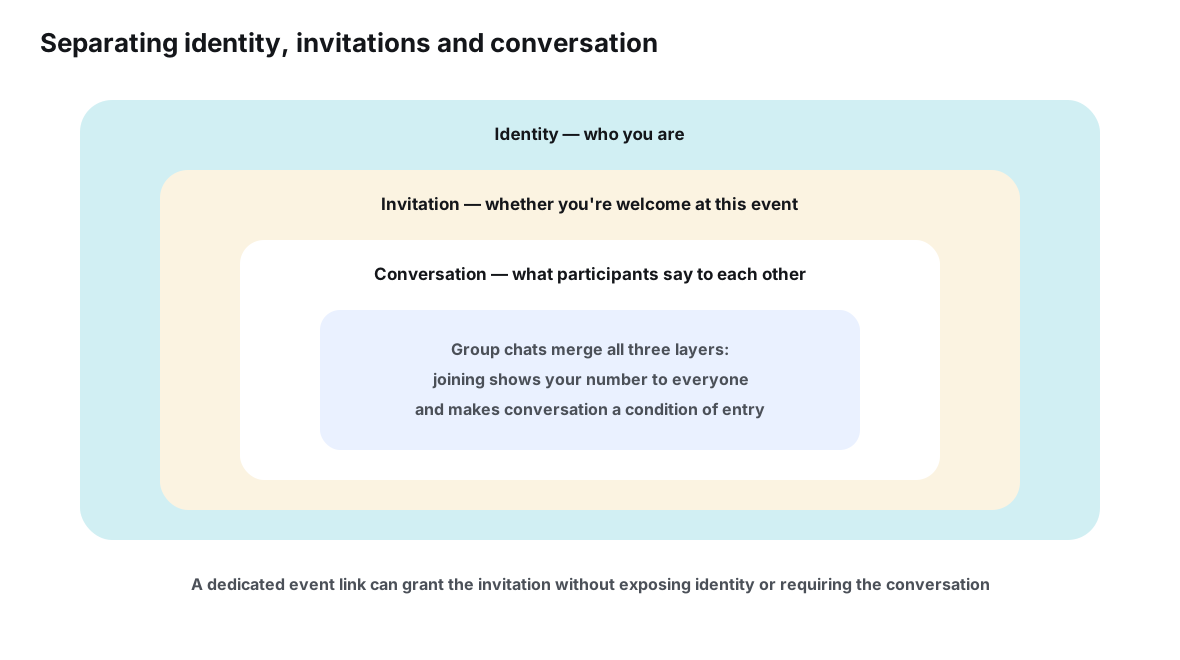
The way out is not better manners inside the monolith; it is taking the monolith apart. The rest of this article describes each layer, what separation looks like in practice, and what it buys on both sides of an invitation.
| Layer | What it is for | Inside a group chat | Separated by design |
|---|---|---|---|
| Identity | Establishing who is present and accountable | Your full platform identity — often phone number, photo, profile — shown to every member | Minimal per-event identity: the name you attach to an RSVP, nothing more |
| Invitation | Granting access to one occasion | Membership in the room: open-ended, visible, and required before you can even see the plan | A scoped link per event: open, look, answer — no enrollment, no roster |
| Conversation | Discussing the plan and the occasion | Mandatory: the conversation is the container of the event and of your membership | Optional: attached to the event page where offered, otherwise wherever guests already talk |
Layer one: identity — the minimum needed to attend
Start with what an event genuinely needs to know about a guest. For the plan to work, the organizer needs a count of who intends to come, distinguishable enough that one person’s “maybe” doesn’t blur into another’s “going.” A first name and a status carry that information completely. Everything else — your number, your photo, your account history, your presence indicators — serves the platform, not the event.
Contact-based messengers cannot offer this minimum because their membership model is built on maximum identity. The WhatsApp Help Center documents groups whose membership is expressed through phone numbers; that design predates event planning and serves reachability — knowing who in your contacts uses the app. But when that identity model is borrowed as the ticket to a birthday hike, the guest pays with a durable, portable identifier — one that works across every app and every contact list it is saved into. There is a reason the law takes phone numbers seriously: they are personal data under the EU’s GDPR (Regulation 2016/679, published by the EU) and covered contact information under California’s CCPA. This article is not legal advice, and those regimes bind organizations processing personal data rather than friends planning dinners. Still, the design principle the law encodes — hold the minimum data the purpose requires — is precisely what a separated identity layer implements socially.
Separated identity is contextual. To your close friends, you are fully yourself; to the parents’ group, a name and a child’s team; to the open meetup, a first name on a list. None of these is deception — they are the different amounts of self that different contexts warrant, the same judgment you make when you give a shop your email but not your childhood nickname. An event platform that lets identity scale down to “a name next to an RSVP” is simply letting guests make that judgment, which the monolith makes for them.
Layer two: invitation — permission with a boundary
The invitation layer answers one question: who may attend this occasion, and how do they say whether they will? It deserves to be its own layer because an invitation is a bounded object. It has a scope (this event), an audience (people the organizer chooses), a set of possible answers (going, maybe, no), and an end (when the event passes, the question dissolves).
A group chat cannot represent any of that. Its access object is membership — unbounded, visible, and carrying the full identity payload of layer one. The consequences are the ones canvassed across this cluster: invitations become enrollments; declining becomes a performance; the “guest list” is a permanent room. The social dynamics are explored in why not everyone wants to join another group chat, and the privacy costs in how event invitations can protect participant privacy.
The separated version is almost embarrassingly simple: the invitation is a link. One address per event, shared by the organizer with chosen people, displaying the plan and collecting responses. Possession of the link is the permission; the response is the answer; the event’s passing is the expiry. Because the link asks nothing of the recipient’s identity, it can be declined silently — the quiet no that the monolith structurally lacks. And because it is a single object rather than a room, forwarding it is a policy question the organizer can actually state (“plus-ones welcome”), rather than an all-or-nothing membership grant.
It is worth saying what the invitation layer is not: it is not secrecy. A link-shared event is unlisted, not encrypted — its boundary is distribution, enforced socially, exactly like a paper invitation to a house. What the layer guarantees is not that no unauthorized person can glimpse the plan, but that no person — authorized or not — acquires identity data or a persistent channel as a side effect of being invited.
Layer three: conversation — optional, attached to the event
The third layer is the discussion: negotiating the date, arguing about the restaurant, sharing photos afterwards. Conversation is genuinely valuable — it is where an event becomes a social occasion rather than a calendar entry. Nothing in this architecture is against it. The separation is about two properties chat platforms cannot give it: optionality and location.
Optionality first. In the monolith, conversation is mandatory because it is the container — you cannot attend the event without being enrolled in the discussion, and you cannot leave the discussion without leaving the event. Separated, conversation attaches to the event but does not gate it. A guest who wants only the facts reads the page and answers; a guest who wants banter finds it — on the event’s page where the platform offers discussion, or in whatever chat the group already shares. The organizer with a lively WhatsApp circle loses nothing: the circle keeps talking, and the link keeps the plan from dissolving into the talk, the dynamic explained at length in why messaging apps were never designed to be event databases.
Then location. Conversation, separated, can live anywhere — including the apps where it already lives. This is the quiet interoperability win of layered design: the event page does not replace anyone’s messenger, it sits above all of them as the shared object, while each app keeps doing what it is best at. The formal web even has a vocabulary for this arrangement: schema.org models an Event as a first-class object — a thing with an identity and a URL, distinct from any conversation about it — which is exactly the boundary being described here in plain language.
What participants gain from the separation
Layer by layer, the gains for guests are concrete rather than abstract. From the identity layer: your phone number, photo and profiles stay with you; strangers at an event learn only what you choose to show, which is usually a first name. From the invitation layer: you can look before committing, answer privately, change your answer without a message, and decline without an audience — the social costs documented in this cluster’s piece on unrequested additions simply do not arise. From the conversation layer: attendance stops signing you up for a permanent room; you bring your enthusiasm to the evening and your evenings back to your own calendar.
There is a subtler gain: honesty of signals. In the monolith, a yes often means “I lacked a polite no.” When declining is free — private, invisible, costless — the yeses that remain mean something. Guests in separated systems are not more enthusiastic people; they are the same people, finally able to indicate enthusiasm accurately. Anyone who has watched a quiet friend bloom at an event they nearly skipped, because skipping was made easy, has seen this effect.
And for the privacy-conscious guest, the gains compound across a season of events. Ten events a year, each hosted in the monolith, means ten rosters holding your identity, ten rooms to leave, ten sources of notifications. The same ten events on separated layers means ten pages you glanced at and answered — and a phone that still rings only for people you chose. The difference is not behavior; it is architecture.
What organizers gain
The organizer’s ledger is just as favorable, though the entries are different. The first is reach: every guest who would not join another group — the colleague, the parent, the privacy-careful friend — becomes reachable again, because the invitation asks nothing they mind giving. The second is data quality: RSVPs collected on an event page, unattached to membership, measure intent rather than acquiescence; the headcount finally predicts the headcount.
The third is workload, which surprises organizers until they feel it. In the monolith, the organizer is the room’s moderator, IT desk, and repeater-in-chief: answering the same “what time?” for whoever missed the message, re-announcing changes into the scroll, adjudicating who should be added next. Separated, most of those jobs dissolve into the page — the plan is current for everyone who looks, updates are edits rather than broadcasts, and there is no roster to curate because there is no roster. What remains is the organizing: choosing the date, picking the place, welcoming people on the day.
The fourth gain is the healthiest one: the community that forms around separated events is made of people who opted in. Regulars who return event after event, and eventually ask for a standing chat or a club, arrive as genuine members — the graduation described in why event participation shouldn’t require joining a community. The organizer’s inner circle gets smaller in roster terms and larger in trust terms.
Three failure modes the separation quietly eliminates
Because the layers are distinct, several classic planning failures stop being possible. The first is the phantom headcount: enthusiasm expressed as reactions and “should be able to make it!” messages, which the organizer counts and the evening contradicts. In a separated design the headcount is built from RSVP objects — current, personal, updatable — and the noise never enters the ledger.
The second is the roster-as-guest-list confusion, where the organizer cannot tell members from attendees because they are the same list. Was the quiet person on the server coming tonight, or just lingering from last year? Separation answers cleanly: respondents are coming; members belong; the two sets overlap exactly as much as they genuinely overlap.
The third is the zombie room — the group created for one event that outlives it by years, resurrecting with a stray message twice a season, quietly holding everyone’s identity the whole time. Events built on links cannot become zombie rooms, because there was never a room. The failure mode is not mitigated; it is structurally absent — which is the deepest kind of fix architecture can offer.
| What someone needs | The layer that provides it | How it works in practice |
|---|---|---|
| “I want to attend without giving strangers my number.” | Identity | Respond with a first name on the page; no platform identity is shared with other guests |
| “I want to invite without adding anyone to anything.” | Invitation | Share the event link; recipients look and answer, nothing is created on their side |
| “I want to decline without announcing it.” | Invitation | Answer privately on the page — or simply don’t; no departure is visible |
| “We want to argue about the restaurant.” | Conversation | Discuss in the chat the group already uses, or in discussion attached to the event; the page records the outcome |
| “I need one update to reach everyone.” | The event object itself | Edit the page once; every link-holder sees the current state |
| “I want this to be over when it’s over.” | All three | The event passes; the link goes quiet; no membership to resign from |
What the layers share: the event object
A fair objection arises here: three separate layers sounds like three separate places to check, three apps, three sources of truth — the very fragmentation this blog spends whole articles warning about. The answer is the connective tissue that makes separation coherent instead of scattered: the event itself, as a shared object with one address.
The layers meet in the event, not in any person or any chat. The identity layer leaves a name on it; the invitation layer is the address by which it is reached; the conversation layer orbits it, wherever the orbiters happen to talk. Because the object is single, nothing fragments: there is one current time, one place, one headcount, one history of changes. Compare that with the monolith-at-scale — one person’s plan smeared across a WhatsApp group, a Messenger thread and a Discord server, each holding a stale copy — and it becomes clear which design is actually fragmented.
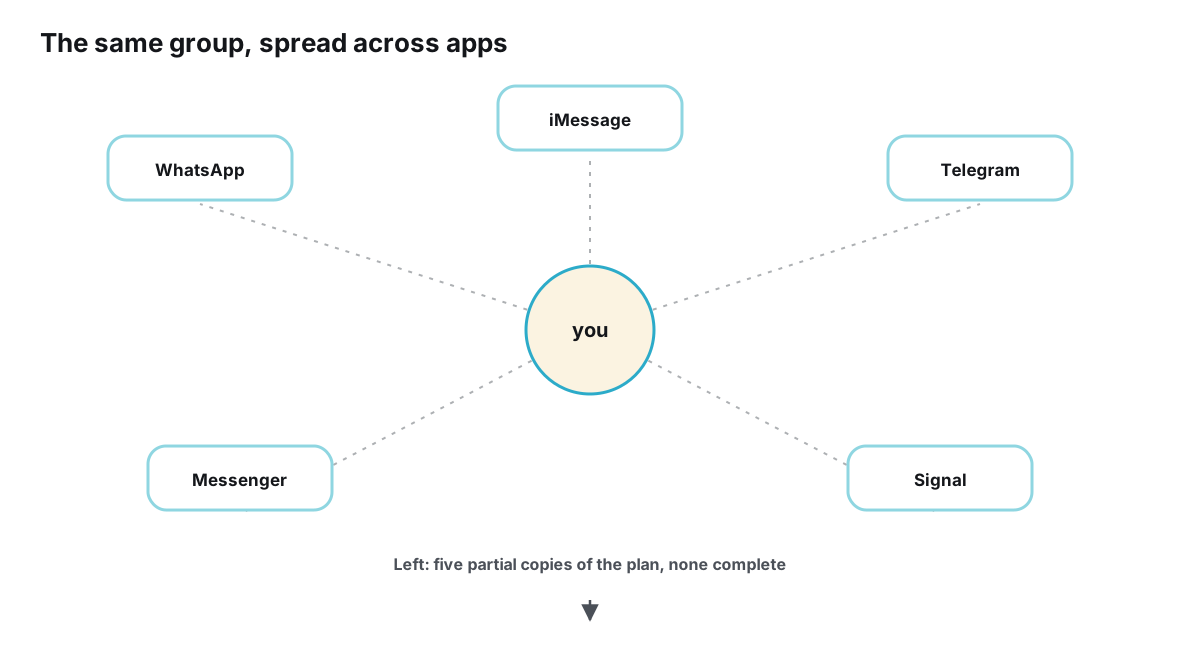
This is also why separation composes so well with the tools people already use. The link travels through WhatsApp because the sender uses WhatsApp; another guest receives it over iMessage; a third by email. The messengers are not displaced — they are demoted from containers to transports, a role they excel at. No one must convince a group to switch apps; the architecture simply stops requiring that anyone’s app be everyone’s app. Ontaym is built on exactly this composition — one link per event, statuses and updates attached to it, conversation welcome wherever it already lives — but the pattern belongs to no single product; it is how event coordination behaves when the three layers are finally distinct.
One book club, two architectures
A worked example makes the abstractions concrete. A book club of a dozen regulars wants to open its monthly meeting to newcomers. Under the monolith, the move is obvious: share the invite to the club’s chat. The newcomer joins, and their number lands in front of twelve strangers; they receive every between-meeting message about chapters they have not read; and if the book is not for them, their exit from the room is a visible event the regulars will notice and interpret. Some newcomers will join anyway. Many will not — and the club will read the empty chairs as disinterest in books.
Under the layered design, the club keeps its chat and creates a page for each meeting. The newcomer receives the link, reads what the group is reading and where it meets, and marks themselves as going. Their identity is a first name. Their silence afterward is just a Tuesday that worked differently. If they come twice and want the between-meeting conversation, joining the chat is their ask — and the regulars receive a new member who arrived as a reader, not as an enrollment. The event did all the recruiting; the layers decided what each moment would cost.
Notice what did not happen in the second version: no policy on newcomers, no moderation of strangers, no rules about who may join. The architecture absorbed the boundary questions that the monolith turns into social negotiation. That is the quiet promise of separated layers — not that boundaries disappear, but that they stop needing to be policed by people.
Frequently asked questions
Doesn’t separating everything mean more apps and accounts, not fewer?
The reverse. In the monolith, each event can mean a new room, each room an app requirement, and mixed groups end up with parallel chats. Separation replaces all of that with one link per event that opens in a browser. Total memberships go down, not up; the only account anyone maintains is the one they already had.
How do the three layers stay connected if they’re separate?
Through the event object they all point at. The identity layer leaves a name on the event’s response list, the invitation layer is the event’s address, and the conversation layer orbits the event wherever it happens. One address, one current plan — separation of concerns without separation of information.
Is this only valuable for privacy-conscious people?
Privacy is the most visible benefit, but participation is the larger one. Every identity requirement and membership step at the door filters out guests who would happily attend. Separation lowers the door for everyone — including people who have never thought about privacy in their lives and just didn’t want one more group chat.
My messaging app already has events and communities. Isn’t it separated enough?
Those features genuinely add structure — scheduled events, announcements, channels — and for a community living wholly inside one app, they work well. The boundary is that access still runs through membership in that app’s container, so the identity and invitation layers remain fused. Full separation is what lets an event reach beyond one platform’s membership — which, for mixed groups, is most real groups.
What does this have to do with GDPR and CCPA?
Both treat contact details like phone numbers as personal data — GDPR across the EU, CCPA in California — and both emphasize holding only what a purpose needs. Those laws chiefly bind organizations, and this is not legal advice. The connection is architectural: an identity layer that collects a first name instead of a phone number is the social equivalent of the minimization those regimes formalized.
Does a small friend group need any of this?
For four close friends, the monolith is harmless — the trust already covers the exposure, and no one should over-engineer a coffee. The separation earns its keep the moment the circle widens: friends-of-friends, colleagues, mixed apps, or any guest who has ever hesitated at a “join group” button. It scales up gracefully precisely because it asks so little at the bottom.
Conclusion
This article closes a circle. The cluster began with everyday frictions — numbers shared with rooms of strangers, additions that skipped consent, attendance gated on membership — and each of those turned out to be a symptom of one underlying merge: a single gesture that binds identity, invitation and conversation into one irreversible package. Take the package apart and the symptoms have nowhere to live. Guests who touch only the invitation layer share only a name and a status; declines happen in private; membership becomes something chosen rather than extracted; conversation returns to being a pleasure instead of a container.
The design brief, if you are choosing tools or building habits, is short. Let identity scale to the context — a first name is usually enough. Let invitations be bounded objects — one link, one event, one private answer. Let conversation be optional and located wherever people already talk. And let the event itself be the single shared object that everything else references.
Privacy and participation are usually framed as a trade-off — hide more, reach less. The layered view dissolves the trade-off: the same walls that protect a guest’s identity are the wide gates that let them attend. That is the quiet conclusion of everything in this cluster. Events built on separated layers are not just safer for guests; they are simply easier to say yes to — and an invitation that is easy to accept, and easy to decline, is finally doing its one job well.
Give your events separated layers: a link, a headcount, and your guests’ privacy intact.
Set it up with Ontaym